


RSS
UK joins US in announcing travel ban on extremist Israeli settlers
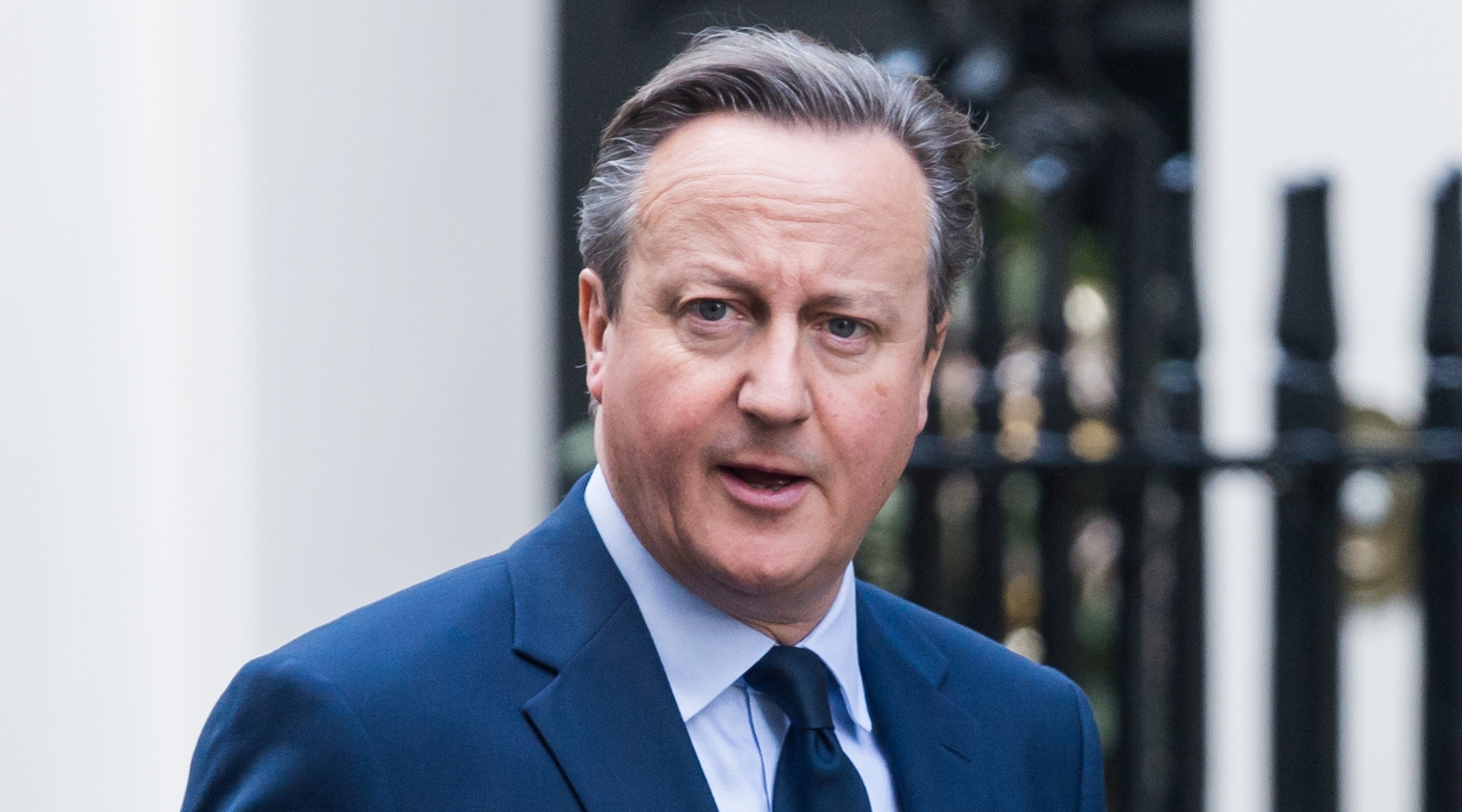
(JTA) — British Foreign Secretary David Cameron announced that extremist Israeli settlers would be banned from entering the United Kingdom, following a similar announcement by the United States last week.
The ban comes amid a reported increase in settler violence in the West Bank during the Israel-Hamas war, including physical assaults and attacks preventing Palestinians from accessing their own land.
“Extremist settlers, by targeting and killing Palestinian civilians, are undermining security and stability for both Israelis and Palestinians,” Cameron wrote on X. “Israel must take stronger action to stop settler violence and hold the perpetrators accountable. We are banning those responsible for settler violence from entering the UK to make sure our country cannot be a home for people who commit these intimidating acts.”
The announcement comes 10 days after the Biden administration announced that it would bar people who have “been involved in undermining peace, security, or stability in the West Bank” from entering the United States. The ban applies to both Israelis and Palestinians but was directed toward surging violence by settlers.
Since Oct. 7, 271 Palestinians have been killed in the West Bank — mostly as the Israeli army carries out operations against suspected terrorists, but at least eight of them by settlers, the United Nations’ Office for the Coordination of Humanitarian Affairs reported. U.N. figures show daily settler attacks against Palestinians have nearly doubled since Hamas’ attack on Israel on Oct. 7.
Israeli Prime Minister Benjamin Netanyahu has condemned settler violence and Israeli security forces have arrested and charged some Jewish extremists. But allies or sympathizers of settler extremists are members of his governing coalition, including Itamar Ben-Gvir, the far-right national security minister, who praised the extrajudicial killing of a Palestinian by a settler extremist earlier this year, saying the shooter should receive a medal.
More consequences for extremist settlers in the West Bank could be on the way. On Monday, European Union foreign policy chief Josep Borrell said he would propose sanctions against s
“The time has come to move from words to actions and to start adopting the measures we can take with regard to the acts of violence against the Palestinian population in the West Bank,” Borrell said.
Borrell also said he would propose a special sanctions program targeting Hamas, which has backing from the foreign ministers of France, Germany and Italy.
The United Kingdom, European Union, and multiple other countries also put out a statement Friday condemning settler violence.
“Israel’s failure to protect Palestinians and prosecute extremist settlers has led to an environment of near complete impunity in which settler violence has reached unprecedented levels. This undermines security in the West Bank and the region and threatens prospects for a lasting peace,” the statement said.
“While we welcomed the Government of Israel’s statement on this issue on 9 November where it conveyed that action would be taken against violent perpetrators, proactive steps must now be taken to ensure the effective and immediate protection of Palestinian communities,” the statement continued. “Words are important, but must now be translated into action.”
—
The post UK joins US in announcing travel ban on extremist Israeli settlers appeared first on Jewish Telegraphic Agency.
RSS
After False Dawns, Gazans Hope Trump Will Force End to Two-Year-Old War

Palestinians walk past a residential building destroyed in previous Israeli strikes, after Hamas agreed to release hostages and accept some other terms in a US plan to end the war, in Nuseirat, central Gaza Strip October 4, 2025. Photo: REUTERS/Mahmoud Issa
Exhausted Palestinians in Gaza clung to hopes on Saturday that US President Donald Trump would keep up pressure on Israel to end a two-year-old war that has killed tens of thousands and displaced the entire population of more than two million.
Hamas’ declaration that it was ready to hand over hostages and accept some terms of Trump’s plan to end the conflict while calling for more talks on several key issues was greeted with relief in the enclave, where most homes are now in ruins.
“It’s happy news, it saves those who are still alive,” said 32-year-old Saoud Qarneyta, reacting to Hamas’ response and Trump’s intervention. “This is enough. Houses have been damaged, everything has been damaged, what is left? Nothing.”
GAZAN RESIDENT HOPES ‘WE WILL BE DONE WITH WARS’
Ismail Zayda, 40, a father of three, displaced from a suburb in northern Gaza City where Israel launched a full-scale ground operation last month, said: “We want President Trump to keep pushing for an end to the war, if this chance is lost, it means that Gaza City will be destroyed by Israel and we might not survive.
“Enough, two years of bombardment, death and starvation. Enough,” he told Reuters on a social media chat.
“God willing this will be the last war. We will hopefully be done with the wars,” said 59-year-old Ali Ahmad, speaking in one of the tented camps where most Palestinians now live.
“We urge all sides not to backtrack. Every day of delay costs lives in Gaza, it is not just time wasted, lives get wasted too,” said Tamer Al-Burai, a Gaza City businessman displaced with members of his family in central Gaza Strip.
After two previous ceasefires — one near the start of the war and another earlier this year — lasted only a few weeks, he said; “I am very optimistic this time, maybe Trump’s seeking to be remembered as a man of peace, will bring us real peace this time.”
RESIDENT WORRIES THAT NETANYAHU WILL ‘SABOTAGE’ DEAL
Some voiced hopes of returning to their homes, but the Israeli military issued a fresh warning to Gazans on Saturday to stay out of Gaza City, describing it as a “dangerous combat zone.”
Gazans have faced previous false dawns during the past two years, when Trump and others declared at several points during on-off negotiations between Hamas, Israel and Arab and US mediators that a deal was close, only for war to rage on.
“Will it happen? Can we trust Trump? Maybe we trust Trump, but will Netanyahu abide this time? He has always sabotaged everything and continued the war. I hope he ends it now,” said Aya, 31, who was displaced with her family to Deir Al-Balah in the central Gaza Strip.
She added: “Maybe there is a chance the war ends at October 7, two years after it began.”
RSS
Mass Rally in Rome on Fourth Day of Italy’s Pro-Palestinian Protests

A Pro-Palestinian demonstrator waves a Palestinian flag during a national protest for Gaza in Rome, Italy, October 4, 2025. Photo: REUTERS/Claudia Greco
Large crowds assembled in central Rome on Saturday for the fourth straight day of protests in Italy since Israel intercepted an international flotilla trying to deliver aid to Gaza, and detained its activists.
People holding banners and Palestinian flags, chanting “Free Palestine” and other slogans, filed past the Colosseum, taking part in a march that organizers hoped would attract at least 1 million people.
“I’m here with a lot of other friends because I think it is important for us all to mobilize individually,” Francesco Galtieri, a 65-year-old musician from Rome, said. “If we don’t all mobilize, then nothing will change.”
Since Israel started blocking the flotilla late on Wednesday, protests have sprung up across Europe and in other parts of the world, but in Italy they have been a daily occurrence, in multiple cities.
On Friday, unions called a general strike in support of the flotilla, with demonstrations across the country that attracted more than 2 million, according to organizers. The interior ministry estimated attendance at around 400,000.
Italy’s right-wing government has been critical of the protests, with Prime Minister Giorgia Meloni suggesting that people would skip work for Gaza just as an excuse for a longer weekend break.
On Saturday, Meloni blamed protesters for insulting graffiti that appeared on a statue of the late Pope John Paul II outside Rome’s main train station, where Pro-Palestinian groups have been holding a protest picket.
“They say they are taking to the streets for peace, but then they insult the memory of a man who was a true defender and builder of peace. A shameful act committed by people blinded by ideology,” she said in a statement.
Israel launched its Gaza offensive after Hamas terrorists staged a cross border attack on October 7, 2023, killing some 1,200 people and taking 251 people hostage.
RSS
Hamas Says It Agrees to Release All Israeli Hostages Under Trump Gaza Plan

Smoke rises during an Israeli military operation in Gaza City, as seen from the central Gaza Strip, October 2, 2025. Photo: REUTERS/Dawoud Abu Alkas
Hamas said on Friday it had agreed to release all Israeli hostages, alive or dead, under the terms of US President Donald Trump’s Gaza proposal, and signaled readiness to immediately enter mediated negotiations to discuss the details.
