



Uncategorized
80 Years After the Holocaust, Did Antisemitism Disappear? Or Did Anti-Zionism Replace It?

A German and Israeli flag fly, on the day Chancellor Friedrich Merz meets with Israeli President Isaac Herzog for talks, in Berlin, Germany, May 12, 2025. Photo: REUTERS/Liesa Johannssen
There is a comforting narrative circulating in Western discourse. It insists that the surge of anti-Israel activism we see today is nothing more than political engagement. We are told it is about policy disagreements, about borders, about governments and human rights. We are assured it has nothing to do with Jews as Jews.
Yet over and over again, the façade cracks. Beneath the slogans and hashtags, something much older surfaces. What presents itself as principled opposition to a state too often reveals itself as hostility toward a people.
For centuries, Jews have been blamed for calamities that had nothing to do with them. During the Black Death in medieval Europe, Jewish communities were accused of poisoning wells and spreading plague. These lies triggered massacres. In times of disease and social instability, fear sought an outlet and found it in the Jewish minority.
The pattern did not end there. Blood libels claimed that Jews murdered Christian children to use their blood in religious rituals. Jews were portrayed as shadowy financiers manipulating global markets, engineering wars, and controlling governments. These were not fringe ideas whispered in dark corners. They were preached from pulpits, embedded in political rhetoric, and woven into cultural narratives.
The consequences were catastrophic. The expulsions from European kingdoms. The pogroms that swept across Eastern Europe and parts of the Middle East all the way up until the 1900s. The 1929 massacre in Hebron, where Jews were slaughtered in their homes. And ultimately the Holocaust, orchestrated by the Nazi regime under Adolf Hitler, in which six million Jews were systematically murdered. Each era insisted it was responding to some new threat. Each era recycled ancient accusations.
Many antisemites now claim they only oppose Israel — but are we really supposed to believe that 80 years after 1/3 of every Jew on Earth was murdered, that antisemitism has disappeared and this is all about Israel?
Modern terrorism continued the pattern. At the 1972 Munich Olympics, members of the Israeli team were murdered in cold blood. In 1985, during the hijacking of the cruise ship Achille Lauro, a Jewish passenger was singled out and killed. In 1976, Jewish hostages were separated from others in Entebbe before a dramatic rescue operation. And on October 7, 2023, Israeli civilians were massacred in their homes, children were abducted, and elderly people were dragged into Gaza by Hamas. Once again, Jews were targeted not for what they had done as individuals, but for who they were.
Each time, the world proclaims never again. Each time, hatred finds new language.
That’s why most “anti-Zionism” is just antisemitic logic repackaged for the digital age.
The intellectual dishonesty extends further. Marginal sects such as Neturei Karta are frequently showcased as the authentic voice of Judaism because they oppose the State of Israel. This tiny, fringe group does not represent mainstream Jewish communities in Israel or the Diaspora. Yet their images are amplified to suggest that “real Jews” reject Jewish self determination. It is not an honest engagement with Jewish diversity. It is a strategy to legitimize hostility.
In online spaces, the pattern is unmistakable. Comment sections filled with recycled tropes about Jewish control of media, finance, and politics are everywhere. Every geopolitical development is reframed as evidence of a hidden Jewish hand. Emotional accusations drown out factual context. In the age of algorithms, outrage spreads faster than correction. A sensational claim travels further than a careful explanation.
None of this means that Israel is beyond criticism. But there is a difference between criticism and much of what is happening now.
The State of Israel was established after centuries in which Jews lacked sovereignty and paid for that vulnerability with blood. It emerged in the aftermath of the Holocaust, when the absence of refuge proved fatal. To reduce its existence to colonial ambition is to erase Jewish history and the lived reality of exile, persecution, and statelessness.
Antisemitism disguised as anti-Zionism is not diminishing. It is intensifying across university campuses, in activist movements, and in mainstream conversation. The vocabulary may sound modern, but the underlying message echoes the past. Jews are uniquely malevolent. Jews are collectively responsible. Jews are the problem.
The antidote is not censorship but clarity. Historical literacy matters. Facts matter. Calling out antisemitic tropes when they appear, even when wrapped in fashionable language, is not an attempt to silence dissent. It is a defense of truth and moral consistency.
The lesson of history is neither abstract nor distant. When antisemitism is trivialized or excused, it spreads. When it is confronted with moral seriousness and factual rigor, it loses legitimacy. If we are sincere in our commitment to a world where Jews are not scapegoats for every crisis, then we must recognize that anti-Zionism too often serves as the latest vessel for the oldest hatred.
The responsibility to say so belongs to all of us.
Sabine Sterk is the CEO of Time To Stand Up For Israel.
Uncategorized
At Trump’s Christian revival on the National Mall, one rabbi made a Jewish case for America
On the National Mall Sunday, Christian worship music boomed from giant speakers as “Adonai” and other names of God flashed across jumbo screens behind a praise band. Pastors invoked America’s biblical destiny. Sadie Robertson, the Christian social media personality and granddaughter of Duck Dynasty patriarch Phil Robertson, preached from both the Old and New Testaments.
And then Rabbi Meir Soloveichik — the lone Jewish speaker at the planned nine-hour “Rededicate 250” rally called by President Donald Trump, billed as a national “jubilee of prayer, praise and thanksgiving” — stepped to the podium and began talking about Irving Berlin.
Soloveichik, 48, a scion of one of modern Orthodoxy’s most revered rabbinic families and a member of Trump’s Religious Liberty Commission, used his remarks to offer a Jewish case for American exceptionalism, a contrast to the explicitly Christian vision of the nation’s founding that defined the day.
Recalling how Berlin wrote “God Bless America” as fascism spread across Europe and antisemitism consumed the continent, Soloveichik described the song as both a patriotic anthem and a prayer of gratitude from a Jewish immigrant who found refuge in the United States. The hymn, he said, represented “a plaintive prayer to God that America continue to be blessed.”
The four-minute speech fit squarely within Soloveichik’s broader worldview. A senior scholar at the conservative Tikvah Fund and rabbi of Congregation Shearith Israel in Manhattan, the oldest Jewish congregation in the United States, he has long argued that America’s civic ideals are aligned with traditional Judaism and biblical morality. His 2024 book, Providence and Power: Ten Portraits in Jewish Statesmanship, examines Jewish political leadership through the lens of faith and moral responsibility.
For Soloveichik, the connection between Judaism and American identity culminated in the Second World War. He noted that “God Bless America” was first broadcast publicly the day after Kristallnacht, when Nazis destroyed Jewish homes and synagogues across Germany. “At the very moment when darkness deepened,” Soloveichik said, “America raised its voice united in the song that Irving Berlin wrote.”
He added that “in the years that followed 1938, the prayer that is ‘God Bless America’ was carried by American soldiers who defeated evil, liberating Europe and the world.”
Then came the line that drew some of the loudest applause of his remarks: “It is a reminder, as hatred of Jews makes itself manifest again, that antisemitism is utterly un-American.”
Separation of church and state
The moment captured the complicated role Jews increasingly occupy within the Trump-era religious right: embraced as part of America’s Judeo-Christian heritage, even as critics warn that the broader movement surrounding events like Rededicate 250 blurs the line between religious pluralism and Christian nationalism.
Rachel Laser, the Jewish CEO of Americans United for the Separation of Church and State, denounced the rally before the event. “If President Trump and his allies truly cared about America’s legacy of religious freedom, they would be celebrating church-state separation as the unique American invention that has allowed religious diversity to flourish in our country,” she said in a statement. “Instead, they continue to threaten this foundational principle by advancing a Christian Nationalist crusade to impose one narrow version of Christianity on all Americans.”
Sunday’s event — part revival meeting, part patriotic pageant — was the centerpiece of the Trump administration’s religious programming tied to this year’s 250th anniversary of the founding of the United States. Secretary of Defense Pete Hegseth and House Speaker Mike Johnson were slated to appear alongside evangelical pastors, worship leaders and conservative Christian influencers. President Trump and Vice President JD Vance were scheduled to address the crowd by video, while Trump himself spent the weekend golfing after returning from an overseas trip to China.
“This is a recognition of the deeply embedded history and religious and moral tradition of the country,” Johnson said Sunday on Fox News, dismissing criticism that the rally blurred the separation of church and state. Those objecting to the event, he added, “want to erase the history of America.”
No Muslim speakers appeared on the lineup. Organizers promoted Trump’s declaration of a national “Shabbat 250” observance the day prior as evidence of interfaith inclusion.
One of the Sunday event’s chief promoters, Trump spiritual adviser Pastor Paula White-Cain, had reassured supporters beforehand that the gathering would celebrate America’s Christian foundations without “praying to all these different Gods.”
Soloveichik did not address those tensions. Instead, he closed by returning to the image of America as a nation uniquely capable, in his telling, of transforming a Jewish refugee into the composer of one of the country’s most enduring patriotic hymns.
“To sing this song,” he said, “is to be reminded that America’s story is unique.”
“GOD BLESS AMERICA IS NOT JUST A SONG. IT’S A PRAYER.” 🇺🇸🙏
Rabbi Meir Soloveichik delivers a powerful reminder that America’s love of liberty has always been tied to faith — tracing its story and why anti-Semitism is fundamentally un-American. pic.twitter.com/aKMg42nS2I
— Real America’s Voice (RAV) (@RealAmVoice) May 17, 2026
The post At Trump’s Christian revival on the National Mall, one rabbi made a Jewish case for America appeared first on The Forward.
Uncategorized
Israel to Establish Defense Offices in Former UNRWA Compound

A man handles fallen cables at the Jerusalem headquarters of the United Nations Relief and Works Agency for Palestine Refugees (UNRWA) as the headquarters is dismantled by Israeli forces, in East Jerusalem, January 20, 2026. Photo: REUTERS/Ammar Awad/File Photo
Israel’s cabinet on Sunday approved a plan to build a defense compound on the site of the recently demolished premises of the United Nations Relief and Works Agency in East Jerusalem.
Israel in January demolished structures inside the UN Palestinian refugee agency’s East Jerusalem compound after seizing the site last year, in an act condemned by the agency as a violation of international law.
In a joint statement, the Defense Ministry and Jerusalem Municipality said the new compound would include the establishment of a military museum, a recruitment office and a defense minister’s office.
Defense Minister Israel Katz called the decision one of “sovereignty, Zionism, and security.”
UNRWA, which Israeli authorities accuse of bias, had not used the building since the start of last year after Israel ordered it to vacate all its premises and cease its operations.
A UNRWA spokesperson declined to comment on the Israeli plan.
The agency operates in East Jerusalem, which the U.N. and most countries consider territory occupied by Israel as it was captured from Jordan in the 1967 Middle East war. Israel considers all Jerusalem to be its indivisible capital.
UNRWA also operates in Gaza, the West Bank and elsewhere in the Middle East, providing schooling, healthcare, social services and shelter to millions of Palestinians.
“There is nothing more symbolic or justified than establishing the new IDF recruitment office and defense establishment institutions precisely on the ruins of the former UNRWA compound — an organization whose employees took part in the massacres, murders, and atrocities committed by Hamas terrorists on October 7,” Katz said.
Israel has alleged that some UNRWA staff were members of the Palestinian terrorist group Hamas and took part in the attack on Israel on October 7, 2023, that killed about 1,200 Israelis and led to Israel’s war against Hamas.
Uncategorized
Palestinian Leader’s Son Wins Role in Abbas’ Party, Official Says
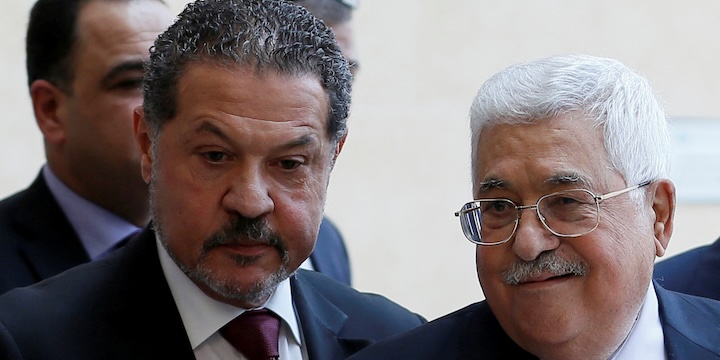
Palestinian President Mahmoud Abbas, accompanied by his son Yasser, leaves a hospital in Ramallah in the Israeli-occupied West Bank, May 28, 2018. REUTERS/Mohamad Torokman
The millionaire businessman son of Palestinian President Mahmoud Abbas has won a steering role in his father’s political party Fatah, a party official said on Sunday, as a succession fight looms for control of the embattled Palestinian Authority (PA).
Yasser Abbas won a seat in elections for the Fatah Central Committee, the party’s highest decision-making body, at its first general conference in almost a decade. Mahmoud Abbas, 90, will remain chairman, it decided.
The PA was set up as an interim administration under the 1990s Oslo accords between Israel and the Palestine Liberation Organization, an umbrella group still internationally recognized as the representative of the Palestinian people. The powerful Fatah party dominates both the PA and the PLO.
Abbas’ son’s foray into politics has fueled speculation that the president may be seeking to position Yasser, 64, to succeed him as head of Fatah.
That has drawn criticism from some Fatah officials, who say Yasser would be unable to unify Palestinians or help them chart a new political future after years without national elections or tangible steps toward statehood.
In the more than two decades since Mahmoud Abbas was elected to succeed Fatah founder Yasser Arafat, Palestinians have come to view the PA as ineffective and corrupt, something denied by Abbas, who has ruled by decree since his mandate expired in 2009.
In 2007, Abbas’ Fatah forces in the Gaza Strip were overpowered by Hamas militants who seized control of the enclave, a year after Hamas swept the Palestinian parliamentary elections.
Peace talks with Israel meant to lead to the creation of a Palestinian state in the West Bank, Gaza and East Jerusalem collapsed in 2014, with expanding Israeli settlements since carving up areas slated for Palestinian statehood. The PA is also grappling with a financial crisis.
Yasser Abbas, who has never held an official role within Fatah or the PA, runs tobacco and contracting firms in the parts of the West Bank where the PA exercises limited self rule. Critics have long alleged that he and his brother Tarek have used public funds to help their businesses, allegations both men reject.
Among others to have won seats on the Central Committee are Majed Faraj, head of the General Intelligence Agency, and former militant group leader Zakaria Zubeidi, released in a Hamas-Israel prisoner-hostage exchange as part of a 2025 Gaza ceasefire.