



Uncategorized
Palestinian Leader’s Son Wins Role in Abbas’ Party, Official Says
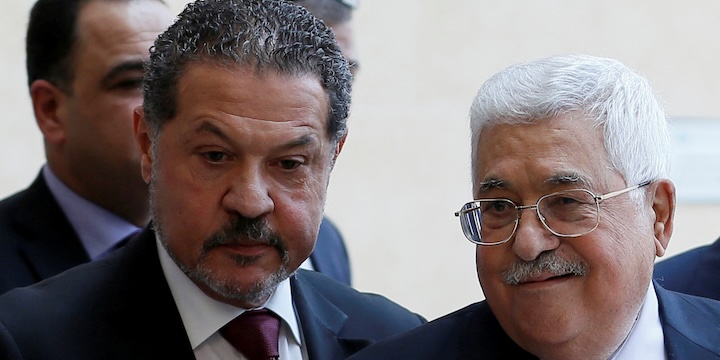
Palestinian President Mahmoud Abbas, accompanied by his son Yasser, leaves a hospital in Ramallah in the Israeli-occupied West Bank, May 28, 2018. REUTERS/Mohamad Torokman
The millionaire businessman son of Palestinian President Mahmoud Abbas has won a steering role in his father’s political party Fatah, a party official said on Sunday, as a succession fight looms for control of the embattled Palestinian Authority (PA).
Yasser Abbas won a seat in elections for the Fatah Central Committee, the party’s highest decision-making body, at its first general conference in almost a decade. Mahmoud Abbas, 90, will remain chairman, it decided.
The PA was set up as an interim administration under the 1990s Oslo accords between Israel and the Palestine Liberation Organization, an umbrella group still internationally recognized as the representative of the Palestinian people. The powerful Fatah party dominates both the PA and the PLO.
Abbas’ son’s foray into politics has fueled speculation that the president may be seeking to position Yasser, 64, to succeed him as head of Fatah.
That has drawn criticism from some Fatah officials, who say Yasser would be unable to unify Palestinians or help them chart a new political future after years without national elections or tangible steps toward statehood.
In the more than two decades since Mahmoud Abbas was elected to succeed Fatah founder Yasser Arafat, Palestinians have come to view the PA as ineffective and corrupt, something denied by Abbas, who has ruled by decree since his mandate expired in 2009.
In 2007, Abbas’ Fatah forces in the Gaza Strip were overpowered by Hamas militants who seized control of the enclave, a year after Hamas swept the Palestinian parliamentary elections.
Peace talks with Israel meant to lead to the creation of a Palestinian state in the West Bank, Gaza and East Jerusalem collapsed in 2014, with expanding Israeli settlements since carving up areas slated for Palestinian statehood. The PA is also grappling with a financial crisis.
Yasser Abbas, who has never held an official role within Fatah or the PA, runs tobacco and contracting firms in the parts of the West Bank where the PA exercises limited self rule. Critics have long alleged that he and his brother Tarek have used public funds to help their businesses, allegations both men reject.
Among others to have won seats on the Central Committee are Majed Faraj, head of the General Intelligence Agency, and former militant group leader Zakaria Zubeidi, released in a Hamas-Israel prisoner-hostage exchange as part of a 2025 Gaza ceasefire.
Uncategorized
At Trump’s Christian revival on the National Mall, one rabbi made a Jewish case for America
On the National Mall Sunday, Christian worship music boomed from giant speakers as “Adonai” and other names of God flashed across jumbo screens behind a praise band. Pastors invoked America’s biblical destiny. Sadie Robertson, the Christian social media personality and granddaughter of Duck Dynasty patriarch Phil Robertson, preached from both the Old and New Testaments.
And then Rabbi Meir Soloveichik — the lone Jewish speaker at the planned nine-hour “Rededicate 250” rally called by President Donald Trump, billed as a national “jubilee of prayer, praise and thanksgiving” — stepped to the podium and began talking about Irving Berlin.
Soloveichik, 48, a scion of one of modern Orthodoxy’s most revered rabbinic families and a member of Trump’s Religious Liberty Commission, used his remarks to offer a Jewish case for American exceptionalism, a contrast to the explicitly Christian vision of the nation’s founding that defined the day.
Recalling how Berlin wrote “God Bless America” as fascism spread across Europe and antisemitism consumed the continent, Soloveichik described the song as both a patriotic anthem and a prayer of gratitude from a Jewish immigrant who found refuge in the United States. The hymn, he said, represented “a plaintive prayer to God that America continue to be blessed.”
The four-minute speech fit squarely within Soloveichik’s broader worldview. A senior scholar at the conservative Tikvah Fund and rabbi of Congregation Shearith Israel in Manhattan, the oldest Jewish congregation in the United States, he has long argued that America’s civic ideals are aligned with traditional Judaism and biblical morality. His 2024 book, Providence and Power: Ten Portraits in Jewish Statesmanship, examines Jewish political leadership through the lens of faith and moral responsibility.
For Soloveichik, the connection between Judaism and American identity culminated in the Second World War. He noted that “God Bless America” was first broadcast publicly the day after Kristallnacht, when Nazis destroyed Jewish homes and synagogues across Germany. “At the very moment when darkness deepened,” Soloveichik said, “America raised its voice united in the song that Irving Berlin wrote.”
He added that “in the years that followed 1938, the prayer that is ‘God Bless America’ was carried by American soldiers who defeated evil, liberating Europe and the world.”
Then came the line that drew some of the loudest applause of his remarks: “It is a reminder, as hatred of Jews makes itself manifest again, that antisemitism is utterly un-American.”
Separation of church and state
The moment captured the complicated role Jews increasingly occupy within the Trump-era religious right: embraced as part of America’s Judeo-Christian heritage, even as critics warn that the broader movement surrounding events like Rededicate 250 blurs the line between religious pluralism and Christian nationalism.
Rachel Laser, the Jewish CEO of Americans United for the Separation of Church and State, denounced the rally before the event. “If President Trump and his allies truly cared about America’s legacy of religious freedom, they would be celebrating church-state separation as the unique American invention that has allowed religious diversity to flourish in our country,” she said in a statement. “Instead, they continue to threaten this foundational principle by advancing a Christian Nationalist crusade to impose one narrow version of Christianity on all Americans.”
Sunday’s event — part revival meeting, part patriotic pageant — was the centerpiece of the Trump administration’s religious programming tied to this year’s 250th anniversary of the founding of the United States. Secretary of Defense Pete Hegseth and House Speaker Mike Johnson were slated to appear alongside evangelical pastors, worship leaders and conservative Christian influencers. President Trump and Vice President JD Vance were scheduled to address the crowd by video, while Trump himself spent the weekend golfing after returning from an overseas trip to China.
“This is a recognition of the deeply embedded history and religious and moral tradition of the country,” Johnson said Sunday on Fox News, dismissing criticism that the rally blurred the separation of church and state. Those objecting to the event, he added, “want to erase the history of America.”
No Muslim speakers appeared on the lineup. Organizers promoted Trump’s declaration of a national “Shabbat 250” observance the day prior as evidence of interfaith inclusion.
One of the Sunday event’s chief promoters, Trump spiritual adviser Pastor Paula White-Cain, had reassured supporters beforehand that the gathering would celebrate America’s Christian foundations without “praying to all these different Gods.”
Soloveichik did not address those tensions. Instead, he closed by returning to the image of America as a nation uniquely capable, in his telling, of transforming a Jewish refugee into the composer of one of the country’s most enduring patriotic hymns.
“To sing this song,” he said, “is to be reminded that America’s story is unique.”
“GOD BLESS AMERICA IS NOT JUST A SONG. IT’S A PRAYER.” 🇺🇸🙏
Rabbi Meir Soloveichik delivers a powerful reminder that America’s love of liberty has always been tied to faith — tracing its story and why anti-Semitism is fundamentally un-American. pic.twitter.com/aKMg42nS2I
— Real America’s Voice (RAV) (@RealAmVoice) May 17, 2026
The post At Trump’s Christian revival on the National Mall, one rabbi made a Jewish case for America appeared first on The Forward.
Uncategorized
Israel to Establish Defense Offices in Former UNRWA Compound

A man handles fallen cables at the Jerusalem headquarters of the United Nations Relief and Works Agency for Palestine Refugees (UNRWA) as the headquarters is dismantled by Israeli forces, in East Jerusalem, January 20, 2026. Photo: REUTERS/Ammar Awad/File Photo
Israel’s cabinet on Sunday approved a plan to build a defense compound on the site of the recently demolished premises of the United Nations Relief and Works Agency in East Jerusalem.
Israel in January demolished structures inside the UN Palestinian refugee agency’s East Jerusalem compound after seizing the site last year, in an act condemned by the agency as a violation of international law.
In a joint statement, the Defense Ministry and Jerusalem Municipality said the new compound would include the establishment of a military museum, a recruitment office and a defense minister’s office.
Defense Minister Israel Katz called the decision one of “sovereignty, Zionism, and security.”
UNRWA, which Israeli authorities accuse of bias, had not used the building since the start of last year after Israel ordered it to vacate all its premises and cease its operations.
A UNRWA spokesperson declined to comment on the Israeli plan.
The agency operates in East Jerusalem, which the U.N. and most countries consider territory occupied by Israel as it was captured from Jordan in the 1967 Middle East war. Israel considers all Jerusalem to be its indivisible capital.
UNRWA also operates in Gaza, the West Bank and elsewhere in the Middle East, providing schooling, healthcare, social services and shelter to millions of Palestinians.
“There is nothing more symbolic or justified than establishing the new IDF recruitment office and defense establishment institutions precisely on the ruins of the former UNRWA compound — an organization whose employees took part in the massacres, murders, and atrocities committed by Hamas terrorists on October 7,” Katz said.
Israel has alleged that some UNRWA staff were members of the Palestinian terrorist group Hamas and took part in the attack on Israel on October 7, 2023, that killed about 1,200 Israelis and led to Israel’s war against Hamas.
Uncategorized
Federal Funding for Trump’s Ballroom in Jeopardy After Senate Ruling
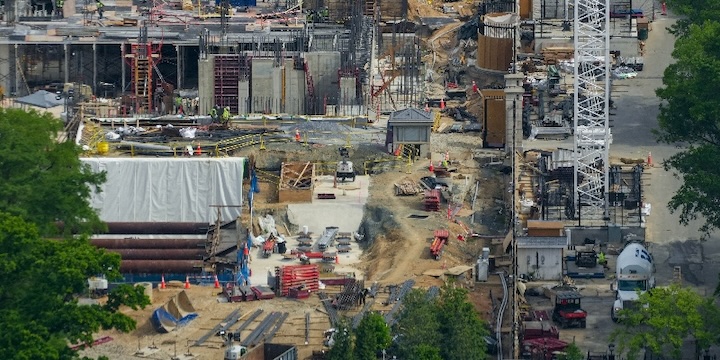
Aerial view from the top of the Washington Monument shows construction crews as they continue site preparation for a planned White House ballroom in the area of the former East Wing in Washington, D.C., U.S., May 2, 2026. Photo: REUTERS/Ken Cedeno
A US Senate official on Saturday removed security funding that could be used for President Donald Trump’s planned White House ballroom from a massive spending package, Democratic lawmakers said, imperiling Republican efforts to devote taxpayer money to the contentious project.
The decision by the Senate’s parliamentarian, Elizabeth MacDonough, deals a blow to Trump and his administration, which has sought the money for security purposes related to the ballroom.
Trump has said the construction of the ballroom would be funded by $400 million in private donations. But Senate Republicans are seeking $1 billion in taxpayer funding to the Secret Service for security upgrades to the ballroom and other structures being built beneath it.
FRIVOLOUS DIVERSION OR NECESSARY MODERNIZATION?
Democrats have criticized the ballroom as an expensive and frivolous diversion by Trump at a time when Americans face rising costs such as higher fuel prices. Trump, a real estate developer-turned-politician, has written on social media that it will be “the finest Building of its kind anywhere in the World.”
MacDonough ruled that the security funding provision falls under chamber rules that require 60 votes to pass most legislation, according to the office of Senator Jeff Merkley, the top Democrat on the Senate Budget Committee.
Republicans hold a 53-47 majority in the Senate.
The parliamentarian interprets Senate rules, including whether legislative provisions are permitted. Republican senators still could revise the legislation to try to gain the parliamentarian’s approval.
Ryan Wrasse, spokesman for Senate Majority Leader John Thune, said in a social media post that Republicans would keep trying. “Redraft. Refine. Resubmit,” Wrasse wrote on X.
If Republicans do not succeed, they may be unable to include the ballroom-related funding in a $72 billion spending package they plan to bring to a vote on the Senate floor, with passage expected on a party-line vote with Democrats opposed. The bulk of the legislation is devoted to immigration enforcement.
Republicans have been invoking complex budget rules to try to secure passage without any Democratic support.
“While we expect Republicans to change this bill to appease Trump, Democrats are prepared to challenge any change to this bill,” Merkley said in a statement.
Democrats have opposed funding for Trump’s signature immigration crackdown absent reforms they have sought since federal immigration agents killed US citizens in separate incidents in Minnesota in January.
Republicans have said federal funding for ballroom security is needed to ensure presidential safety, citing an April incident in which an alleged gunman is accused of storming a black-tie media gala in Washington that Trump attended.
The administration has said the ballroom will modernize infrastructure, bolster security and ease strain on the White House, which often relies on temporary outdoor structures to host large events. Trump has said the ballroom will be completed around September 2028, near the end of his second term in office.
Democrats, hoping to win control of Congress in November’s midterm elections, are seizing on Republican support of the ballroom to portray Trump’s party as out of touch with the cost-of-living concerns of Americans at a time of rising energy costs driven by the Iran war he and Israel launched in February.
Trump last year ordered the demolition of the White House’s East Wing – constructed in 1902 during Theodore Roosevelt’s presidency and expanded four decades later during Franklin Roosevelt’s presidency – to make way for his ballroom.
The National Trust for Historic Preservation, a nonprofit organization, filed a lawsuit challenging the project, arguing that neither the president nor the National Park Service, which manages the White House grounds, possessed the authority to tear down the historic structure or erect a major new facility without explicit congressional approval.
A US appeals court in April allowed construction to continue after the judge handling the National Trust lawsuit issued an order halting the project.