



Uncategorized
Federal Funding for Trump’s Ballroom in Jeopardy After Senate Ruling
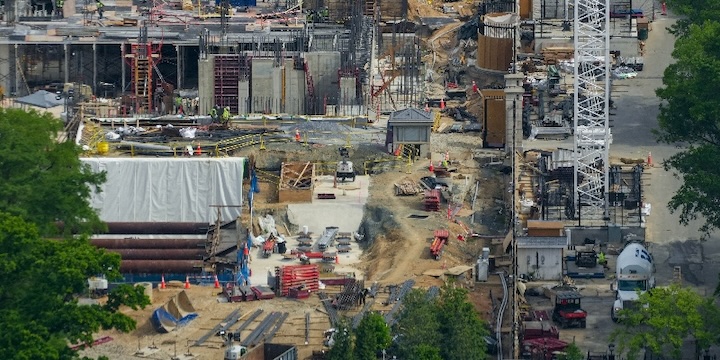
Aerial view from the top of the Washington Monument shows construction crews as they continue site preparation for a planned White House ballroom in the area of the former East Wing in Washington, D.C., U.S., May 2, 2026. Photo: REUTERS/Ken Cedeno
A US Senate official on Saturday removed security funding that could be used for President Donald Trump’s planned White House ballroom from a massive spending package, Democratic lawmakers said, imperiling Republican efforts to devote taxpayer money to the contentious project.
The decision by the Senate’s parliamentarian, Elizabeth MacDonough, deals a blow to Trump and his administration, which has sought the money for security purposes related to the ballroom.
Trump has said the construction of the ballroom would be funded by $400 million in private donations. But Senate Republicans are seeking $1 billion in taxpayer funding to the Secret Service for security upgrades to the ballroom and other structures being built beneath it.
FRIVOLOUS DIVERSION OR NECESSARY MODERNIZATION?
Democrats have criticized the ballroom as an expensive and frivolous diversion by Trump at a time when Americans face rising costs such as higher fuel prices. Trump, a real estate developer-turned-politician, has written on social media that it will be “the finest Building of its kind anywhere in the World.”
MacDonough ruled that the security funding provision falls under chamber rules that require 60 votes to pass most legislation, according to the office of Senator Jeff Merkley, the top Democrat on the Senate Budget Committee.
Republicans hold a 53-47 majority in the Senate.
The parliamentarian interprets Senate rules, including whether legislative provisions are permitted. Republican senators still could revise the legislation to try to gain the parliamentarian’s approval.
Ryan Wrasse, spokesman for Senate Majority Leader John Thune, said in a social media post that Republicans would keep trying. “Redraft. Refine. Resubmit,” Wrasse wrote on X.
If Republicans do not succeed, they may be unable to include the ballroom-related funding in a $72 billion spending package they plan to bring to a vote on the Senate floor, with passage expected on a party-line vote with Democrats opposed. The bulk of the legislation is devoted to immigration enforcement.
Republicans have been invoking complex budget rules to try to secure passage without any Democratic support.
“While we expect Republicans to change this bill to appease Trump, Democrats are prepared to challenge any change to this bill,” Merkley said in a statement.
Democrats have opposed funding for Trump’s signature immigration crackdown absent reforms they have sought since federal immigration agents killed US citizens in separate incidents in Minnesota in January.
Republicans have said federal funding for ballroom security is needed to ensure presidential safety, citing an April incident in which an alleged gunman is accused of storming a black-tie media gala in Washington that Trump attended.
The administration has said the ballroom will modernize infrastructure, bolster security and ease strain on the White House, which often relies on temporary outdoor structures to host large events. Trump has said the ballroom will be completed around September 2028, near the end of his second term in office.
Democrats, hoping to win control of Congress in November’s midterm elections, are seizing on Republican support of the ballroom to portray Trump’s party as out of touch with the cost-of-living concerns of Americans at a time of rising energy costs driven by the Iran war he and Israel launched in February.
Trump last year ordered the demolition of the White House’s East Wing – constructed in 1902 during Theodore Roosevelt’s presidency and expanded four decades later during Franklin Roosevelt’s presidency – to make way for his ballroom.
The National Trust for Historic Preservation, a nonprofit organization, filed a lawsuit challenging the project, arguing that neither the president nor the National Park Service, which manages the White House grounds, possessed the authority to tear down the historic structure or erect a major new facility without explicit congressional approval.
A US appeals court in April allowed construction to continue after the judge handling the National Trust lawsuit issued an order halting the project.
Uncategorized
Bulgaria Wins Eurovision Song Contest, Israel Comes Second Again

Noam Bettan, representing Israel, performs “Michelle” during the Grand Final of the 2026 Eurovision Song Contest in Vienna, Austria, May 16, 2026. REUTERS/Lisa Leutner
Bulgaria won the Eurovision Song Contest for the first time on Saturday in a final overshadowed by five countries’ boycott over Gaza, claiming a dramatic victory despite another big public vote for Israel that again secured it second place.
The garish and usually good-natured competition involving pop acts from countries across Europe and beyond, now in its 70th year, was plunged into crisis by a dispute over Israel’s military offensive in Gaza, a response to the Hamas-led attack on October 7, 2023.
The public broadcasters of heavyweights Spain, the Netherlands and Ireland, as well as Iceland and Slovenia, chose not to take part in protest at Israel’s participation.
Israel has alleged a global smear campaign against it. Its performance at the final was not, however, marred by any obvious protests, unlike Tuesday’s semi-final.
“This is unbelievable. I don’t even know what’s going on right now,” Bulgaria’s entrant Dara told a press conference after winning with her thumping, crowd-pleasing dance track “Bangaranga” that avoided politics altogether.
The song touches on themes of empowerment and surrendering to the night. It also left many puzzled as to its meaning.
“Bangaranga is a feeling that everybody gets in themselves. It’s the moment that you choose to be in love and not fear,” Dara said when asked to explain the song in the “green room” where artists await the results.
“This is a special energy… Once you feel (at) one with nature and your universe, you feel the harmony that you can be whatever you want to be and that everything is possible,” she said.
BOOS WERE HEARD AT ISRAEL’S RESULT
Israel’s effort, trilingual love song “Michelle,” stirred less controversy than its entry last year, which was sung by a survivor of the October 7 attack.
Some booing from the audience was audible when Israel’s massive points haul from the public vote sent it surging up the table from eighth place, similarly to 2025, when it also finished second but much closer to the winner than this year.
Israeli public broadcaster KAN received a formal warning from organizers a week ago over videos posted online in which Bettan courted votes too aggressively, after a similar controversy involving Israel last year.
KAN said it plays by the rules and the videos were immediately taken down.
Finland’s entry, “Liekinheitin,” or Flamethrower, a love song in Finnish featuring violinist Linda Lampenius and pop singer Pete Parkkonen on a burning set, was the favorite this year, followed by Australia’s “Eclipse,” a celestially themed love ballad sung by national pop star Delta Goodrem.
In the end, Australia came fourth and Finland sixth.
ONLY MINOR PROTESTS IN VIENNA
The boycotts cut the number of contest entries to 35, the fewest since 2003, which will almost certainly have reduced the global television viewership of an event that last year was estimated at 166 million people, more than the Super Bowl’s 128 million.
The mood in the Austrian capital has been subdued, with protests over Israel’s participation drawing only small crowds. Police anticipated “blockades and disruption attempts” on Saturday that did not materialize.
There was a brief disruption during Tuesday’s semi-final, when one protester chanted “Stop, stop the genocide” and “Free, free Palestine” within range of a television microphone and was ejected along with three others for disrupting the show.
Uncategorized
Israel’s Economy Shrinks in First Quarter but Seen Rebounding After Iran War
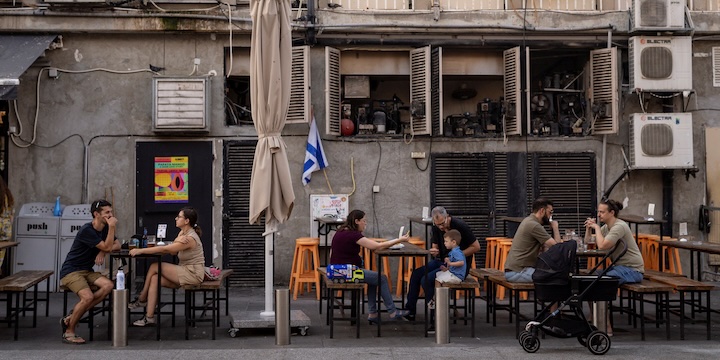
People sit at an outdoor restaurant where Israeli flags are displayed, amid the ongoing conflict between Hamas and Israel, in Tel Aviv, Israel, July 12, 2024. REUTERS/Eloisa Lopez
Israel’s economy began 2026 with a slowdown, hit by war with Iran, but growth is expected to recover as long as the conflict does not reignite.
Gross domestic product contracted at an annualized rate of 3.3 percent in the first three months of 2026, the Central Bureau of Statistics said on Sunday, less severe than a 4 percent drop forecast in a Reuters poll of economists.
Israel’s economy grew 2.9 percent in 2025 and was expected to bounce back in 2026 to more than 5 percent growth after a ceasefire in October ended major fighting in the two-year Gaza war.
But growth took a hit after the US and Israel launched strikes against Iran on February 28, resulting in weeks of ballistic missile fire from Iran that closed schools and dampened business activity along with consumer spending.
“The Israeli economy began the year with strong momentum, with rapid growth in the first two months,” said Ofer Klein, head of economics and research at Harel Insurance and Finance.
“The lifting of most restrictions in April and the improvement in economic activity since then… indicate a relatively quick return to positive growth in the current quarter,” said Klein, who raised his growth estimate for this year to 3.5 percent from 3.2 percent.
The Bank of Israel sees 3.8 percent growth this year, down from a 5.2 percent estimate before the Iran war, depending on whether a ceasefire with Iran holds.
Jonathan Katz, chief economist at Leader Capital Markets, said he expected 4 percent growth.
“This is a modest GDP contraction compared to the second quarter of 2025 – the last Iran confrontation in June of 2025 – when GDP contracted by over 10 percent,” he said, adding that industrial exports bounced back in April.
The statistics bureau reported on Friday that the annual inflation rate held steady at 1.9 percent in April. Some economists believe interest rate reductions could resume as early as May 25, the Bank of Israel’s next rate decision meeting.
Israeli financial markets do not trade on Sunday. The shekel has appreciated 20 percent in the past year to 2.91 per dollar, a 33-year high. Tel Aviv share indices are close to all-time highs reached earlier in May.
In the first quarter, consumer spending fell 4.7 percent, exports declined 3.7 percent and government spending shed 4.8 percent. Investment in fixed assets rose 12.6 percent.
On a per capita basis, the economy shrank 4.5 percent in the quarter.
Uncategorized
UAE Reports Drone Strike at Nuclear Power Plant as Iran War Deadlock Endures
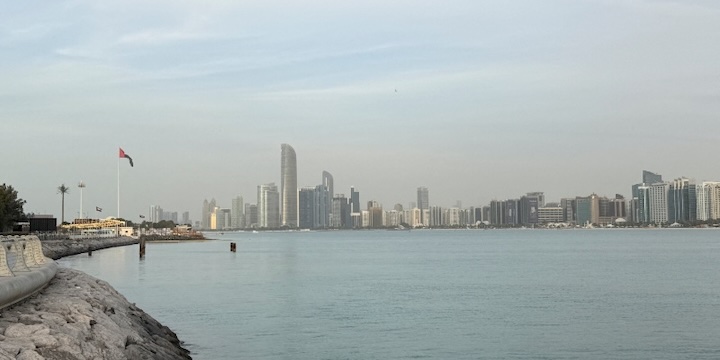
FILE PHOTO: The skyline of Abu Dhabi, where Russian, U.S. and Ukrainian military officials are expected to hold talks, in Abu Dhabi, United Arab Emirates, January 23, 2026. Picture taken with a mobile phone. REUTERS/Abdelhadi Ramahi/File Photo
A drone strike caused a fire at a nuclear power plant in the United Arab Emirates, officials in Abu Dhabi said on Sunday, at a time when progress appears to have stalled in efforts to end the US-Israeli war with Iran and restart shipping in the Gulf.
Emirati officials said they were investigating the source of the strike and that the UAE had the full right to respond to such “terrorist attacks.” The UAE has previously accused Iran of attacking its energy targets in what it has called an escalation of the conflict in the region.
The drone hit an electrical generator outside the inner perimeter of the Barakah Nuclear Power Plant, the Abu Dhabi Media Office said. Radiological safety levels were unaffected and there were no injuries, it said.
The International Atomic Energy Agency said emergency diesel generators were providing power to the plant’s “unit 3,” and called for “maximum military restraint” near any nuclear power plant, adding that it was following the situation closely.
The UAE defense ministry said two other drones had been “successfully” dealt with, and that the drones had been launched from the “western border.” It did not elaborate.
During the war that began with US and Israeli strikes against Iran on February 28, Iran has repeatedly targeted the UAE and other Gulf states that host US military bases, hitting sites that include civilian and energy infrastructure.
Iran stepped up such attacks on the UAE earlier this month after US President Donald Trump announced a naval mission to try to open the Strait of Hormuz, which Trump suspended after 48 hours.
DIPLOMATIC DEADLOCK
More than five weeks after a tenuous ceasefire in the conflict took effect, US and Iranian demands remain far apart despite diplomatic efforts to end the war and reopen the strait, the world’s most important shipping route for oil and gas.
Washington has called for Tehran to dismantle its nuclear program and lift its hold on the strait. Iran has demanded compensation for war damage, an end to a U.S. blockade of Iranian ports and a halt to fighting on all fronts, including in Lebanon, where Israel is battling Iran-backed Hezbollah.
Trump, who held talks with Chinese President Xi Jinping this week without securing an indication from China that it would help resolve the conflict, has threatened to resume attacks if Iran does not agree to a deal.
A senior spokesperson for the Iranian armed forces, Abolfazl Shekarchi, said on Sunday that if Trump’s threats were carried out, the US would “face new, aggressive, and surprise scenarios, and sink into a self-made quagmire.”
Iranian foreign ministry spokesperson Esmaeil Baqaei said the US and Israel had tried to shift the blame for destabilizing energy markets following their “unprovoked military aggression against Iran.”
RIVAL BLOCKADES
The disruption to shipping through the Strait of Hormuz has caused the biggest oil supply crisis in history, pushing up prices. The US has imposed its own blockade of Iranian ports, and said that as of Sunday it had redirected 81 commercial vessels and disabled four vessels to ensure compliance.
Ebrahim Azizi, who heads the Iranian parliament’s national security committee, said on Saturday that Tehran had prepared a mechanism to manage traffic through the strait along a designated route that would be unveiled soon.
Thousands of Iranians were killed in the US and Israeli airstrikes. Thousands more have been killed in Lebanon in fighting between Israel and the Iran-backed group Hezbollah.
Israel and Lebanon agreed on Friday to a 45-day extension of a ceasefire there, though the truce has failed to end clashes.