


Uncategorized
A fortress won’t save American Jews
Jews have found themselves at the center of politics over the past few years — not a place we want to be, at least not like this.
Anton Jäger, a historian at Oxford University, has argued that since the Covid-19 pandemic spurred more government intervention into the lives of ordinary citizens, many Western countries have become “engulfed in a kind of permanent Dreyfus Affair.”
His point was that a contemporary obsession with politics has consumed society in the same way that the conviction of Captain Alfred Dreyfus on manufactured treason charges sucked up the oxygen in France at the end of the 19th century.
Jäger doesn’t mention the fact that Dreyfus was Jewish. But just as his Jewishness animated the scandal in the Third French Republic, Jews — real and imagined — have also found themselves at the center of today’s toxic political climate.
As many Americans became unmoored from reality during the pandemic, they alternately blamed Jews for creating the virus and described themselves as being victimized like Jews during the Holocaust for refusing to get vaccinated or comply with other public health guidance.
Jews have also found themselves at the center of debates over immigration, with suggestions on the right that George Soros is fueling mass migration intended to displace white Americans even as some on the left think of Jews as too white to be included in the minority coalitions fighting white supremacy.
Joe Biden made countering antisemitism a keystone of his presidency, while simultaneously providing Israel with a blank check after the Oct. 7 Hamas terrorist attack that allowed the country to wreak absolute devastation on Gaza — a military assault drove many Americans toward strident forms of anti-Zionism that teeter into antisemitism.
Donald Trump accelerated the logic of Biden’s fight against campus antisemitism — which held that the intense discomfort some Jewish college students felt over speech targeting Israel was a violation of their civil rights — to decimate elite universities that had long been targets of the conservative movement.
Meanwhile, right-wing media stars like Tucker Carlson and Candace Owens have won massive audiences while inveighing against Jews who they claim are supposedly controlling American politics, and even establishment institutions like the Heritage Foundation have struggled to keep what were once fringe antisemitic views from coming into the mainstream.
The overt kind of antisemitism peddled by the right is far less severe on the left — but the emergence of strident opposition to Israel as perhaps the core litmus test for inclusion in progressive spaces has hit many Jews hard in politics. At workplaces, schools and in social settings, people often fail to make space for any sense of Jewish attachment to Israel even when those Jews share deep outrage over the country’s actions or structure of government. AIPAC has ascended into the pantheon of liberal enemies alongside longstanding and much vaguer villains like “corporations” and “billionaires.”
Israel’s actions, and its apparent impunity to international concerns about its often abhorrent conduct, are an obvious and real explanation for this. But it doesn’t explain everything. Whatever one thinks about Zionism, the almost messianic notion that Palestinian liberation would unlock everything from world peace to Medicare for All is both unserious and, at its worst, part of an ignominious tradition of assigning Jews outsized control over the world.
***
This can make it feel like there is little room for persuasion in the fight against antisemitism. If someone believes that Israelis engineered Covid-19 in a lab to kill gentiles, what can you really say to sway them — and is it even worth it, if they’re just going to move on to a new conspiracy about George Soros or the Rothchilds? And if someone believes that all the allegations against Graham Platner were a plot by Israel and its supporters to sink his candidacy, it’s hard to believe they’re coming from a place of genuine concern about Palestinians.
It’s a feeling of hopelessness that has ironically animated both the argument that we should stop trying to counter antisemitism, promoted by New York Times columnist Bret Stephens in his State of World Jewry speech earlier this year at the 92nd St. Y, and the Jewish establishment’s turn toward embracing the use of force against perceived enemies of the Jews.
This force is literal in the case of Israel’s campaign in Gaza and more figurative — though sometimes still involving arrests and police violence — when it comes to cracking down on campus protests at home.
Both Stephens and the Anti-Defamation League, which he took target at in his remarks for supposedly spinning its wheels in a hopeless attempt to defeat antisemitism, seem to have adopted a belief that Jews are better off going it alone.
Stephens argued that we should shift the hundreds of millions of dollars that have been invested in countering antisemitism into day schools and other institutions that can cultivate a sense of Jewish belonging and peoplehood.
The ADL, along with much of the Jewish establishment and dozens of new Jewish defense organizations created over the past decade, have abandoned past efforts to combat antisemitism through coalitions with other minority groups in favor of a rhetorical and legal assault on those they contend criticize Israel in unacceptable ways. Their methods — including promoting rigid definitions of antisemitism that include anti-Zionism, sponsoring lawsuits against colleges and universities, and cheering on the Trump administration’s move to deport student activists — seem to accept that they aren’t going to win hearts and minds but can perhaps still bludgeon their enemies into submission.
***
But I don’t think Jews have the luxury of throwing up our hands in the face of rising antisemitism and deciding to either completely retreat, as Stephens has proposed, or strategically retreat while launching some rear-guard actions meant to keep the antisemites at bay for as long as possible.
First, there just aren’t enough of us. Jews may collectively have more wealth and resources at our disposal than any other community in the history of the Jewish diaspora, but there are still only a few million of us in the United States. Any fortress we try to build here would be cramped and vulnerable to being overrun by the 98% of the country that is not Jewish.
The community’s strength and power has come from our engagement in the political process and the fact that elected officials and civic leaders across the political spectrum take us seriously as citizens and constituents.
Smaller Jewish communities around the world, including those in Europe, have tried the fortress approach — often faced with little other choice as their numbers have shrunk and hostility has skyrocketed well beyond American levels — with dismal results. Following their lead voluntarily would be a tragic mistake.
Second, many Jews would be left outside the walls of any fortress. That’s because Stephens and his allies in the establishment seem determined to protect Jews not only from neo-Nazis, but also from anti-Zionists, who they often describe as posing the same threat as white supremacists. Where, then, would the roughly 50% of young Jews (and smaller shares of older groups) who oppose Israel’s existence as a Jewish state — preferring a binational one — find protection from those who wish them ill based on their identity?
An insular community that conditioned American Jewish identity on political support for Israel would also serve to legitimize antisemitic arguments that diaspora Jews should be held responsible for the country’s actions.
But the third, and most hopeful, reason to stay in the fight is it’s not a futile one. Antisemitism in the U.S. has receded dramatically since the 1960s, when university quotas and “gentiles only” disclaimers in employment ads were still common. The phenomenon of intermarriage, sometimes held up as an existential threat in its own right, is also a testament to the widespread acceptance of Jews in American society, and Jews remain welcome in the highest echelons of government, corporate and cultural life in this country.
That was not always true — but it became true in part as more Americans got to know Jews, and as Jews forged intentional alliances with other minorities to cultivate a more accepting climate in the country.
Antisemitism never disappeared, and I’m not suggesting that Jews can make it disappear any more than other minorities can make racism disappear or women can make sexism disappear. Prejudices ebb and flow according to factors beyond any of our control.
But if there’s one thing I’ve learned in five years on this beat it’s that we need Jews in the fight. The most effective path to fighting antisemitism is having Jews with credibility who are genuine participants in movements across the political spectrum and have allies who will listen to them when they raise concerns.
This isn’t a panacea. There’s no magic bullet to stop antisemitism and no singular approach that will work. Many people, and many communities, are hurting in this country right now. My appeal is simply that we accept that hurting alongside them — and working with them to lessen the pain — is our best shot at preserving Jewish safety.
The post A fortress won’t save American Jews appeared first on The Forward.
Uncategorized
Israeli-Arab influencer behind ‘Nas Daily’: Anti-Zionism is antisemitism
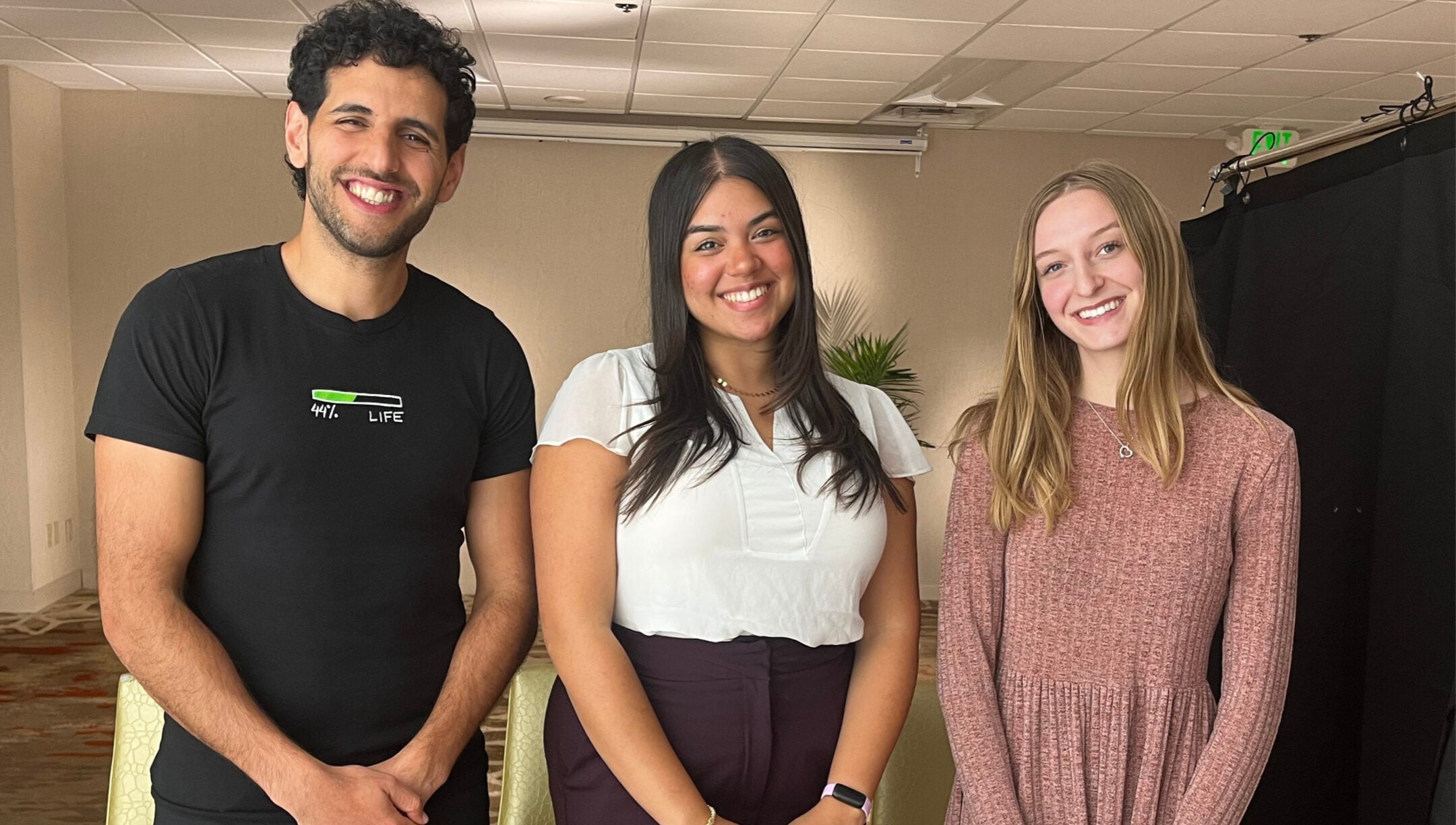
(JTA) — DENVER – Israeli-Arab social media entrepreneur Nuseir Yassin, of the viral vlog “Nas Daily,” said he believes “anti-Zionism is a form of antisemitism” and stressed his commitment to overturning “misguided hate” against Jews, at a conference devoted to the subject this week.
Yassin, 34, was speaking with the Jewish Telegraphic Agency on the sidelines of the conference, hosted by the David Merage Foundation for Confronting Antisemitism. A self-described “village boy” from the Lower Galilee town of Arraba in Israel, he achieved massive success through viral short-form videos that attracted viewers from all over the world. Today he boasts more than 68 million followers across numerous social networks.
Yassin is a Muslim of Palestinian origin, although he said he is not religious. Asked why it was important for a non-Jewish person to participate in a conference about combatting antisemitism, Yassin equated this battle to fighting for his family, noting that “the success of Israel and the Jewish people is also my success as an Israeli citizen.”
“I’m not a fan of the Israeli government, and I’m not here to defend it, just like I’m not a fan of many governments,” Yassin noted, but he asserted that the reaction to the government “is absolutely fueled by antisemitism.”
“I do believe anti-Zionism is a form of antisemitism,” he added.
He said he views Zionism as “the most vanilla thing in the world – a group of people wanting a place to live,” and has therefore concluded that Israel’s detractors “just really don’t like Jews.”
Yassin, who first broke through in 2016, has become increasingly outspoken in recent years about his combined Israeli and Palestinian identity. During the conference, he recalled that he grew up labeling himself Arab-Israeli. After the Hamas attacks of Oct. 7, 2023, he started listing Israeli first and Palestinian second.
“I could not relate to the extremism that I saw, and I wanted to distance myself from it without erasing my identity connected to it,” Yassin said. “I’m not just Israeli because I think it removes a little bit of spice, but I’m also not just Palestinian anymore.”
“A lot of Israeli culture is inside me,” he continued. “I never agree with people. I’m always disagreeable. That’s Israeli. I speak up.”
Yassin noted that he was “the first guy to go study in the United States out of my entire lineage,” graduating from Harvard University in 2014 with a degree in economics and a minor in computer science. Despite having grown up in Israel, Yassin said that Harvard was the place where he made his first Jewish friend.
After working as a software developer for Venmo in New York, Yassin left his job in 2016 to travel and document his journeys. Ultimately, he launched a Facebook page called Nas Daily – using the word for “people” in Arabic – where he posted one-minute videos for 1,000 days, telling the stories of communities around the world.
What was once a personal brand has since expanded into the parent Nas Company, which offers platforms for solo entrepreneurs to build and monetize their online businesses.
Yassin earned an honorary degree from Ben-Gurion University of the Negev in 2025 in recognition of his advocacy work for Israeli and Palestinian coexistence. This past August, he also joined the advisory board for the Genesis Prize Foundation, which each year celebrates inspiring Jewish individuals for their achievements.
“I do not relate to hundreds of men on the street shouting ‘Allahu Akbar,’” Yassin told JTA, adding that there needed to be more women and fewer religious fanatics participating in the Israeli-Palestinian conversation.
Yassin argued that he’s “not a weird Arab for saying this” and that “the entire country of the UAE says the same thing,” referring to one of the Gulf countries that signed onto the Abraham Accords normalizing relations with Israel. He also challenged “Free Palestine” activists to envision a concrete future for Palestinians rather than fixating on Israel’s transgressions.
“We should all be ‘Free Palestine’ – but from what?” Yassin asked. “We disagree on the solution, not on the problem. We don’t want suffering. Nobody wants suffering.”
“I’m a free-Palestine-from-Hamas guy,” he continued. “Just free Palestine,” he said, ”is not an answer. I’m free-Palestine-from-extremism.”
Yassin affirmed that there is room for criticism of Israel’s government, noting, for example, that he would like to see an Israeli-Arab presence in the government.
But he marveled at the notion that an alien visiting Earth would likely guess that the most hated country in the United Nations is North Korea, when in fact “It’s not – It’s Israel.”
That struck him as absurd because “the Israel-Palestine conflict is not a big deal when you compare it to everything else that’s happening on planet Earth. The only thing that makes it a big deal is that we, as Palestinians, have the perfect enemy.”
That enemy, he continued, is “the most hated type of enemy, which is the Jews.”

As part of his appearance at the conference, Yassin presented a recap of a fellowship he launched this past spring in partnership with the David Merage Foundation to help 50 content creators – 25 Jewish and 25 Muslim – produce meaningful material.
Participants received $1,000 and spent a month learning from the Nas Daily team about viral and impactful storytelling during the fellowship, named for Yassin’s first Jewish friend, Zaki Djemal, who recently died of a sudden heart attack.
To Laura Merage, the Iranian-born Jewish co-founder of the foundation, Yassin was a natural partner for this bridge-building effort. Given his social media following and “infectious personality,” Merage said she felt “that’s what we need more of in the world.”
At the conference on Tuesday, Yassin announced two winners of the fellowship’s influencer competition: recent McGill University graduate Raihaana Adira, a Canadian Muslim, and Grace, a Jewish-American digital content creator who preferred to use only her first name for privacy reasons. Grace tells stories about unique public figures, such as the first Arab “Miss Israel.” Adira, meanwhile, began posting about antisemitism and Muslim-Jewish relations after witnessing anti-Zionist protests at McGill.
“When I see a Jewish person being attacked on campus or online, it feels like I’m watching someone from my own community hurt,” Adira told JTA, noting that she started posting because no one believed her when she talked about incidents on campus.
“I wanted the protests and the graffiti on the walls that said ‘Death to the IDF’ to be seen,” she continued. “I am a Canadian, I am a Muslim, and when people at school on the streets say, ‘Death to Canada, We are Hamas, Hamas is heroic’ – that is not me.”
Adira said she received many death threats when she first started posting. While acknowledging how difficult that was, she also emphasized an influx of support that has helped “drown out the hate.”
Yassin offered a similar perspective, noting that at the beginning of his career, he “used to amplify the blowback and talk a lot about it,” referring to the criticisms he’d receive for promoting coexistence and calling out antisemitism. But after realizing that this deterred others from speaking out, he deemed the threats insignificant, calling them “the smallest price to pay for the largest outcome you can possibly imagine.”
During his travels around the world, Yassin said he has witnessed how flawed people’s perceptions of Jews can be and that he feels “a responsibility to set the record straight.” He also noted that he is dating a Jewish woman, author and influencer Aija Mayrock, whom he is marrying next year and with whom he expects to have children.
“They’re going to be Jewish, so that’s my family – literally, my family,” Yassin said.
This article originally appeared on JTA.org.
The post Israeli-Arab influencer behind ‘Nas Daily’: Anti-Zionism is antisemitism appeared first on The Forward.
Uncategorized
Four Seats or No Seats? Why Israel’s Final Polls Disagree Over Amcha Yisrael

Conflicting projections for Ofer Winter’s party illustrate the uncertainty of measuring public support near an electoral threshold.
A Channel 12 poll gives Ofer Winter’s Amcha Yisrael four parliamentary seats.
An i24NEWS survey reaches the same seat total.
Other final polls find that the party does not qualify for representation.
How can surveys conducted close to the same election produce such different results?
The answer lies partly in the difference between measuring a vote share and converting it into parliamentary seats.
A Statistical Boundary
Israel’s electoral threshold is 3.25 percent.
For a party receiving substantially more than that percentage, modest sampling fluctuations may change its expected number of seats without calling its parliamentary presence into question.
For a party whose support lies near 3.25 percent, the same type of fluctuation may change its projected representation from several seats to zero.
This does not necessarily mean the polls are measuring completely different political realities.
They may be producing estimates close to the same threshold but on opposite sides of it.
Sample Size Is Only One Factor
The i24NEWS survey conducted on October 22 included 5,124 adult respondents and reported a sampling error of plus or minus 1.4 percentage points at the 95 percent confidence level.
That is a substantial sample by conventional political polling standards.
But a larger sample does not eliminate every source of uncertainty.
Different pollsters may employ different recruitment methods, weighting systems and procedures for estimating turnout.
They may also differ in how they handle respondents who are undecided or reluctant to state their preferences.
These choices can matter particularly for smaller parties.
The Problem of Turnout
Opinion polls generally estimate voting preferences before actual voting takes place.
Election results reflect the ballots cast by people who participate.
Differences between intended and actual turnout can affect parties in different ways.
Analysts must therefore consider not only how many respondents express support for a party, but also whether the poll’s turnout model accurately reflects the eventual electorate.
Without transparent, comparable information about the methods used by each polling organization, it is difficult to identify which methodological difference is responsible for a particular disagreement.
Reading the Final Surveys
The appropriate interpretation of Amcha Yisrael’s polling is neither that its parliamentary representation is guaranteed nor that exclusion is certain.
The available surveys demonstrate uncertainty around a legally decisive boundary.
The four-seat projections reported by Channel 12 and i24NEWS are meaningful observations.
So are the below-threshold findings published by Channel 13, Maariv and Zman Yisrael.
Each survey is a measurement of electoral intentions under a particular methodology, not a count of actual votes.
For readers following Israel’s election, this makes Amcha Yisrael an instructive case study in how polling uncertainty interacts with electoral law.
The final result will provide the definitive seat allocation. The polls explain why the outcome was difficult to measure in advance.
Uncategorized
As Trump betrays Ukraine, it’s beginning to feel a lot like Munich
In Munich on Sept. 30, 1938, the leaders of Britain and France signed an agreement with Adolf Hitler that caved to the Nazi leader’s demand that Germany be given a chunk of Czechoslovakia. Five months later, Hitler ordered the German military to forcibly take the remainder of the neighboring country.
On Oct. 9, 2026, Donald Trump and Vladimir Putin struck a deal allowing Russia to sell diesel fuel to global markets, most importantly to the US. Then Trump waived a package of sanctions on Russia that had been passed by Congress. By replenishing Russia’s war coffers, it is likely more Ukrainians will die because of these twin gifts from America’s president to the warmongering Russian autocrat.
Why is Trump doing this? He seems to be hoping the diesel deal will help him avert disaster in the upcoming midterms. Or maybe there’s more to it than that. Perhaps Trump seriously thinks that this will get him the Nobel Peace Prize by ending the war in Ukraine through helping Putin win it. Perhaps it’s one more scheme to further enrich himself and his family. Or maybe Putin really does have something on Trump.
In any event, it feels like Munich all over again.
There are some remarkable parallels between Czechoslovakia’s predicament in 1938 and Ukraine’s nine decades later: separatists in two vulnerable Central European democracies were encouraged and supported by a neighboring authoritarian regime that sought to seize adjacent territory under the pretext of protecting a minority from oppression.
And at the center of both narratives is betrayal: of Czechoslovakia by Britain and France, and Ukraine by Trump.

In the spring and summer of 1938, Konrad Henlein, leader of the Nazi-allied Sudeten German Party in Czechoslovakia, held secret meetings with Hitler and other Nazi officials. They concocted a plan: Cause so much disorder in the Sudetenland that the Czech government would declare martial law, thus creating an excuse for German troops to march in to protect the ethnic German minority.
Tensions that had long existed along the Czech frontier erupted into gunfire and death in the Sudeten town of Habersbirk on the morning of Sept. 13, 1938. A mob of German separatists hung a swastika banner from a church tower, stormed the police station, kidnapped the wife of a cop, and engaged in gunfights with police officers that lasted hours. Four Czech police officers and four insurgents died. Outbreaks of violence, terror and torture raged along the border for days, backed by Freikorps paramilitary troops who crossed from Germany and by SA and SS men who took part in cross-border sabotage and armed attacks.
The uprising had the desired impact. Just 17 days later — on Sept. 30, 1938 — Britain, France, Italy and Nazi Germany signed the Munich Agreement, yielding to Hitler’s demand that the Sudetenland be ceded to him. After landing at an airport outside London, Prime Minister Neville Chamberlain waved a document in his hand and jubilantly proclaimed:
“The settlement of the Czechoslovak problem which has now been achieved is, in my view, only the prelude to a larger settlement in which all Europe may find peace.”
“I believe it is peace for our time,” Chamberlain said later that day.
But it didn’t take long for Hitler to show he could not be trusted. Hitler’s army marched into Czechoslovakia on March 15, 1939. Germany’s invasion of Poland followed less than six months later, and by 1942 German forces controlled territory spanning from the Atlantic Ocean to deep inside the Soviet Union.
Ethnic Germans’ uprising in Czechoslovakia in 1938 found an echo nine decades later in Ukraine’s Donbas region, where unrest that began with pro-Russia protests in 2014 evolved into the war Russia has been waging on its neighbor for nearly five years.
In the spring of 2014, paramilitary units led by Russian intelligence officers stormed government office buildings in several towns and cities in Donbas, seizing weapons and clashing with police. In a scene reminiscent of the Habersbirk siege of 1938, on April 14, 2014, pro-Russian militants seized the police station in Horlivka, beat up the police chief, and murdered a member of the city council, whose body was found in a river. Similar clashes occurred throughout Donbas.
Two Kremlin-backed pseudo-states soon emerged: the Donetsk People’s Republic and the Luhansk People’s Republic. Russia funneled tanks, artillery, air defense systems and fighters into Donbas, fueling a war between separatists and Ukrainian forces that dragged on for years.
Like Hitler in the Sudetenland, Russia’s de facto occupation of Donbas was not enough for Vladimir Putin. His eyes were on all of Ukraine, and he spent years manufacturing pretexts for the full-scale invasion that began on Feb. 24, 2022.
Trump has been buttering up Putin for more than a decade, starting with his 2015 campaign for president, when he effusively praised the ruthless Russian autocrat’s leadership style. Putin is a “strong leader,” is “far more respected than our president,” meaning the immensely popular Barack Obama, and was someone he “would get along with very well,” Trump said back then.
Trump’s admiration for Putin took on ominous tones after becoming president. During a press conference after the two leaders’ 2018 Helsinki summit, Trump questioned intelligence findings on Russian election interference and said he believed Putin’s denial. “I don’t see any reason it would be Russia,” Trump told reporters, with the Russian strongman standing at his side.
After Russia’s invasion of Ukraine in 2022, during Biden’s presidency, Trump called it “a pretty smart move,” praised Putin as a “genius,” and also said it wouldn’t have happened if Trump was still president, remarks that were amplified by Russian state media.
During Trump’s second term, his buddy-buddy relationship with Putin has turned into a virtual strategic alliance, as the American president repeatedly makes moves and statements that seem designed to please the Russian autocrat. There are Trump’s threats to abandon NATO, his humiliation of Ukraine President Volodymyr Zelensky during a February 2025 meeting inside the Oval Office, and most recently Trump’s demand that Ukraine cease its drone attacks on Russian oil refineries, his call for Zelensky’s ouster, and envoy Steve Witkoff thanking Putin for being a “humanitarian.”
Putin has proposed a summit between himself, Trump, and Chinese leader Xi Jinping to discuss ending the war in Ukraine. It’s notable that Ukraine has not been invited. This is also what happened in Munich nine decades ago, when Czech delegates were excluded from the room, and others decided Czechoslovakia’s fate.
Last October, aboard Air Force One, Trump told reporters the Donbas region should be “cut up,” leaving most of it in Russian hands.
“Let it be cut the way it is,” he said. “They can negotiate something later on down the line.”
It seems the fate Trump envisions for Ukraine is similar to the one Hitler envisioned for Czechoslovakia. It would be naïve to think that Putin’s expansionist ambitions would stop there.
The post As Trump betrays Ukraine, it’s beginning to feel a lot like Munich appeared first on The Forward.
