



Uncategorized
A Look Inside Gaza: More Questions Than Answers as Israel Remains Vigilant, Hamas Refuses to Give Up Weapons

Israeli soldier on guard in Gaza, February 2026. Photo: Jonathan Sacerdoti / The Algemeiner
GAZA — Going into Gaza remains a rare opportunity for journalists. Access has been tightly controlled throughout the Israel-Hamas war, and even now, months into a ceasefire that has paused the fighting without resolving it, entry is neither routine nor casual. Last week I had the opportunity to interview Nadav Shoshani of the Israel Defense Forces (IDF) inside the Gaza Strip itself, as he walked me through the so-called “Yellow Line” roughly dividing the enclave between east and west, the strained reality on the ground, and the directions in which this conflict may now move.
Shoshani is the IDF’s international spokesperson, one of the most visible Israeli figures to emerge since Hamas’s Oct. 7, 2023, invasion of the Jewish state. For months he has been a fixture in global media, correcting casualty claims and explaining operations in real time. In modern conflict, the spokesman is not an afterthought to the battlefield but an extension of it. What is said publicly shapes diplomatic reaction, public opinion, and operational latitude. English-language briefings in particular are conducted with as much care as any military deployment.
Spokesmen can be dry to interview: They do not reveal classified plans or freelance personal views. Instead, they articulate the institutional position. They present what Israel wants seen, understood, and, ideally, repeated. But even this is useful data for us journalists, and for our readers, too. It is a form of evidence, explaining the narrative the army — and the state — wants to be repeated. From this embed, and from this conversation, the message was consistent: tense but disciplined control in a moment of relative calm (but not peace), determination without appetite for escalation, action in response to violations rather than initiative for renewed war. It was almost as if they wanted to portray a sense of disciplined, determined boredom.

IDF international spokesperson Nadav Shoshani in Gaza. Photo: Jonathan Sacerdoti / The Algemeiner
We met at an IDF post a few hundred meters from what is now called the Yellow Line, the boundary dividing Israeli-controlled territory from areas still under Hamas control. Just beyond it lay Deir al-Balah and the central camps, dense urban belts whose origins stretch back to the aftermath of 1948 and whose political culture has long been shaped by displacement, factional rivalry, and Islamist terrorist organizations.
Shoshani’s own trajectory mirrors the way this war has pulled figures back into public roles. During his initial decade-plus in the IDF he served in key communications positions, including spokesperson for Military Intelligence and head of the IDF’s social media desk. In 2022 he moved into politics, advising Gadi Eisenkot in Israel’s parliament, known as the Knesset. He briefly entered private consulting. After Oct. 7, he was called back into uniform at Eisenkot’s request. Since then, he has become one of the IDF’s most recognizable English-language voices.
As we moved between locations in a military jeep, he spoke about operating in a conflict that is scrutinized but rarely visited, as a result of Israel’s own decision to bar free movement of journalists in the area. The informational theater runs parallel to the physical one. Every strike, every claim, every casualty figure is contested. The spokesman stands at the junction between battlefield and broadcast.
From the vantage point near the Yellow Line, the broader strategic dilemma came into focus.

Israeli military jeep driving in Gaza. Photo: Jonathan Sacerdoti / The Algemeiner
Hamas continues to control significant internal areas of Gaza. Israeli assessments indicate that weapons accumulated earlier in the war remain dispersed across the enclave. Tunnels are still being uncovered even in the southern city of Rafah, where the IDF has operated for an extended period. “The IDF are world class experts in dealing with terror tunnels,” Shoshani said. “And still, after a year plus in Rafah, there are still tunnels.” He described the network as vast and deeply embedded.
In the sector we were visiting, Shoshani said, there are dozens of tunnel shafts. “Single digits” are dismantled each week. It is a steady, grinding process rather than a decisive sweep. As the Israelis are still discovering new shafts and tunnels, the assumption is that the network is even more vast than they know. And for Israel, destroying the tunnels is part of Hamas’s commitment to disarmament in accordance with the US-backed ceasefire.
“The first line of the agreement says Gaza will be a terror free zone,” Shoshani told me. “The agreement speaks about Hamas disarming.” Israel, he said, is committed to that outcome.
Yet Hamas leaders abroad have recently made clear that disarmament is not under consideration. Khaled Meshaal has described surrendering weapons as removing the “soul” of the resistance. Instead, he has floated the prospect of a long “hudna” — a five, seven, or ten-year truce in which weapons remain intact. A pause, not a conclusion. The way things are at the moment it seems like America remains undecided, torn between the momentum of building on the relative calm of the ceasefire and the inclination toward helping Israel defeat its jihadist enemies.
That divergence defines the uncertainty of this moment. A ceasefire predicated on demilitarization rests on a premise one side openly rejects.

Landscape in Gaza, February 2026. Photo: Jonathan Sacerdoti / The Algemeiner
Israel currently controls somewhere between 51-58 percent of the Gaza Strip. Within Israel’s political and security leadership, the argument is not over whether Hamas must be weakened, but over how far that effort must go. One school supports sustained operational control and calibrated pressure, judging that persistent attrition imposes manageable diplomatic costs while limiting Israeli exposure. Another warns that leaving Hamas organizationally intact, even in a diminished form, merely postpones the next confrontation and preserves its capacity to reconstitute. The dispute turns on a single question: Can Hamas be contained, or must it be eradicated to prevent recurrence?
“We are literally standing between Hamas and our civilians,” Shoshani said, pointing toward Israeli communities only a kilometer or two away. The distance is short enough to be visible. Oct. 7 lingers as the unspoken baseline of risk. I walked through the burnt-out homes of Be’eri shortly after the massacre. I cried quietly among the makeshift memorials at Re’im for the Nova party victims slain by the barbarous Palestinian terrorists full of bloodlust. I met survivors from Nahal Oz, evacuated for months from their beloved home and living as a family of four in a single kibbutz bedroom in the north. The scars will remain in the psyche of Israel and Jews for decades to come.
The atmosphere at the post was quiet but taut. Occasional distant fire cracked and faded. Wind carried sand across the position. A short drive away, at the Kissufim crossing, pallets of humanitarian aid sat stacked inside Gaza, inspected and approved. “Every week, 4,200 trucks are going into Gaza,” Shoshani said. He emphasized that the Israeli depot on the other side was empty because everything cleared had been transferred into the Strip, awaiting collection by international agencies.

Supplies stacked in Gaza. Photo: Jonathan Sacerdoti / The Algemeiner
Humanitarian logistics and sniper fire exist side by side. Reconstruction frameworks are discussed internationally while tunnel shafts are dismantled meter by meter.
US President Donald Trump is expected to announce billions in funding for Gaza and provide an update on an international stabilization force at the next meeting of his Board of Peace. Israeli Prime Minister Benjamin Netanyahu has now formally joined the initiative, signing a back-dated letter during his US trip last week. Public language emphasizes transformation and demilitarization.
Questions surrounding the proposed international stabilization force are also occupying serious attention among policymakers. Under the framework advanced during the Trump administration’s post-war planning, the concept envisages a multinational force deployed in Gaza after the cessation of major combat operations. Its stated purpose would be to oversee demilitarization, support reconstruction, assist in training local security forces, and provide a transitional security umbrella while Israeli forces reduce their footprint.
Within the proposed international architecture, Indonesia has emerged as a potential contributor. Jakarta signaled its readiness, in principle, to supply a substantial contingent to such a force, positioning itself as a Muslim-majority state willing to participate in post-conflict stabilization. The rationale is clear. Indonesian involvement would lend broader regional legitimacy to any arrangement and dilute the perception that Gaza’s future security is being shaped solely by Western actors or by Israel. But everyone knows that nobody can truly disarm Hamas other than the IDF.
Legitimacy is only one dimension of the problem. For Israeli decision-makers, the critical issues are structural and operational. Under what mandate would such an international force operate? Would it be authorized to conduct active counter-terror operations, or confined to monitoring and training? How would intelligence be shared? What happens if armed factions attempt to regroup or test the limits of the force’s authority? These are the foundations upon which success or failure rests.

Israeli soldier on guard in Gaza, February 2026. Photo: Jonathan Sacerdoti / The Algemeiner
The Indonesian proposal illustrates the wider tension embedded in the international force concept. A deployment designed primarily for peacekeeping and humanitarian support may stabilize the optics of the post-war environment, but stabilization in a territory where armed networks have deep roots requires more than presence. It requires enforceable authority, coherent command structures, and the political will to confront spoilers — all things I witnessed in the IDF outpost in Gaza but cannot imagine will be present among foreign forces.
I ask LTC Shoshani about the Indonesian rumors and statements. On the ground, foreign troops are absent. “I think that’s more in the in the level of declaration and statements made by politicians,” he said. “It’s not something on the ground happening right now. As you can see, there’s only IDF soldiers in Gaza, but we’re working within the [US-led Civil Military Coordination Center] CMCC for the different solutions that have been agreed upon.” For the IDF, political declarations have yet to alter operational reality.
The central questions remain stark. Can Hamas realistically be disarmed without permanent occupation? If not, can Israel accept a reduced but armed Hamas presence? And if neither path proves viable, how long before the present equilibrium fractures? My embed in the Gaza Strip seems designed not to answer these questions, but to prompt them to the rest of the world to ponder. Criticism is easy, but Israel has to deal in solutions.
Meanwhile, the yellow line is clearly marked, by fluorescent yellow blocks of concrete dotted along the length of the strip. “It is not the type of area where you cross by accident,” Shoshani said. The IDF post we were standing in was deliberately positioned 200 to 300 meters back, allowing time for warnings, leaflets, shots into the air if necessary. Escalation is designed to be gradual.

Israeli soldier on guard in Gaza, February 2026. Photo: Jonathan Sacerdoti / The Algemeiner
Yet he seems keen to point out that ceasefires erode incrementally. A sniper attack. A targeted strike in response. Another violation. The cumulative weight builds.
From inside Gaza, the picture is neither triumphant nor chaotic. It is controlled, watchful, provisional. Israel is holding territory, responding to attacks, dismantling infrastructure, insisting on disarmament as the stated end state. As Trump and his two key negotiators — Steve Witkoff and Jared Kushner — talk publicly about reconstruction and rebuilding, and as Britain, France, and Canada deal in fantasies of Palestinian statehood, the Israeli soldiers I meet are tasked with the boring, grinding, slow process of degrading Hamas, pushing back when it ventures forward, and keeping alert as it declares it will not disarm.
That thick mud wall Shoshani and I stand behind wasn’t here a few weeks ago. It has been built because the line did not hold well enough. Though the line itself remains in place, what lies beyond it, and what may yet cross it again, remains unresolved.
Jonathan Sacerdoti, a writer and broadcaster, is now a contributor to The Algemeiner.
Uncategorized
Polish novel portrays nostalgic image of the Jewish life that once existed there
ס׳איז לעצטנס אַרויס אַן ענגלישע איבערזעצונג פֿונעם ראָמאַן „איך הייס שטראַמער“, וועגן אַ ייִדישער משפּחה אין דער פּױלישער שטאָט טאַרנע (טאַרנאָוו). דאָס בוך האָט אָנגעשריבן דער פּױלישער שרײַבער מיקאָלײַ לאָזינסקי.
אין משך פֿון העכער װי 150 יאָר האָט טאַרנע געהערט צו דער עסטרײַכישער פּראָװינץ גאַליציע. אונטער דער עסטרײַכישער אימפּעריע האָבן ייִדן ניט געליטן פֿון מלוכישן אַנטיסעמיטיזם, און די באַציִונגען צװישן ייִדן און פּאָליאַקן זײַנען געװען רעלאַטיװ רויִקע.
דער מצבֿ האָט זיך געביטן נאָכן אױפֿקום פֿון דער אומאָפּהענגיקער פּױלישער רעפּובליק נאָך דער ערשטער װעלט־מלחמה. די באַציִונגען זײַנען געװאָרן אַלץ מער געשפּאַנט מיטן צוּװוּקס פֿונעם פּױלישן אַנטיסעמיטיזם אין די 1930ער יאָרן.
די העלדן פֿונעם ראָמאַן זײַנען די משפּחה שטראַמער, װאָס באַשטײט פֿון זעקס מענטשן: דער טאַטע, די מאַמע, פֿיר זין און צװײ טעכטער. זײ זײַנען ייִדן פֿון אַ גאַנץ יאָר. דער טאַטע נתן איז אַ לא־יוצלח, װאָס האָט אַ מאָל עמיגרירט קײן אַמעריקע אָבער האָט ניט געהאַט קײן מזל אין דער „גאָלדענער מדינה“ און זיך אומגעקערט אַהײם צו זײַן פֿרױ און קינדער. זינט דעם פֿעפֿערט ער זײַנע ייִדישע רײד מיט ענגלישע װערטער און האַלט אין אײן חלומען װעגן צוריקפֿאָרן קײן ניו־יאָרק, װוּ ער האָט אַ ברודער אַן אָלרײַטיק.
זײַן פֿרױ רבֿקה איז אַ יוסטע באַלעבאָסטע װאָס האַלט אונטער דאָס גאַנצע געזינד. יעדער אײנער פֿון די קינדער האָט אײגענע דאגות, באַגערן און פּלענער פֿאַר דער צוקונפֿט.
לאָזינסקי שטעלט צונויף דעם סיפּור־המעשׂה אויף אַ קונציקן אופֿן, מישנדיק פּערזענלעכע שטאַנדפּונקטן פֿון פֿאַרשײדענע פּערסאָנאַזשן. אַזױ אַרום שאַפֿט ער אַ פֿילזײַטיקן קאָלעקטיװן פּאָרטרעט פֿון אַ טיפּישער משפּחה מיט אירע טאָגטעגלעכע עסקים.
לכתּחילה איז דער נאַראַטיװער טאָן אַ ביסל איראָניש. עס דאַכט זיך אַז די פּאָליטישע ענדערונגען האָבן ניט קײן סך השפּעה אױף זײער לעבן. דער טאַטע בענקט נאָך די אַלטע גוטע צײַטן פֿונעם אַמאָליקן עסטרײַכישן מלכות: „עס װעט קײן מאָל ניט זײַן אַזױ גוט װי בײַם קייסער פֿראַנץ־יאָזעף“, בעת זײַנע קינדער פּרוּװן זיך צוצופּאַסן צו די נײַע פּױלישע פּאַראָנדקעס.
די קינדער װאַקסן אונטער און די שטימונג פֿונעם ראָמאַן װערט ערנסטער. די האַנדלונג שטײַגט אַריבער די דלתּ־אַמות פֿון דער הײמישער שטאָט טאַרנע. נתן און רבֿקה רעדן נאָך אַלץ ייִדיש, אָבער זײערע קינדער פֿילן זיך הײמיש אין פּױליש. זײ בײַטן זײערע נעמען — הערש־צבֿי למשל װערט העסיאָ – און לערנען זיך אין פּױלישע גימנאַזיעס.
שפּעטער קלײַבן זײ אױס פֿאַרשײדענע דרכים: דער עלטסטער זון שטודירט לאַטײַן און גריכיש אינעם יאַגעלאָנער אוניװערסיטעט אין קראָקע אָבער קלײַבט אױס אַ קאַריערע װי אַ געשעפֿטסמאַן. זײַן ייִנגערער ברודער װערט פֿאַרטאָן אין דער קאָמוניסטישער פּאַרטײ, ער פֿאַרברענגט אַ פּאָר יאָר אין תּפֿיסה און דערנאָך פֿאָרט ער קײן שפּאַניע צו קעמפֿן אינעם בירגערקריג.
מיט דער צײַט װערט דער דערצײלערישער טאָן אַלץ מער דראַמאַטיש. דאָס שפּיגלט אָפּ די אַלגעמײנע פֿינצטערע אַטמאָספֿער אין פּױלן אין די 1930ער יאָרן, װען דער אַנטיסעמיטיזם װערט אַלץ מער בולט, און די עקאָנאָמישע לאַגע פֿון ייִדן ווערט אַלץ ערגער.
„עס האָט זיך אָנגעהױבן מיט ׳יעדער אײנער פֿאַר זײַנע אײגענע און מיט זײַנע אײגענע׳ און ׳קױף ניט בײַ די ייִדן׳ [די פּאָפּולערע אַנטיסעמיטישע לאָזונגען], און ענדיקט זיך מיט צעבראָכענע פֿענצטער אין ייִדישע קראָמען און לאָזונגען ׳ייִדן קיין מאַדאַגאַסקאַר!׳.“
אַזױ טראַכט דער ייִנגערער זון נוסעק, װאָס האַלט זיך װײַט פֿון פּאָליטיק. אָבער אַפֿילו ער װערט געװױר, אַז פּױלן גליטשט זיך אַרײַן אין אַ פֿאַשיסטישן רעזשים װי אין דײַטשלאַנד און איטאַליע.
פֿון דעסט װעגן קומט דער חורבן אומגעריכט פֿאַר די שטראַמערס. אַפֿילו װען היטלער און סטאַלין צעטײלן פּױלן, האַלטן זײ נאָך אַלץ בײַ אַ האָפֿענונג, אַז אַלץ װעט זיך װי ניט איז אױססדרן און דאָס לעבן װעט זײַן װידער נאָרמאַל.
„איך הייס שטראַמער“ געהערט צו אַ נײַער כװאַליע אין דער פּױלישער ליטעראַטור, װאָס פּרוּװט צו באַטראַכטן דעם פּױלישן עבֿר דורך אַ ייִדישן שפּאַקטיװ. פֿאַרן חורבן זײַנען בערך צען פּראָצענט פֿון דער פּױלישער באַפֿעלקערונג, דאָס הײסט, בערך דרײַ מיליאָן נפֿשות, געװען ייִדן. ערשט ניט לאַנג צוריק האָט מען אָנגעהױבן צו באַטראַכטן ייִדן װי אַ װיכטיקער באַשטאַנדטײל פֿון דער פּױלישער געשיכטע.
עס איז ניט קײן חידוש, װאָס דער פֿאָקוס איז דאָ אױף די באַציִונגען צװישן ייִדן און פּאָליאַקן און ניט אױף די אינעװײניקע פּראָבלעמען פֿונעם ייִדישן ציבור. דער דאָזיקער חילוק צװישן דעם פּױלישן און ייִדישן קוקװינקל איז בולט װען מען פֿאַרגלײַכט „ איך הייס שטראַמער“ מיט די ייִדישע ראָמאַנען פֿון יענער תּקופֿה, װי למשל מיכל בורשטינס „איבער די חורבֿות פֿון פּלױנע“, לײב ראַשקינס „די מענטשן פֿון גאָדלבאָזשיץ“ אָדער אַלטער קאַציזנעס „שטאַרקע און שװאַכע“.
די פּערסאָנאַזשן אין אָט די ייִדישע ראָמאַנען זײַנען געװען טיף פֿאַרטאָן אין ייִדישע סאָציאַלע, רעליגיעזע, קולטורעלע און פּאָליטישע פּראָבלעמען, בעת די קריסטלעכע פּאָליאַקן זײַנען געװען זײַטיקע און לרובֿ פֿײַנטלעכע פֿיגורן.
די ייִדישע מחברים האָבן באַטאָנט די אָפּזונדערונג פֿון ייִדן אין פּױלן, בעת בײַ לאָזינסקין זײַנען ייִדן מיטגלידער פֿון דער ברײטער פּױלישער געזעלשאַפֿט, כאָטש זײער אינטעגראַציע איז װײַט ניט קײן פֿולע.
אַזאַ צוגאַנג איז היסטאָריש אַקוראַט, װײַל אַ היפּשע צאָל ייִדן, בפֿרט אין די שטעט, האָבן טאַקע זיך געװאָלט אַסימילירן אין דער פּױלישער געזעלשאַפֿט. לאָזינסקי װײַזט די דאָזיקע טענדענץ גאַנץ גוט, אָבער װען עס קומט צו ייִדישקײט, זײַנען דאָ פֿעלערס װי למשל װען נתן, און ניט רבֿקה און די טעכטער, צינדט אָן די שבת־ליכט און דערצו נאָך, שרײַבט ער, „אײן ליכט פֿאַר יעדן משפּחה־מיטגליד“.
צום סוף פֿונעם ראָמאַן גיט לאָזינסקי צו אַ רשימה ביכער, װאָס ער האָט גענוצט װי היסטאָרישע מאַטעריאַלן. דאָס רובֿ זײַנען דאָס סאָלידע פּױלישע היסטאָרישע שטודיעס און זכרונות, אָבער עס איז ניטאָ קײן אײן מקור איבערגעזעצט פֿון ייִדיש אָדער העברעיִש. עס פֿעלט דאָ אַפֿילו דאָס יזכּור־בוך „טאַרנע: קיום און אומקום פֿון אַ ייִדישער שטאָט“ װאָס איז פֿאַראַן אין אַן ענגלישער איבערזעצונג. אין דער הײַנטיקער פּױלישער ליטעראַטור װעגן ייִדן פֿאַרבלײַבט ייִדיש בלױז אַ סימן פֿון ייִדישקײט, און ניט קײן שליסל צום רײַכן קולטורעלן אוצר.
The post Polish novel portrays nostalgic image of the Jewish life that once existed there appeared first on The Forward.
Uncategorized
There Are No ‘Moderates’: Most of the Democratic Party Is Turning Against Israel

Former Wayne County Health Director Abdul El-Sayed, a Democrat now running for US Senate in Michigan, speaks at a “Hands Off” protest at the state Capitol in Lansing, Michigan, on April 5, 2025. Photo: Andrew Roth/Sipa USA via Reuters Connect
Americans are bracing for a politically charged summer as momentum builds for radical Democrats in key races across the country.
In what is emerging as a clarifying moment for just how far the Democratic Party is willing to swing, current polls depict a competitive race among the three candidates running for US Senate in Michigan’s August Democratic primary.
Some of the latest numbers show Abdul El-Sayed, the Bernie Sanders-endorsed physician, holding a slight lead over the other two Democratic challengers, Michigan State Senator Mallory McMorrow and Congresswoman Haley Stevens.
In a page pulled out of New York City Mayor Zohran Mamdani’s playbook, El-Sayed, who blamed Israel for the attempted terrorist attack in March that targeted preschoolers at Temple Israel in Detroit, often cloaks his radicalism in rhetoric that focuses on affordability and universal healthcare.
He displays open contempt for Israel, and has called the Jewish State “just as evil” as the genocidal terrorist group Hamas.
El-Sayed campaigns with people who justified the 9/11 attacks, and refused to take a position on the death of former Supreme Leader Khamenei for fear of offending the Islamist sensibilities of Michigan’s Dearborn residents.
For many Jewish Americans, the ascendance of El-Sayed, Mamdani, and Graham Platner, the Democratic Senate Candidate from Maine who has praised Hamas’ military tactics (and had an SS symbol tattooed on his body), reflects a new moment — a shifting of the Overton window that not only propels dangerous candidates to prominence, but paves a paradigm in which politicians whose views would have been disqualifying just a decade ago are rebranded as moderates.
Campaigning as a suburban mom trying to capture the votes of centrists and peel off some left-wing voters from El-Sayed’s camp, the present political landscape is planting the 39-year-old Mallory McMorrow firmly in the center of the Democrats’ electoral path in Michigan, with El-Sayed to her left, and the Congresswoman Haley Stevens, who has pro-Israel views, to her right.
Yet when it comes to the state senator’s platform regarding Israel, McMorrow engages with many of the same anti-Zionist ideas espoused by her challenger, El-Sayed.
She traffics in similar language falsely accusing Israel of committing genocide in Gaza with a deft talent for fashioning her far-left views in a palatable package: a Christian wife and relatable mother, whose husband also happens to be Jewish.
McMorrow satisfies the Democrats’ defined virtuous, big-tent philosophy with competing statements insisting that she would not meet with Israeli Prime Minister Benjamin Netanyahu but also believes that Democrats’ affinity for Hasan Piker is a step too far into the realm of radicalism.
Should McMorrow be elected to the US Senate, would she vote any differently than El-Sayed when it comes to supporting the US-Israel alliance and providing Israel with the critical weapons it needs for its self-defense? It seems highly unlikely.
Much of the public discourse surrounds the surge of left-wing Democrats such as El-Sayed, Platner, and Mamdani, but the larger story to consider lies with politicians like McMorrow, who are using the atmospheric conditions to claim the mantle of moderation, but adopting the exact far-left positions of the candidates who hate Israel, and spread libels about Israel committing “genocide” and practicing “apartheid.”
If McMorrow is victorious in Michigan’s Democratic primary, her win would certainly be used by the Democratic establishment and its media allies to uphold a false narrative that the election was a defeat for the far left.
Yet there is perhaps no better example that illustrates just how successful leftists have been in dragging the center down than last month’s vote in the United States Senate, when nearly 80 percent of Democrats voted in favor of two anti-Israel measures introduced by Vermont Senator Bernie Sanders (I-VT) that, if passed, would have blocked approximately $450 million in weapons transfers to Israel.
The retreat from previously held pro-Israel leanings is reverberating beyond Congress, as “moderates” like Pennsylvania Governor Josh Shapiro (D) and Rahm Emanuel showcase their willingness to create daylight between the US and Israel.
For its part, AIPAC has been historically quick to praise and bolster the candidacies of politicians like New Jersey Senator Cory Booker, only to have the lawmaker court his state’s growing Muslim and Arab constituencies by announcing that he will no longer accept money from AIPAC. Senator Booker also backed both Senate resolutions halting military aid to Israel.
If there are legitimate debates about AIPAC’s policies to be had, Democrats aren’t engaging in it. They’re instead using AIPAC as a bogeyman to jump on the “Israel is evil bandwagon,” and perpetuate the libel that Jews control American politics with money.
Progressive populists and Muslim Socialists may differ in their ideological appeal, but both brands of candidates use their gaining leverage as a vehicle to inject their morally blind politics into the American ecosystem and generate a new standard of what constitutes a moderate in today’s Democratic Party.
There’s very little that separates El-Sayed and McMorrow’s foreign policy vision, just as there would be scant differences in how a Shapiro or a Kamala Harris White House would approach America’s relationship with Israel.
When it comes to supporting Israel’s right to exist and defend itself, the party appears nearly united in intensifying its hostility and moving the Democratic coalition onward — and firmly against Israel.
Irit Tratt is a writer residing in New York. Follow her on X @Irit_Tratt.
Uncategorized
Abraham Foxman, Former ADL Head and Advocate for American Jews, Dies at 86
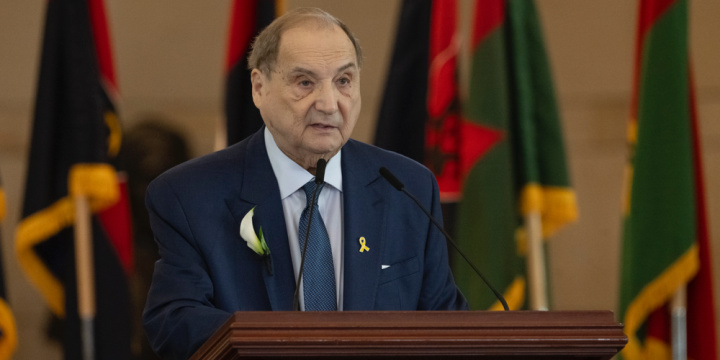
Abraham Foxman, a Holocaust survivor and member of the US Holocaust Memorial Council, speaks at the US Holocaust Memorial Museum’s Annual Days of Remembrance Commemoration in the Emancipation Hall of the US Capitol on April 23, 2025. Photo: Mattie Neretin/Sipa USA via Reuters Connect
Abraham H. Foxman, who was the national director of the Anti-Defamation League for nearly three decades, has died at the age of 86, the ADL announced in a statement on Sunday.
The organization said it “deeply mourns the loss of our longtime national director,” but did not provide details about where, when, and how Foxman died. He is survived by his wife Golda, children Michelle and Ariel, son-in-law Brandon Cardet-Hernandez, and grandchildren, Cielo, Leila, Gideon, and Amirit.
Foxman retired in 2015 after spending his entire 50-year career with the ADL. He was “one of the world’s foremost voices against antisemitism and hate,” as well as an “outspoken, passionate, and tireless advocate for the Jewish people and Israel,” according to the advocacy organization.
Foxman graduated from City College of New York and NYU School of Law. He joined the ADL immediately after graduating from law school and served in various roles in the organization, including assistant director of legal affairs, before being becoming its national director in 1987. When Foxman announced his retirement from the ADL, then-US President Barack Obama said the long-time civil rights activist was “irreplaceable.”
Jonathan Greenblatt, the current CEO of the ADL, described Foxman as “an iconic Jewish leader who embraced the ideal of an America free from antisemitism and hate and who strongly believed that these scourges could be defeated if good people opposed it.”
“America and the Jewish people have lost a moral voice, a passionate advocate for the Jewish people and the state of Israel, and a remarkable leader,” Greenblatt said in a released statement. “In his storied career, Abe transformed ADL while confronting antisemitism and hate (from both left and right), opposing the global rise in antisemitism, holding world leaders accountable and working to ensure that Israel was Jewish, secure and democratic. Abe’s voice was heard – and listened to – by popes, presidents, and prime ministers, a voice he used wherever Jews were at risk. Abe Foxman spoke on the global stage with moral authority and clarity and was relentlessly dedicated to his pursuit of a world without hate.”
“Abe Foxman helped build the modern liberal era of America,” ADL Board Chair Nicole Munchnik added in a separate statement. “He was recognized across the globe as a great leader and passionate advocate for tolerance, a voice of the generation rebuilding in the shadow of the Shoah, and longtime advisor to American presidents and world leaders. To those of us who knew him, Abe was a warm friend, advisor, spirited antagonist and hugger – all over lunch.”
The American Jewish Committee praised Foxman as a “towering figure in the fight against antisemitism and hatred” and someone who “brought moral clarity, courage, and unwavering conviction to generations of advocacy and leadership.” The AJC said his advocacy “helped shape the American Jewish experience and strengthened the global fight against bigotry in all its forms.”
Born in 1940 to Polish Jews in what is now Belarus, Foxman survived the Holocaust under the care of his Polish Catholic nanny Bronislawa Kurpi, who baptized him and raised him as a Catholic to hide his Jewish identity. He lost 14 family members in the Holocaust but was reunited with his parents after the war. Together they immigrated to the United States, where Foxman attended the Yeshiva of Flatbush as a teenager. He later served as vice chairman of the Museum of Jewish Heritage in New York City and was a member of the United States Holocaust Memorial Council, to which he was appointed by President Ronald Reagan in 1987 and reappointed by Presidents George H.W. Bush, Bill Clinton, and Joe Biden.
The Auschwitz Jewish Center Foundation (AJCF) called Foxman “one of the most consequential Jewish leaders of the postwar era” and a Holocaust survivor who “devoted his life to confronting antisemitism and defending the Jewish people.”
“Abe Foxman belonged to a generation that carried the weight of history personally and transformed it into public service,” said AJCF Chairman Simon Bergson in a statement. “He dedicated his life to ensuring that the lessons of the Holocaust were applied to the defense of democratic values, human dignity, and the Jewish people. His legacy will endure for generations.”
Following the news of Foxman’s death, Israeli President Isaac Herzog praised him as a “legendary leader of the Jewish people, a champion of justice and equality, and a longtime, dear friend of mine.”
“Coming into a world at war, the Holocaust shaped Abe’s character and defined his mission: Combating antisemitism and hypocrisy, calling out racism and bias, speaking up for the Jewish people and the Jewish democratic Israel,” Herzog shared in a post on X. “His story, of rising from the ashes, is our story, the story of our people.”
Israel’s president also described Foxman as “a prominent, distinguished force in the American Jewish community, and a bridge between Israel and the Diaspora” as well as a “passionate Zionist, a humanist, and an outspoken, wise friend.”
“The affection and the respect we had for one another enabled us to openly discuss every challenge and every obstacle,” added Herzog. “I am so grateful for the profound conversations we shared over the years, and for the brave leadership he exemplified. I will miss Abe’s counsel and voice, and I know that his legacy and his message will live on.”
Foxman was a board member of the Met Council on Jewish Poverty, America’s largest organization combating Jewish poverty. Its CEO and Executive Director David G. Greenfield said he was “heartbroken” by the passing of his “dear friend and mentor.”
“At Met Council, we were privileged to have Abe as a board member, adviser, and friend,” Greenfield explained. “He brought wisdom, compassion, and deep commitment to everything he did. Even near the end of his life, Abe continued showing up for the community. Just a few weeks ago, he joined us with his granddaughters at Met Council’s Passover Day of Service at the Spitzer Fulfillment Center, helping ensure that New Yorkers in need could celebrate Pesach with dignity.”
“Public leaders do not always match their public reputations in private,” Greenfield added. “Abe was the rare person whose private kindness, humility, and generosity were even greater than his public stature. All who knew him loved him … His voice, his courage, his friendship, and his leadership will be deeply missed.”
Foxman also served as vice chairman of the Museum of Jewish Heritage in New York City.