


Uncategorized
A new bill would ban protests near synagogues, after the Park East protest. Is that legal?
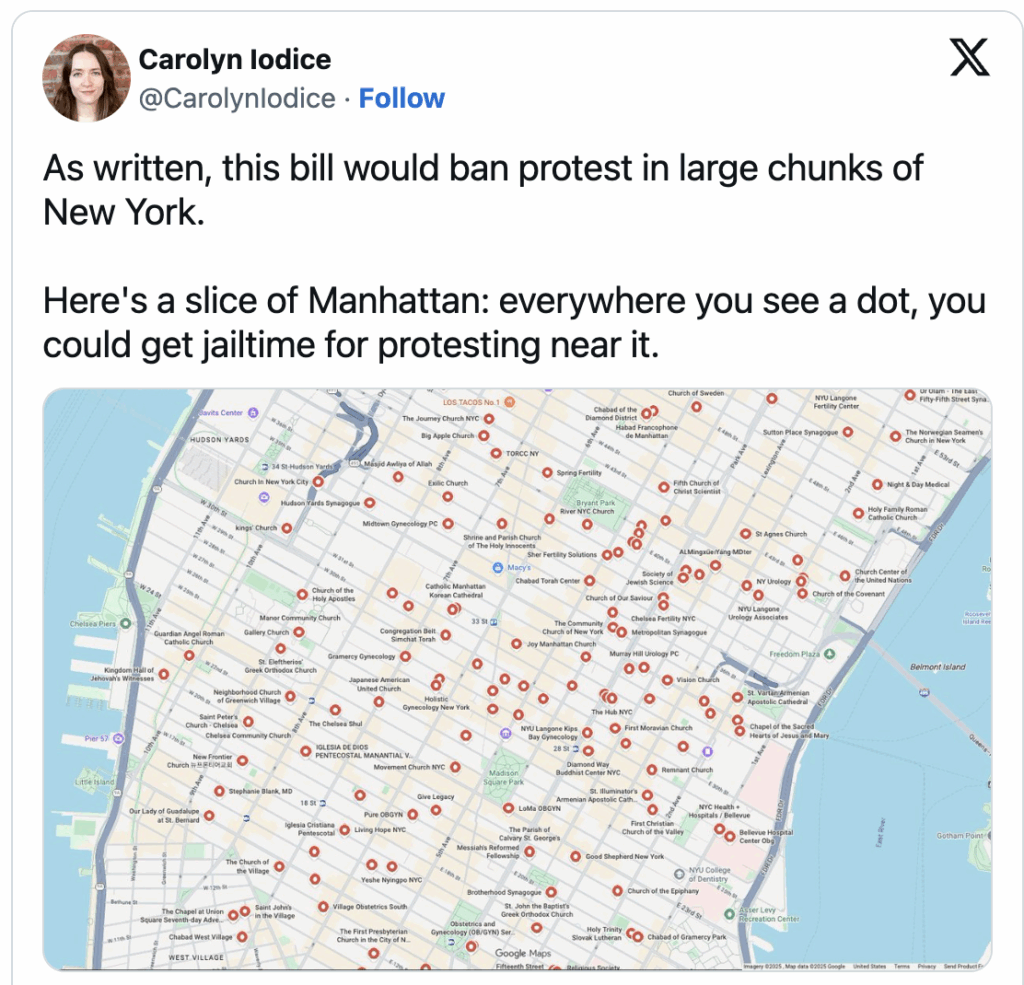
A protest outside a prominent New York City synagogue has prompted a bill that would ban demonstrations within 25 feet of houses of worship and reproductive health care clinics. But free speech advocates say the proposed restriction raises constitutional concerns that could put the measure on shaky ground.
“This bill, especially as written, would ban an enormous amount of protests in New York and contradict pretty well established First Amendment protections for protest on sidewalks and public streets,” Carolyn Iodice, legislative and policy director for the Foundation for Individual Rights and Expression, told the Forward.
If passed, the bill could tee up a legal clash over how to balance the protection of worshippers with protesters’ First Amendment rights.
State Assemblyman Micah Lasher, who introduced the bill, defended it in an interview with CNN: “There needs to be some reasonable space so that people who are trying to enter a house of worship or reproductive care facility can do so without having to run a gauntlet,” he said.
Mayor-elect Zohran Mamdani was reportedly receptive to the idea of limiting protests near houses of worship during a conversation with Rabbi Marc Schneier, the son of Park East Rabbi Arthur Schneier. Later, Mamdani told the Forward that he would consult community leaders and legal experts before determining whether he supports the legislation.
Why was the bill introduced?
Lasher said he introduced the legislation partly in response to a protest outside Park East Synagogue, where demonstrators objected to an event inside promoting immigration to Israel. Protesters chanted slogans like “death to the IDF” and “globalize the intifada.”
Mamdani condemned the demonstration and said New Yorkers should be free to enter houses of worship without intimidation. But he also said that “sacred spaces should not be used to promote activities in violation of international law,” referring to the promotion of Jewish settlements in the Israeli-occupied West Bank.
That statement drew outrage from some Jewish leaders who view making aliyah, or immigrating to Israel, as a core Jewish value. Two weeks later, UJA-Federation of New York hosted a rally outside Park East Synagogue, where speakers condemned the protesters’ rhetoric.
Speaking to the crowd, Rabbi Arthur Schneier backed the legislation and urged attendees to call their representatives to express support.
“Legislators, keep your eyes open,” Schneier said. “This is what we want.”
What are the constitutional concerns?
In weighing constitutionality, courts consider whether a law restricts more speech than necessary to achieve the government’s interest.
In this case, if the state’s goal is simply to ensure physical access to places of worship, there are already laws in place, according to Iodice. A 1994 federal law, the Freedom of Access to Clinic Entrances Act, makes it illegal to use force, threats, or physical obstruction to block access to reproductive health services or houses of worship.
If the government’s goal is to ensure congregants can worship without emotional distress, the bill may be too broad, according to Alan Brownstein, a constitutional law scholar and professor emeritus at UC Davis School of Law.
“Suppose you had three people and they had a sign that said, Reconsider attending this house of worship, because the clergy oppose same sex marriage. And that’s all you had, three people with signs and they’re 20 feet away,” Brownstein said. “Is that traumatizing? Is that so disturbing to people who are going to attend a house of worship that we have to prohibit it?”
It’s also unclear what the bill means by “demonstrating,” he said. Some definitions — like two or more people engaging in expressive conduct — could apply to a wedding ceremony outside a synagogue as easily as a protest.
Legislators also cannot ban speech they dislike while allowing speech they approve. So if the bill only targets protests but permits supportive demonstrations, that creates another legal problem, Brownstein said.
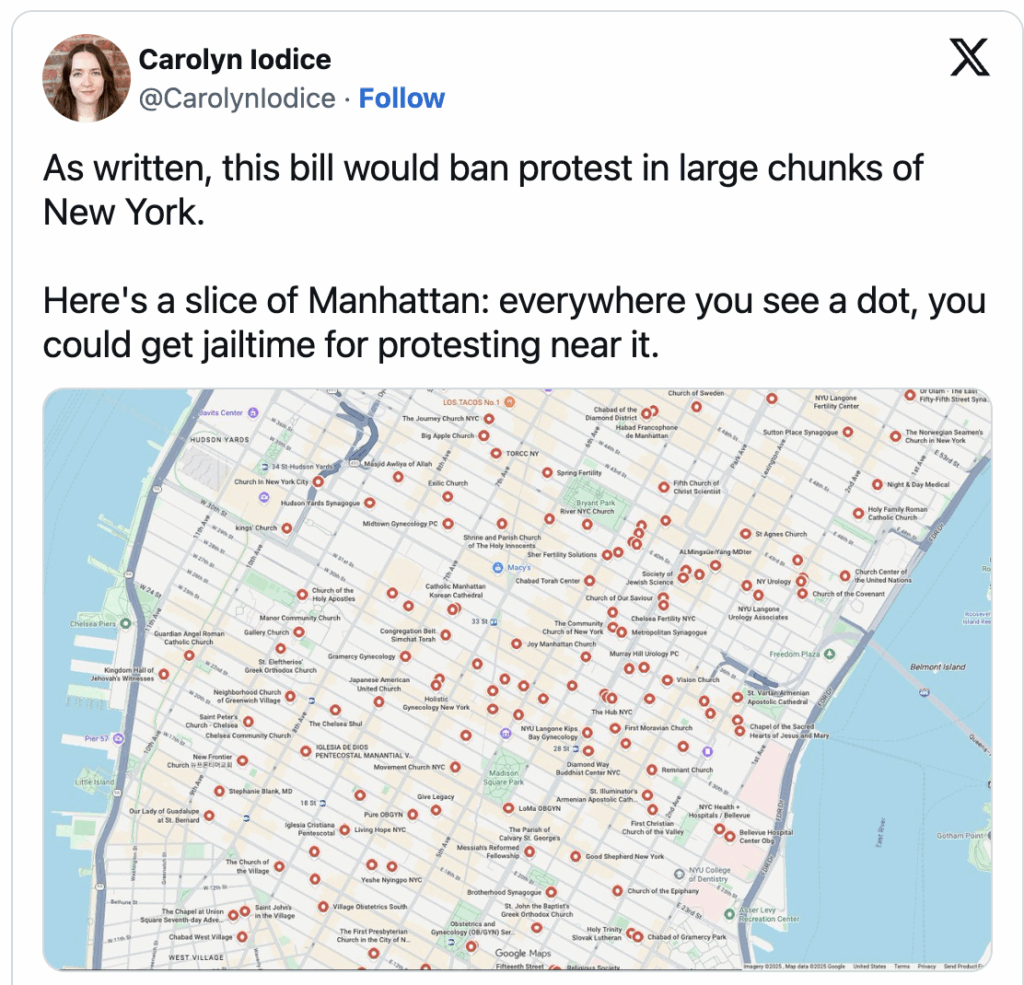
The distance requirement could also be an issue. The bill requires demonstrators to stay 25 feet away from not only the building, but also its parking lot, driveway, and sidewalk, which could make the actual restriction larger, Iodice said.
In a densely packed area like Manhattan, that could eliminate a lot of protest space.
“Banning protests across wide swaths of Manhattan, as a realistic matter, that’s not going to fly constitutionally because of how much speech it restricts,” Iodice said.
There is some precedent for this kind of restriction: Laws creating protest-free buffer zones have been used in a variety of other contexts, including at funerals and abortion clinics in other states.
But it’s an open question whether those cases translate to houses of worship, Brownstein said, because healthcare clinics and cemeteries don’t participate in public discourse in the same way a synagogue or church does.
He considered a hypothetical law barring demonstrations within 25 feet of a political party’s headquarters, in what would be an obvious attempt to silence opposing views.
“Now, houses of worship aren’t political campaign headquarters,” Brownstein said. “But if anyone argued to me that religion is not a major voice in public discourse and debate in the United States, I don’t know where they’ve been.”
The post A new bill would ban protests near synagogues, after the Park East protest. Is that legal? appeared first on The Forward.
Uncategorized
Trump Says Gas Prices May Remain High Through November Midterm Election

U.S. President Donald Trump takes questions from reporters while Vice President JD Vance and Secretary of State Marco Rubio look on, as they attend a meeting with oil industry executives, at the White House in Washington, D.C., U.S., January 9, 2026. REUTERS/Kevin Lamarque
US President Donald Trump said on Sunday that the price of oil and gasoline may remain high through November’s midterm elections, a rare acknowledgement of the potential political fallout from his decision to attack Iran six weeks ago.
“It could be, or the same, or maybe a little bit higher, but it should be around the same,” Trump, who is in Miami for the weekend, told Fox News’ “Sunday Morning Futures With Maria Bartiromo” when asked whether the cost of oil and gas would be lower by the fall.
The average price for regular gas at US service stations has exceeded $4 per gallon for most of April, according to data from GasBuddy. Trump’s comments on Sunday came after weeks of asserting that the spike in prices is a short-term phenomenon, though his top advisers are cognizant of the war’s economic impacts, officials have said.
Earlier on Sunday, Trump announced on social media that the US Navy would blockade the Strait of Hormuz and intercept any ship that paid a crossing fee to Iran, after marathon talks between the US and Iran in Pakistan over the weekend did not yield a peace deal.
“No one who pays an illegal toll will have safe passage on the high seas,” he wrote on Truth Social.
Any US blockade is likely to add more uncertainty to the eventual resolution of the conflict, which is currently subject to a tenuous two-week ceasefire. The new tactic is in response to Iran’s own closure of the strait’s critical shipping lanes, which has caused global oil prices to skyrocket about 50%.
UNPOPULAR WAR HITS TRUMP’S APPROVAL
The war began on February 28, when the US launched a joint bombing campaign with Israel against Iran. The scope quickly expanded as Iran and its allies attacked nearby countries, while Israel targeted Hezbollah with massive strikes in Lebanon.
The war has buffeted global financial markets and caused thousands of civilian deaths, mostly in Iran and Lebanon.
Trump’s political standing at home has suffered, with polls showing the war is unpopular among most Americans, who are frustrated by rising gasoline prices.
The president’s approval rating has hit the lowest levels of his second term in office, raising concern among Republicans that his party is poised to lose control of Congress in the midterm elections. A Democratic majority in either chamber could launch investigations into the Trump administration while blocking much of his legislative agenda.
US Senator Mark Warner of Virginia, the ranking Democrat on the Senate Intelligence Committee, questioned the strategy behind Trump’s planned blockade.
“I don’t understand how blockading the strait is going to somehow push the Iranians into opening it,” he told CNN’s “State of the Union” on Sunday.
In a separate appearance on CBS’s “Face the Nation,” Warner said the blockade would not undermine Iranian control of the waterway.
“The Iranians have hundreds of speedboats where they can still mine the strait or put bombs against tankers in closing the strait,” he said. “How is that going to ever bring down gas prices?”
Although Trump has repeatedly said that the war would be over soon, Republican US Senator Ron Johnson of Wisconsin told ABC News’ “This Week” on Sunday that achieving US aims in Iran “could take a long time.”
“It’s going to be a long-term project,” said Johnson, who was not asked about Trump’s proposed blockade. “I never thought this would be easy.”
Uncategorized
Israel’s Ben-Gvir Visits Flashpoint Al-Aqsa Mosque Compound

Israeli politician Itamar Ben-Gvir walks inside the Knesset, in Jerusalem, Oct. 13, 2025. Photo: Chip Somodevilla/Pool via REUTERS
Israel’s far-right police minister Itamar Ben-Gvir visited the flashpoint Al-Aqsa Mosque compound in Jerusalem on Sunday, saying he was seeking greater access for Jewish worshipers and drawing condemnation from Jordan and the Palestinians.
The compound in Jerusalem’s walled Old City is one of the most sensitive sites in the Middle East. Known to Jews as Temple Mount, it is the most sacred site in Judaism and is Islam’s third-holiest site.
Under a delicate, decades-old arrangement with Muslim authorities, it is administered by a Jordanian religious foundation and Jews can visit but may not pray there.
Suggestions that Israel would alter the rules have sparked outrage among Muslims and ignited violence in the past.
“Today, I feel like the owner here,” National Security Minister Ben-Gvir said in a video filmed at the site and distributed by his office. “There is still more to do, more to improve. I keep pushing the Prime Minister (Benjamin Netanyahu) to do more and more — we must keep rising higher and higher.”
A statement from the Jordanian foreign ministry said it considered Ben-Gvir’s visit to be a violation of the status quo agreement at the site and “a desecration of its sanctity, a condemnable escalation and an unacceptable provocation.”
The office of Palestinian president, Mahmoud Abbas, said such actions could further destabilize the region.
Ben-Gvir’s spokesman said the minister was seeking greater access and prayer permits for Jewish visitors. He also said that Ben-Gvir had prayed at the site.
There was no immediate comment from Netanyahu’s office. Previous such visits and statements by Ben-Gvir have prompted Netanyahu announcements saying that there is no change in Israel’s policy of keeping the status quo.
Muslim, Christian and Jewish sites, including Al-Aqsa had been largely closed to the public during the Iran war. There was no immediate sign of unrest on Sunday after Ben-Gvir’s visit.
Uncategorized
Netanyahu Visits Troops Fighting Hezbollah in Southern Lebanon

Israeli Prime Minister Benjamin Netanyahu speaks during a press conference at the Prime Minister’s office in Jerusalem, Aug. 10, 2025. Photo: ABIR SULTAN/Pool via REUTERS
i24 News – Israeli Prime Minister Benjamin Netanyahu visited Israeli forces operating in southern Lebanon on Sunday as military operations against Hezbollah-linked targets continue.
Netanyahu toured forward positions alongside Defense Minister Yisrael Katz, Eyal Zamir, and Northern Command Commander Rafi Milo, meeting troops and receiving operational briefings from commanders on the ground.
Speaking to soldiers, Netanyahu praised their performance and said operations in the Lebanese security zone were ongoing.
“The war continues, including within the security zone in Lebanon,” he said, adding that Israeli forces were working to prevent infiltration attempts and neutralize threats such as anti-tank fire and missiles.
He described the northern campaign as part of a broader regional struggle involving Iran and its allies, saying Israel’s adversaries were now “fighting for their survival” following sustained Israeli military pressure.