



Uncategorized
A New Book Shows How Archaeology Proves the Jewish Connection to Jerusalem and Israel
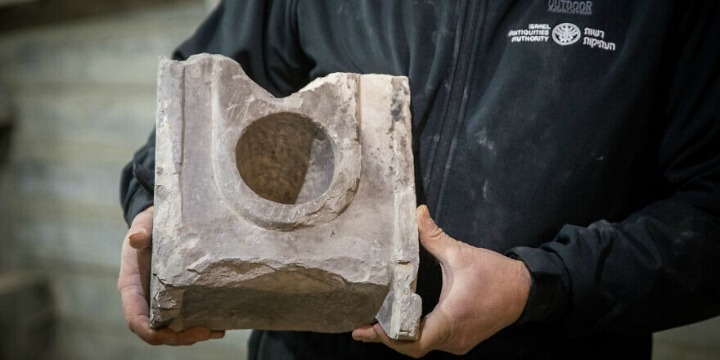
Israel Antiquities Authority Archaeologist Ari Levy holds a 2,000-year-old measuring table found near the Pilgrimage Road at the City of David in Jerusalem on Jan. 6, 2020. Photo: Yonatan Sindel/Flash90.
I have always enjoyed history and archaeology. That’s why I bought a new book that was recommended to me: When the Stones Speak: The Remarkable Discovery of the City of David and What Israel’s Enemies Don’t Want You to Know by Doron Spielman.
In the book, Spielman describes his work in the field of archaeology in Jerusalem, trying to discover as much as possible about the history of Jerusalem — and the extent to which archeology confirms the Biblical record of Jerusalem as an Israelite, Jewish city, against those who claim that the Biblical narrative was a modern Zionist fiction.
A small minority of people take everything in the Bible as fact. Others thought that much of the Bible’s history, locations, and narratives could be objectively verified, at least in part. A third group claims that early Biblical narratives were totally unreliable, and there had never been a serious Jewish state in the land of Israel. They said stories about David and Solomon were either fictitious or unverifiable.
Professor Israel Finkelstein and his followers at Tel Aviv University made a career out of denying Biblical reliability, claiming that there was no evidence of a significant Jewish presence in Jerusalem going back thousands of years, just as supporters of Palestinian ideology have always maintained.
Serious archaeology is a relatively recent science, and it wasn’t until the 19th century that Europeans began to seriously excavate in and around the Old City of Jerusalem.
Many of the earlier archeologists were antagonistic towards a Jewish perspective. But excavations did uncover a great deal about what became known as the City of David.
The recovery of this city showed that Israel and Jerusalem were indeed ancient Jewish sites going back more than 3,000 years — a question apart from whether or not all Biblical stories were necessarily facts.
Israel’s opponents continue to deny a connection between ancient Israel and the modern Holy Land, despite clear scientific evidence. That is why this new book by Doron Spielman is so important.
Spielman has worked on the ground in Jerusalem together with major specialists such as the late Eilat Mazar (1956-2021), and he sets the record straight on the extent to which the stones of Jerusalem undeniably support the Jewish narrative of presence over millennia.
Spielman also records the international and even national attempts to prevent progress politically because of the sensitivity of the discoveries, and how the archaeologists had to rely almost entirely on outside financial support to ensure that the excavations could continue and prevent sabotage.
This is a book in three parts. The first part focuses on the actual excavations and revelations that the author personally witnessed. The second describes the political struggles to support the work, to combat opposition, and to fight against political exigencies. The third part is a fascinating story of the author’s life and the delight in the work he has thrown himself into since his arrival in Israel as a young man.
This is not a dry academic book, but an easy and enjoyable read and one I can heartily recommend to understand the history of Jerusalem — and to counter those who want to deny the Jewish connection to the Holy Land.
The author is a writer and rabbi, currently based in New York.
Uncategorized
Trump Rejects Latest Iran Proposal as Hormuz Closure Persists

A woman walks past an anti-US billboard depicting US President Donald Trump and the Strait of Hormuz, in Tehran, Iran, May 2, 2026. Photo: Majid Asgaripour/WANA (West Asia News Agency) via REUTERS
President Donald Trump has swiftly rejected Iran‘s response to a US peace proposal to end the 10-week-old conflict between the two countries, describing the Iranian offer as “totally unacceptable.”
Days after Washington floated a proposal aimed at reopening negotiations, Iran on Sunday released a response focused on ending the war on all fronts, including Lebanon, where US ally Israel is fighting Iran-backed Hezbollah terrorists.
Tehran also demanded compensation for war damage, emphasized its sovereignty over the Strait of Hormuz, and called on the United States to end its naval blockade, guarantee no further attacks, lift sanctions, and remove a ban on Iranian oil sales.
Within hours, Trump dismissed Tehran’s offer in a social media post.
“I don’t like it — TOTALLY UNACCEPTABLE,” Trump wrote on Truth Social, without giving further detail.
Trump’s response has fueled concerns that the conflict, which began on Feb. 28 with US-Israeli strikes on Iran, will drag on and continue to paralyze shipping through the Strait of Hormuz, pushing oil prices higher on Monday.
The US had proposed an end to fighting before starting talks on more contentious issues, including Iran‘s nuclear program.
Tehran responded on Monday by defending its stance.
“Our demand is legitimate: demanding an end to the war, lifting the [US] blockade and piracy, and releasing Iranian assets that have been unjustly frozen in banks due to US pressure,” Foreign Ministry spokesperson Esmaeil Baghaei said.
“Safe passage through the Strait of Hormuz and establishing security in the region and Lebanon were other demands of Iran, which are considered a generous and responsible offer.”
Brent crude oil futures lost some strong early gains on Monday to trade nearly 2% higher at around $103 a barrel, as the deadlock left the Strait of Hormuz largely closed. Before the war began, the narrow waterway carried one-fifth of the world’s oil and liquefied natural gas, and has since become a central pressure point in the conflict.
Disruption caused by the near-closure of the strait has forced oil producers to cut exports, and OPEC oil output dropped further in April to the lowest in more than two decades, a Reuters survey showed on Monday.
TRICKLE OF SHIPPING THROUGH HORMUZ
Traffic through the Strait of Hormuz is at a trickle compared to before the war. Shipping data on Kpler and LSEG showed that three tankers laden with crude exited the waterway last week, with trackers switched off to avoid Iranian attack.
A second Qatari LNG tanker was attempting to transit the strait, the data showed, days after the first such cargo crossed under an arrangement involving Iran and Pakistan.
Sporadic flare-ups around the strait in recent days have tested a ceasefire that has paused all-out warfare since it took effect in early April.
In the United States, surveys show the war is unpopular with voters facing sharply higher gasoline prices less than six months before nationwide elections that will determine whether Trump’s Republican Party retains control of Congress.
Washington has also struggled to build international support, with NATO allies refusing to send ships to reopen the waterway without a full peace deal and an internationally mandated mission.
Hakan Fidan, the foreign minister of Turkey, which has been liaising closely with the US, Iran, and mediator Pakistan since the start of the war, will hold talks in Qatar on Tuesday on the conflict and on ensuring navigational safety in the strait, a Turkish diplomatic source said.
TRUMP SET TO DISCUSS IRAN IN BEIJING
The next diplomatic or military steps remain unclear. Trump is expected to arrive in Beijing on Wednesday, where Iran is set to be among the topics discussed with Chinese President Xi Jinping as pressure mounts to end the conflict and the energy crisis it has triggered.
Trump has been leaning on China to use its influence to push Tehran toward a deal with Washington.
Iran‘s foreign ministry spokesperson Baghaei suggested China could instead use the visit to push back against US objectives in the Gulf. “Our Chinese friends know very well how to use these opportunities to warn about the consequences of the US’ illegal and bullying actions on regional peace and security,” he said.
Addressing whether combat operations against Iran were over, Trump said in remarks aired on Sunday: “They are defeated, but that doesn’t mean they’re done.”
Israeli Prime Minister Benjamin Netanyahu said the war was not over because there was “more work to be done” to remove enriched uranium from Iran, dismantle enrichment facilities, and address its proxy forces and ballistic missile capabilities.
Netanyahu told CBS News’ “60 Minutes” that the preferred route was diplomacy, but he did not rule out the use of force.
Despite the ongoing diplomatic efforts, risks to shipping lanes and regional economies remain high.
On Sunday, the United Arab Emirates said it intercepted two drones launched from Iran, while Qatar condemned a drone strike on a cargo ship in its waters. Kuwait reported that its air defenses had dealt with hostile drones entering its airspace.
Clashes have also continued in southern Lebanon between Israel and Hezbollah, despite a US-brokered ceasefire announced on April 16.
Uncategorized
Boy George Shares Message in Support of Thousands Rallying Against Antisemitism in London

Boy George. Photo: ddp via Reuters Connect
British pop icon Boy George expressed solidarity with Jewish people in a video message that was featured at a rally against antisemitism held in London on Sunday.
The British charity Campaign Against Antisemitism (CAA) shared a photo on X that showed Boy George’s video message being played during the event, which was organized by the Board of Deputies of British Jews and the Jewish Leadership Council, with support from other Jewish organizations.
The Board of Deputies of British Jews said around 20,000 people gathered in Whitehall in central London, opposite Downing Street, for the rally that was held in solidarity with the Jewish community following a rise in antisemitic attacks across the United Kingdom, including the recent stabbing of two Jewish men in Golders Green.
In his video message, Boy George voiced support for the Jewish community at Sunday’s rally, which he could not attend in-person since he was in Vienna, Austria, preparing for the 2026 Eurovision Song Contest.
“It’s going to be such a beautiful, powerful event, not only full of amazing Jewish people, but also people who support their Jewish friends. People like me, who keep being thanked for speaking up for Jewish people,” the Culture Club singer said in the video. “I don’t want to be thanked for doing what is right. I have so many beautiful Jewish friends, and I know some of you will be there today. But even if I don’t know you, I send you my love and I hope today sends a powerful message to the entire world.”
CAA thanked Boy George for his support in a message on X.
“It is extraordinary how few celebrities have been willing to stand unequivocally with the Jewish community during this unprecedentedly challenging period. It is thus even more appreciated that a small number, like Boy George, do so, and are prepared to endure the abuse that they receive from antisemites as a result,” CAA said.
Political leaders who spoke at the rally included Conservative party leader Kemi Badenoch, Liberal Democrats leader Ed Davey, Reform UK Deputy Leader Richard Tice, and Secretary of State for Work and Pensions Pat McFadden.
Thank you also to @BoyGeorge for sending a recorded message of solidarity: “I don’t want to be thanked for doing what is right. God bless you all.”
It is extraordinary how few celebrities have been willing to stand unequivocally with the Jewish community during this… pic.twitter.com/w1OaGESShd
— Campaign Against Antisemitism (@antisemitism) May 10, 2026
Boy George and Italian artist Senhit will represent San Marino in the Eurovision this year with their song “Superstar.”
Boy George and more than 1,000 other members of the entertainment industry signed an open letter recently that expressed support for Israel’s participation in the 2026 Eurovision Song Contest, despite widespread efforts to have Israel banned from the international competition because of its military actions targeting Hamas terrorists in the Gaza Strip.
The musician has been outspoken about his support for the Jewish community in the past and defended Israel’s right to participate in the Eurovision this year.
Uncategorized
UK Sanctions Iran-Linked Network, Cites Attack Plots and Finance Operations

An Orthodox Jewish man walks by at a wall showing pictures of protesters killed during anti-government demonstrations in Iran, in Golders Green, London, Britain, March 7, 2026. Photo: REUTERS/Jack Taylor
Britain on Monday sanctioned 12 individuals and entities linked to Iran, accusing them of involvement in hostile activity including plotting attacks and providing financial services to groups seeking to destabilize the UK and other countries.
Those targeted by the sanctions include alleged members and associates of what the British government described as the Zindashti criminal network, as well as several exchange houses and financial operators.
The government said the network was involved in Iranian-backed hostile activity, including threatening, planning, or conducting attacks against people and assets in Britain and elsewhere.
Iran has repeatedly denied involvement in attacks or plots in the UK and other countries.
According to the notice, some individuals were sanctioned for directly participating in hostile acts, while others were accused of providing financial services or other material support to facilitate such activity.
The measures, set out in a government sanctions notice, include asset freezes, travel bans, and director disqualification orders.
Britain said the financial entities sanctioned had provided services to individuals and groups linked to destabilizing activity, allowing networks connected to Iran to move and access funds despite international restrictions.
Last month, police said they were investigating possible Iran links to a recent series of arson attacks on Jewish targets in London, which prompted counter-terrorism inquiries and warnings about hostile activity by Tehran or groups acting on its behalf.
The UK raised its national terrorism threat level to “severe,” the second-highest rating, with police and ministers warning of an elevated risk of attacks and growing concern about hostile activity linked to foreign states, including Iran.