


Uncategorized
A Yiddish circus in a suitcase
Imagine aerial acrobatics accompanied by a dreamy melody on fiddle and cimbalom. A juggler maneuvering seven bouncing balls at once to the beat of a klezmer band. A saxophonist charming a suspiciously human-looking snake with a terkisher (a type of klezmer dance) — and all this interwoven with Yiddish songs and poetic stories of distant hometowns and faded Jewish circus traditions. Above all, suitcases, serving as seats, drums, and, of course, containers for circus equipment.
This is just a glimpse of the show “Tshemodan,” performed by what may be Germany’s first Yiddish circus company, Tsirk Dobranotch. The word tshemodan, Yiddish for “suitcase,” is the company’s second production. The ensemble consists of the klezmer band Dobranotch, joined by circus artists Sam Gurwitt and Eliana Pliskin Jacobs.
Jacobs, an aerialist and singer, has been dreaming of creating a klezmer circus ever since she entered the Yiddish scene in Berlin and other cities in Germany around 2018. In 2022, she met Sam Gurwitt, and they soon realized that they shared not only a background as circus artists but also a connection to the Yiddish and klezmer world: Gurwitt is trained both as a clown and as a klezmer fiddler. Creating a klezmer circus together was the obvious next step.
A few months later, Jacobs, a longtime fan of the band Dobranotch, pitched the idea to its members who have long been known for including comedy and stunts in their musical performances. “We like to do entertainment and eccentric, funny things, and with the circus company we tried to put it on another level,” said Mitia Khramtsov, the band’s fiddle player.
Tsirk Dobranotch’s first show, “Das Fliegende Balagan,” (Yiddishized German for “flying bedlam”) premiered in Dresden in 2023. For their second production, the group decided to incorporate a more coherent “thematic glue,” as Gurwitt calls it, focusing on the theme of migration as reflected in the title “Tshemodan” and to use the suitcase as a recurring element.
Migration — whether voluntary, pressured, or forced – is an experience that runs through all the ensemble members’ family histories or personal biographies. Jacobs and Gurwitt both grew up in the United States as grandchildren of German and Eastern European Holocaust survivors and moved to Germany in their twenties. Dobranotch members Mitia Khramtsov, Germina Gordienko, Ilya Gindin, and Evgenii Lizin are from St. Petersburg and fled to Germany after Russia’s full-scale invasion of Ukraine in 2022. They were joined by Paul Milmeister, who was born in Ukraine and migrated to Germany as a teenager. Some of the Tshemodan shows feature Bertan Canbeldek, an acrobat who was born in Germany to Turkish parents, as a guest artist.
Aside form the overall theme of migration and wandering, the company’s mission is to recall the almost forgotten history of Jewish circuses in pre-Holocaust Europe. In one of Jacobs’s solo acts, she tells the story of Jewish families, among them the Blumenfeld, Lorch, and Straßburger families, who had been running circuses in German-speaking Europe since the 17th century. She then asks herself whether her German-Jewish grandmother might have seen one of the pre-war Jewish circuses.
Comparing herself to “a ghost connecting the living with the dead, the past with the present,” Jacobs swings on a trapeze in a pensive, elegant aerial performance to the delicate sound of a slow hora played by Khramtsov and Gordienko.
Tsirk Dobranotch is aware, however, that these German and Western European Jewish circuses were historically not closely related to Eastern European Yiddish culture or klezmer music. This incongruence makes it difficult to justify why klezmer and circus would go together, Gurwitt admitted. On the other hand, as Jacobs pointed out, “the theme of wandering works well with both circus and klezmer.”
In fact, there is evidence that the klezmer musicians who played at weddings in different shtetls may have been accompanied by jugglers and acrobats. In fact, Khramtsov said, the old tradition of badkhonim (wedding jesters), certainly had historical connections to medieval Jewish jesters known as leytsonim.
While these links between Yiddish culture and the circus world did exist, Jewish culture and religion didn’t play much of a role in the Jewish circuses traveling throughout the German-speaking regions. As Jacobs put it: “They were normal circus performers who happened to be Jewish.”
According to Jacobs and Gurwitt, Jews joining and running important German circuses was evidence of their assimilation into the broader society, even though it eventually failed. Under the Nazi regime, Jewish circus artists were boycotted and persecuted; forced into hiding or exile, and many were eventually murdered.
But there was one circus performer that did not try to hide his Jewish identity. That was Siegmund “Zishe” Breitbart, also called the Iron King and allegedly the “strongest man on Earth.” Born in 1897 and raised in the Yiddish-speaking community of Lodz (at that time part of the Russian Empire), Breitbart overtly expressed his Jewishness on stage. Many of his advertisements and costumes, and even the chariot on which he entered the arena, were adorned with Magen David decorations.
In “Tshemodan,” Gurwitt brings Breitbart’s heroic figure to life by wittily constructing an entire mime act around a muscleman displaying his physical strength. Accompanied by a klezmer march, using only a kitchen towel as a prop, he keeps the audience in laughter and suspense, throwing an imaginary elephant up in the air.
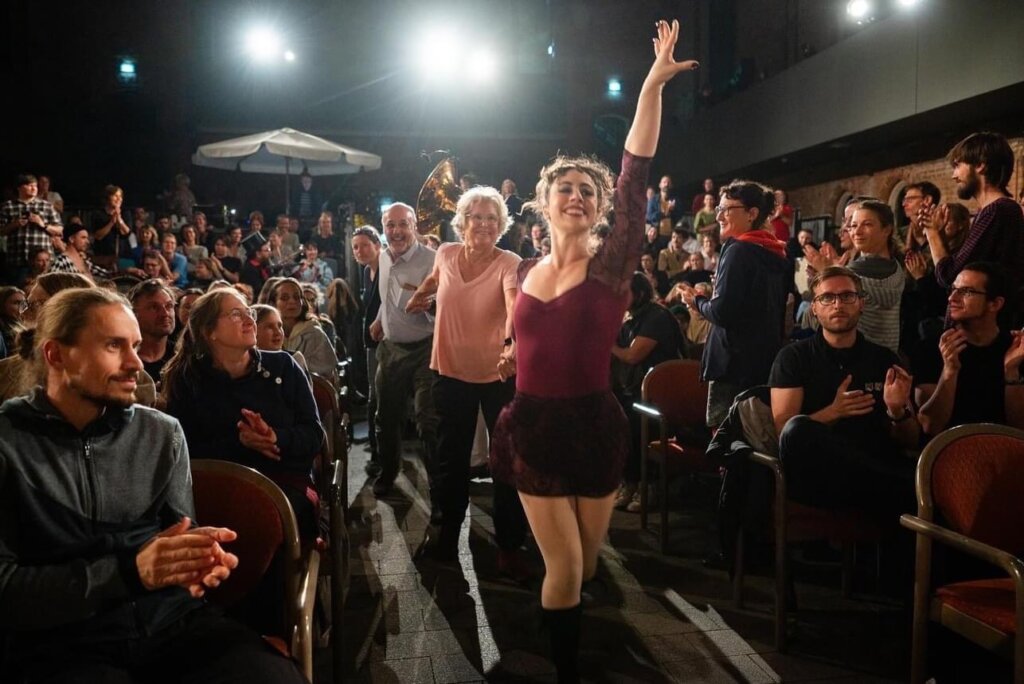
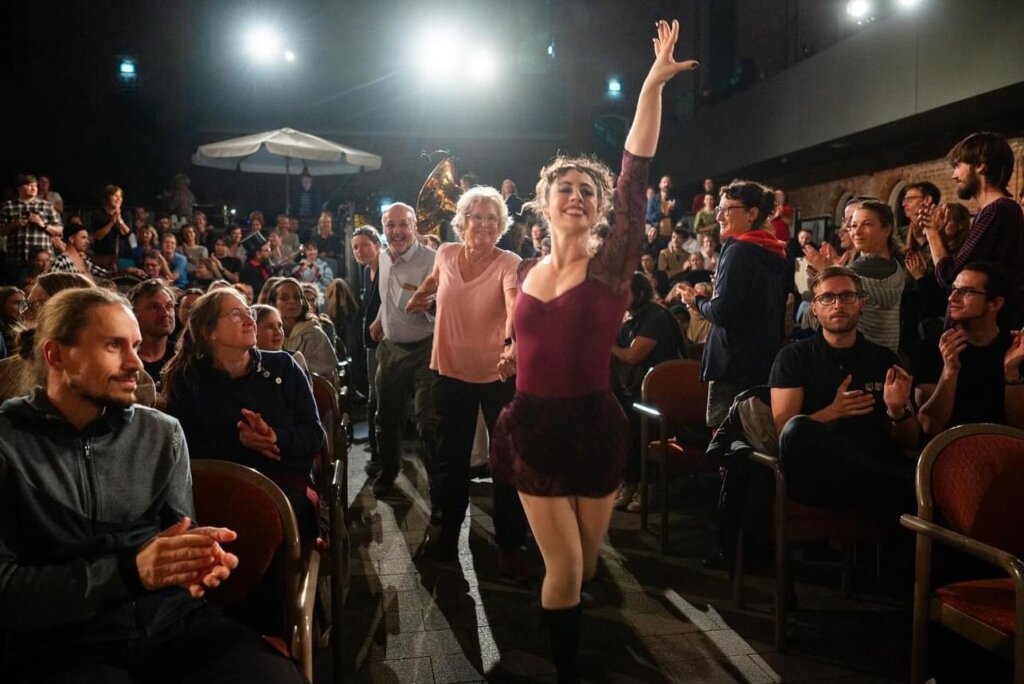
As Tsirk Dobranotch celebrates its third year, it’s clear that audiences have come to love the show, as seen by their cheers and standing ovations. Many audience members even join in the dance leading the troupe offstage after the show.
As the company plans a new show for 2026, their fans can only guess what they’ll continue to unpack from their suitcases.
The post A Yiddish circus in a suitcase appeared first on The Forward.
Uncategorized
Katz: ‘Israel’s Goal in Lebanon is to Disarm Hezbollah’

Then-Israeli transportation minister Israel Katz attends the cabinet meeting at the Prime Minister’s office in Jerusalem, Feb. 17, 2019. Katz currently serves as the foreign minister. Photo: Sebastian Scheiner/Pool via REUTERS
i24 News – Israel’s Defense Minister Israel Katz held a situation assessment Friday with senior military and defense officials, reiterating that the country’s policy in Lebanon remains focused on disarming Hezbollah by military and political means. Katz emphasized that the goal applies “regardless of the Iran issue” and pledged continued protection for Israeli northern communities.
Katz said the Israel Defense Forces are completing ground maneuvers up to the anti-tank line to prevent direct threats to border towns. He outlined plans to demolish houses in villages near the border that serve as Hezbollah outposts, citing previous operations in Rafah and Khan Yunis in Gaza as models.
The Defense Minister added that the IDF will maintain security control over the Litani area and that the return of 600,000 residents of southern Lebanon who had evacuated north will not be permitted until northern communities’ safety is ensured. Katz also reaffirmed that the IDF will continue targeting Hezbollah leaders and operatives across Lebanon, noting that 1,000 terrorists have already been eliminated since the start of the current campaign.
“We promised security to the northern towns, and that is exactly what we will do,” Katz said. He further warned that the IDF will act decisively against rocket fire from Lebanon, stating that Hezbollah “will pay heavy prices.”
Uncategorized
Pope Leo Urges Israel’s Herzog to End Iran War in Phone Call, Vatican Says

Pope Leo XIV delivers a homily during the Palm Sunday Mass in Saint Peter’s Square at the Vatican, March 29, 2026. Photo: REUTERS/Remo Casilli
Pope Leo spoke on the phone with Israeli President Isaac Herzog on Friday and urged him to “reopen all paths of dialogue” to end the Iran war, the Vatican said.
The pope, who has emerged as a sharp critic of the regional conflict, also urged Herzog to protect civilians and promote respect for international and humanitarian law, the Vatican added.
Uncategorized
Iran Leaders Join Crowds on Tehran’s Streets to Project Control in Wartime

Iranians gather at a park on Nature Day, amid the U.S.-Israeli conflict with Iran, in Tehran, Iran, April 2, 2026. Photo: Majid Asgaripour/WANA (West Asia News Agency) via REUTERS
After more than a month of being stalked by targeted assassinations, Iran’s leadership has adopted a new tactic to show it is still in control – with senior officials walking openly in the streets among small crowds who have gathered in support of the Islamic Republic.
In recent days, Iran’s president and foreign minister have separately mixed with groups of several hundred people in central Tehran. On Tuesday, state television aired footage of the two posing for selfies, talking to members of the public and shaking hands with supporters who had gathered in public areas.
According to insiders and analysts, the appearances are part of a calculated effort by Iran’s theocratic leadership to project resilience and authority — not only over the vital Strait of Hormuz but also over the population — despite a sustained US-Israeli campaign aimed at “obliterating” it.
One insider close to the hardline establishment said such public outings are intended to show that the Islamic Republic is “unshaken by strikes and that it remains in control and vigilant” as the war grinds on.
The US-Israeli war on Iran began on February 28 with the killing of veteran Supreme Leader Ayatollah Ali Khamenei and several senior military commanders in waves of strikes that have since continued to target top officials.
Iran’s new Supreme Leader, Mojtaba Khamenei, has not been seen in public since taking over on March 8 from his father. Foreign Minister Abbas Araqchi, meanwhile, was removed from Israel’s hit list amid mediation efforts last month, including by Pakistan, to bring Tehran and Washington together for talks to end the war.
Talks aimed at ending the war have since appeared to have petered out, as Tehran brands US peace proposals “unrealistic.” Against that backdrop, recent public appearances by President Masoud Pezeshkian and Araqchi appear designed to project defiance, if not a convincing display of public support.
A senior Iranian source said officials’ public presence demonstrates that “the establishment is not intimidated by Israel’s targeted killing of top Iranian figures.”
Asked whether Iran’s foreign minister or president were on any sort of kill list, an Israeli military spokesperson, Nadav Shoshani, said on Friday he would not “speak about specific personnel.”
NIGHTLY RALLIES TO SHOW RESILIENCE
Despite widespread destruction, Tehran appears emboldened by surviving weeks of intense US-Israeli attacks, firing on Gulf countries hosting US troops and demonstrating its ability to effectively block the Strait of Hormuz.
On Wednesday, US President Donald Trump vowed more aggressive strikes on Iran, without offering a timeline for ending hostilities. Tehran responded by warning the United States and Israel that “more crushing, broader and more destructive” attacks were in store.
Encouraged by clerical rulers, supporters of the Islamic Republic take to the streets each night, filling public squares to show loyalty even as bombs rain down across the country.
Analysts say the establishment is also seeking to raise the “political and reputational” cost of the strikes at a time when civilian casualties are deeply disturbing for Iranians.
Omid Memarian, a senior Iran analyst at DAWN, a Washington-based think tank, said the decision to send officials into gatherings reflects a layered strategy, including an effort to sustain the morale of core supporters at a moment of acute pressure.
“The system relies heavily on this base; if its supporters withdraw from public space, its ability to project control and authority weakens significantly,” Memarian said.
Speaking to state television, some in the crowds voice unwavering loyalty to Iran’s leadership; others oppose the bombing of their country regardless of politics; and some have a stake in the system, including government employees, students and others whose livelihoods are tied to it.
Hadi Ghaemi, head of the New York-based Center for Human Rights in Iran, said the establishment is using such loyal crowds as human shields to raise the cost of any assassination attempts.
“By being in the middle of large crowds they have protections that would make Israeli-American attacks against them very bloody and generate sympathy worldwide,” he said.
POTENTIAL PROTESTERS STAY OFF STREETS AT NIGHT
The Islamic Republic emerged from a 1979 revolution backed by millions of Iranians. But decades of rule marked by corruption, repression and mismanagement have thinned that support, alienating many ordinary people.
While there has been little sign so far of anti-government protests that erupted in January and abated after a deadly crackdown, the establishment has adopted harsh measures – such as arrests, executions and large-scale deployment of security forces – to prevent any sparks of dissent.
Rights groups have warned about “rushed executions” during wartime after Iran hanged at least seven political prisoners during the war.
“Many potential protesters are frightened by the continuing presence of armed men and violent crowds in the streets and largely stay at home once darkness falls,” Ghaemi said.