



Uncategorized
After blue wave, Texas Democrats plan to ‘keep the church’ out of the classroom

Few states have pushed as aggressively as Texas to infuse Christianity into public schools. Texas requires public school classrooms to display the Ten Commandments, mandates a statewide reading list that includes Bible passages, and approved a curriculum called Bluebonnet Learning that incorporates Biblical references into math and history lessons.
But the midterm elections, which produced the biggest Democratic victory in Texas in more than three decades, put the future of those policies in doubt.
Democrats now hold the majority in the Texas state house and on the Texas State Board of Education. Democratic Gov.-elect Gina Hinojosa has said she plans to replace Mike Morath, the state’s education commissioner who championed the Bluebonnet curriculum, on Jan. 19, 2027, her first day in office.
“In states like Texas, we can safely say that voters rejected Christian nationalism,” Rachel Laser, president and CEO of Americans United for the Separation of Church and State, told the Forward.
The results dealt a blow to some of the state’s most prominent lawmakers who defended incorporating Christianity into public schools — including Candy Noble, a four-term Republican incumbent in the Texas state house who had sponsored the bill requiring classrooms to display the Ten Commandments. Democrat Angie Carraway defeated Noble in a tight race with 50.8% percent of the vote.
“I’m hoping that the turnout of the last election will right the ship,” Carraway told the Forward. “Some of these things that have been going terribly will turn back the other way.”
Christian curriculum
Lisa Epstein, director of Jewish Community Relations for the Jewish Federation of San Antonio, has testified twice before the Texas State Board of Education to express concern about how the Bluebonnet curriculum teaches students about religion.
Bluebonnet, developed by the Texas Education Agency in 2024, incorporates Biblical references across multiple subjects — and drew criticism from several Texas Jewish groups for prioritizing Christianity at the expense of other religions.
“It made it sound like these things were facts, that Christianity was fact, that Jesus was the Messiah. Instead of teaching kids that these were beliefs,” Epstein told the Forward. “That’s when things started to take off as far as the advocacy that we felt we needed to do for Jewish families — because in San Antonio, most of our Jewish families are in public schools.”
Adopting Bluebonnet was optional, but it came with a financial incentive: School districts that adopted the curriculum were allocated an extra $20 per student. Roughly a quarter of Texas school districts signed up to use Bluebonnet.
But now, Epstein said she hopes that both the curriculum and financial incentive could be rolled back. By a majority vote, the State Board of Education could call for a review of the Bluebonnet curriculum. Alternatively, the board could vote to change required curricular standards, triggering a process to revise the materials.
A separate state initiative has raised similar concerns. In June, the board approved a required statewide reading list, scheduled to take effect in 2030. The list includes passages from the Old and New Testaments, as well as Christian parables for elementary schoolers. First graders, for example, read the picture book Jonah and the Whale.
“Stories that were written by Christian publishing houses, that are really just things you would read in a Sunday school,” Epstein said. “So there were a lot of problems that we saw for Jewish families.”
But with its new Democratic majority, the state board could also vote to revise the reading list, including by removing or replacing individual books.
Several newly elected board members have indicated that revisiting curriculum will be a priority.
“We’ve been running with that as a day one promise,” Democrat Dana Van de Walker, who was just elected to the state Board of Education, told the Houston Chronicle earlier this month. “We’re really committed to keeping the church out of our state.”
The Ten Commandments
It may prove more difficult to roll back the law that requires the Ten Commandments to be displayed in classrooms. Because the mandate was enacted into law, any effort to repeal it must also come from the legislature.
But it’s not clear that Texas Democrats have the votes. While Democrats have a 16-seat majority in the state House, Republicans retain a seven-seat majority in the state Senate.
Still, Carraway told the Forward she is drafting a bill to repeal the Ten Commandments law for when she takes office in the state House in January 2027. In the Texas Senate, meanwhile, state Sen. José Menéndez, a Democrat from San Antonio, has already filed a bill to repeal the classroom-display requirement.

For Carraway, the repeal effort is partly symbolic.
“I just think it sends a good message,” Carraway told the Forward. “Because my opponent is the one who authored the bill for the Ten Commandments, so I feel it’s a good message to start with a clean slate and try to undo that legislation.”
At the same time, the blue wave has the potential to impact ongoing litigation over the law. In July 2025, several Texans — including lead plaintiff Rabbi Mara Nathan of Temple Beth-El in San Antonio — filed a lawsuit challenging the constitutionality of the Ten Commandments law, arguing that it violated the First Amendment.
But incoming Democratic Texas Attorney General Nathan Johnson told CBS News in April that he would not defend the law requiring Ten Commandments in classrooms “because it’s unconstitutional.” If Texas still intends to defend the law, Johnson said, the state will need to hire private, outside attorneys.
That gives Carraway, a middle school social studies teacher in Collin County, Texas, reason for hope. Carraway told the Forward that she “will never forget” the moment the Ten Commandments were posted in her classroom last year.
The display, Carraway said, was among the reasons she decided to run for public office, as she grew increasingly frustrated by what she saw as government overreach by lawmakers who had never worked in a classroom themselves.
“I am a Christian,” Carraway told the Forward. “I just don’t think that Christianity belongs in our schools.”
The next session of the Texas State Board of Education is scheduled to begin Jan. 25.
The post After blue wave, Texas Democrats plan to ‘keep the church’ out of the classroom appeared first on The Forward.
Uncategorized
In a triumphant, life-affirming documentary, a Jewish virtuoso looks back on his astounding career
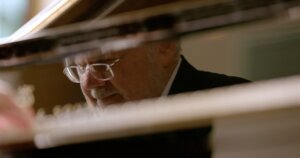
Joseph Levy’s documentary All the Music in the World, is a wonderful, loving tribute to concert pianist Emanuel Ax, an iconic figure in the world of classical performance. Devoid of airs or pretensions, Ax is a remarkably likable musician who still suffers from stage fright. He does not view himself as a “virtuoso” or “maestro.” Everyone, at least in this flick, calls him “Manny.”
Though the film grapples with the passage of time — Ax, inevitably, has been slowing down of late — it is at once triumphant, gentle and life-affirming. I loved it.
Born in 1949 in what is now Ukraine, Ax is the son of Polish Holocaust survivors who never talked about their World War II experiences, short of acknowledging that each had immediate family members who perished in concentration camps. Both his parents, who met after the war, had been married before; his mother had had a child. Ax’s father managed to escape the camps when he jumped off the train carrying him to a camp. He made his way back to his hometown and was ultimately hidden in a church by a local priest.

When Ax was six, the family moved to Warsaw, where his dad took him to the Tchaikovsky opera Eugene Onegin. Young Emanuel was transfixed. To this day he has a special affection for the opera, he says. His formal training started almost as a fluke. The family had inherited an old upright piano from earlier tenants who had abandoned the instrument in the apartment.
Ax continued his musical studies when the family emigrated to Winnipeg and later New York, where they lived across the street from Carnegie Hall. It’s an evocative scene watching him, now in his late 70s, in front of the legendary building and still viewing it with wonder.
“I heard all the greats,” Ax marvels. “I came three or five times a week. I remember in May of 1965 how the line for tickets went around the block because Horowitz was playing. My great regret is that my father was not alive to hear me play at Carnegie Hall or anywhere else except Juilliard. My mother lived to 101 and went to a lot of my concerts.”
Ax studied at Juilliard from the ages of 12 to 26. Along the way, he earned a degree from Columbia University, where he majored in French. He participated in competitions, which he abhorred and dreaded, he says. Although he won several prizes, he never got first place until the Arthur Rubinstein International Piano Master Competition in 1974. Rubinstein served as one of the judges. In addition to earning $5,000 in prize money, Ax landed engagements with the BBC Orchestra and the Israel Philharmonic and got his first recording contract.
“I knew I would never have to do another competition,” he says, sounding slightly stunned and humbled.
For more than half a century the multiple Grammy-winning pianist has played close to a hundred concerts yearly. He has made dozens of albums — some solo performances, others collaborations with such luminaries as Itzhak Perlman, Leonidas Kavakos and, most frequently, Yo-Yo Ma, with whom Ax has enjoyed a 50-year friendship and artistic collaboration.
To celebrate Ax’s 50th anniversary on the world stage, director Levy spent two years filming Ax just living his life — preparing fresh pasta with his grandchildren; conducting master classes; recording a new album; touring and performing Mozart, Chopin, Beethoven and Liszt.
The doc’s two central narrative threads feature Ax rehearsing for a premiere piano concerto that movie composer John Williams wrote for him, and a special concert at Carnegie Hall to commemorate his half-century career.
Interwoven throughout are testimonials offered by his legendary colleagues, including composers Williams and Anders Hillborg and conductors Esa-Pekka Salonen and Andris Nelsons who extol his humility, perfectionism, and artistry.
Despite all this praise, Ax says he never feels he has rehearsed enough and that whatever piece he is about to perform is the most difficult ever. He routinely suffers tremendous anxiety that his performances won’t be up to snuff. Still, he is compelled to play.
“I dream about piano all the time,” he said. “My relationship to music is all- consuming. All the music in the world exists to express what you can’t put into words.”
Besides his passion for great music, what emerges most forcefully is his compassionate nature. In his master classes there is none of the condescension or even cruelty that one sometimes witnesses in these sessions. By contrast, Ax makes modest suggestions on how a student can perhaps improve an already fine performance.
This film could easily have become claustrophobic. Much of it is set in studios and theaters. It’s to Levy’s credit that he seamlessly opens it up to nature. We frequently see Ax practicing on a stage at Skidmore College whose backdrop is a massive floor-to-ceiling window that faces a landscape awash in trees. Later Ax is seen driving through forested dirt roads in the Berkshires on his way to performing the premiere of Williams’ piano concerto at Tanglewood.
Perhaps Levy, who was at one time a cellist himself, is suggesting that great music and pastoral scenes are somehow connected if not synonymous. Either way, the visuals offer a welcome counterpoint to the many enclosed spaces.
The sections featuring Ax and Ma rehearsing or engaging in post-rehearsal analysis are especially delightful. The two met at Juilliard when Ax was about 20 and Ma was 15. Their long-term mutual affection is evident as Ax picks nonexistent pieces out of Ma’s hair and Ma, grinning, teasingly provokes Ax about his performance being too slow.
Ax also met his wife Yoko, a pianist too, when they were students at Juilliard. Their beginning was not auspicious. In fact, on their first date, she brought along a friend. “I didn’t know it was a date,” she says. In the end, Ax’s persistence paid off and they have now been married for more than 50 years and have two adult children. The time spent away from home has been challenging for everyone in many ways, not least Ax’s inability to help with, well, virtually everything, he admits.
The transitional moment that he’s struggling with now, and it will be seismic, is when he should step away from the limelight. His fear that he will disappoint his audience is constant. Performing new pieces has become especially arduous. Still, he can’t imagine not making music. He will always look forward to collaborating with Ma, if not for an audience, then at least for themselves.
In one of the film’s final, and most touching, scenes Ax listens to a recording of his debut concert at Carnegie Hall. His attention is fixed and intent, his expression a marriage of assessment, wonder, and nostalgia. “It’s not bad,” he said. “I’m astounded.”
All The Music in the World is screening online through Nov. 29 as part of DOC NYC festival. It is slated to be theatrically released in 2027.
The post In a triumphant, life-affirming documentary, a Jewish virtuoso looks back on his astounding career appeared first on The Forward.
Uncategorized
Mossad helped foil terrorist attack at 2024 Taylor Swift show in Vienna, former chief says
(JTA) — Mossad helped prevent an Islamic State-linked attack at a planned 2024 Taylor Swift concert at Ernst Happel Stadium in Vienna, the former chief of Israel’s foreign intelligence agency said on Monday.
David Barnea, Mossad’s director at the time, said during the ELNET Jerusalem Summit that Austrian intelligence shared a warning with Mossad ahead of the show scheduled for Aug. 9, 2024. ELNET promotes Israeli-European ties.
The Israeli agency analyzed Austria’s information to aid in the arrest of members of a suspected terrorist cell, Barnea said, adding that the arrests prevented the potential mass murder of “up to hundreds of young European men and women.”
The concert organizer Barracuda Music canceled the three back-to-back, sold-out concerts on Aug. 7, a day before Swift’s first show at the venue. Austrian national Beran A., whose last name was not shared in accordance with Austrian privacy rules, was sentenced in May 2026 to 15 years in prison after being convicted of offenses including planning the attack.
The CIA and other U.S. intelligence agencies helped disrupt the plot, then-CIA deputy director David Cohen said at the time.
This article originally appeared on JTA.org.
The post Mossad helped foil terrorist attack at 2024 Taylor Swift show in Vienna, former chief says appeared first on The Forward.
Uncategorized
In a small town in Germany, remnants of the family history my father no longer remembers
Whenever my parents travel, they like to find Jews. Living, dead — doesn’t matter. They just want to see the places their people once roamed. Send them to Greenland, and they’ll track down the tidal cavities that served as a mikveh circa 1571.
So when my brother, Ray, planned a family vacation to Croatia, we knew Jews would be involved. Zagreb, Dubrovnik, Split; we’d track down our landsmen even in the decidedly Catholic country.
But first, Ray wanted us to take a detour to Bad Soden-Salmünster, Germany, the freckle of a village outside Frankfurt where my father’s mother, Martha Ellin (née Grünebaum), grew up. Ray had visited a few years earlier and thought my parents might enjoy it. Left unspoken was that this would probably be my dad’s last trip, and that he wouldn’t understand why we were there.

At 89, my dad is a physical specimen. He walks about four miles a day, can lift 70-pound weights on the triceps machine, and jogs with the ease of a man 15 years younger. Last year he was hospitalized with pneumonia for 16 days, and the doctors said he would probably have died had he not been in such good shape. During my parents’ annual Jewish semester in Boca, my dad plays senior softball. He can hit! And catch! And run! He just can’t find the field.
His memory began quietly disintegrating years ago, but it got noticeably worse after the pandemic. The way my father tells it — and he tells it often, sometimes two or three times in a single conversation — he and my mother were sitting on a bench in Manhattan when suddenly something flew out of his body, something yellow, and hit a wall across the street. When that happened, he became a tabula rasa.
“Everything I knew went away,” he said.
Years of his life vanished. He has no idea how his oldest daughter died, that his brother was murdered, that he met my mother at Grossinger’s 62 years earlier. He does not recall that he worked as an engineer at Polaroid, designing cameras and the flash for the SX-70. He forgets that he loved to take things apart just for the joy of putting them back together.
Somehow, he can still read Hebrew. But he doesn’t really understand what things mean. (To be fair, does anyone?) A sukkah? “That’s a place where Jews hang out,” he told me recently. Technically true, I suppose, but not quite what I was angling for.
He is no longer familiar with Netanyahu, but he does know Hitler and Trump, with whom he “interfaced” a few years ago. (Nota bene: He did not.)
He knows he had parents, obviously, but the specifics are gone. He did not realize that they left Russia and Germany because, well, conscription and pogroms weren’t good for the Jews. My grandparents met in what was then Palestine and my dad was born in Herzliya in 1937. The family moved to a farm in Connecticut when he was 6 months old. My grandfather became a carpenter, and my grandmother ran the show. She was one of those 4’8” balabustas who could go blow for blow with Max Schmeling, and win. Almost all of her family was wiped out during the war, but she forced herself to watch Shoah. “It’s my duty,” she said, which meant it was mine, too. We watched it together.
Over the years I offered to take her back to her hometown, but she didn’t think she could handle it. “It would be too hard,” she said, and she looked so sad that I didn’t push it. I didn’t understand it then, but I do now. She often talked about her family: her father, Alexander Grünebaum, a leader of the Salmünster Jewish community; her evil stepmother, Emilie, who made her sweep the stairwell every day; her sister, Sophie, killed in a hit-and-run at 15; her brothers Isidore and Manfred-Jacob, both killed in camps. Who wants to visit a place filled with ghosts?
My grandmother died of a stroke at 88, the same age my father was when we brought him to Germany. Her memory was shot, too. One of the last things she asked was, “What is Jewish?”

My brother and I weren’t expecting much from our trip. No, that’s not true. We hoped for some kind of emotion from our dad, maybe a sliver of clarity, but nothing too dramatic. Just an acknowledgment that this was his mother’s birthplace, and that relatives he never knew had lived here, too.
Ray had befriended Thomas Hummel, a tidy Salmünsterian who spoke flawless English. Like most young people, Thomas had left the town; there was nothing there for them. He worked in Frankfurt as a civil servant but was highly invested in preserving local history.
Thomas walked us through the village (pop 14,000-ish), now a spa town with bubbling baths, hot stone massages, hiking trails, and a few boutique hotels. “Growing up in Salmünster, I was always aware that the town once had a vibrant Jewish community dating back to 1750,” he said.
Thomas had resistance in his bones. His great-grandfather, Franz Göbel, loathed the Führer. According to Hummel family lore, on the day Hitler was supposed to pass through Salmünster, Franz positioned an ox cart loaded with manure on the road where the motorcade would pass. Officials ordered him to remove the cart, but he wouldn’t budge.
“My great-grandfather calmly replied that he could not move the cart because the oxen simply refused to go any further,” Thomas said. So the soldiers unharnessed the oxen and replaced them with horses and pulled the cart away themselves. “The road was eventually cleared, but not before my great-grandfather had made his point.”
I’ve heard stories like this, or variations of them, so many times, and they always make me laugh. If every German had resisted the Nazis as much as they claim to have done, then the Holocaust would never have happened. (I’ve only met one person, a German living in Brazil, who, when asked what his ancestors did during the war, replied, “You know…” I appreciated his candor.)
But Thomas was lovely and seemed sincere; he spent a lot of time with us at no charge. He showed us my grandmother’s home at Frankfurter Straße 10, where my great-grandfather operated a department store. It now housed a nonprofit aid organization. And we saw the infamous wooden stairwell my grandmother scrubbed, which looked surprisingly like … a stairwell.
Around the corner was the Heritage museum, furnished to resemble a home from the early 20th century. Wooden hangers with the original Grünebaum logo were mounted on the wall along with other tchotchkes.
My dad was underwhelmed. “It’s a nice town,” he said with a shrug. But he felt no kinship. All he wanted to know was why we weren’t in Florida where he could play ball, and when we were going home. He had also left his hearing aid charger in the States, which meant he was navigating in silence. Whose idea was this trip, anyway?
We trekked to a two-story, timber-frame structure that had once been the synagogue. Erected in 1846, it served the community until Nov. 10, 1938, otherwise known as Kristallnacht. The SS gutted it, but because a non-Jewish family had bought the adjacent half of the semi-detached structure, the Nazis graciously refrained from burning the building down. It now housed the city’s Social Welfare Office.
Apart from a menorah on a bookshelf and a view of the stream that fed the mikveh, nothing about the place screamed Jewish. A painting of the Virgin Mary cradling baby Jesus was prominently displayed in the former women’s section. “I’m pretty sure that wasn’t on the wall when Grandma davened here,” said Ray.
Our last stop was the Jewish cemetery, tucked into the woods off a main thoroughfare. There were no signs or markers; just a few concrete steps in a thicket of brush. It was slightly uphill and muddy, the weeds tickling our shins. My father zipped up like it was nothing.
We hiked to an overgrown clearing with a cement pillar bearing the names of seven people buried there between 1920 and 1935, including my grandmother’s sister Sophie. Only two original headstones remained. Thomas had brought pebbles for us to set on the graves and pillar.
“OK,” my dad said, turning to walk back down the hill. “Let’s go.”

On our second and last day in Salmünster, we stood outside my grandmother’s old house. The mayor, Dominik Brasch, had shown up for a photo op, along with a reporter from a local newspaper. They wanted to document the American Jews in their midst.
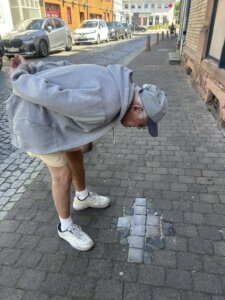
We posed in front of the Stolpersteine embedded into the sidewalk, the “stumbling blocks” that mark the last known residences of people persecuted by the Nazis. This included not only Jews, but also gays, Romani, political opponents, and those with disabilities.
The brass-plated plaques were created by artist Gunter Demnig and surreptitiously placed in Cologne in 1995 before gaining official approval. Today, more than 116,000 have been installed across Europe. Each one is engraved with the victim’s name, birth date, and, if known, the date and place of their deportation or murder.
The stones are supposed to be obstacles, designed to stop people in their tracks. If they don’t quite cause a stubbed toe, they at least prompt passersby to look down and acknowledge the person being remembered.
But apparently not everyone is on board. In late September, the right-wing city council of Heidenau, near Dresden, passed a motion to ban new Stolpersteine on its streets and sidewalks. The vote, by secret ballot, was 13 to 6, with one abstention.
Council members argued that it was “disrespectful” to tread on victims’ names. The five plaques already in Heidenau could stay, but future remembrance would be relegated to a Christian cemetery where it would be “impossible to step directly onto the memorial elements.”
Thomas disagreed. He had done research for the Stolpersteine project, tracing family histories and digging up archival records, and he supported the mission. “The stones return memory to the very locations from which it was once erased,” he said. “In my view, the fact that passersby stop, read, and reflect is not a weakness of the concept but its greatest strength. That direct connection between biography and place is something I have seen work remarkably well in Salmünster.”
I didn’t expect any of this to register with my dad. But for whatever reason, something clicked. He peered down at the three rows of tiles until his eyes settled on one: “Martha Grünebaum, born 1907, fled to Palestine in 1933 and then to America in 1937.”
“That’s Grandma!” I said.
“Isn’t that something?” my dad said. He crouched down like a shortstop fielding a ground ball. “She must have been very important to have her name on the sidewalk.” He positively kvelled.
Neither my brother nor I had the heart to tell him that the Stolpersteine were all over the country, that his mother wasn’t, unfortunately, unique in this way. We didn’t tell him that the names on the stones next to hers belonged to his ancestors, almost all of whom were annihilated in the camps.
My mother, who is 85 and completely compos mentis, frequently talks about her deceased relatives, mourning them aloud. When I compare my parents, I think, maybe my dad’s better off. Maybe it’s better to be physically fit and mentally addled, to forget the aunts and uncles you never met, the grandparents you never knew. I’m still not sure.
Six months later, my dad doesn’t remember our trip. But he does remember seeing his mother’s name on a brass-plated plaque somewhere. “I have no idea how it got there, what the motive was, or what the reason was,” he said.
I often think about the sidewalk outside my grandmother’s home, and the nine plaques embedded in the pavement out front. I think about my father, who interpreted his mother’s name as an honor. How the only tie he felt to her was from a 4-inch cube. How sometimes the heart processes what the mind can’t.
But mostly I think about how happy he was that his mother was celebrated in such a public way. This I know because he said so himself.
“She must have really been an upstanding citizen,” he said at the time. “I’m glad I planned this trip.”
The post In a small town in Germany, remnants of the family history my father no longer remembers appeared first on The Forward.
