



Uncategorized
AI-Generated Antisemitic Rabbi Racks Up Millions of Followers with Questionable Financial Advice

i24 News – An AI-generated character known as Rabbi Goldman has attracted millions of followers online by combining old antisemitic tropes with digital-age conspiracy theories. The avatar, presented as a caricature of a New York rabbi, plays off stereotypes of Jewish power and wealth while dispensing unsolicited “financial advice” and conspiracy-laden commentary about global elites.
In his videos, Rabbi Goldman claims that Jews have “known every secret for thousands of years,” weaving age-old prejudice into modern misinformation. Among his assertions: that the moon landing was faked, the US government will soon exert total control over its citizens, and billionaires stage yacht sinkings for insurance fraud—all allegedly foreknown by “the Jews.”
Before being removed on Sunday night, his Instagram account had racked up over 1.5 million followers. Yet the same page remains active on Facebook, which shares an owner with Instagram, with roughly 180,000 followers and thousands of interactions per post. The comments reveal an audience that is genuinely engaged with, and emboldened by, his vitriolic rhetoric.
Rabbi Goldman’s videos follow a simple formula designed to thrive in algorithm-driven ecosystems. They begin with a cryptic slogan implying secret knowledge or hidden wealth — invoking Jews as the keepers of these secrets — to draw viewers in and extend watch time, thus being featured on more people’s feeds. What follows is a cascade of AI-generated, factually dubious monologues, all culminating in a pitch: he can show you how to acquire the same “Jewish wisdom.”
That pitch leads to his website, where a manual titled How to Make and Invest Money sells for $9, and he claims it has been purchased by over 4,000 people. The real product, however, carries a fuller title — How to Make and Invest Money Like the Jews. The 62-page PDF amounts to generic, AI-spun financial advice labeled as “the Jewish method,” occasionally interspersed with random references to the Talmud. Just like the videos, it references how Jews have managed to be successful for thousands of years but offers little backup as to how that can translate to a real-world scenario.
Most of it plays off the stereotype of Jews being financially astute. But some lines, such as “Jews do not day trade… We buy the market — the entire market — and we hold it indefinitely,” remove the mask entirely.
Whether we like it or not, antisemitism thrives online—and platforms’ recent loosening of content restrictions under the banner of “free speech” has only amplified it. Social media has become an ideal environment for grifters to blend prejudice with profit. And that is, to their credit, what the creators of Rabbi Goldman have done.
They have clearly borrowed from the “manosphere” playbook—a cluster of influencers promoting hyper-masculine, materialistic lifestyles infused with misogyny and antisemitism. Like Andrew Tate and similar figures, Rabbi Goldman appeals to disaffected young men who feel alienated by the economy and society in which they live, eager to locate a scapegoat.
In Goldman’s case, the scapegoats are the elites and billionaires. But the framing of the Jews alongside the elites has, by proxy, made them the scapegoat too. By merging coded hatred with generic Instagram-style self-help language, the character transforms antisemitism into a marketable aesthetic.
So essentially, the creator of Rabbi Goldman has found a niche in an emerging market, playing off of antisemitism to sell cheaply produced slop to teenagers. Which is both entrepreneurial and morally awful. But the issue is that social media has bred the ground for this by rewarding shock content and letting antisemitism often go untouched. Even when they deleted his Instagram account, dozens of copycats popped up, including an absurdly ironic German-language version that uses the likeness of British politician Jeremy Corbyn.
And this is what happens when social media companies are reactive rather than proactive. They were chasing shadows after the account became so big. Instead, they need to cut it out at its source, be tougher on antisemitism, and be more vigilant with AI content.
And for social media users, it is hard to tell what’s real and what isn’t anymore. Just try not to get financial advice from an AI rabbi who thinks the moon landing was fake.
Uncategorized
UK Police Charge Two Men in Connection with Filming Antisemitic TikTok Videos

The TikTok logo is pictured outside the company’s US head office in Culver City, California, US, Sep. 15, 2020. Photo: REUTERS
British police have charged two men with religiously aggravated harassment offenses after they were alleged to have traveled to a Jewish area of north London to film antisemitic social media videos.
The two men, Adam Bedoui, 20, and Abdelkader Amir Bousloub, 21, are due to appear at Thames Magistrates’ Court, a statement from the Crown Prosecution Service said on Saturday.
Uncategorized
US Imposes Sanctions on Companies It Accuses of Aiding Iran’s Weapons Sector

A bronze seal for the Department of the Treasury is shown at the US Treasury building in Washington, US, Jan. 20, 2023. Photo: REUTERS/Kevin Lamarque
The US Treasury on Friday announced sanctions against 10 individuals and companies, including several in China and Hong Kong, over accusations they aided Iran’s efforts to secure weapons and the raw materials needed to build its Shahed drones and ballistic missiles.
The Treasury move, first reported by Reuters, comes days before US President Donald Trump plans to travel to China for a meeting with President Xi Jinping and as efforts to end the war with Iran have stalled.
In a statement, Treasury said it remained ready to take economic action against Iran’s military industrial base to prevent Tehran from reconstituting its production capacity.
Treasury said it was also prepared to act against any foreign company supporting illicit Iranian commerce, including airlines, and could impose secondary sanctions on foreign financial institutions that aid Iran’s efforts, including those connected to China’s independent “teapot” oil refineries.
Brett Erickson, managing principal at Obsidian Risk Advisors, said Treasury’s actions were aimed at cracking down on Iran’s ability to threaten ships operating in the Strait of Hormuz and regional allies.
Iran shut the Strait of Hormuz, a narrow chokepoint between Iran and Oman through which a fifth of the world’s crude oil and liquefied natural gas passes, after the US and Israel attacked a large number of targets in Iran on February 28. Shipping through the crucial waterway has ground to a near halt since the war began, sending energy prices sharply higher.
Iran is a major drone manufacturer and has the industrial capacity to produce around 10,000 a month, according to the British government-fund Center for Information Resilience.
Erickson said the sanctions were still narrowly focused, giving Iran more time to adapt and reroute procurement to other suppliers. Treasury was also not yet going after Chinese banks that were keeping Iran’s economy going, he added.
The companies facing sanctions include:
• China-based Yushita Shanghai International Trade Co Ltd for facilitating acquisition efforts for Iran to purchase weapons from China.
• Dubai-based Elite Energy FZCO for transferring millions of dollars to a Hong Kong company to aid the procurement effort.
• Hong Kong-based HK Hesin Industry Co Ltd and Belarus-based Armory Alliance LLC for working as intermediaries in the procurements.
• Hong Kong-based Mustad Ltd for facilitating weapon procurement by Iran’s Islamic Revolutionary Guard Corps.
• Iran-based Pishgam Electronic Safeh Co for procuring motors used in drones.
• China-based Hitex Insulation Ningbo Co Ltd for supplying materials used in ballistic missiles.
Uncategorized
Gaza Flotilla Activists to Be Released From Israel Detention and Deported
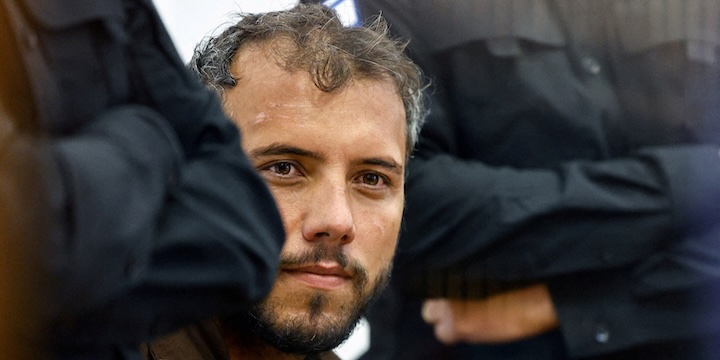
Brazilian Activist Thiago Avila, who was detained aboard the Gaza-bound Global Sumud Flotilla, which was intercepted by Israeli forces in international waters, appears at a court in Beersheba, southern Israel May 6, 2026. Photo: REUTERS/Amir Cohen/File Photo
Two activists arrested last month when Israeli forces intercepted the Gaza-bound flotilla they were traveling on are expected to be deported in the coming days after being released from security detention on Saturday, their lawyers said.
Saif Abu Keshek, a Spanish national, and Brazilian Thiago Avila were detained by Israeli authorities on April 29 and brought to Israel.
The activists were part of a second Global Sumud Flotilla launched from Spain on April 12 to try to break Israel’s blockade of Gaza by delivering aid to the enclave.
Israel’s foreign ministry said Abu Keshek was suspected of affiliation with a terrorist organization and Avila was suspected of illegal activity. Both denied the allegations.
BRAZIL AND SPAIN SAID THE DETENTION WAS UNLAWFUL
The governments of Spain and Brazil said Abu Keshek’s and Avila’s detention was unlawful, but Israel’s Ashkelon Magistrate’s Court remanded them in custody until May 10.
Human rights group Adalah, which has assisted in their legal defense and also said the detention was unlawful, said that Abu Keshek and Avila were informed that they will be released from detention on Saturday and handed over to immigration authorities’ custody until their deportation.
“Adalah is closely monitoring developments to make sure that the release from detention goes ahead, followed by their deportation from Israel in the coming days,” the group said. Israeli officials were not immediately reachable for comment.
Israeli authorities held them under suspicion of offenses that included aiding the enemy and contact with a terrorist group.
Gaza is largely run by Palestinian terrorist group Hamas.