



Uncategorized
Al Jazeera Center for Studies: Academic Veneer Normalizing Terrorism

The Al Jazeera Media Network logo is seen on its headquarters building in Doha, Qatar, June 8, 2017. Photo: REUTERS/Naseem Zeitoon
Is Al Jazeera using its “academic” arm, the Al Jazeera Center for Studies (AJCS), to normalize Hamas’s atrocities, while hiding behind the veneer of a purportedly rigorous research institution? From Feb. 7 to 9, an AJCS-sponsored forum in Doha, Qatar, gave pride of place to figures such as Hamas leader Khaled Meshal under the banner of academic discourse.
AJCS is one of at least a dozen parts of the Al Jazeera Media Network’s ecosystem, funded and run by the Qatari ruling family, and used as soft power tools to amplify anti-Western and pro-Islamist narratives. Established to provide research support to Al Jazeera’s news channels, AJCS also serves to integrate the network into academic spheres. Those connections allow AJCS to enjoy a patina of academic credibility to launder and legitimize the violent ideas espoused by figures like Meshal and Iran’s Foreign Minister Abbas Araghchi.
When Meshal spoke in Doha, he justified Hamas’s October 7, 2023, massacre in Israel by calling it legitimate “resistance.” Hamas has ruled Gaza since 2007. The US Justice Department announced terrorism and murder conspiracy charges against Meshal for his central role in the Oct. 7 atrocities in 2024.
Araghchi had a different agenda: deflecting attention away from the thousands of Iranians slaughtered by his regime in recent weeks in the deadliest massacre since the country’s 1979 revolution. Araghchi used his remarks to call “Palestine … a test of whether international law has meaning, whether human rights have universal value.” There was no pushback from the moderator about this ironic call for justice.
Past speakers at the conference include Hamas officials Osama Hamdan and Basem Naim. Hamdan was placed on the Specially Designated Global Terrorist (SDGT) list by the US Treasury after a Hamas suicide attack in Jerusalem killed 23 people and injured 130 others in 2003. Hamdan facilitated training for a key planner of the 1996 Jaffa Road bus suicide bombings that killed 45 commuters.
Naim’s Treasury designation noted that he “holds a leadership role on Hamas’s Council on International Relations.”
The Doha forum also gave voice to some of Al Jazeera’s co-opted correspondents, including Gaza-based Al Jazeera Arabic correspondent Ismail Abu Omar. Besides being a reporter for Al Jazeera, the Israel Defense Forces (IDF), based on documents found in Gaza, identified him as a company commander in the East Khan Younis Battalion. If true, this raises additional concerns about its reporters serving as Hamas operatives while on Al Jazeera’s payroll. Not surprisingly, the network denied the allegations.
Abu Omar filmed himself with Hamas operatives breaching Israeli kibbutzim on Oct. 7. His published accounts on Al Jazeera expressed joy at the atrocities unfolding against Israelis, telling the network that he “was filled with tears” and “experiencing the scenes that we have always heard about, live and directly.”
Abu Omar amplified Hamas military chief Mohammed Deif’s words that “everyone who has a gun should take it out, because today is the day.”
Abu Omar is a former reporter for Al-Aqsa TV, which is sanctioned by the US Treasury Department as “a television station financed and controlled by Hamas” that airs content “designed to recruit children to become Hamas suicide bombers.” When AJCS chooses its speakers, it signals what it values.
AJCS is about more than sketchy forums, of course. Its partnerships deserve scrutiny too. In May 2025, AJCS co-hosted a conference with the obscure but influential Strategic Council on Foreign Relations in Iran (SCFR). SCFR is the advisory board to the supreme leader of Iran, helping to shape the ayatollah’s policies around the world.
It should raise eyebrows that an ostensibly independent research arm of a media entity partners with a murderous office of Supreme Leader Ali Khamenei. By partnering with the SCFR, AJCS signals solidarity with Iran’s oppressors, not its victims.
Technically, Araghchi is a diplomat. But he gave the lie to that title at the 2024 Al Jazeera Forum when, as secretary general of SCFR, he cautioned Arab nations against diplomacy with Israel and normalizing relations with the Jewish state.
At the 2024 forum, Araghchi also said nuclear weapons “have no place” in Iran’s religious doctrine but proclaimed that Iran has the right to enrich uranium for civilian purposes. In fact, the regime has stymied international monitoring of its enrichment, sought to expand its nuclear program, and has no civilian use for its production of 60 percent enriched uranium. But there was no refutation or questioning of Araghchi’s statement when he appeared at the Al Jazeera Forum.
In 2025, AJCS co-organized a conference with Qatar’s Hamad Bin Khalifa University in order to “deconstruct Western narratives.” Reflecting Qatar’s foreign policy, Al Jazeera’s organizers charged Western media with “justifying” Israel’s right to self-defense in the face of Hamas’s atrocities. Moreover, they attacked media outlets for “false reports” about Hamas terrorists raping Israeli women, notwithstanding the evidence to the contrary.
Arafat Madi Shoukri, a senior researcher at AJCS, organized the conference. Israel designated Shoukri as a Hamas operative for his work with the Hamas-aligned Council for European Palestinian Relations (CEPR).
Shoukri has been photographed with Ismail Haniyeh, an architect of the Oct. 7 massacre. He also directed the London-based Palestinian Return Center (PRC), which former Israeli Defense Minister Ehud Barak declared an illegal Hamas-affiliated organization that engages in terror-affiliated activities.
That conference featured as its keynote speaker Wadah Khanfar, a former director general of Al Jazeera. According to the Palestinian outlet Raya Media Network, Khanfar was “active in the Hamas movement” and a “leader in the movement’s office in Sudan.”
In May 2024, Khanfar praised Hamas’s Oct. 7 terrorist attack, proclaiming it “came at the ideal moment for a radical and real shift in the path of struggle and liberation.”
Mutaz al-Khatib, from Hamad Bin Khalifa University’s College of Islamic Studies, spoke at the conference on “professional ethics” in war coverage. On October 7, 2023, he posted on Facebook that “what happened was merely a rehearsal that shows that liberating Jerusalem is possible.”
Fatima Alsmadi, a researcher at the Al Jazeera Center for Studies, lectured that Israel has somehow “benefited” from Nazism in the aftermath of its extermination of European Jewry. She praised Al Qassam Brigade spokesperson Abu Obaida’s propaganda techniques that had “a specific goal to link Israel to the Nazis” and were “not arbitrary,” “done in stages,” and “well thought out.” Weaponizing Nazi imagery against Israel legitimizes Hamas terrorism and inverts historical truth.
AJCS’s Journal for Communication and Media Studies adheres to the same editorial approach as its conferences. A January 2026 journal article relies on quotes from the International Association of Genocide Scholars (IAGS), a discredited group that requires no expertise to have voting rights, as evidenced by Emperor Palpatine, the villain of the Star Wars franchise, and similar non-experts joining as members. This is important because IAGS touted a resolution it represented as “a definitive statement from experts in the field of genocide studies” that what is happening on the ground in Gaza is genocide.
Al Jazeera and AJCS have two personas. One is radical and platforms Hamas and Islamists like the late Yusuf Qaradawi, the most influential cleric aligned with the Muslim Brotherhood, whose show “Shariah and Life” was on the news channel for 17 years. The other is slick and partners with big tech to leverage modern technology throughout the newsroom, in the field, and online that, in turn, amplifies Islamists and Qatari foreign policy.
AJCS operates under strict Qatari media laws that prohibit criticism of the tiny Persian Gulf nation’s emir and Doha’s policies. Freedom House has rated Qatar “Not Free” for 27 years. Al Jazeera as a whole seeks to appeal to Western sensibilities by crafting a public-facing image of an independent institution that it says “aims to present a balanced understanding” of the Middle East and the Arab world. AJCS has not lived up to any standard of scholarship.
The glitz of Al Jazeera’s flashy conference and global reach should not distract from the perils of treating the Al Jazeera ecosystem like a neutral entity, untethered to a foreign authoritarian state’s policies.
US government agencies should investigate whether Al Jazeera or its center, or others on its behalf, have paid any expenses or provided material support associated with Hamas officials’ participation in any of its programming. If investigators discover such connections, appropriate sanctions, fines, or other measures should be taken.
Likewise, the US Department of Education should assess whether any American educational institutions have partnerships with AJCS.
Congress and the Justice Department should assess if the center’s actions should be disclosed under the Foreign Agents Registration Act. The Justice Department has already determined that other parts of AJMN must register as Qatari foreign agents.
Until Doha stops using any part of the Al Jazeera Media Network to whitewash terrorism, American institutions and companies need to reconsider their relationship with all platforms in its vast ecosystem. Continued collaboration from Western organizations only emboldens the next denials and justifications for violence.
Toby Dershowitz is a senior adviser at the Foundation for Defense of Democracies (FDD), on whose website this article first appeared. Eitan Fischberger is an independent OSINT investigator. Follow Toby on X @tobydersh. Follow Eitan on X @EFischberger. Follow FDD on X @FDD. FDD is a Washington, DC-based, nonpartisan research institute focusing on national security and foreign policy.
Uncategorized
US, Israel Said to Plan New Iran Strikes as Tehran Pounds UAE
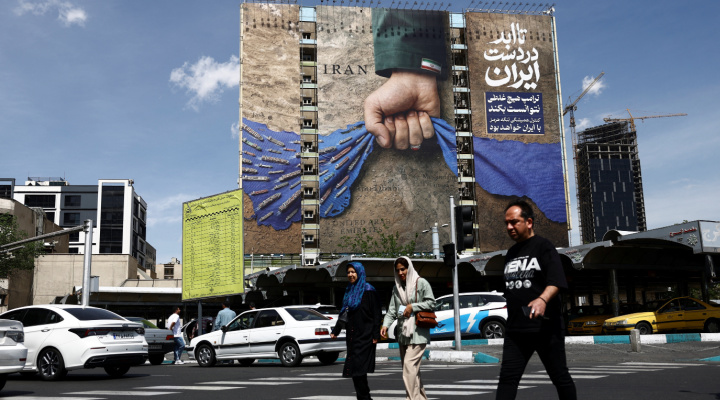
People walk past a billboard with a graphic design about the Strait of Hormuz on a building, amid a ceasefire between US and Iran, in Tehran, Iran, April 27, 2026. Photo: Majid Asgaripour/WANA (West Asia News Agency) via REUTERS
Israel and the US are coordinating plans for another round of strikes on Iranian targets, CNN reported Tuesday, as Iran kept up its attacks on the United Arab Emirates for a second straight day and amid reports that the Gulf state’s defense increasingly appeared to be drawing on Israeli support.
CNN cited an Israeli source as saying that the plans, largely drawn up before the ceasefire with Iran began in April, include strikes on Iran’s energy infrastructure and targeted killings of senior officials.
“The intention would be to carry out a short campaign aimed at pressuring Iran into further concessions in negotiations,” the source said, adding that any decision to resume the war would be made by US President Donald Trump.
CNN also reported that an Israeli-operated Iron Dome battery intercepted an Iranian missile over the UAE on Monday, the first known use of the system to defend a Gulf state. The system had been secretly deployed there at the start of the war, according to the report, along with Israel Defense Forces (IDF) soldiers sent to operate the system.
The system has so far intercepted dozens of Iranian missiles in the UAE, according to Israeli officials cited in a separate report by Axios.
The UAE said Iran fired 12 ballistic missiles, three cruise missiles, and four drones at the country on Monday. And then, according to Emirati officials, Iran launched additional missiles and drones on Tuesday. The UAE’s Foreign Ministry called the attacks a “serious escalation” and a “direct threat” to national security, adding that the UAE reserves its “full and legitimate right” to respond.
Another report by the London-based Iran International said that Iranian President Masoud Pezeshkian was furious over the escalation and warned military commanders of the regime’s Islamic Revolutionary Guard Corps (IRGC) that the “completely irresponsible” attacks risked dragging Iran back into full-scale war.
He also described the IRGC’s handling of tensions with regional states as “madness,” the report said, citing sources close to the matter, and warned that the consequences could be irreversible.
The New York Times reported last week that senior IRGC commanders were increasingly driving decision-making in Tehran, with Iran’s new supreme leader, Ayatollah Mojtaba Khamenei, unable to command the system with the authority once wielded by his father. The report added to mounting rumors over Khamenei’s health and capacity, and to growing confusion over who is ultimately directing Iran’s military and political response.
Iranian state media, citing an unnamed military official, said that the strikes on the UAE were unintentional and “the result of the US military’s adventurism to create passage for illegal ship transit” through the Strait of Hormuz, a narrow waterway between the Persian Gulf and the Gulf of Oman through which about one-fifth of the world’s trade in oil and liquefied natural gas flows.
Adm. Brad Cooper, the head of US Central Command, on Monday said American forces had cleared a mine-free route through the strait, which Iran shut in response to the US-Israeli strikes, and were escorting civilian vessels when Tehran launched cruise missiles, drones, and small boats at ships under US protection.
US military helicopters destroyed six of the boats, Cooper told reporters, saying “each and every” threat had been defeated.
Beyond mounting escorted transits for commercial vessels, the US has countered Iran’s shutdown of the waterway by blockading Iranian ports, a move that has further crippled the country’s already ailing economy and pushed it to the brink of collapse.
Iran’s Revolutionary Guards issued a new warning Tuesday, saying any vessel that does not use the route approved by Tehran through the Strait of Hormuz would face retaliation.
“We warn all vessels planning to transit the Strait of Hormuz that the only safe passage is the corridor previously announced by Iran. Any diversion of ships to other routes is dangerous and will result in a firm response from the Iranian Revolutionary Guards navy,” the Guards said in a statement carried by state television.
IDF Chief of Staff Lt. Gen. Eyal Zamir on Tuesday said the military was “closely monitoring developments in the Gulf” and is “prepared to respond with force against any attempt to harm Israel.”
Uncategorized
Brooklyn Nets Forward Michael Porter Jr. Defends Deni Avdija Against Hate for Representing Israel

Mar 2, 2025; Cleveland, Ohio, USA; Portland Trail Blazers forward Deni Avdija (8) drives to the basket against Cleveland Cavaliers guard Ty Jerome (2) and forward Dean Wade (32) during the second half at Rocket Arena. Photot: Ken Blaze-Imagn Images via Reuters Connect
Brooklyn Nets forward Michael Porter Jr. defended fellow NBA player and Trail Blazers forward Deni Avdija against the hate he receives for representing his home country of Israel.
Porter Jr. recently made an appearance on a live stream with YouTuber N3on and mentioned that Avdija is a player who gets to the free-throw line often. N3on then commented that Avdija “gets a lot of hate,” referring to hate messages on social media, even though “he’s a good player.” When Porter asked the streamer if Avdija is criticized because he is Jewish, N3on replied yes.
“Really? What are people mad about?” Porter asked.
“Because he wore a flag or something,” N3on replied, referring to Avdija’s public display of pride for Israel, such as wearing a jersey featuring an Israeli flag or draping himself in an Israeli flag on the court.
“It’s so weird,” Porter said in response. “Do people not want others to represent their country? What do they expect from him?”
Michael Porter Jr. tells N3on people are weird for hating on Deni Avdija just because he proudly represents Israel
“Why hate someone for repping their country?”
pic.twitter.com/C945Xr0dhB
— luci. (@inmaxera) May 2, 2026


Avdija, who is set to become a free agent in 2028, is the first Israeli to be named an NBA All-Star and last month became the first Israeli to reach and win an NBA Playoff game. Unfortunately, the Portland Trail Blazers ended their 2025-26 season last week with a 114-95 loss to the San Antonio Spurs in the first round of the 2026 playoffs.
Earlier the year, Avdija spoke to The Athletic about the hate that he receives as an NBA player from Israel.
“I obviously stand for my country, because that’s where I’m from. It’s frustrating to see all the hate,” he said. “Like, I have a good game or get All-Star votes, and all the comments [on social media] are people connecting me to politics. Like, why can’t I just be a good basketball player? Why does it matter if I’m from Israel, or wherever in the world, or what my race is? Just respect me as a basketball player.”
“You don’t have to love what I stand for or how I look, but if I’m a good player, give props,” Avdija added. “All this hate … for no reason, like I’m deciding things in the world … I’m from there, and I respect my country, and I stand behind it. I’m a proud Israeli because that’s where I grew up. I wouldn’t be where I am today if it weren’t for Israel and the support the people and fans gave me. But all the extra stuff around it? It’s just unnecessary.”
Uncategorized
Mike Stoller and Iris Rainer Dart talk ‘Beaches’ and reviving their Yiddish musical
A Peanuts poster in the background of our video call reminds Iris Rainer Dart of her brief time starring in a musical.
“I was the understudy for Judy Kaye in the L.A. company of You’re A Good Man, Charlie Brown,” recalled Dart, 82, the author of the bestselling novel Beaches and the book and lyrics for the new Broadway musical based on it. “She wanted to go home for Thanksgiving, and so they let me go on one time to see if I could do it. And then for Thanksgiving, I had a peanut butter and jelly sandwich and then went on as Lucy!”
After that, it was curtains. “That’s my distinguished acting career,” Dart said. “Boy, am I glad it gave me up!”
But Dart never gave up on musicals, which she started writing as an undergrad at Carnegie Mellon with an up-and-coming composer named Stephen Schwartz. She worked as a writer for Sonny and Cher’s variety show, and used Cher as a partial model for the character of Cee Cee Bloom, the brassy diva whose friendship with the more refined Bertie White is the center of Beaches. (There’s a bit of Dart in Bloom, too — namely the Jewishness.) Years later, after Garry Marshall directed the 1988 film version of Beaches, Bette Midler, who gave life to Cee Cee on screen, asked Dart to write a new vehicle for her.
Searching for subject matter, Dart remembered her stint as a replacement teacher at her daughter’s Jewish school in her largely Judenrein neck of California. She felt unprepared to take over — “The understudy doesn’t know the lines” — but she got mailers from Jewish institutions to develop her lesson plans. One was a catalog of Yiddish films.
Growing up in Pittsburgh with Yiddish-speaking immigrant parents, she didn’t need subtitles to watch them. Inspired, she wrote what would become The People in the Picture, a memory play of Yiddish theater and the Holocaust.
Midler wouldn’t go on to star in the show, which debuted on Broadway in 2011 with Donna Murphy, but she made the shidduch between Dart and Mike Stoller, the legendary songsmith who, with lyricist Jerry Leiber, penned “Hound Dog,” “Jailhouse Rock,” “Yakety Yak” and, yes, a tune called “Charlie Brown” for the Coasters.
When it came time to adapt Beaches, a story built in part around backstage drama, and an enduring friendship that grows out of it, Dart reconnected with Stoller after working with a different composer on a previous run of the show.
Stoller, 93, has had his music feature in many Broadway musicals — mostly of the jukebox variety, long after they had already been hit records. He says he approaches crafting an original score differently, writing for characters rather than an artist like Elvis. With Beaches he set out to write a “musical-musical,” that was traditional and book-driven. In the case of both Beaches and People in the Picture, there’s a heaping helping of Yiddishkeit.
One line that has audiences rolling in the aisles comes when Cee Cee (played by Jessica Vosk) pays a visit to her friend Bertie (Kelli Barrett), whose mother is dying at a Catholic hospital. She tells the nuns “my mother used to point you out to me on the street and say, ‘At least they married a Jewish guy.’”
Stoller spent some of his early years living in the converted basement of his grandparents’ house in Bell End, Queens. His grandmother spoke Yiddish, Russian, Polish and English with a Cockney accent.
“She left Bialystok and moved to Whitechapel in London on her way to America,” Stoller explained.
Stoller never had a bar mitzvah, and learned his father didn’t either. It was only when the family moved to California that Stoller learned his dad, A.L. Stoller’s, full name.
“I was thrilled to find out that his name was really ‘Abraham Lincoln Stoler,’” Stoller recalled. “In a way, it sounded Black, and I was working primarily with African American people when I started writing along with Jerry, and those were the singers that inspired us, and so I felt additional pride in his name.”
The People in the Picture brought Stoller to tears. Beaches, which (spoilers for a 41-year-old story) ends with Bertie’s untimely death, has audiences cracking up before they reach for a Kleenex.
The one song Stoller didn’t compose for the show is “The Wind Beneath My Wings,” which became a standard from the film. But beyond that, the story stays truer to Dart’s novel than the movie did.
“I always knew, because I wasn’t writing it, that it would not be the story that I wanted to tell,” said Dart of the film version. “The story I wanted to tell was in the book and in this musical.”
In the meantime, Stoller and Dart want to bring back People in the Picture. Dart said she has a new draft ready to go.
“I’m hoping that maybe we can get Jeff Goldblum, who says he loves Yiddish,” Dart said. “He’s from Pittsburgh also, and I think his father, Dr. Goldblum, may have been the doctor to my family, to my mother. Because there were two Dr Goldblums, and one of them was an eye doctor, and my mother was always trying to fix him up with my cousin.”
“Need I say more?” Dart asked.
The post Mike Stoller and Iris Rainer Dart talk ‘Beaches’ and reviving their Yiddish musical appeared first on The Forward.