



Uncategorized
US, Israel Said to Plan New Iran Strikes as Tehran Pounds UAE
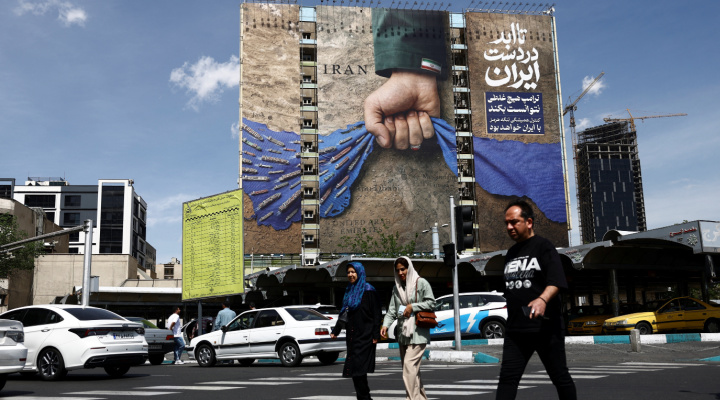
People walk past a billboard with a graphic design about the Strait of Hormuz on a building, amid a ceasefire between US and Iran, in Tehran, Iran, April 27, 2026. Photo: Majid Asgaripour/WANA (West Asia News Agency) via REUTERS
Israel and the US are coordinating plans for another round of strikes on Iranian targets, CNN reported Tuesday, as Iran kept up its attacks on the United Arab Emirates for a second straight day and amid reports that the Gulf state’s defense increasingly appeared to be drawing on Israeli support.
CNN cited an Israeli source as saying that the plans, largely drawn up before the ceasefire with Iran began in April, include strikes on Iran’s energy infrastructure and targeted killings of senior officials.
“The intention would be to carry out a short campaign aimed at pressuring Iran into further concessions in negotiations,” the source said, adding that any decision to resume the war would be made by US President Donald Trump.
CNN also reported that an Israeli-operated Iron Dome battery intercepted an Iranian missile over the UAE on Monday, the first known use of the system to defend a Gulf state. The system had been secretly deployed there at the start of the war, according to the report, along with Israel Defense Forces (IDF) soldiers sent to operate the system.
The system has so far intercepted dozens of Iranian missiles in the UAE, according to Israeli officials cited in a separate report by Axios.
The UAE said Iran fired 12 ballistic missiles, three cruise missiles, and four drones at the country on Monday. And then, according to Emirati officials, Iran launched additional missiles and drones on Tuesday. The UAE’s Foreign Ministry called the attacks a “serious escalation” and a “direct threat” to national security, adding that the UAE reserves its “full and legitimate right” to respond.
Another report by the London-based Iran International said that Iranian President Masoud Pezeshkian was furious over the escalation and warned military commanders of the regime’s Islamic Revolutionary Guard Corps (IRGC) that the “completely irresponsible” attacks risked dragging Iran back into full-scale war.
He also described the IRGC’s handling of tensions with regional states as “madness,” the report said, citing sources close to the matter, and warned that the consequences could be irreversible.
The New York Times reported last week that senior IRGC commanders were increasingly driving decision-making in Tehran, with Iran’s new supreme leader, Ayatollah Mojtaba Khamenei, unable to command the system with the authority once wielded by his father. The report added to mounting rumors over Khamenei’s health and capacity, and to growing confusion over who is ultimately directing Iran’s military and political response.
Iranian state media, citing an unnamed military official, said that the strikes on the UAE were unintentional and “the result of the US military’s adventurism to create passage for illegal ship transit” through the Strait of Hormuz, a narrow waterway between the Persian Gulf and the Gulf of Oman through which about one-fifth of the world’s trade in oil and liquefied natural gas flows.
Adm. Brad Cooper, the head of US Central Command, on Monday said American forces had cleared a mine-free route through the strait, which Iran shut in response to the US-Israeli strikes, and were escorting civilian vessels when Tehran launched cruise missiles, drones, and small boats at ships under US protection.
US military helicopters destroyed six of the boats, Cooper told reporters, saying “each and every” threat had been defeated.
Beyond mounting escorted transits for commercial vessels, the US has countered Iran’s shutdown of the waterway by blockading Iranian ports, a move that has further crippled the country’s already ailing economy and pushed it to the brink of collapse.
Iran’s Revolutionary Guards issued a new warning Tuesday, saying any vessel that does not use the route approved by Tehran through the Strait of Hormuz would face retaliation.
“We warn all vessels planning to transit the Strait of Hormuz that the only safe passage is the corridor previously announced by Iran. Any diversion of ships to other routes is dangerous and will result in a firm response from the Iranian Revolutionary Guards navy,” the Guards said in a statement carried by state television.
IDF Chief of Staff Lt. Gen. Eyal Zamir on Tuesday said the military was “closely monitoring developments in the Gulf” and is “prepared to respond with force against any attempt to harm Israel.”
Uncategorized
Israeli Restaurant Owned by Syrian Repeatedly Attacked in Germany

Illustrative: Graffiti reading “Kill All Jews” was discovered on a residential building in Berlin-Pankow on April 26, 2026, part of a wave of antisemitic vandalism reported across the German capital over the past week, including swastikas and other hate-filled slogans scrawled on multiple sites. Photo: Screenshot
An Israeli restaurant in Germany has been repeatedly attacked while its Syrian Kurdish owner has been subjected to relentless harassment, underscoring a broader climate of hostility faced by Jews and Israelis across the country.
Restaurant owner Billal Aloge, a Muslim from Syria, has been subjected to escalating hatred and violence after publicly expressing support for Jewish life in his city by opening restaurants aimed at fostering dialogue and coexistence.
Shortly after opening his Israeli restaurant “Jaffa” in Freiburg, a city in western Germany, Aloge faced immediate hostility and a wave of online abuse.
Even after filing multiple police reports, the harassment did not stop, with unknown individuals continuing to target the restaurant. This included incidents of vandalism such as throwing rotten eggs at the premises, prompting the owner to repeatedly seek police intervention.
Then last Tuesday, the restaurant’s newly deployed food truck was vandalized after being parked for just a single day in Colombipark in the heart of the university town, according to German media.
The food truck was extensively damagd, with paint thrown across its exterior, Israeli symbols defaced with Palestinian flag stickers and antisemitic slogans, and its door kicked so forcefully that it was left visibly dented.
Three days later, Aloge and his wife were preparing to open the food truck for Labor Day, when they discovered a broken side mirror.
“The food truck was brand new. I bought it for the new season and had it lovingly refurbished,” Aloge told the German newspaper Bild.
“Once again, I had to file a police report and now I estimate the total damage from the two attacks at approximately 30,000 euros,” he continued.
Freiburg Mayor Martin Horn strongly condemned the attacks, stressing that the city would not tolerate such acts of hatred and would take them seriously, with full efforts to ensure accountability and protection for those targeted.
“There is no place in Freiburg for antisemitism, anti-Muslim racism, or any other form of hatred and incitement,” the German official said in a statement.
Like most countries across Europe and the broader Western world, Germany has seen a shocking rise in antisemitic incidents over the last two years, in the wake of the Hamas-led invasion of and massacre across southern Israel on Oct. 7, 2023.
According to recently released figures, the number of antisemitic offenses in the capital city Berlin reached a record high in 2025, totaling 2,267 incidents, including violence, incitement, property damage, and propaganda offenses.
By comparison, officially recorded antisemitic crimes were significantly lower at 1,825 in 2024, 900 in 2023, and fewer than 500 in 2022, prior to the Oct. 7 atrocities.
Officials warn that the real number of antisemitic crimes is likely much higher, as many incidents go unreported.
In one of the latest antisemitic incidents in the country, a synagogue in Cottbus, a city in eastern Germany, was defaced with a swastika painted on its facade, marking the second time in just four days that the Jewish house of worship had been vandalized.
Separately, authorities also discovered antisemitic graffiti across several apartment buildings in Berlin-Pankow, including messages reading “Kill all Jews,” a swastika, and the statement “Only a dead Jew is a good Jew,” in a series of disturbing incidents over the week.
Uncategorized
North Africa Signals New Openings for Jews as Morocco Weighs Citizenship Reform, Tunisia Sees Pilgrimage Return

Jews from Tunisia and other countries of the world complete the annual Jewish pilgrimage to the El Ghriba Synagogue, which is considered one of the oldest Jewish places of worship in Africa and has a history of approximately 2,400 years, in Djerba Island, Tunisia on May 4, 2026. Photo: Hasan Mrad/ZUMA Press Wire via Reuters Connect
Jews are seeing cautious but notable signs of renewed inclusion in North Africa, as Morocco advances a landmark citizenship proposal for descendants abroad while pilgrims begin returning to Tunisia’s historic religious sites under tight security.
Last week, a Moroccan citizen submitted a legislative petition to the country’s House of Representatives to grant citizenship to the children and grandchildren of Moroccan Jews living abroad, marking a renewed push after a similar 2024 effort failed to secure enough support.
Supporters of the initiative argue that many Moroccan Jews emigrated for economic, religious, or other reasons, gradually losing their citizenship over generations even as they preserved strong cultural ties, underscoring that Jewish identity remains deeply embedded in Morocco’s history and monarchy.
Opponents of the proposal argue that Jews are already Moroccan citizens with equal rights regardless of religion, adding that existing legal frameworks sufficiently guarantee access to nationality without the need for new legislation.
Among the most vocal opponents, Jacky Kadoch, president of the Jewish Community of Marrakech — a major city in western Morocco — told Sky News Arabia that descendants of Moroccan Jewish emigrants face no real obstacles in obtaining citizenship or passports, and dismissed supporters of the initiative as “simply trying to stir chaos.”
Under current law, individuals of Moroccan Jewish origin can claim citizenship through lineage up to the fourth generation, reinforced by a 2011 constitutional amendment recognizing Judaism as a core component of the country’s heritage.
The newly introduced proposal focuses on simplifying the application process by establishing dedicated services and launching a national online portal to manage applications, while promoting the integration of descendants into Morocco’s economic, political, cultural, and social life.
The measure also seeks to strengthen ties with the diaspora by allowing Hebrew to be used alongside Arabic and Amazigh, creating an independent national body for Jewish religious affairs, and introducing safeguards to protect Moroccan Jewish communities from discrimination or attacks.
While Morocco’s Jewish population today numbers around 2,000, an estimated 500,000 to 1 million people of Moroccan Jewish descent live in Israel, where they form one of the country’s largest ethnic groups.
Meanwhile, Tunisian authorities are expecting a gradual return of international pilgrims to the island of Djerba for the annual Jewish pilgrimage, under heightened security and an atmosphere overshadowed by memories of violence.
In the past, the pilgrimage to the El Ghriba Synagogue — one of the oldest synagogues in North Africa — drew thousands of visitors from Europe and beyond, serving as both a religious and cultural attraction.
However, since the 2023 deadly attack on the synagogue that killed two worshippers and three police officers, attendance has dropped significantly and authorities have imposed tighter restrictions on the event.
Perez Haddad, who oversees the synagogue, noted that while religious services have continued, public celebrations remain suspended as fear still keeps many from returning, and in memory of the victims of the terror attack, whose loss is still deeply felt.
René Trabelsi, the pilgrimage organizer and former tourism minister, said confidence is slowly returning as more visitors arrive from abroad despite regional tensions.
“This year, there has been a marked return of pilgrims to the island. We estimate that around 200 people have come from abroad,” Trabelsi said in a statement.
This year, the gathering is being held from April 30 to May 6, marking the Lag B’Omer festival, observed 33 days after the start of Passover.
Tunisia is home to one of the largest remaining Jewish communities in the region outside Israel, with about 1,500 Jews living in the country, most of them in Djerba.
About 850,000 Jews were forced to flee or expelled from Middle Eastern and North African countries in the 20th century, primarily in the aftermath of Israel’s declaring independence in 1948.
Uncategorized
Indiana synagogue that shaped Reform movement is sold — and will become a coffee shop, event space
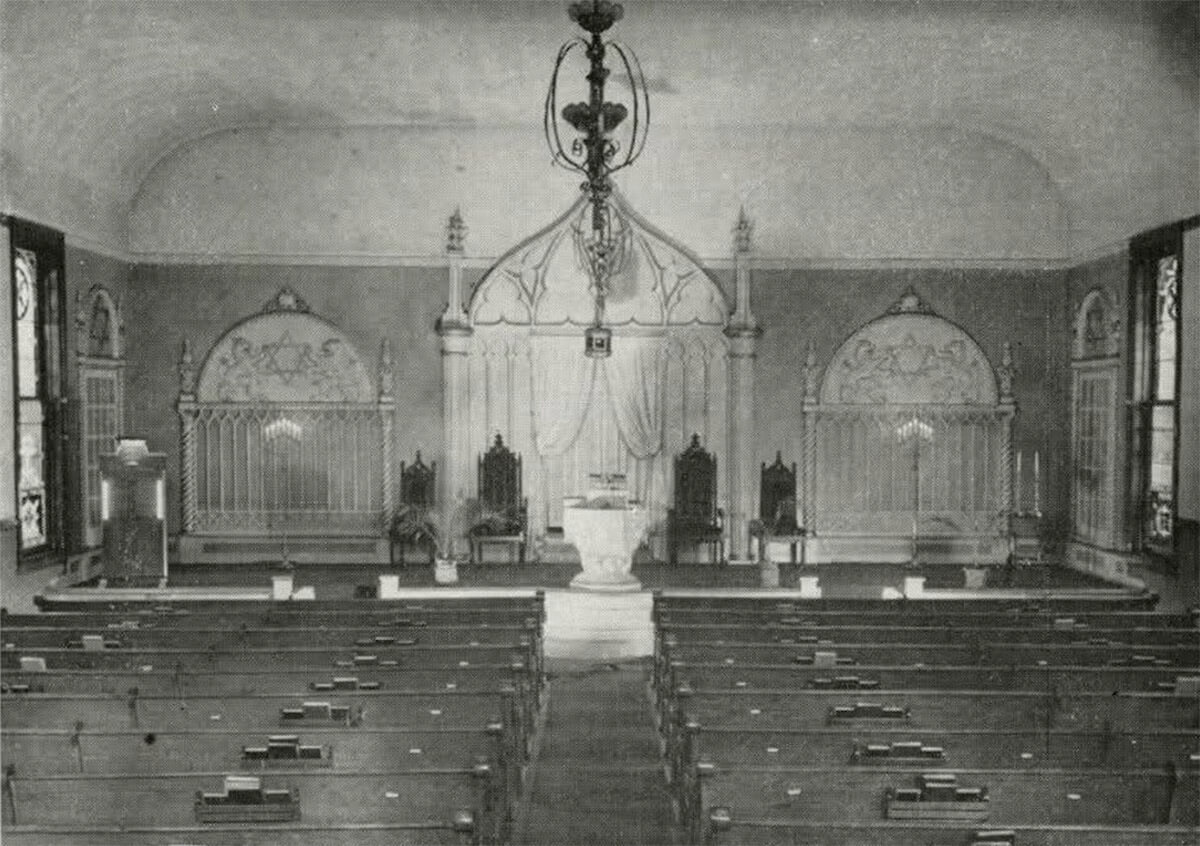
The 1867 synagogue in Lafayette, Indiana — once a laboratory of the Reform movement — has been sold, after a grassroots effort to bring it back into Jewish hands fell short.
In recent months, a small group of local Jews tried to crowdfund roughly $300,000 to buy the building, hoping to turn it into a cultural and educational center preserving the city’s Jewish history. But the campaign ran out of time.
“Including pledges, we had about $60,000,” said Robyn Soloveitchik, one of the organizers. They needed nearly five times that amount. Now, the donations will be returned.
The sale of the building closed May 1 to a new owner, Ed Bahler, a local businessman whose family has worked in construction for decades.
“We hope to make it a super vibey, cool, historic coffee shop and place to have events,” Bahler said. He plans to preserve the exterior, which has landmark status and is topped by a large Star of David, but said it requires repairs to brickwork, gutters and landscaping.
The former sanctuary, with its high ceilings and stained glass windows, will remain a focal point.
Bahler said the project is partly about giving back. “We’re invested in the community,” he said, noting that seven of his children attended Purdue University in neighboring West Lafayette.
Soloveitchik said her group knew from the outset the purchase effort faced long odds. “Of course, it’s not what we wished for,” she said, “but we did know it was going to be an uphill battle.”
The nonprofit she and others formed to purchase the building plans to continue operating, shifting its focus to other preservation efforts in the state. “Hopefully we can find a way to stick around and just do a little bit of good for our community, even if this project didn’t work out,” she said.
Michael Brown, executive director of the Indiana Jewish Historical Society, called the outcome disappointing. “I’m sad that they weren’t able to acquire the building,” he said.
He hopes Bahler will mount a plaque or display photos documenting the building’s history as a pioneering synagogue.
A changing landscape
What happened in Lafayette is part of a broader pattern across Indiana.
In April in Terre Haute, the state’s oldest continuously operating Jewish congregation sold its synagogue building after more than a century. The 1910 structure, known for its sweeping stained glass windows, is expected to become a wedding venue.
“We had to sell in order to continue operating,” said Scott Skillman, president of the United Hebrew Congregation. They now plan to meet at a smaller location, or to rent space from a church.
Like many small towns, Terre Haute has seen its Jewish population shrink for decades. “There’s no amount of programming that’s going to change that,” Skillman said.
Other Indiana synagogues have found more unusual second lives that would have been unimaginable to the people who built them.
When a new baseball stadium was built in 2012 in South Bend, the team owner had to figure out what to do with a 1901 Romanesque Revival–style synagogue on the property that was listed on the National Register of Historic Places. The team spent $1 million restoring the building, where the team gift shop now operates. A mural on the wall of what’s now known as the Ballpark Synagogue riffs on the Sistine Chapel, depicting God passing a baseball to Adam along with the words “Play Ball.”

Wendy Soltz, a history professor at Ball State University who led the federally funded Indiana Synagogue Mapping Project, has documented 66 purpose-built synagogues across the state dating back to the 19th century. Of those, 24 have already been demolished.
The Lafayette building, she said, had “statewide and national significance.”
A legacy reshaped
The Lafayette synagogue was founded in 1849 as Ahavas Achim.
The congregation was among the early adopters of Reform Judaism in America and is believed to have hosted one of the first egalitarian minyanim in the country. The building it moved into in 1867 stood as a marker of that ambition — a place where a small Midwestern Jewish community helped shape a national religious movement.
Rabbi Julian Morgenstern served the shul, and later rose to lead Hebrew Union College. He helped secure visas for several Jewish scholars fleeing Nazi persecution, including Abraham Joshua Heschel. Several other future luminaries passed through Lafayette’s pulpit.
The congregation moved to a new Lafayette location in 1969. Since then, the old building has housed churches, the Red Cross and other nonprofits.
Lafayette today has two synagogues, one Reform and one Conservative. It also has a Chabad and Hillel connected to Purdue University. The school has roughly 1,500 Jewish students, according to Hillel.
For more than a century, Ahavas Achim’s building anchored Jewish life in the city. Now, it is entering a new chapter, one shaped by a different vision of community.
Bahler said he hopes to open the coffee shop and event space by the third quarter of this year, pending rezoning and renovations.
“We saw a historic building that had a very interesting spirit to it,” he said. “Something that could be brought alive into a place that draws people — a place of connection.”
The post Indiana synagogue that shaped Reform movement is sold — and will become a coffee shop, event space appeared first on The Forward.