



Uncategorized
North Africa Signals New Openings for Jews as Morocco Weighs Citizenship Reform, Tunisia Sees Pilgrimage Return

Jews from Tunisia and other countries of the world complete the annual Jewish pilgrimage to the El Ghriba Synagogue, which is considered one of the oldest Jewish places of worship in Africa and has a history of approximately 2,400 years, in Djerba Island, Tunisia on May 4, 2026. Photo: Hasan Mrad/ZUMA Press Wire via Reuters Connect
Jews are seeing cautious but notable signs of renewed inclusion in North Africa, as Morocco advances a landmark citizenship proposal for descendants abroad while pilgrims begin returning to Tunisia’s historic religious sites under tight security.
Last week, a Moroccan citizen submitted a legislative petition to the country’s House of Representatives to grant citizenship to the children and grandchildren of Moroccan Jews living abroad, marking a renewed push after a similar 2024 effort failed to secure enough support.
Supporters of the initiative argue that many Moroccan Jews emigrated for economic, religious, or other reasons, gradually losing their citizenship over generations even as they preserved strong cultural ties, underscoring that Jewish identity remains deeply embedded in Morocco’s history and monarchy.
Opponents of the proposal argue that Jews are already Moroccan citizens with equal rights regardless of religion, adding that existing legal frameworks sufficiently guarantee access to nationality without the need for new legislation.
Among the most vocal opponents, Jacky Kadoch, president of the Jewish Community of Marrakech — a major city in western Morocco — told Sky News Arabia that descendants of Moroccan Jewish emigrants face no real obstacles in obtaining citizenship or passports, and dismissed supporters of the initiative as “simply trying to stir chaos.”
Under current law, individuals of Moroccan Jewish origin can claim citizenship through lineage up to the fourth generation, reinforced by a 2011 constitutional amendment recognizing Judaism as a core component of the country’s heritage.
The newly introduced proposal focuses on simplifying the application process by establishing dedicated services and launching a national online portal to manage applications, while promoting the integration of descendants into Morocco’s economic, political, cultural, and social life.
The measure also seeks to strengthen ties with the diaspora by allowing Hebrew to be used alongside Arabic and Amazigh, creating an independent national body for Jewish religious affairs, and introducing safeguards to protect Moroccan Jewish communities from discrimination or attacks.
While Morocco’s Jewish population today numbers around 2,000, an estimated 500,000 to 1 million people of Moroccan Jewish descent live in Israel, where they form one of the country’s largest ethnic groups.
Meanwhile, Tunisian authorities are expecting a gradual return of international pilgrims to the island of Djerba for the annual Jewish pilgrimage, under heightened security and an atmosphere overshadowed by memories of violence.
In the past, the pilgrimage to the El Ghriba Synagogue — one of the oldest synagogues in North Africa — drew thousands of visitors from Europe and beyond, serving as both a religious and cultural attraction.
However, since the 2023 deadly attack on the synagogue that killed two worshippers and three police officers, attendance has dropped significantly and authorities have imposed tighter restrictions on the event.
Perez Haddad, who oversees the synagogue, noted that while religious services have continued, public celebrations remain suspended as fear still keeps many from returning, and in memory of the victims of the terror attack, whose loss is still deeply felt.
René Trabelsi, the pilgrimage organizer and former tourism minister, said confidence is slowly returning as more visitors arrive from abroad despite regional tensions.
“This year, there has been a marked return of pilgrims to the island. We estimate that around 200 people have come from abroad,” Trabelsi said in a statement.
This year, the gathering is being held from April 30 to May 6, marking the Lag B’Omer festival, observed 33 days after the start of Passover.
Tunisia is home to one of the largest remaining Jewish communities in the region outside Israel, with about 1,500 Jews living in the country, most of them in Djerba.
About 850,000 Jews were forced to flee or expelled from Middle Eastern and North African countries in the 20th century, primarily in the aftermath of Israel’s declaring independence in 1948.
Uncategorized
University of Michigan in Row Over Professor’s Endorsement of ‘Pro-Palestinian Student Activists’
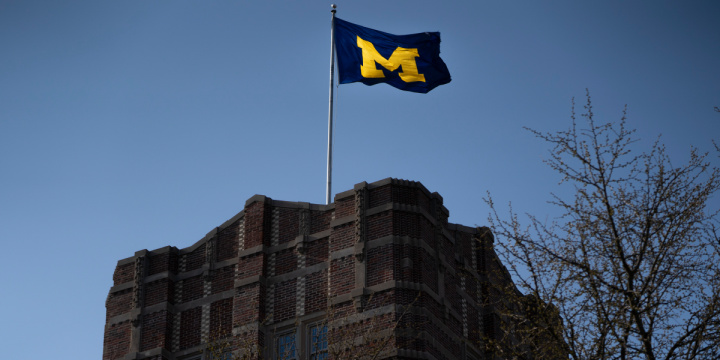
The University of Michigan Union. Photo: Dominick Sokotoff/Sipa USA via Reuters Connect
The University of Michigan in Ann Arbor is a house divided after a professor used his commencement speech to praise pro-Hamas activists, dozens of whom participated in a destructive wave of protests that scarred Jewish students and prompted the intervention of the federal government.
“Sing for the pro-Palestinian student activists who have over these past two years opened our hearts to the injustice and inhumanity of Israel’s war in Gaza,” university faculty Senate chair Derek Peterson, whose governance position makes him one of the powerful people on campus, said on Saturday.
Hours later, university president Domenico Grasso denounced the remarks for having “deviated” from what Peterson had submitted for review before taking the stage. Expressing regret that Peterson had caused “pain … on a day devoted to celebration and accomplishment,” he stated that the Senate chair’s expressed views do not represent the institution’s, and, moreover, violated its commitment to neutrality on divisive political issues.
“Commencement is a time of celebration, recognition, and unity,” Grasso continued. “The chair’s remarks were expected to be congratulatory, not a platform for personal political expression. Introducing such commentary in this setting was inappropriate and did not align with the purpose of the occasion. In the coming weeks, I will work with university leadership to review and refine future commencement programming.”
The matter did not end there. Grasso’s statement rankled the school’s anti-Israel element, and within just over a day some 1,000 professors signed a petition demanding that Grasso retract his commentary and apologize not to any Jewish students who were outraged by the speech but rather to Peterson, whom they thanked “for his care and insight.” Firing off a litany of anti-Israel accusations confected by the Jewish state’s enemies, the petition concluded by turning the table: Grasso, it charged, had violated the university’s commitment to institutional neutrality.
“We can only conclude that there is nothing neutral about the institution’s supposed commitment to institutional neutrality,” the petition stated. “The institution’s supposed principles on diversity of thought and freedom of expression cease to operate when a faculty member expresses a ‘forbidden’ view.”
Peterson responded to this outpouring of support on campus by doubling down.
“It should not be controversial to have one’s ‘heart opened to the inhumanity and injustice of Israel’s war in Gaza,’ which is what I credited activists with doing,” Peterson told The Michigan Daily. “Having an open heart to other people’s suffering is a fundamental human virtue, and it is a quality that I hope we teach our students, whatever their political posture might be.”
For several years, spanning before and after Hamas’s Oct.7, 2023, massacre across southern Israel, The Algemeiner has reported daily on campus antisemitism incidents which involved identity-based physical assaults, verbal abuse, and others acts of discrimination.
Committed by the “pro-Palestinian student activists” whom Peterson extolled, they included spitting on Jewish students at the University of California, Berkeley while calling them “Jew”; gang assaults at Columbia University’s Butler Library; swastika graffiti; the desecration of Jewish religious symbols; and the expulsion of a sexual assault survivor from a victim support group over her support for Zionism. In another incident, a Cornell University student threatened to murder Jewish men, whom he called pigs, and to rape Jewish women, and perpetrate a mass shooting at the campus’ kosher dining hall.
Professors, while operating largely behind the curtain, assumed roles as purveyors of anti-Jewish content too. At Harvard University, a “Faculty for Palestine” group shared an antisemitic political cartoon which named Jews and Israel as enemies Black and Brown people. At Cornell, a professor said Hamas’s Oct. 7 massacre, in which the group murdered children and pets while raping both women and men, as “exhilarating.”
On Tuesday, Alyza Lewin president of US affairs at the Combat Antisemitism Movement (CAM), told The Algemeiner that “the activists Derek Peterson endorsed are the same students responsible for normalizing a campus climate that equates with evil those who recognize Jewish peoplehood and the Jews’ ancestral connection to the Land of Israel.”
Lewin represents most of the Jewish community and its allies, many of whom have said in recent days that Peterson’s choosing commencement to proclaim solidarity with such a controversial and extremist political movement is indicative of a deeper problem in higher education.
“Protests on campus have repeatedly crossed the line: encampments, disrupted ceremonies, demonstrations at officials’ homes, clashes with police,” Nikki Haley, who previously served as governor of South Carolina and US ambassador to the United Nations, said in a statement on Tuesday. “The First Amendment must be protected, but it doesn’t absolve any one of consequences. Universities have deep culture problems they must address. If they don’t, they should face repercussions.”
Meanwhile, Ted Deutch, chief executive officer of the American Jewish Committee (AJC), said the “graduation is about more than commencement; it’s about campus culture.”
He continued, “Ensuring that moments like this and the broader campus environment reflect the university’s highest values require clear, consistent leadership from the university’s president and the Board of Regents, and I urge them to lead.”
Commencement speeches are a coveted theater for anti-Zionist activists searching for notoriety ahead of their transition to the real world. More often than not, the performances make them infamous, not least because pulling off the act requires deceiving the professors and administrators who approved their being conferred the high honor of addressing the graduating class.
Last year, New York University withheld the diploma of a Gallatin School of Individualized Study student who “lied” to the administration about the content of his commencement speech to conceal its claim that Israel is committing a genocide of Palestinians in Gaza, a falsehood parroted by both jihadist terrorist organizations and neo-Nazis. New York University promptly denounced the student.
Days later at George Washington University, one of its students, Cecilia Culver, not only uttered the same claim but added that her school’s hands are stained with “blood.”
George Washington University noted that Culver had been “dishonest” too and banned her from campus. The university also stripped Culver of her status as a “distinguished scholar.” Culver, whose misstep cost her a job Ernest & Young, is now suing the university for “defamation” and “retaliatory suppression of her protected expression.” The suit adds that her “professional reputation in the economics and policy community in Washington, D.C. and beyond … cannot be remedied.”
Follow Dion J. Pierre @DionJPierre.
Uncategorized
Tucker Carlson Praises JD Vance, Signals Increasingly Distant Relationship: ‘No One’s Seeking My Counsel’

Tucker Carlson speaks on first day of AmericaFest 2025 at the Phoenix Convention Center in Phoenix, Arizona, Dec. 18, 2025. Photo: Charles-McClintock Wilson/ZUMA Press Wire via Reuters Connect
Far-right commentator Tucker Carlson is signaling continued personal support for US Vice President JD Vance even as their differences over Israel and Iran come into sharper focus and questions arise about the current status of their relationship, a divide with implications for US national security policy and the future of Republican leadership.
In a new interview with The New York Times, Carlson reaffirmed his support for Vance, reinforcing a longstanding alignment and personal friendship between the two figures. But he also acknowledged that Vance is in a “tough spot” as part of an administration led by President Donald Trump that has taken decisive action, including military strikes, against Iran.
While praising Vance’s character, Carlson suggested that the vice president has been constrained by the limitations of his position. Nonetheless, the podcaster, former Fox News host, and outspoken anti-Israel voice speculated that Vance has tried to redirect the foreign policy objectives of the Trump administration in what he perceives as a more productive direction.
“I know him well and think so much of him as a person. And it is my guess that, based on his past behavior, that he’s doing everything he can to mitigate what he sees as the ill effects of [the Iran war]. But it’s kind of hard to call the shots when you’re vice president, because that’s not in the Constitution,” Carlson said.
Carlson, notably, did not indicate the last time he and the vice president spoke when asked, stoking speculation that the relationship between the two political power brokers has deteriorated.
“Oh, I don’t know. But I wouldn’t want to add to his problems at all,” said the online provocateur, who reportedly played a role in persuading Trump to name Vance as his running mate. “I would just say what’s obvious, which is that I’m hardly an adviser to this administration. And I think it’s also clear that Donald Trump makes these decisions.”
When Carlson was pressed to say the last time he spoke to Vance, he continued to avoid giving a direct answer.
“I don’t know. I mean, I would never characterize that,” he said. “I don’t want to cause him more problems. I would just say I’m not advising. No one’s seeking my counsel. I’m not trying to influence anything. I gave it my best shot. Didn’t work.”
While polling has shown Republicans overwhelmingly supportive of Trump’s military campaign against Iran, the tension between the Trump administration’s approach to Middle East and the Republican base is becoming increasingly central to inter-party discourse.
In the wake of the wars in Iraq and Afghanistan, many younger voters have, according to recent polling, expressed deep skepticism of US military operations abroad and support for certain traditional allies, especially Israel.
Vance rose politically in part on a more restrained foreign policy outlook, skeptical of overseas military engagement. Now, as vice president, he is tied to policies that emphasize confronting Iran’s regional aggression, including support for US actions aimed at degrading Tehran’s nuclear and ballistic missile capabilities and support for terrorist groups.
Carlson, by contrast, has intensified his criticism of such efforts, reflecting an isolationist strand of “America First” thinking that questions US involvement abroad. His rhetoric has raised alarm bells among many Republicans, including pro-Israel advocates, who argue that reducing pressure on Iran risks emboldening a regime that routinely chants “death to America, death to Israel” and has been, according to the US intelligence community, the world’s foremost state sponsor of terrorism for several years.
Carlson has gone further, however, to increase his criticisms of Israel in the two-and-a-half years following Hamas’s Oct. 7, 2023, massacre across southern Israel. He has alarmed and mystified establishment conservatives by condemning Israel’s military operations in Gaza, accusing the Jewish state of committing “genocide,” and seemingly defending Hamas and Qatar, the terrorist group’s long-time backer. The podcaster has even suggested that Israel oppresses and murders Christians, despite the fact that they enjoy full equal rights and high levels of education in the Jewish state. At the same time, he has noticeably not criticized many Islamic countries for persecuting Christians, failing to acknowledge the oppression of Christians throughout much of Africa and the Middle East.
During the Times interview, Carlson chided US Secretary of State Marco Rubio, accusing the official of engaging in “nonstop treachery” against the vice president in service of advancing his own goals.
“There are people in the White House who want to hurt JD Vance and have wanted that since the very first day. They were bitter. They wanted Marco Rubio to be the choice as vice president,” Carlson said.
Republican leaders including Rubio have pushed back forcefully on the view that the US should take an isolationist approach to foreign policy, maintaining that a strong US posture is indispensable.
Against the backdrop of a shifting ideological landscape within the Republican Party, the Carlson-Vance relationship is becoming a defining lens on the party’s internal debate. Carlson’s personal backing offers Vance credibility with a key segment of the Republican base, but their policy divergence, particularly on Israel, places Vance at the center of a contentious debate regarding the GOP’s future posture toward the closest US ally in the Middle East.
Vance has refused to outright condemn Carlson and, on several occasions, has dismissed concerns about rising antisemitism on the political right, where many young voters have increasingly embraced unfounded conspiracy theories regarding the Jewish state.
Uncategorized
Boulder hostage-march firebombing suspect to plead guilty to state charges
(JTA) — The man charged with firebombing a Boulder, Colorado, march for Israeli hostages in 2025 will plead guilty to killing one person and attempting to kill others in the incident, according to documents filed in the case over the weekend.
Mohamed Sabry Soliman, who was arrested at the scene of the June 1, 2025, attack, is asking for his ex-wife and children to be able to remain in the United States as a condition of his guilty plea, according to the documents.
His ex-wife and five children, like him all Egyptian nationals who came to the United States in 2022 via Kuwait, were arrested by immigration authorities shortly after the attack. They were detained until Thursday, when they were released from a detention center in Texas, then briefly detained again on Saturday in Boulder and, their attorneys say, put onto a plane bound for Egypt before being freed once again. His ex-wife, whom he divorced in April, has not been charged with a crime and said she did not know about Soliman’s planned attack.
Soliman is reportedly pleading guilty to all state charges but still faces federal charges in relation to the attack, which he allegedly said he staged to “wanted to kill all Zionist people and wished they were all dead,” according to an earlier court filing. He has previously pleaded not guilty to the federal charges, for which prosecutors could seek the death penalty.
Thirteen people were physically injured in the attack, which took place on a pedestrian mall in downtown Boulder where supporters of the Israelis then held hostage in Gaza marched weekly. One, 82-year-old Karen Diamond, died weeks later of her injuries.
The post Boulder hostage-march firebombing suspect to plead guilty to state charges appeared first on The Forward.