



Uncategorized
Tucker Carlson Praises JD Vance, Signals Increasingly Distant Relationship: ‘No One’s Seeking My Counsel’

Tucker Carlson speaks on first day of AmericaFest 2025 at the Phoenix Convention Center in Phoenix, Arizona, Dec. 18, 2025. Photo: Charles-McClintock Wilson/ZUMA Press Wire via Reuters Connect
Far-right commentator Tucker Carlson is signaling continued personal support for US Vice President JD Vance even as their differences over Israel and Iran come into sharper focus and questions arise about the current status of their relationship, a divide with implications for US national security policy and the future of Republican leadership.
In a new interview with The New York Times, Carlson reaffirmed his support for Vance, reinforcing a longstanding alignment and personal friendship between the two figures. But he also acknowledged that Vance is in a “tough spot” as part of an administration led by President Donald Trump that has taken decisive action, including military strikes, against Iran.
While praising Vance’s character, Carlson suggested that the vice president has been constrained by the limitations of his position. Nonetheless, the podcaster, former Fox News host, and outspoken anti-Israel voice speculated that Vance has tried to redirect the foreign policy objectives of the Trump administration in what he perceives as a more productive direction.
“I know him well and think so much of him as a person. And it is my guess that, based on his past behavior, that he’s doing everything he can to mitigate what he sees as the ill effects of [the Iran war]. But it’s kind of hard to call the shots when you’re vice president, because that’s not in the Constitution,” Carlson said.
Carlson, notably, did not indicate the last time he and the vice president spoke when asked, stoking speculation that the relationship between the two political power brokers has deteriorated.
“Oh, I don’t know. But I wouldn’t want to add to his problems at all,” said the online provocateur, who reportedly played a role in persuading Trump to name Vance as his running mate. “I would just say what’s obvious, which is that I’m hardly an adviser to this administration. And I think it’s also clear that Donald Trump makes these decisions.”
When Carlson was pressed to say the last time he spoke to Vance, he continued to avoid giving a direct answer.
“I don’t know. I mean, I would never characterize that,” he said. “I don’t want to cause him more problems. I would just say I’m not advising. No one’s seeking my counsel. I’m not trying to influence anything. I gave it my best shot. Didn’t work.”
While polling has shown Republicans overwhelmingly supportive of Trump’s military campaign against Iran, the tension between the Trump administration’s approach to Middle East and the Republican base is becoming increasingly central to inter-party discourse.
In the wake of the wars in Iraq and Afghanistan, many younger voters have, according to recent polling, expressed deep skepticism of US military operations abroad and support for certain traditional allies, especially Israel.
Vance rose politically in part on a more restrained foreign policy outlook, skeptical of overseas military engagement. Now, as vice president, he is tied to policies that emphasize confronting Iran’s regional aggression, including support for US actions aimed at degrading Tehran’s nuclear and ballistic missile capabilities and support for terrorist groups.
Carlson, by contrast, has intensified his criticism of such efforts, reflecting an isolationist strand of “America First” thinking that questions US involvement abroad. His rhetoric has raised alarm bells among many Republicans, including pro-Israel advocates, who argue that reducing pressure on Iran risks emboldening a regime that routinely chants “death to America, death to Israel” and has been, according to the US intelligence community, the world’s foremost state sponsor of terrorism for several years.
Carlson has gone further, however, to increase his criticisms of Israel in the two-and-a-half years following Hamas’s Oct. 7, 2023, massacre across southern Israel. He has alarmed and mystified establishment conservatives by condemning Israel’s military operations in Gaza, accusing the Jewish state of committing “genocide,” and seemingly defending Hamas and Qatar, the terrorist group’s long-time backer. The podcaster has even suggested that Israel oppresses and murders Christians, despite the fact that they enjoy full equal rights and high levels of education in the Jewish state. At the same time, he has noticeably not criticized many Islamic countries for persecuting Christians, failing to acknowledge the oppression of Christians throughout much of Africa and the Middle East.
During the Times interview, Carlson chided US Secretary of State Marco Rubio, accusing the official of engaging in “nonstop treachery” against the vice president in service of advancing his own goals.
“There are people in the White House who want to hurt JD Vance and have wanted that since the very first day. They were bitter. They wanted Marco Rubio to be the choice as vice president,” Carlson said.
Republican leaders including Rubio have pushed back forcefully on the view that the US should take an isolationist approach to foreign policy, maintaining that a strong US posture is indispensable.
Against the backdrop of a shifting ideological landscape within the Republican Party, the Carlson-Vance relationship is becoming a defining lens on the party’s internal debate. Carlson’s personal backing offers Vance credibility with a key segment of the Republican base, but their policy divergence, particularly on Israel, places Vance at the center of a contentious debate regarding the GOP’s future posture toward the closest US ally in the Middle East.
Vance has refused to outright condemn Carlson and, on several occasions, has dismissed concerns about rising antisemitism on the political right, where many young voters have increasingly embraced unfounded conspiracy theories regarding the Jewish state.
Uncategorized
Canadian Intel Reveals Gaza War Motivated At Least 7 Lone-Wolf Terror Plots in 2025

Dueling pro-Israel and anti-Israel demonstrations at McGill University in Montreal, Canada; May 2, 2024. Photo: ZUMA Press Wire via Reuters Connect
The Canadian Security Intelligence Service (CSIS)’s newly published annual report documents how aspiring domestic terrorists have felt justified to plan attacks in response to the Israel-Hamas war in Gaza.
“The threat of a domestic lone-actor attack in Canada increased significantly since the beginning of the Israel-Hamas conflict,” the CSIS report said in a section on religion-motivated crime. “In 2025, at least seven of CSIS’s priority investigations involving mobilization to violence have been assessed as motivated by this conflict in whole or in part.”
CSIS Director Dan Rogers offered examples in the report’s introduction, writing that “we achieved a number of counterterrorism successes that led to law enforcement action, including the arrests of Hide & Stalk members in Québec, and of a minor who intended to violently target Jewish people and police in Montréal.”
The report further described how the war in Gaza “has also fueled violent extremist organization narratives and has the potential to inspire a new generation of extremists. The conflict will likely continue to motivate some extremists in the near term, but understanding the true impact of the conflict will only be clear over time.”
Antisemitism appears in Canada in many forms today, with the report noting continued incidents of vandalism, graffiti, online propaganda, overt racist statements, and bomb threats. The document also said that, since 2014, there has been one attack against a Jewish institution and five plans stopped, including an incident in August 2025 involving a minor in Montreal.
Earlier this year, three shootings targeted Jewish institutions in less than a week in Toronto.
Other terrorist crimes from last year spotlighted in the report included a man in Winnipeg charged in March for offenses motivated by “nihilistic violent extremism,” and a woman in Montreal who pleaded guilty in July to providing material support to the Islamic State of Iraq and Syria (ISIS). That month, law enforcement arrested four members of Hide & Stalk, a far-right conspiracist militia driven by an “accelerationist” ideology which seeks to speed up societal collapse.
In September, the neo-Nazi propagandist Patrick Gordon MacDonald, known by the alias “Dark Foreigner,” received a 10-year prison sentence on three terrorism offenses. The report described how “his objective was to inspire others to engage in violence through his graphic designs and videos he produced in support of Atomwaffen Division (AWD).”
Founded in 2015 by neo-Nazi Brandon Russell — who now serves a 20-year prison sentence after a conviction last year for plotting attacks on electrical substations in Baltimore — AWD draws inspiration from James Mason, a former member of the American Nazi Party (ANP) and leader of the National Socialist Liberation Front (NSLF), who wrote an essay collection titled SIEGE which advocated for a white American ethno-state. The group has often blended with Salafi and Jihadist terrorists, “citing their culture of martyrdom and insurgency as inspiration for their tactics and propaganda.”
Another terrorism conviction in Canada came in October when Matthew Althorpe pleaded guilty for his involvement in the Terrorgram Collective, a neo-Nazi Telegram channel. CSIS explained that “the violent tenets of Terrorgram’s content and manifestos have inspired at least three violent attacks in Slovakia, Brazil, and Türkey, two plots to attack critical infrastructure in the United States, and the attempted assassination of a foreign government official in Australia.”
While a variety of ideologies can inspire terrorist attacks in Canada, the perpetrators fit a familiar pattern, with 93 percent being male and the average age being 34, findings consistent since 2022. However, the report noted increases in both youth and those over 48.
The Canadian government also designated numerous organizations as terrorist organizations. In February, newly proscribed groups included seven transnational criminal organizations reclassified as terrorist entities: Cártel del Golfo, Cártel de Sinaloa, La Familia Michoacana, Cárteles Unidos, La Mara Salvatrucha, Tren de Aragua, and Cártel de Jalisco Nueva Generación.
Later in the year Canada added Lawrence Bishnoi Gang, 764, Maniac Murder Cult, Terrorgram Collective, and the ISIS-aligned Islamic State-Mozambique.
The report explained how foreign governments engage in espionage in Canada. Tactics range from agents cultivating friendships with targets to manipulate them to using blackmail and launching cyber-attacks to compromise digital devices. “In 2025, the main perpetrators of foreign interference and espionage against Canada remained the People’s Republic of China (PRC), India, the Russian Federation, the Islamic Republic of Iran, and Pakistan,” the report stated.
Canada joined 13 other countries in July 2025, issuing a statement condemning “the attempts of Iranian intelligence services to kill, kidnap, and harass people in Europe and North America in clear violation of our sovereignty.”
The report described the concept of transnational repression as “when foreign governments, or those acting on their behalf, reach beyond their borders to harass, threaten or harm individuals or groups to advance their interests or to silence criticism and dissent.” Methods employed include physical violence, threatening overseas relatives, lawfare, cyberbullying, online defamation, extortion, and community ostracism.
CSIS named Handala Hack Team as among Iran’s henchmen. The group “doxed several Iran International-linked journalists, including a Canadian resident,” the report said. “The Canadian’s photos, provincial driver’s license, permanent resident card, and Iranian passport details were released on the internet and social media platforms. The hacktivist group reproached the Canadian for, among other things, their promotion of 2SLGBTQIA+ issues in Iran.”
The doxxing resulted in death threats and the harassment of family members in Iran. CSIS warned that Iran may use proxies to go after dissidents, sometimes relying on transnational organized crime networks.
Hostile governments may also seek to plant disinformation, false narratives deliberately spread as “part of broader information operations aimed at manipulating audiences.”
One of the report’s most alarming findings was the degree to which extremist groups with differing ideologies draw inspiration from one another. CSIS described finding “an overlap in content, aesthetics, conspiracy theories and grievance narratives, including those that are anti-liberal, anti-2SLGBTQIA+, antisemitic, and Islamophobic … On occasion, similar violent content is consumed, including gore sites, jihadi beheading videos, and attack manuals.”
CSIS warned that “violent extremists with these different ideologies are increasingly finding common causes. They find inspiration and motivation in the events and trends that polarize society or cause them to lose hope for the future. They easily access and amplify content online that radicalizes them and reinforces their view that violence is justified to achieve their extremist goals.”
The report named Islamic State as the most significant threat to Western interests, with CSIS analysts warning the terrorist group “will continue to attempt to influence supporters — particularly from Syria, Afghanistan, and Pakistan — to plan attacks on targets related to world events, and enable them to do so, while Al Qaeda will continue efforts to reconstitute itself in permissive territories, including through the rise of the Islamic State in Somalia and increased Al-Shabaab terrorism activities in North Africa.”
A recent example of the trend of cross-ideological alliances appeared late last month in Mali, where Jama’at Nusrat al-Islam wal-Muslimin (JNIM,) an Al-Qaeda-linked jihadist group, joined with Azawad Liberation Front (FLA), a Tuareg rebel separatist militia, in a shared effort to overthrow the military junta which has ruled the African nation since Aug. 18, 2020. The coordinated attacks resulted in the killing of Defense Minister Sadio Camara and the seizure of Kidal, a key town in Mali’s eastern region.
Uncategorized
A best-selling novelist identified a minor character as Israeli. Some fans are canceling their orders.
(JTA) — A bestselling author is facing a flurry of anger from fans after advance copies of her upcoming novel identified a character as Israeli — a move that her critics say advances “normalization” of a country they oppose.
Rebecca “R. F.” Kuang, the Chinese-American author of the 2023 satirical novel “Yellowface” and “The Poppy War” trilogy, is set to publish her seventh novel, “Taipei Story,” in September. The advance version, an excerpt of which was leaked on social media on Sunday, includes a short scene involving an Israeli musician.
The musician, a successful pianist whose performance ignites a near-religious fervor for a character in the story, is not named, and the text identifies him as “a dour-faced man who did not so much as crack a smile as we applauded.”
That was enough to trigger some readers and potential readers who said Kuang was whitewashing Israel in the wake of the war in Gaza — even as she has previously expressed support for the movement to boycott Israel.
“RF kuang had 190+ countries to choose from to write about a character’s nationality and she still chose to write about the one who’s actively committing gen0cide against Palestinians for years,” user alltoowellreads wrote on X, in one representative comment that has been shared nearly 1,000 times that used an online version of the word “genocide” meant to evade censors.
Others railed against the excerpt on Threads, where there is a thriving community of people discussing books. Some readers said they even canceled their preorders of the book.
Kuang and her publicists did not respond to requests for comment, and she has disabled comments on her recent Instagram posts, where she has not addressed the criticism.
The backlash to Kuang’s inclusion of the Israeli character reflects a trend in the literary world, in which even minor mentions of Israel or Israelis are enough to land authors on boycott lists.
The trend predates the most recent war in Gaza: Casey McQuiston, the author of the 2019 romance novel “Red, White, and Royal Blue,” initially included a scene where the U.S. president jokes that an ambassador “said something idiotic about Israel, and now I have to call Netanyahu and personally apologize.” In 2021, McQuiston said they would remove the reference to Israeli Prime Minister Benjamin Netanyahu in future printings of the book.
But the trend has intensified after Oct. 7 thrust Israel into the center stage of cultural conversations. An online list titled “Is your fav author a Zionist???” that went viral in 2024 urged boycotts against authors for whom the crowd-sourced answer was yes.
Some authors landed on the list without ever commenting publicly about Israel or Gaza. Gabrielle Zevin, for example, was included in part because her 2024 hit novel about Jewish video game designers, “Tomorrow and Tomorrow and Tomorrow,” received backlash for its inclusion of an Israeli character even though he was presented unfavorably. (Zevin also drew criticism for having spoken at a Hadassah event in February 2023.)
Kuang’s silence on the dustup has left some readers to speculate about why she chose to identify the pianist as Israeli in “Taipei Story,” a work of literary fiction about a young Chinese-American woman on an intensive summer language program in Taiwan.
Kuang, whose work largely deals with the Asian diaspora from an anti-colonial perspective, has historically supported the Boycott, Divestment and Sanctions movement against Israel. In December, she withdrew from an appearance at a literature festival in Dubai, citing a call from the BDS movement.
That record had led some of her fans to argue that the Israeli character may have been included to subtly critique Israel. Others speculated without evidence that Kuang could have been paid to mention Israel in the book, while others simply expressed bafflement or anger at her choice to mention a state they believe is a colonial enterprise.
“Making your books sm about colonization but normalizing israel is insane to me idk im very disappointed,” wrote one X user who garnered 1 million views with the sentiment. (“Sm” is internet shorthand for “so much.”)
For Jews who have been keeping a close eye on trends in publishing since Oct. 7, the response to the Kuang excerpt has been worrying, even if its ultimate impact remains unclear. Meg Keene, a writer who argues that data shows a sidelining of Jewish content in new book deals, summarized the brouhaha with a deflated tweet: “This is where we are now.”
Even some Jews who do not identify as Zionists say they see something worrying in the backlash to the Kuang excerpt.
“The people canceling a preorder over [a] single mention of an Israeli pianist being booked at a concert hall in R.F. Kuang’s new book lack so much f–king nuance. There’s literally no mention of Zionism yet y’all can’t seem to differentiate,” wrote a Jewish threads user who goes by Axis of Anarchy.
After experiencing some blowback, she followed up: “Also stop with this ‘y’all’ business about normalizing Israel. This is exactly the problem and I have been very vocal on calling Zionists out on their s–t so goodness forbid, I point out when y’all are taking your s–t too far.”
Though Kuang has closed most of her recent Instagram posts to comments, her readers continue to comment on older ones that are still open, asking the author about her choice to include an Israeli character.
Some books bloggers argue that the immediate call to boycott Kuang’s latest book is akin to censorship — and distracting from literary analysis.
“Reactionary outrage like this only acts as a form of censorship, because it discourages analysis,” wrote a user who goes by emily.isliterate, accompanying a widely viewed video on the episode. “From what I can read, I think Kuang (in very few words) manages to criticize the way people treat musicians from certain places over others (namely colonizer states). Maybe people stopped reading after the word Israel or they simply can’t garner subtext and theme, but either way, I think the entire situation is troublesome.”
The post A best-selling novelist identified a minor character as Israeli. Some fans are canceling their orders. appeared first on The Forward.
Uncategorized
University of Michigan in Row Over Professor’s Endorsement of ‘Pro-Palestinian Student Activists’
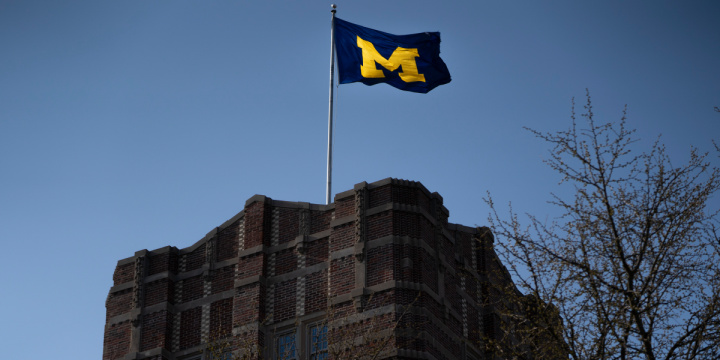
The University of Michigan Union. Photo: Dominick Sokotoff/Sipa USA via Reuters Connect
The University of Michigan in Ann Arbor is a house divided after a professor used his commencement speech to praise pro-Hamas activists, dozens of whom participated in a destructive wave of protests that scarred Jewish students and prompted the intervention of the federal government.
“Sing for the pro-Palestinian student activists who have over these past two years opened our hearts to the injustice and inhumanity of Israel’s war in Gaza,” university faculty Senate chair Derek Peterson, whose governance position makes him one of the powerful people on campus, said on Saturday.
Hours later, university president Domenico Grasso denounced the remarks for having “deviated” from what Peterson had submitted for review before taking the stage. Expressing regret that Peterson had caused “pain … on a day devoted to celebration and accomplishment,” he stated that the Senate chair’s expressed views do not represent the institution’s, and, moreover, violated its commitment to neutrality on divisive political issues.
“Commencement is a time of celebration, recognition, and unity,” Grasso continued. “The chair’s remarks were expected to be congratulatory, not a platform for personal political expression. Introducing such commentary in this setting was inappropriate and did not align with the purpose of the occasion. In the coming weeks, I will work with university leadership to review and refine future commencement programming.”
The matter did not end there. Grasso’s statement rankled the school’s anti-Israel element, and within just over a day some 1,000 professors signed a petition demanding that Grasso retract his commentary and apologize not to any Jewish students who were outraged by the speech but rather to Peterson, whom they thanked “for his care and insight.” Firing off a litany of anti-Israel accusations confected by the Jewish state’s enemies, the petition concluded by turning the table: Grasso, it charged, had violated the university’s commitment to institutional neutrality.
“We can only conclude that there is nothing neutral about the institution’s supposed commitment to institutional neutrality,” the petition stated. “The institution’s supposed principles on diversity of thought and freedom of expression cease to operate when a faculty member expresses a ‘forbidden’ view.”
Peterson responded to this outpouring of support on campus by doubling down.
“It should not be controversial to have one’s ‘heart opened to the inhumanity and injustice of Israel’s war in Gaza,’ which is what I credited activists with doing,” Peterson told The Michigan Daily. “Having an open heart to other people’s suffering is a fundamental human virtue, and it is a quality that I hope we teach our students, whatever their political posture might be.”
For several years, spanning before and after Hamas’s Oct.7, 2023, massacre across southern Israel, The Algemeiner has reported daily on campus antisemitism incidents which involved identity-based physical assaults, verbal abuse, and others acts of discrimination.
Committed by the “pro-Palestinian student activists” whom Peterson extolled, they included spitting on Jewish students at the University of California, Berkeley while calling them “Jew”; gang assaults at Columbia University’s Butler Library; swastika graffiti; the desecration of Jewish religious symbols; and the expulsion of a sexual assault survivor from a victim support group over her support for Zionism. In another incident, a Cornell University student threatened to murder Jewish men, whom he called pigs, and to rape Jewish women, and perpetrate a mass shooting at the campus’ kosher dining hall.
Professors, while operating largely behind the curtain, assumed roles as purveyors of anti-Jewish content too. At Harvard University, a “Faculty for Palestine” group shared an antisemitic political cartoon which named Jews and Israel as enemies Black and Brown people. At Cornell, a professor said Hamas’s Oct. 7 massacre, in which the group murdered children and pets while raping both women and men, as “exhilarating.”
On Tuesday, Alyza Lewin president of US affairs at the Combat Antisemitism Movement (CAM), told The Algemeiner that “the activists Derek Peterson endorsed are the same students responsible for normalizing a campus climate that equates with evil those who recognize Jewish peoplehood and the Jews’ ancestral connection to the Land of Israel.”
Lewin represents most of the Jewish community and its allies, many of whom have said in recent days that Peterson’s choosing commencement to proclaim solidarity with such a controversial and extremist political movement is indicative of a deeper problem in higher education.
“Protests on campus have repeatedly crossed the line: encampments, disrupted ceremonies, demonstrations at officials’ homes, clashes with police,” Nikki Haley, who previously served as governor of South Carolina and US ambassador to the United Nations, said in a statement on Tuesday. “The First Amendment must be protected, but it doesn’t absolve any one of consequences. Universities have deep culture problems they must address. If they don’t, they should face repercussions.”
Meanwhile, Ted Deutch, chief executive officer of the American Jewish Committee (AJC), said the “graduation is about more than commencement; it’s about campus culture.”
He continued, “Ensuring that moments like this and the broader campus environment reflect the university’s highest values require clear, consistent leadership from the university’s president and the Board of Regents, and I urge them to lead.”
Commencement speeches are a coveted theater for anti-Zionist activists searching for notoriety ahead of their transition to the real world. More often than not, the performances make them infamous, not least because pulling off the act requires deceiving the professors and administrators who approved their being conferred the high honor of addressing the graduating class.
Last year, New York University withheld the diploma of a Gallatin School of Individualized Study student who “lied” to the administration about the content of his commencement speech to conceal its claim that Israel is committing a genocide of Palestinians in Gaza, a falsehood parroted by both jihadist terrorist organizations and neo-Nazis. New York University promptly denounced the student.
Days later at George Washington University, one of its students, Cecilia Culver, not only uttered the same claim but added that her school’s hands are stained with “blood.”
George Washington University noted that Culver had been “dishonest” too and banned her from campus. The university also stripped Culver of her status as a “distinguished scholar.” Culver, whose misstep cost her a job Ernest & Young, is now suing the university for “defamation” and “retaliatory suppression of her protected expression.” The suit adds that her “professional reputation in the economics and policy community in Washington, D.C. and beyond … cannot be remedied.”
Follow Dion J. Pierre @DionJPierre.