


Uncategorized
An Arizona cemetery now requires mourners to leave before burial. A rabbi plans to sue.
At Jewish funerals, the final act is often the simplest: the casket is lowered into the earth, mourners take turns with a shovel, and the grave slowly fills. It is a moment many rabbis describe as the essence of burial — the point at which ritual, grief and physical reality meet.
At a cemetery in Scottsdale, Arizona, that moment now does not happen.
A new safety policy at Paradise Memorial Gardens requires families to leave before a casket is lowered into the ground. Cemetery officials say the rule, which applies to all funerals, is necessary to prevent accidents, likely involving uneven ground, heavy equipment and mourners overcome with grief. But Jewish clergy say the policy interferes with a core religious ritual, and one local rabbi is preparing a lawsuit.
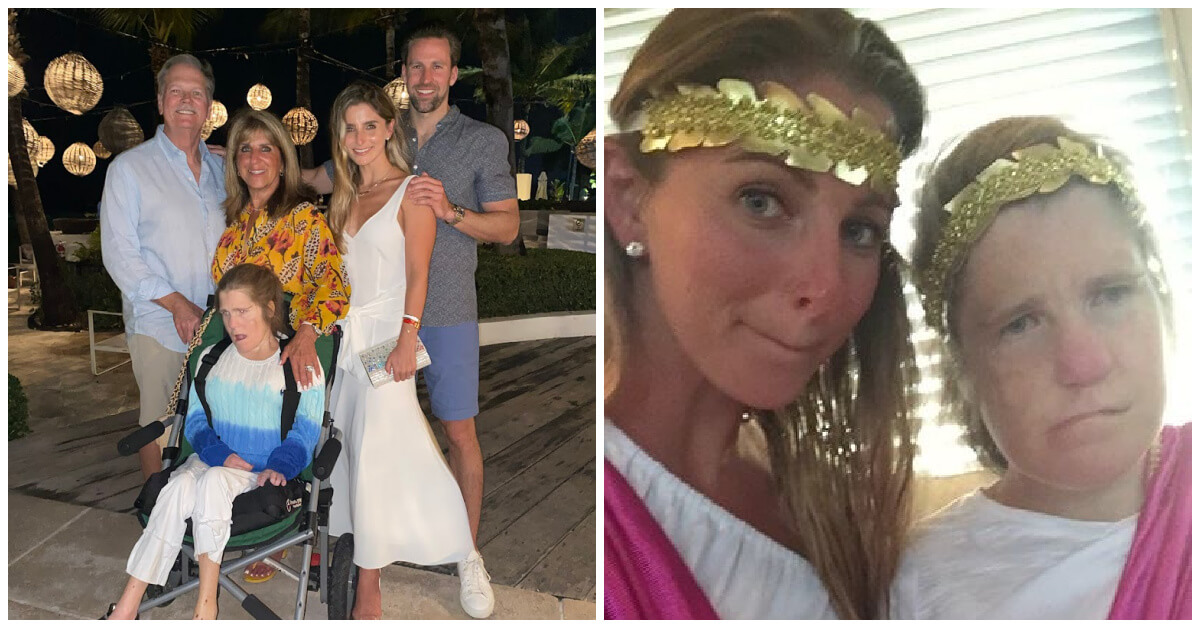
For Cindy Carpenter, 66, the dispute became painfully personal.
Her younger daughter, Chelsea, died at 33 of cancer in November. As Carpenter arranged the funeral, she and her husband purchased five burial plots at Paradise — for their two daughters, themselves and Chelsea’s husband — expecting the family would be buried together and according to Jewish practice. In total, the plots cost about $50,000, Carpenter said.
Eleven weeks later, Carpenter returned to the same cemetery to bury her older daughter, Cortney, who had significant disabilities and died at 40 after a long illness. Between the first funeral and the second, Carpenter said, the cemetery moved from compromise to refusal.
At Chelsea’s funeral, after intervention from local rabbis, mourners say they were allowed to stay but were placed around 20 feet away behind a rope while the casket was lowered. It was an imperfect accommodation Carpenter said she accepted. She understood the attempt to balance safety and tradition.
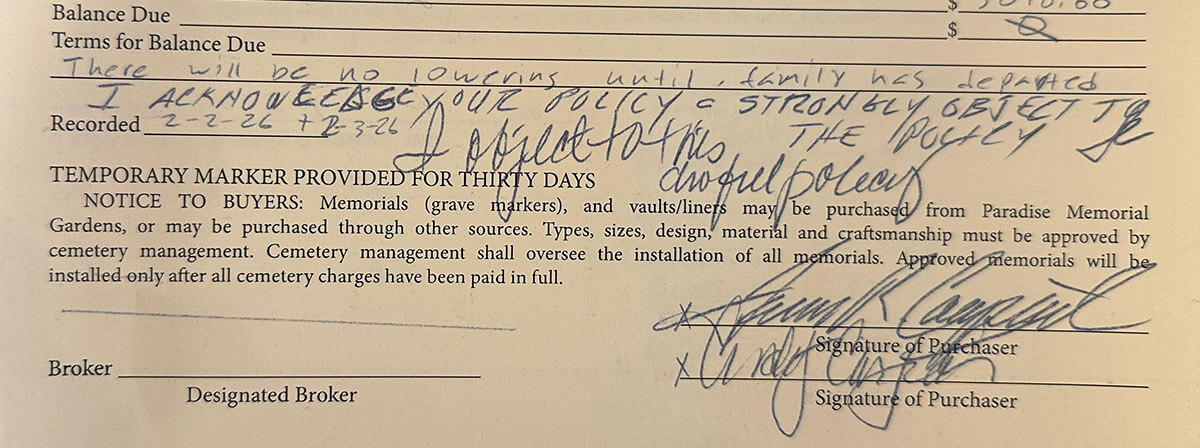
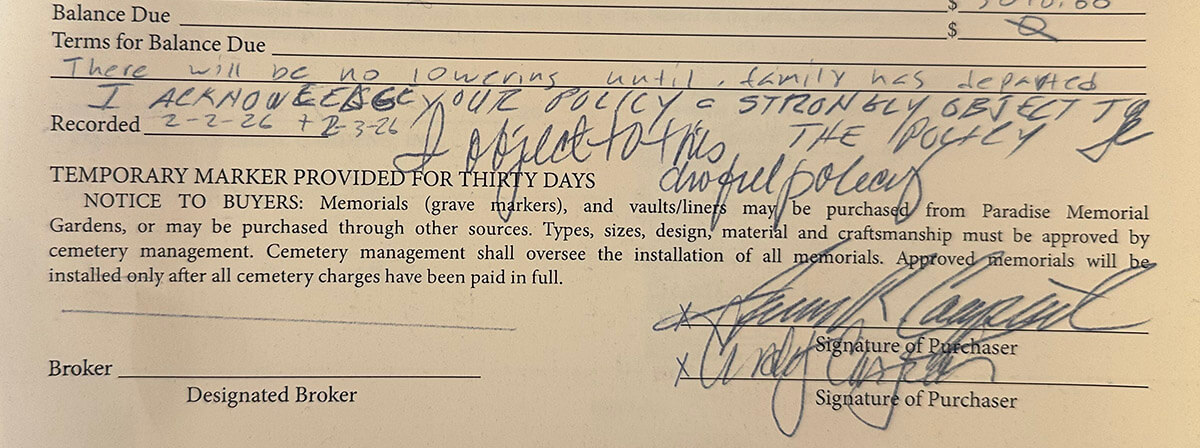
When Cortney died at the end of January, Carpenter said, that accommodation was gone. The standardized printed contract for the graveside service had added to it an additional handwritten note at the bottom stating that the casket would not be lowered until the “family has departed.” Carpenter said she was told that they had to leave the property altogether and that her request to stay inside a building at the cemetery and watch from a window was denied. Carpenter and her husband, Jim, signed under protest because the funeral was the next day.
Cindy added her own handwritten note: “I object to this awful policy,” while Jim wrote: “I acknowledge your policy & strongly object to the policy.”
“We’re grieving parents for the second time in 11 weeks,” Carpenter said in an interview. “And you’re telling me I can’t stay to see my daughter buried?”
Rabbi Pinchas Allouche of Scottsdale’s Congregation Beth Tefillah, who officiated at the funerals for both of Carpenter’s daughters, confirmed that everyone who came for Cortney’s funeral was told they could not wait in their cars and had to leave the property. “It was horrible,” Allouche said.
Afterwards, Allouche sent his 24-year-old son back into the cemetery — dressed in a baseball cap and sunglasses — to pretend to be a random person visiting a nearby grave. “From there,” Allouche said, his son “took a video of the lowering of the casket and the covering of the grave for the family to have some slice of comfort in all this.”
Cemetery officials say the rule is not aimed at any one faith. Sabrina Messinger-Acevedo, CEO and owner of Messinger Mortuaries, which operates Paradise Memorial Gardens, said the cemetery is non-denominational and that its safety policies are applied uniformly. She acknowledged the new policy does “not fully align with certain religious traditions,” but said it was adopted after past incidents in which attendees failed to follow staff directions, creating safety concerns.
Messinger Mortuaries operates multiple funeral homes, cemeteries and crematories across Arizona, including Paradise Memorial Gardens, which has a large Jewish section.
Cortney’s funeral was Feb. 3, but the dispute did not gain attention until it was reported by the local news on Feb. 16. Carpenter said the delay was due to the non-stop coverage of the Tucson disappearance of Nancy Guthrie, the mother of Today show host Savannah Guthrie.
Eddie Dressler, a funeral director who has served Atlanta’s Jewish community since the 1990s, said he has never encountered a cemetery policy requiring families to leave before the lowering of a casket. “Having a rule like that is just crazy,” Dressler said.
The only similar restrictions he has seen are at some U.S. Department of Veterans Affairs cemeteries, which open multiple graves at once for logistical reasons — but even there, he said, exceptions are typically made for Jewish burial practices.
Safety and spirituality
Allouche said the rule removes what Jewish law considers the defining moment of burial. The lowering of the casket and the covering of the grave, he said, are not symbolic gestures but the final act of care for the dead — one traditionally performed with mourners present and often participating.
Allouche said he is working with an attorney and expects to challenge the policy, arguing that families who purchased plots in the cemetery did so with the expectation they would be able to bury loved ones according to Jewish practice. Applying the rule without exception, he said, effectively prevents that.
Rabbi Randy Brown, the resident rabbi at Arlington National Cemetery who has officiated at more than 900 funerals there, said safety concerns at gravesides are real. He has personally helped prevent people from falling in “dozens of times.”
But Brown said most cemeteries do not impose blanket bans. Instead, clergy, funeral directors and grounds crews typically coordinate accommodations, such as keeping families at a distance during the lowering and allowing them to return afterward to place earth on the grave, a practice that preserves both safety and ritual meaning.
Graveside funerals, he said, function both as sacred ritual and, with bulldozer equipment nearby, active work sites. Arlington, he added, approaches each burial individually — considering weather, terrain and family needs — rather than applying a single policy to every service.
Brown described the moment when earth strikes the casket as emotionally powerful for many mourners, recalling his own experience at his grandmother’s funeral as “visceral and cosmic.” That meaning, he said, is why cemeteries and clergy typically seek practical compromises. “It’s not one size fits all,” he said.
Religious disputes have surfaced elsewhere. In Atlanta in 2023, for example, a synagogue threatened to sue after a cemetery policy was seen by rabbis as interfering with Jewish burial customs. The cemetery eventually settled.
Allouche said he expects legal action to move forward. Some families who own plots at the cemetery have begun reconsidering their plans, he said, while others are waiting to see whether the cemetery revises its rules or reaches a compromise with community leaders.
Messinger-Acevedo said her company — founded in 1959 by her grandparents, Paul and Cora Messinger — has “deep roots in the community” and a commitment to serve families with “care and compassion.” She said they offer “partial refunds to families who choose to rescind the purchase of an unused burial space” — a complex decision for those with relatives already buried at the cemetery.
Carpenter said the dispute is not something she wanted to fight, but one she felt compelled to pursue. Nearly two decades ago, she founded Cortney’s Place, a day program for adults with disabilities created in her older daughter’s honor, and is now working with local clergy to create “Shabbat boxes” for Jewish patients in hospitals — small packages with challah, candles and grape juice inspired by Chelsea.
“I fought for them all of their life,” Carpenter said. “And this is no different.”
The post An Arizona cemetery now requires mourners to leave before burial. A rabbi plans to sue. appeared first on The Forward.
Uncategorized
High-Stakes US Special Forces Mission Rescues Airman From Iran After F-15 Crash

FILE PHOTO: A U.S. Air Force F-15E Strike Eagle aircraft takes off for a mission supporting Operation Epic Fury during the Iran war at an undisclosed location, March 9, 2026. U.S. Air Force/Handout via REUTERS/File Photo
US forces staged the audacious rescue of an airman behind enemy lines after Iran downed his fighter jet, officials said on Sunday, resolving a crisis for President Donald Trump as he weighs escalating the war, now in its sixth week.
The airman rescued by special operations forces, who Trump said was a colonel, was the weapons-systems officer on the downed F-15, a US official told Reuters.
“Over the past several hours, the United States Military pulled off one of the most daring Search and Rescue Operations in US History,” Trump said in a statement, adding that the airman was injured but “he will be just fine.”
The officer was the second of two crew members on the warplane that Iran said on Friday had been brought down by its air defenses. Iran’s Revolutionary Guards said several aircraft were destroyed during the US rescue mission, Tasnim news agency reported.
Reuters reported on Friday that the first crew member had been retrieved, triggering a high-profile search by both Iran and the United States for the remaining airman.
Iranian officials had urged citizens to help find him, hoping to gain leverage against Washington in the war Trump and Israel launched on February 28.
Trump has threatened to escalate the conflict in the coming days with attacks on Iran’s energy infrastructure.
Had Iran captured the airman, the ensuing hostage crisis could have shifted American public perception of a conflict that opinion polls show was already unpopular.
Trump said the airman was rescued “in the treacherous mountains of Iran” in what he said was the first time in military memory that two US pilots had been rescued, separately, deep in enemy territory.
The official told Reuters that as the weapons-systems officer was moved from near a mountain to a transport aircraft parked within Iran, US forces had to destroy at least one of the aircraft because it had malfunctioned.
U.S. AIRCRAFT HIT
The rescue effort, involving dozens of military aircraft, encountered fierce resistance from Iran.
Reuters reported on Friday that two Black Hawk helicopters involved in the search were hit by Iranian fire but escaped from Iranian airspace.
Separately, a pilot ejected from an A-10 Warthog fighter aircraft after it was hit over Kuwait and crashed, the officials said, though the extent of crew injuries was unclear.
Still, Trump was triumphant.
“The fact that we were able to pull off both of these operations, without a SINGLE American killed, or even wounded, just proves once again, that we have achieved overwhelming Air Dominance and Superiority over the Iranian skies,” he said in his statement.
US air crews are trained in what to do if they go down behind enemy lines, measures known as Survival, Evasion, Resistance and Escape, but few are fluent in Persian and face a challenge in staying undetected while seeking rescue.
The conflict has killed 13 US military service members, with more than 300 wounded, US Central Command says. No US troops have been taken prisoner by Iran.
While Trump has repeatedly sought to portray the Iranian military as being in tatters, they have repeatedly been able to hit US aircraft.
Reuters reported on US intelligence showing that Iran retains large amounts of missile and drone capability. Until just over a week ago, the US could only determine with certainty that it had destroyed about one-third of Iran’s missile arsenal.
The status of about another third was less clear, but bombings probably damaged, destroyed or buried those missiles in underground tunnels and bunkers, Reuters sources said.
The US and Israeli war on Iran has spread across the Middle East, killing thousands and hitting the global economy with soaring energy prices that are fueling fears of inflation.
Uncategorized
On Easter, Pope Leo Urges World Leaders to End Wars, Renounce Conquest

Pope Leo XIV waves from the main balcony of St. Peter’s Basilica after delivering his “Urbi et Orbi” (To the city and the world) message, on Easter Sunday at the Vatican, April 5, 2026. Photo: REUTERS/Remo Casilli
Pope Leo urged global leaders in his Easter message on Sunday to end the conflicts raging across the world and abandon any schemes for power, conquest or domination.
The pope, who has emerged as an outspoken critic of the Iran war, lamented in a special message to the thousands gathered in St. Peter’s Square that people “are growing accustomed to violence, resigning ourselves to it, and becoming indifferent.”
“Let those who have weapons lay them down!” the first US pope exhorted. “Let those who have the power to unleash wars choose peace!”
Leo did not mention any specific conflicts in the message, known as the “Urbi et Orbi” (to the city and the world) blessing. It was unusually brief and direct.
The pope said that the story of Easter, when the Bible says Jesus rose from the dead three days after not resisting his execution by crucifixion, shows that Christ was “entirely nonviolent.”
“On this day of celebration, let us abandon every desire for conflict, domination, and power, and implore the Lord to grant his peace to a world ravaged by wars,” Leo urged.
Leo, who is known for choosing his words carefully, has been forcefully decrying the world’s violent conflicts in recent weeks and ramping up his criticism of the Iran war.
In a sermon for the Easter vigil on Saturday night, he urged people not to feel numbed by the scope of the conflicts raging across the world but to work for peace.
The pope made a rare direct appeal to US President Donald Trump on Tuesday, urging him to find an “off-ramp” to end the Iran war.
In his address from the balcony of St. Peter’s Basilica on Sunday to the Square below, decorated with thousands of brightly colored flowers for the holiday, Leo offered brief Easter greetings in ten languages, including Latin, Arabic and Chinese.
The pope also announced he would return to the Basilica on April 11 to host a prayer vigil for peace.
Uncategorized
Temple Mount Set for Limited Reopening to Jews and Muslims

Israeli National Security Minister and head of Jewish Power party Itamar Ben-Gvir gives a statement to members of the press, ahead of a possible ceasefire between Israel and Hamas, in Jerusalem, Jan. 16, 2025. Photo: REUTERS/Oren Ben Hakoon
i24 News – Israeli authorities are preparing to partially reopen the Temple Mount in Jerusalem to both Jewish and Muslim worshipers for the first time since the start of the war with Iran, under a tightly controlled and highly restricted security arrangement, i24NEWS has learned.
According to details obtained by i24NEWS, the Israeli police, backed by National Security Minister Itamar Ben-Gvir, are also expected to permit limited access for Jewish worshipers to the Western Wall as part of the same phased plan.
Under the framework, access to the Temple Mount and surrounding holy sites would be restricted to small groups of up to 150 people at a time. In the event of a missile alert, all visitors would be immediately evacuated in accordance with emergency protocols.
The decision follows a recent Supreme Court ruling allowing demonstrations in a limited format. Police argue that a consistent standard must apply across both civic gatherings and religious sites, with Ben-Gvir insisting that “there cannot be one rule for demonstrations and another for the Temple Mount.”
However, the reopening contradicts recommendations from the Home Front Command, which has advised keeping sensitive sites closed due to the ongoing risk of missile attacks.
Israeli Justice Minister Yariv Levin has proposed transferring authority over such security-related decisions exclusively to defense officials, an initiative that could reshape the balance between the judiciary and security establishment regarding restrictions on public access.