



Uncategorized
Anne Carson — a poet of spirituality and ‘small things’ — has won the Nobel Prize
Anne Carson, today awarded the Nobel Prize in Literature, can be a difficult poet. Much of her work is erudite, complex and genre-defying; it is poetry and prose and criticism and translation and, occasionally, a kind of theology. But Carson’s work is also profoundly spiritual and richly rewarding, especially for those of us prone to introspection, intellection, melancholy, and, as Carson once described the task of a writer, “noticing small things.”
There are many facets of Carson’s work, and many lenses through which one might relate to it. Born in 1950, Carson was trained as a classicist, and spent much of her career teaching Ancient Greek; in addition to her translations of Sophocles, Sappho, and others, her own poems are often saturated with classical references. Her essays on a wide variety of subjects are similarly erudite and rich. Many have written on these aspects of her work.
Personally, though, as a contemplatively-inclined Jewish reader, I have found her to be a literary as well as spiritual role model. I use the word ‘spiritual’ with hesitation. I doubt Carson would like it much, and what I mean by it is not the cultivation of certain warm feelings but the choice to pay attention, in a certain way, to both the surfaces and the depths of things; to refuse the pat dichotomy between the head and the heart; to dwell in the interiority of experience that, paradoxically, arises from “noticing small things.”
When Carson does turn explicitly to religious and spiritual subjects (she was raised Catholic), she excels, perhaps more than any other writer I have read, in avoiding the clichés that make writing about ‘spirituality’ so challenging. Her long poem from 1992, “The Truth About God” begins:
My religion makes no sense
and does not help me
therefore I pursue it.When we see
how simple it would have been
we will thrash ourselves
Carson isn’t speaking conventionally here, I don’t think — this isn’t quite the Israelites saying, in Sinai, Na’aseh v’Nishmah, we will do and [then] we will understand. But it is a contemplative version of it; a devotional attitude toward the particular. In another section of the poem, entitled “God’s Justice,” she writes:
In the beginning there were days set aside for various tasks.
On the day He was to create justice
God got involved in making a dragonflyand lost track of time.
It was about two inches long
with turquoise dots all down its back like Lauren Bacall.
So this is why there is no justice in the world, or why we must always pursue it anyway: because God was so busy with beauty. The poet, too, gets distracted; the rest of the poem is about the dragonfly. (Like Mary Oliver, Carson is a sublime poet of nature.) As indeed is true in our world — alongside all the evils and injustices of the last few years, the shimmering of tree branches in the breeze, the light refracting into my study, remain as resonant as ever.
When I heard the news about Carson’s Nobel, I came across a post by Florida State University Professor Martin Kavka, whom I’ve known for many years and who, it turns out, is also a Carson fan. Like me, Kavka was elated to hear the news, and we chatted for a while. “Sometimes we think of poetry as something that expresses the way the world is, that pierces the mystery of the world and gives us True Knowledge,” Kavka told me. “But for me, Carson’s poetry, in its odd recombination of words, expresses how we so often feel askew when relating to the world, as if it will always be mysterious, as if its mystery were just there to taunt us.”
“We all know that when we feel askew,” Kavka continued, “authority figures make us feel that it’s our fault. This is true of religious authority figures — and Jewish texts, given that Deuteronomy suggests that we are at fault when we are not thriving — but also of political and educational authorities. Carson gives us all armor for those moments… And for so many of us who are (over)educated, we value assembly too much and beauty not enough. I feel recalibrated whenever I read her, as if I’ve just visited some sort of emotional chiropractor. “
I love that insight. Carson is definitely, in some ways, a nerdy writer. Her work is intellectual, dense, and sometimes opaque. (I find myself reaching again for the word ‘erudite.’) But that is not at the expense of emotional depth. A recent essay, for example, describes Carson’s heartbreaking loss, due to Parkinson’s Disease, of her ability to write legibly — but along the way discusses the Roman poet Catullus, the painter Cy Twombly, composer David Lang, psychiatrist Norman Doidge, as well as Roland Barthes, John Keats, John Cage, Gertrude Stein, and attending a boxing class for people with Parkinson’s. In it, she writes:
Let’s start with life, your life. There it is before you — possibly a road, a ribbon, a dotted line, a map — let’s say you’re 25, then you make some decisions, do things, have setbacks, have triumphs, become someone, a bus driver, a professor, a pirate, years pass, maybe in a family maybe not, maybe happy maybe not, then one day you wake up and you’re seventy. Looking ahead you see a black doorway. You begin to notice the black doorway is always there, at the edge, whether you look at it or not. Most moments contain it, most moments have a sort of sediment of black doorway at the bottom of the glass. You wonder if other people are seeing it too. You ask them. They say no. You ask why. No one can tell you.
A minute ago you were 25. Then you went ahead getting the life you want. One day you glanced over from 25 to now and there it is, the doorway, black, waiting.
Similarly, Kavka’s favorite Carson poem, “Merry Christmas from Hegel,” begins with the poet “wretchedly lonely with all my family dead”:
It was the year my brother died, I lived up north and had few friends or they all went away. Christmas Day I was sitting in my armchair, reading something about Hegel.
Yet she doesn’t stay in the armchair. She is “overjoyed” at Hegel’s language, at “this notion of a philosophic space where words drift in gentle mutual redefinition of one another,” and she goes outside to stand in the snow:
I went to the middle of a woods. Fir trees, the teachers of this, all around. Minus twenty degrees in the wind but inside the trees is no wind. The world subtracts itself in layers. Outer sounds like traffic and shoveling vanish. Inner sounds become audible, cracks, sighs, caresses, twigs, bird breath, toenails of squirrel. The fir trees move hugely. The white is perfectly curved, stunned with itself. Puffs of ice fog and some gold things float up. Shadows rake their motionlessness across the snow with a vibration of other shadows moving crosswise on them, shadow on shadow, in precise velocities. It is very cold; then that, too, begins to subtract itself, the body chills on its surface but the core is hot and it is possible to disconnect the surface, to withdraw to the core, where a ravishing peace flows in, so ravishing that I am unembarrassed to use the word *ravishing*, and it is not a peace of separation from the senses, but the washing-through peace of looking, listening, feeling, at the very core of snow, at the very core of the care of snow.
This is the consolation of the intellectual life, in the best sense: the abstruse philosophical language of Hegel liberates the poet from her melancholy, sends her out into the woods where she has an encounter with the numinous, rendered in perfect, concrete prose without a single platitude of religious or spiritual writing.
Said Kavka of this work, “I learned how to be a widower — how to relate to the world so that death does not govern my existence — from her.”
I am delighted that Carson has won the Nobel, not only for the recognition (and money!) that she deserves, but because it might win her some new readers, including those of us in the Jewish spirituality world for whom Carson’s “noticing” is at the center of our religious lives. I’ll give her the last words, once again taken from the poem “The Truth About God”:
God’s Work
Moonlight in the kitchen is a sign of God.
The kind of sadness that is a black suction pipe extracting you
from your own navel and which the Buddhists call“no mindcover” is a sign of God.
The blind alleys that run alongside human conversation
like lashes are a sign of God.God’s own calmness is a sign of God.
The surprisingly cold smell of potatoes or money.
Solid pieces of silence.From these diverse signs you can see
how much work remains to do.
Put away your sadness, it is a mantle of work.
The post Anne Carson — a poet of spirituality and ‘small things’ — has won the Nobel Prize appeared first on The Forward.
Uncategorized
How Stanley Kubrick created a Jewish universe without Jews
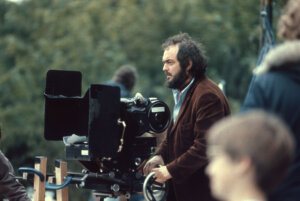
Recently, while watching the new 4K transfer of Lolita in Criterion’s enormous new Stanley Kubrick set, I found myself lingering over an exchange near the start of the film. Humbert Humbert (James Mason) has come to murder Clare Quilty (Peter Sellers), who greets the revolver pointed at the lapel of his pajama with an objection to its owner’s background. “You are either Australian or a German refugee. This is a gentile’s house. You’d better run along,” Sellers mutters with sangfroid. The remark comes verbatim from Nabokov’s novel. Kubrick, a voracious, eclectic reader and an inventive adapter, chose to keep it and put it in the mouth of a Jewish actor.
As a budding cinephile in the late 1990s, I decided to anoint Kubrick my favorite director. When I learned he was Jewish, while preparing a school report on him, I didn’t know what to make of this odd fact. His films gave me very little help. Decades later, I’m still grappling with Kubrick’s small yet profound output — 13 feature films spanning half a century — and how being Jewish helped inform his distinctive cinematic universe. As several scholars have observed, it is largely a universe without Jews, yet one created with an outsider’s suspicion, curiosity and maybe even secret knowledge.
In 7th grade, I made a Geocities website devoted to Kubrick and Peter Greenaway, another director with a baroque aesthetic who was my other favorite auteur du jour. At that time, I was drawn to directors whose films were so visually opulent that they announced themselves almost before anything happened.
My mother had forbidden me from watching A Clockwork Orange, for obvious reasons, which is why I immediately grabbed a VHS off the shelf of a video store on the Upper West Side, long gone now, whose employees were so terminally bored that an adolescent boy could have easily rented a double feature of Deep Throat and Debbie Does Dallas. A Clockwork Orange was the first Kubrick film I saw and it overwhelmed me, not only because it was brutal and disturbing, but because it looked, sounded and felt like nothing else. As I made my way through Kubrick’s catalogue, I understood that these were films to become absorbed in, to revisit endlessly and learn by heart. They helped form my sense of what I wanted from movies.

The boy who taught himself HTML to design that fansite would have wanted The Complete Kubrick very badly. Nearly three decades after the director’s death, Criterion’s lavish boxset is the first time Kubrick’s entire cinematic output, including three shorts, has been gathered in one place. It occupies 30 discs, includes over 25 hours of supplements, is housed in lavish, luxurious packaging and arrives with a ridiculous list price of $599.95. The timing is curious: Kubrick’s centenary falls in 2028; the 30th anniversary of his death in 2029.
In the decades since Kubrick’s death, the cinematic canon has been reshaped several times over. It has been particularly fascinating to follow the changing reputation of Kubrick’s films. When I was growing up, 2001 and Dr. Strangelove were considered the obvious summits; Barry Lyndon, which was hailed upon its release in 1975 but was somewhat forgotten in the home video era (watching a slow-moving historical epic on a pan-and-scan VHS on a small, boxy tube did the film few favors), is again considered one of his greatest achievements. The Shining and Eyes Wide Shut, later works which many critics treated as disappointments, are now among his most analyzed and culturally influential.
Devotion to Kubrick’s labyrinthine works can take extreme forms. Rodney Ascher’s documentary, Room 237 (2012), which would have made an excellent supplement here, brings together viewers who have found radically different films inside The Shining. The historian Geoffrey Cocks, who has studied Kubrick’s preoccupation with Nazi Germany, reads it in the shadow of the Holocaust. Elsewhere in the documentary, The Shining is treated as an allegory of the genocide of Native Americans and a confession that Kubrick helped fake the moon landing. Eyes Wide Shut has acquired a more lurid posthumous life through claims that Kubrick was trying to expose a murderous network of elite pedophiles connected to Jeffrey Epstein who secretly run the world: in this outlandish telling, Warner Bros. executives had him killed, and the evidence (the missing 20 minutes that hardcore conspiracists refer to) was cut from the film.
I confess to finding that theory as addictive as it utterly bonkers. (It’s a very entertaining rabbithole to go down.) I’ve never finished arguing with Eyes Wide Shut, albeit for very different reasons. Around the time that I discovered Kubrick, I learned that he was shooting his first movie since Full Metal Jacket, which had been, up to the point, the only Kubrick film released in my lifetime. I became obsessed with the top secret project about which little was publicly known, downloading its minute-long trailer byte by byte (an operation that took an entire afternoon in 1998) and tracking down the Arthur Schnitzler novella, Traumnovella, or Dream Story, that the film was supposedly based on. Up until his death, in March 1999, Kubrick did his utmost to tease the audience, spreading and nurturing rumors that this was going to be the most risqué and explosively, explicitly sexual film ever made. (Why this speculation appealed to a 13-year-boy doesn’t need spelling out.)
At 14, I managed to attend a sneak preview screening of Eyes Wide Shut. I expected a revelation and came away crushed. By then Kubrick was dead; this would be the only new film of his I could ever anticipate. There was something profoundly frustrating about being left with this one, with its slow, often banal conversations, solemn sexual pageantry (a far cry from the titillation we’d been promised) and New York streets that seemed to belong nowhere. I still go back and forth between thinking the film is a masterpiece and elaborate failure. (I personally doubt that Kubrick had finished tinkering with it. Could such an infamously perfectionist director have failed to notice the sound man reflected in a mirror in one of the film’s early scenes and subsequently scrubbed out digitally? What else would Kubrick have changed if he could have?)
When watching Eyes Wide Shut, it’s instructive to recall that at one point Kubrick considered casting Steve Martin in the main role. If Tom Cruise isn’t exactly the clueless simpleton of The Jerk (a film that Kubrick loved), for most of Eyes Wide Shut’s two and a half hours, his combination of confidence and obliviousness makes him something of a Candide-esque hero. Cruise’s suave, handsome assurance keeps rubbing up against things it cannot comprehend, let alone control. This is the engine of the film’s sly comedy, which crescendoes in Cruise’s “unmasking” during the glacial orgy and the campy “sacrifice” that follows. How a viewer responds to such scenes determines whether he or she will go along with the film’s weirdly ambling nocturnal set pieces or find the whole thing unbearable.

The film has stayed in my senses through years of misgivings. Its social dynamic has also become clearer. Cruise’s character is sufficiently inside the world of the rich and powerful, as personified by Syndey Pollack’s Ziegler, to be invited to his townhouse for a sumptuous Christmas party — the film’s first grand set piece — and then summoned discreetly by the host when a prostitute overdoses upstairs. He is a useful physician with a reassuring bedside manner. Two hours later, after Cruise tries and fails to infiltrate the dangerous erotic power base of the masters of the universe, Ziegler over a red billiard table, explains how little the doctor’s professional competence entitles him to know or participate in.The distinction between belonging and being admitted can seem insignificant until someone decides to enforce it. At a certain point, you run out of passwords.
Kubrick knew something about arranging those distinctions to his own advantage. The Jewish doctor’s son from the Bronx became an English country-house owner who could summon Hollywood executives across the Atlantic. Warner Bros. financed and distributed his films while granting him extraordinary freedom. The Warner Bros. chairman and CEO Terry Semel recalled flying to London to read scripts Kubrick would not send to California; a copy would arrive under his hotel-room door. Here was an outsider who had secured an unusually powerful place inside the system. He could look at its rituals with amusement while conducting elaborate rituals of his own.
That duality seems more illuminating than the familiar picture of a remote intelligence contemplating humanity from above. Kubrick’s camera is luxuriously attentive to the things his characters desire: the candlelit room, the mansion, the uniform, the beautifully appointed bathroom. Wealth and rank are seductive in these films, even when their possessors behave monstrously.
To this day, A Clockwork Orange remains my favorite among his films. Its pleasures are often on the surface: the Korova milkbar’s kinky white female statues serving as tables and dispensing drug-laced milk – they were designed by Liz Moore and inspired by the work of the British pop artist Allen Jones – the brutalist concrete glimpsed in the film’s few exterior shots, the dancing Christs in Alex’s bedroom, Malcolm McDowell’s single false eyelash and insinuating gaze. The film has a nasty lightness that still astonishes me. Everything about the film, even the shocking scenes of violence and rape, seems designed to produce in the viewer an intense pleasure — often followed by a sense of disgust for finding it all so exhilarating. Kubrick’s knack for selecting and editing to music is virtually unmatched in the history of cinema. Rossini’s The Thieving Magpie sends a gang fight skipping along; bodies collide with the precision and extravagance of a comic ballet. After A Clockwork Orange, “Singin’ in the Rain” never sounded the same.

The soundtrack of a Kubrick film bores its way into memory along with the images, until a piece of music can seem to contain a fully-realized scene. The circling spacecraft in 2001 acquires the poise of ballroom partners through Johann Strauss’s Blue Danube. Handel’s Sarabande gives the foolish, deadly business of honor in Barry Lyndon a heavy, implacable tread. His choices could be startlingly current: György Ligeti’s Requiem and Lux aeterna were completed in 1965 and 1966, barely before the film’s 1968 release. Later came Krzysztof Penderecki alongside the earlier Bartók in The Shining. Audiences entering a mainstream movie found themselves listening to some of the most adventurous, avant-garde music in Europe.
The Jewishness I didn’t know what to do with in 7th grade has acquired more texture through the books and testimony that have appeared since Kubrick’s death. Scholars like Nathan Abrams and David Mikics have traced his intellectual formation and his attachments to European Jewish writers. Kubrick tried to adapt Stefan Zweig’s Burning Secret, a 1913 novella about a rakish baron who befriends a 12-year-old boy in order to seduce his mother, before he turned his attention to Traumnovelle. His admiration for the Austrian-Jewish director Max Ophüls, who also adapted Schnitzler in La Ronde, offers another connection to the impossibly sophisticated and profoundly Jewish world of fin-de-siècle Vienna. Kubrick harnessed Ophüls’ fluid mobile camera, the unsentimental sexual bargaining, the casual (and not so casual) cruelty that supposedly civilized people inflict on each other. Kubrick’s European taste was an active part of his American filmmaking.
Since his death and the opening of his archives, even Kubrick’s unmade films have acquired remarkable solidity. In 2005 I wrote in these pages about Aryan Papers, Kubrick’s planned adaptation of Louis Begley’s Wartime Lies. Its Jewish boy and his aunt survive under Catholic identities; the question of who might pass, and who would be recognized, is a matter of life and death. The project remains among the scripts, research and photographs he left behind. His meticulous years’-long research into Napoleon received its own lavish afterlife in Taschen’s Stanley Kubrick’s Napoleon: The Greatest Movie Never Made. (Much of that exacting preparation eventually went into Barry Lyndon.)
The posthumous rediscovery of the atmospheric photographs that the young Kubrick shot for Look and other magazines in the late 1940s, has been another revelation. Already as a teenager, his eye was remarkably assured. These pictures show us a young man with a deep curiosity about what setting, atmosphere, clothing and makeup can reveal about people as well as a preoccupation with telling stories with images. One of Kubrick’s senior colleagues was Diane Arbus, to whom he would pay homage decades later with the immortally unsettling image of the Grady twins in The Shining.

Criterion’s set brings together the director’s juvenalia, including Day of the Fight, his 1951 documentary about the boxer Walter Cartier, which grew out of a Look assignment, and offers a surprising connection to his second feature, the atmospheric and pulpy noir, Killer’s Kiss. His debut feature, the existential war fable Fear and Desire, is a shakier proposition. Kubrick tried to suppress it, and its strained allegory and uncertain acting (it can feel like a discarded “Twilight Zone” episode) make his embarrassment easy to understand. It is no rediscovered masterpiece and I imagine that Kubrick would wince if he were forced to watch the 4K transfer included in the set.
In the decades since his death, Kubrick has been brought considerably down to earth through family recollections (he loved cats, low-brow cinema and was a wonderful dancer, according to widow Christiana, and his daughters) and Robert P. Kolker and Abrams’s comprehensive 2024 biography. Criterion includes a restored version of Vivian Kubrick’s Making “The Shining,” a rare glimpse of him on set, talking with his parents, working through thorny logistical problems and tormenting Shelley Duvall to force a performance of sheer terror out of her. (It’s hard to watch. At one point, he even tells the crew, “Don’t sympathize with Shelley. It doesn’t help her.”) It’s also a reminder that even the most individual and exacting of auteurs works with collaborators to bring his visions to life.
So many films now seem small by design, even when considerable money has gone into them. (Is it any wonder that Paul Thomas Anderson and Christopher Nolan, arguably today’s biggest studio auteurs, are hardcore Kubrickians?) Kubrick’s films continue to demand so much of our attention because we feel that their images contain so much. He could produce that sense of vastness and of meaning in a voyage across the universe or a jealous husband’s walk around a few city blocks. After all these years, I sometimes think I know my way around his films. Then a familiar line makes me wonder how much I’ve missed.
I’m in no hurry to run along.
The post How Stanley Kubrick created a Jewish universe without Jews appeared first on The Forward.
Uncategorized
In ‘American Doctor,’ a Jewish surgeon denounces Israel’s war. Now, a Palestinian colleague has been killed.

To much of the world, news of another deadly Israeli attack on a Gaza hospital last Thursday may have been just another grim headline of endless carnage. But for audiences who attended documentary screenings in more than 200 cities this year, the news will resonate vividly.
Among the six people killed in the airstrike on Nasser Hospital — one of at least a half-dozen direct attacks on the facility since the war began — was Dr. Rizk Abu Shaira, a Palestinian surgeon who appears briefly in the documentary American Doctor.
The film has been shown from Duluth to Copenhagen and it has picked up honors at film festivals since its January debut at Sundance. Director Poh Si Teng produced the Oscar-nominated documentary St. Louis Superman in 2020 and has a national Emmy to her credit.

The film follows three American physicians who traveled to Gaza to treat the wounded during Israel’s war with Hamas. They are Dr. Mark Perlmutter, a hand surgeon who is Jewish; Dr. Feroze Sidhwa, a trauma surgeon who practices Zoroastrianism; and Dr. Thaer Ahmad, a Palestinian American emergency physician. Abu Shaira also appears in the film and on the movie poster, operating alongside Sidhwa.
“He was quite a joy to be around,” Sidhwa told me hours after last week’s attack. “He knew the dangers very well but came back to work.”
So did Sidhwa.
“I was almost killed at Nasser on March 23 [2025],” he said. “I was on my way down to a patient’s room when it was blown up.”
That incident, which Israeli officials said was directed at a senior Hamas official being treated there, is chronicled in the film, which Teng described as a “character-driven journey through three men who couldn’t be more different.” It began with Perlmutter, whom she contacted after seeing him on a news report. He introduced her to Sidhwa and Ahmad.
The Jewish physician among the three, Perlmutter is also the most outspoken in condemning Israel’s conduct. “You can love Israel but hate the fascist right-wing government that runs it,” he says in the film.
While the other two also express criticisms, they are more restrained — though astute moviegoers may notice a plush fabric map of Palestine in the children’s book Ahmad’s wife reads to their toddler, as well as on her pendant necklace, which could be interpreted as an expression of Palestinian pride or erasure of Israel. Regardless, that aspiration is in no way comparable to the horrors shown.
“Three surgeons and four [medical fellows] are working on one little girl for 2½ hours and she’s very likely to lose her left leg and part of her arm,” Perlmutter says in the film, which is presented without narration.
Sidhwa told me of similar determination when remembering Abu Shaira, the doctor slain in last week’s attack.
“Rizk insisted that we take [a severely injured patient] to the operating room [saying], ‘Maybe we can save him,’” he recalled.
“Everybody was rolling their eyes and I said, ‘I’ll operate on him with you.’ He died anyway, but just because we didn’t have the ICU resources needed to keep such a person alive.”
That’s when they can operate.
The hospital was also hit in August 2025, when the Israeli military targeted a camera it said it believed was being used by Hamas. Five journalists were among the dead. Prime Minister Benjamin Netanyahu called that a “tragic mishap” and promised an investigation. Reuters later established that the camera belonged to its journalist.
That kind of incident is why Teng, who has her own production company after previously working at The New York Times, Al Jazeera and ABC News, says she decided to make the film.
“I was seeing people getting killed and executed, [former] Al Jazeera colleagues. That was really tough,” said Teng, a naturalized American born in Malaysia now living in New York. “I’m not Palestinian, I don’t live there, I’m not Jewish, so what is my entry point?”
That was her introduction to Perlmutter, who plotted a way to sneak her into Gaza after Israeli authorities denied her entry, as they had a return visit by Ahmad.
“He said, ‘I’m gonna train you as my scrub nurse and bring you in.’ And I said, ‘Mark, that’s never gonna happen.’”
Instead, she worked remotely with a crew from her Al Jazeera connections. Production started in late 2024 and concluded a year later — breakneck speed for a major documentary, though perhaps contributing to one structural flaw: The film jumps back and forth between 2024 and 2025, making an already confusing chronology of war more difficult to follow.
Still, that hasn’t stopped audiences around the world from responding emotionally to the film.
“American Doctor was very difficult to watch,” said activist Michele Naar-Obed of Duluth. “To see the blatant violation of laws by the Israeli government purposely targeting hospitals, civilians including children, and journalists, aided and abetted by U.S weapons, was hard enough. But we learned the day before that the hospital was hit again, and there is evidence that the bombs can be traced back to the U.S.
“The only way to change the course of these two morally depraved governments will be through the mass movements of we the people,” she added.
Teng has a connection to Duluth, though she’s never been there. The closest she’s come was the Twin Cities, which she first visited 21 years ago as an international student. I met her then and invited her to write for the Duluth News Tribune, where I was editorial page editor. Those became her first columns in a mainstream newspaper.
It would be wonderful to see her on the Oscar stage, or just to get a nod as director, or even to legitimately entertain the idea, given all the accolades the film has already received.
But it would be far better if its story never had to be told.
The post In ‘American Doctor,’ a Jewish surgeon denounces Israel’s war. Now, a Palestinian colleague has been killed. appeared first on The Forward.
Uncategorized
Sen. Elissa Slotkin is having a moment. Are Michigan’s Jews happy about it?

(JTA) — SOUTHFIELD – Ordinarily, Michigan Sen. Elissa Slotkin would seem an anodyne choice to speak at a Shabbat event for Jewish veterans.
Slotkin is Jewish and a former Defense Department official who served three tours in Iraq as a Central Intelligence Agency analyst. Emphasizing her national security background, the Democrat has also championed Israel as a U.S. ally and identifies as a Zionist.
Yet the clergy at Congregation Shaarey Zedek, a large Conservative shul in the Detroit suburbs, needed to defend their invitation to Slotkin in an email to congregants on Friday. One day before the Veteran’s Shabbat program, the synagogue’s leadership acknowledged “your concern, your offense, and even your hurt” in regards to Slotkin’s planned appearance.
The senator wound up not attending the service, with her staff citing flight trouble. The Federal Aviation Administration had ordered a four-hour ground stop for all U.S. flights late Friday stranding more than 1 million travelers.
But why were so many of the congregants at Shaarey Zedek up in arms about the prospect of their Jewish senator’s Shabbat appearance? The clergy didn’t elaborate, and a representative for Slotkin declined requests for an interview for this story.
Some Jewish former supporters of Slotkin’s summed up the biggest backlash to the Jewish Telegraphic Agency this way: She campaigned with the state’s senator-elect, Abdul El-Sayed. More broadly, Slotkin has also sought to put some distance between herself and the party’s staunchly pro-Israel wing as she has strayed left from her own moderate brand.
As Jews question their place in the Democratic Party, Slotkin’s moves — and her Jewish constituents’ reactions to them — could add further instability to the shifting ground.
Michael Horowitz, a Michigan resident and former CEO of the Jewish federation of Atlanta, is one Jewish community member who feels betrayed by her support of El-Sayed.
“I think as a leader in the party, she could have, and should have, called out some of the narrative coming from him and his supporters,” he told JTA about Slotkin stumping for El-Sayed across the state in the general election. “And I’m disappointed that she didn’t do that.”
The furor some Jews in the state have directed at their senior senator for associating with El-Sayed on the campaign trail is indicative of the deep wounds remaining in the state from the election — and a warning sign for the Jewish lawmaker in their midst hoping to rise in the ranks unscathed.
El-Sayed’s historic midterm win, and the Jewish community’s divisions over it, have grabbed the lion’s share of the national headlines from Michigan. But Slotkin’s profile has also grown — and she has teased she may run for president in 2028. If she does, some of her top former Jewish donors are signaling they see her support for the senator-elect as a problem.
El-Sayed has alienated many in the traditional pro-Israel camp with his criticism of Israel, and has had to walk back other statements of his from during the campaign that many Michigan Jews considered offensive. U.S. Rep. Haley Stevens, El-Sayed’s primary rival and a favorite of the state’s pro-Israel Jewish community, broke with her party in the race’s final days to endorse GOP nominee Mike Rogers. Slotkin took the opposite approach, campaigning with El-Sayed across the state and emphasizing the areas they agreed on.
Slotkin has built a name for herself as a bipartisan figure: She worked in both the George W. Bush and Obama administrations before running for Congress. She has sought to play a role as a bridge between El-Sayed’s progressive wing of the party and more moderate members of the voting bloc, including Jews.

“The state of Michigan can send one Jewish senator and one Muslim senator, the first time ever in history,” she told the cheering crowd at the Michigan Democratic Party’s election night watch party in Detroit, hours before El-Sayed’s victory. “That is who we are. That is the promise of America, and we are going to do it and show the whole damn world today.”
That approach speaks to some in the Jewish community. Mary Ellen Gurewitz, a vice chair of Michigan’s state board of canvassers and Jewish El-Sayed supporter, told JTA that she was glad to see Slotkin campaign with him.
The Jews who are opposed to Slokin over her support for El-Sayed, Gurewitz said, have their priorities wrong.
“That is so self-defeating. They need to be communicating with, and speaking on good terms with, their representatives in Congress,” she said. “To say, ‘We don’t want to talk to you because you supported Abdul,’ that’s just astounding to me.”
But Slotkin’s strong support of El-Sayed risks splitting her supporters rather than bringing them together. Slotkin won her 2024 Senate bid against Mike Rogers by 19,000 votes, in a year when Trump won Michigan in the presidential election. Analysts at the time chalked up her narrow win to her political identity as a moderate. Despite her background as an intelligence analyst with extensive Middle East experience, she did not make Israel a defining issue in that election.
Two years later, El-Sayed, also facing Rogers but from a progressive flank, improved on Slotkin’s margins considerably. Around 340,000 votes separated El-Sayed and Rogers as of press time, according to Associated Press tallies that have given El-Sayed a seven-point victory.
One of the major issues of the campaign was the lobbying activities of AIPAC. El-Sayed made AIPAC’s spending against him a key part of his own campaign pitch. Before then, Slotkin had already begun backing away from the group.
“I have not been endorsed by AIPAC,” Slotkin told the populist-minded show “Breaking Points” in 2025, noting that this was a shift from when she had accepted the group’s support in her first congressional run in 2018. She also hedged when the hosts asked her if AIPAC “should register as a foreign lobby.”
In the meantime, independent of El-Sayed, the senator has taken on President Donald Trump. She drew headlines last year for filming a video urging active duty military to “refuse illegal orders,” and again in recent weeks for saying she wanted to send a “deterrence message” to college graduates thinking of working for Trump’s administration.
And last week, Slotkin took on a leader of her own party, too. She joined progressive Vermont independent Bernie Sanders to announce they would not support New York Sen. Chuck Schumer for majority leader. The announcement helped to lay the table for Maryland Sen. Chris Van Hollen, a progressive Israel critic, to formally challenge Schumer, who is Jewish, days later.
“We need a new generation of leadership,” Slotkin said then.
There are other signs that Slotkin is listening more to the progressive flank of her party these days. Along with much of the Democratic Party, she has shifted on Israel. In April the senator voted to block the sale of offensive weapons to Israel, saying, “Being pro-Israel today is not about simply supporting the political or military agenda of Prime Minister Netanyahu, just like being pro-American should not be equated with loyalty to President Trump.” She continues to support funding for the Iron Dome, the country’s missile defense system.
Slotkin’s rhetoric on Israel was another concern for Horowitz, the donor who was previously much more supportive of her. A Jewish Democratic Council of America fundraising call between the two of them briefly led to accusations that she was unethically using her Congressional office to fundraise in 2022.
Now, though, he accuses her of jumping “on that AIPAC dogwhistle.”
“I know she has had criticism of some of the actions of the Israeli government, which is fine,” he said. But, he added, “What she does, and how she says it, becomes tools and ammunition because it’s coming from a Jewish leader.”
Halie Soifer, head of the Jewish Democratic Council of America, does not share the qualms about Slotkin that some Michigan Jews have.
“Senator Slotkin reflects a growing Jewish American consensus of support for Israel’s security and right to self-defense, while opposing extreme policies of the current Israeli government,” Soifer told JTA in a statement.
“We are confident that Senator Slotkin will continue to be a leader and champion on the issues that matter most to Jewish Americans, and we’re grateful for her leadership.”
Back at Shaarey Zedek, the congregation’s leaders may have dodged a scuffle thanks to the FAA. But before they realized that, the rabbis and cantor wanted to offer their own praise of the senator.
Slotkin, they told their members, would address them “with kindness and respect, with humility and empathy, and with an open mind and heart to the differing opinions and concerns of our shul.”
This article originally appeared on JTA.org.
The post Sen. Elissa Slotkin is having a moment. Are Michigan’s Jews happy about it? appeared first on The Forward.
