


Uncategorized
Anti-Israel Lie Online: Jewish Refugees Were Welcomed by Palestinians After the Holocaust
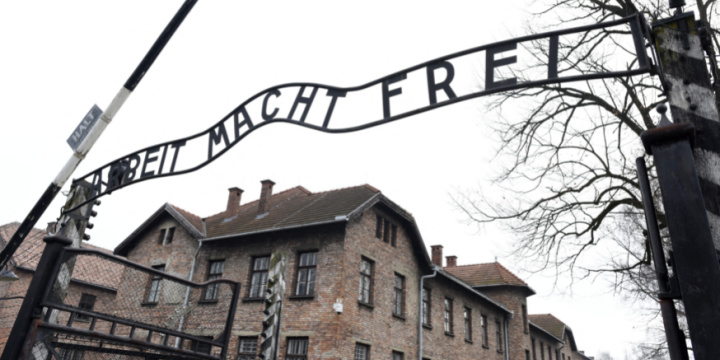
The sign “Arbeit macht frei” (“Work makes you free”) is pictured at the main gate of the former Nazi concentration and extermination camp Auschwitz in Oswiecim, Poland. Photo: Reuters/Pawel Ulatowski
Another day, another lie when it comes to Israel on social media. This includes fabricating the history of the Jewish State.
While most anti-Israel inventions don’t gain traction and get lost in the cacophony of fringe voices that thrive in the dark corners of the Internet, others rise above the fray and take on a life of their own.
One of the latest historical falsehoods to take off online is the claim that, following the Holocaust, the Palestinians welcomed Jewish survivors of the Nazi genocide (with some even claiming that they were welcomed into their private homes), and it was these same survivors who later turned around and expelled them from their homes.
Even the most novice student of Israeli history could tell you that this claim is a laughable distortion of the past, so absurd as to not even warrant a response.
However, despite its blatant untruthfulness, this narrative has gained steam online, with one X (formerly Twitter) account’s telling of it reaching over two million views.
A history professor (!!) at Austin Community College, also shared this fiction on his Instagram page, reaching over 57,000 likes (the second most-liked post on his Instagram).
Jews arriving in Palestine from Europe as refugees in 1947.
Shortly after getting off the boat, they began killing and robbing the homes of the Palestinians who welcomed them with open arms.
Now they believe they are indigenous to the land. pic.twitter.com/N1NExKKszs
— Censored Humans (@CensoredHumans) October 23, 2025
So, before this anti-Israel lie becomes accepted history in certain circles, let’s break down why it’s baseless and ridiculous:
First things first: Between 1945 and 1948, there was no independent Palestinian government that could welcome Jewish refugees, even if they wanted to. The immigration policy was set by the administration of the British Mandate of Palestine, and this policy was hardly welcoming to the thousands of refugees who wished to reach the shores of the Land of Israel.
A few months before the start of the Second World War, the British government issued the 1939 White Paper, which set a severe limit on Jewish immigration to the British Mandate: 75,000 Jews over the next 5 years. After that, any Jewish immigration would be subject to the will of the land’s Arab population. For the masses of Jews who would soon be seeking refuge from the claws of the Nazi regime, this policy effectively served as a death sentence.
The White Paper was a response to three years of violence during the Great Arab Revolt (1936-1939). The Revolt, which saw Arab attacks on both Jews and the British in Mandatory Palestine, was partially due to a rise in Jewish immigration to the land over the past few years. Instead of welcoming those who were fleeing Nazi Germany and Eastern Europe, the leadership of the Arab population of the British Mandate resorted to violence to halt the flow of Jewish immigrants.
Despite the 1939 white paper, illegal Jewish immigration persisted and continued to increase during WW2.
After 1945, Jewish immigration to Mandatory Palestine was still illegal – but persisted anyway via smuggling networks. pic.twitter.com/72XAeqWntF— Tal Hagin (@talhagin) December 6, 2023
If some will respond, “Sure, that was before the Holocaust. After the destruction of European Jewry, the Palestinians opened their arms to Jewish refugees,” this is simply not true.
Even after the Nazi regime was defeated and the mass slaughter of Jews was put to an end, the British continued their policy of barring most Jewish immigration. With so many Jewish displaced persons wanting to immigrate to the Land of Israel, there was a rise in coordinated attempts to break the British maritime blockade with ships full of refugees (the most famous of which was Exodus 1947). Roughly 50,000 Jewish refugees from the ruins of Europe were intercepted by the British and largely interned in detention camps on Cyprus.
It was not only the British seeking to stop Jewish immigration to the British Mandate after the Holocaust. In 1946, the Anglo-American Committee of Inquiry noted that the Arab leadership was opposed to any Jewish immigration to Mandatory Palestine and that their main issue with the 1939 White Paper was that it didn’t go far enough in blocking Jewish immigration.
As paragraph 9 of Chapter VI states:
The White Paper of 1939, and the drastic limitation of Jewish immigration and of land sales to Jews which followed, met the Arab view only in part. The Arabs would have gone much further.
The demands voiced by their leaders are for immediate independence, for the final cessation of Jewish immigration and for the prohibition of all land sales by Arabs to Jews.
This attitude is not surprising as the Committee’s report noted that many of Palestine’s Arabs still aligned themselves with the exiled Grand Mufti of Jerusalem, who had served as a guest and ally of Hitler during the Second World War.
Thus, it is clear that, contrary to the false narrative being promoted online, the Palestinians did not welcome Jewish refugees with open arms after the Holocaust. Rather, they fought against any Jewish immigration to the British Mandate.
Although we have now debunked the key premise of this false narrative of welcoming Palestinians and duplicitous Jews, we should also briefly take a look at its second part: That Palestinians who welcomed Jewish refugees (into the country or even into their own homes) were later expelled by them from their homes.
First, it should be clear that there is no historical evidence for any large-scale phenomenon of Jewish refugees living in Palestinian homes.
Second, there was no mass expulsion of Palestinians by Jews or Israelis.
During the months prior to the establishment of the State of Israel and during the Israeli War of Independence, an estimated 750,000 Palestinians were displaced from their homes. However, the vast majority of these Palestinians fled ahead of the advancing Arab armies or to escape the warzone. It was only in a minority of situations that Israeli forces expelled Palestinians from their homes, usually due to their being in militarily sensitive areas.
Thus, it is clear that from start to finish, this narrative is nonsense and has no basis in reality. Unfortunately, this has not stopped it from gaining popularity among people who are ignorant of Israeli history or simply hostile to the Jewish State online.
The author is a contributor to HonestReporting, a Jerusalem-based media watchdog with a focus on antisemitism and anti-Israel bias — where a version of this article first appeared.
Uncategorized
Contributor to Drop Site News Says Israelis Should ‘Be Removed From Our Planet’

Abubaker Abed reporting from Gaza. Photo: Screenshot
Abubaker Abed, a self-described Palestinian journalist and contributor to the far-left news outlet Drop Site News, has come under intense scrutiny following the circulation of social media posts in which he called for the “wiping out” of Israel and said that Israelis “mustn’t feel safe.”
The remarks, which quickly spread across multiple online platforms, have prompted widespread condemnation and renewed skepticism over the credibility and coverage of Drop Site News, a controversial publication fiercely critical of Israel and US foreign policy in the Middle East.
“Wiping out Israel off the planet is not enough revenge. Israelis mustn’t feel safe anymore. Haunt them and go after them where they go. These terrorist parasites must be removed from our planet,” Abed posted on an Instagram story.
Drop Site co-founder Ryan Grim responded to the incident by clarifying that Abed’s comments do not reflect the editorial position or institutional stance of his publication. Grim, a far-left investigative reporter who has repeatedly accused Israel of committing “genocide” in Gaza, did not condemn the statements by Abed.
“We also are never going to police the language of anyone who survived a genocide,” Grim posted on X.
Abed, a social media influencer from Gaza who evacuated to Ireland during the Israel-Hamas war, has previously suggested that attacks on Jewish institutions might be justified if they signal support for Israel.
Following the recent attack on the Temple Beth Israel Synagogue in Michigan, Abed resurfaced a photo from the synagogue featuring an Israel soldier. Abed wrote that the attempted mass casualty event was justified because the assailant defended himself.
“A person is not criminally responsible if they act reasonably to defend themselves against an imminent and unlawful use of force,” Abed wrote in a since-deleted post on X. “Israel murdered his relatives and is illegally bombing and invading his country.”
The FBI said last week that the attack on the largest Jewish temple in Michigan was an “act of terrorism” inspired by Hezbollah, the Iran-backed Lebanese terrorist group committed to Israel’s destruction.
Drop Site, a new media organization which debuted in July 2024, has found itself under immense criticism over its coverage of the Israeli-Palestinian conflict and the broader Middle East. The outlet has consistently characterized Israel as a “genocidal” aggressor stoking chaos and violence throughout the region.
Meanwhile, Drop Site depicts internationally recognized terrorist groups such as Hamas, Hezbollah, and the Houthis in a far more favorable light. Drop Site lead reporter Jeremy Scahill routinely refers to Hamas as “the resistance” and has given softball interviews to Hamas leaders.
Drop Site has also defended the Iranian regime from accusations of terrorism, asserting that Tehran’s goals “center on national sovereignty.” The site contends that Iran has “sought to project influence regionally through allied governments and forces (Hezbollah, Hamas, Houthi, Iraqi Militants, etc.) what’s often called the ‘Axis of Resistance.’”
Some observers have raised alarm bells over the outlet’s growing popularity among establishment mainstream liberals. Ben Rhodes, a former Obama administration official and co-host of the popular “Pod Save America” podcast, has praised the outlet on his social media profile and confirmed he is a subscriber.
Drop Site’s expanding influence does not seem to be confined to left-wing or liberal ideological circles. Right-wing media personality Mike Cernovich contended on X that young conservatives are increasingly reading Drop Site “for Israel news.” Joe Kent, the former director of the US National Counterterrorism Center, over the weekend reposted a Drop Site article pushing Iranian regime propaganda falsely claiming the US was actually trying to kill a downed American airman — just hours before he was dramatically rescued.
Uncategorized
Frankfurt cinema declines to participate in Jewish film festival, spurring backlash
(JTA) — A Frankfurt cinema’s decision not to participate in the local Jewish film festival is spurring allegations of antisemitism, even as its manager says the move was financial.
The Jewish Community of Frankfurt announced last week that the Astor Film Lounge did not wish to host movies during Jewish Film Days this year. The cinema, it said, had cited its workers’ reluctance to staff movies that are part of the biennial festival, as well as concerns about the security required to host Jewish events.
“The decision unequivocally signifies that Jewish life, Jewish people, and a Jewish media presence are no longer welcome at the Astor Film Lounge,” the community said in a statement.
“This line of reasoning is not only disappointing, but sends a devastating societal signal: If Jewish life and Jewish presence are suppressed out of fear of potential reactions, then this effectively amounts to a capitulation to antisemitic pressure,” the statement continued. “The fact that Jewish life can only take place under police protection is already shameful. That this necessity for police protection is now being used as a pretext to completely prevent Jewish events is a scandal.”
But the cinema’s managing director, Tom Flebbe, contested the Jewish Community of Frankfurt’s interpretation of events. In a statement cited in a leading local newspaper, he said the theater had withdrawn this year for economic reasons, as only 40 to 50 guests had come to screenings last year.
Flebbe said a lower-level manager had made unauthorized and inaccurate remarks about security concerns.
“Economic viability is a legitimate and necessary basis for business decisions — regardless of the thematic context of an event,” Flebbe said, adding that other joint projects with the Jewish community will continue as planned.
“The ASTOR Film Lounge MyZeil views Jewish life as a natural and welcome part of this society,” the statement concluded. “The decision against participating in the 2026 Jewish Film Days is not against Jewish people, Jewish culture, or Jewish presence. It is the result of a careful consideration of economic factors. We regret that our reasoning has been interpreted in this way and stand by our decision.”
During the 2024 festival, a half-dozen venues hosted screenings as part of Jewish Film Days. The Astor Film Lounge hosted one screening, of the film “March ’68,” a love story set during the Polish government’s antisemitic campaign following Israel’s Six-Day War.
Film festivals have emerged as a frontier for tensions over Israel and antisemitism. Germany’s largest film festival, the Berlinale, was roiled by tensions this year as its jury head fended off calls to criticize Israel. A major Toronto film festival, meanwhile, ruffled feathers last year by first canceling and then screening a documentary about the Oct. 7 attack on Israel. And a Jewish film festival was canceled in Malmo, Sweden, last year because too few cinemas would agree to show movies for it.
Flebbe’s explanation for why Astor Film Lounge would not participate in this year’s Jewish Film Days did not satisfy everyone who heard it. The Berlin-based German-Jewish Values Initiative, a non-partisan think tank, in an open letter called the economic justification a “mere pretext.”
“To the best of our knowledge, the Jewish Community of Frankfurt was prepared to guarantee a minimum revenue” for the film festival, the letter said. By apparently giving in to “threats and antisemitic pressure,” it added, the cinema has capitulated “to the very forces seeking to drive Jews out of the public sphere.”
The post Frankfurt cinema declines to participate in Jewish film festival, spurring backlash appeared first on The Forward.
Uncategorized
Israeli, Serbian leaders denounce antisemitic statements at Belgrade protest
(JTA) — Israeli and Serbian officials are denouncing antisemitic comments made by demonstrators during a clash between Serbian students and police at a protest last week.
“Death to Vučić and all the Jews around him,” one protester said in a televised interview, referring to Serbian President Aleksandar Vučić. “Long live Serbia.”
The protest last Tuesday marked the latest flashpoint in a series of anti-government protests that have erupted across the country over the past year after 16 people died in an accident at a railway station in November 2024. Hundreds of students participated in the protest, which came as Serbian police searched the offices of the University of Belgrade as part of an investigation into the death of a female student. The school’s leadership claimed that the investigation was an “attack on the university” for its support for the student-led protest movement.
Serbia and Israel first established diplomatic relations in 1948, and Vučić told the Jerusalem Post last year that the country “will always appreciate, respect, and like the Jewish people and Israel.”
Nemanja Starović, the Serbian minister of European integration and the chair of Serbia’s delegation to the International Holocaust Remembrance Alliance, called on the protest leaders to “unambiguously condemn these antisemitic incidents and to immediately remove all antisemitic messages and slogans from university premises.”
“On multiple occasions over the past months, we have warned about the widespread antisemitic ideology within the so-called blockade movement at universities in Serbia,” Starović wrote in a post on X. “Ignoring this dangerous threat has allowed it to escalate into open calls for murder, which now appear as a logical and inevitable outcome.”
The Israeli Foreign Ministry condemned the demonstrator’s comments in a post on X.
“Israel strongly condemns the reprehensible antisemitic calls made yesterday in Belgrade,” the post read. “Israel appreciates the Serbian government’s immediate condemnation of these calls and its firm and consistent stance in the fight against antisemitism.”
Efraim Zuroff, the director of the Israel Office and Eastern European Affairs for the Simon Wiesenthal Center in Jerusalem, also condemned the antisemitic rhetoric in a Times of Israel op-ed.
“One gets the impression that this is a politically motivated to harm President Aleksandar Vučić, who has close ties with the State of Israel, key Jewish organizations such as AIPAC and the Serbian Jewish community,” Zuroff wrote. “That is completely unacceptable! If these things are not stopped, they will end up in dangerous violence, and therefore cannot be ignored.”
The controversy over the protest comes as antisemitism has surged in Europe in recent years. Last September, Serbia arrested 11 individuals accused of perpetrating hate-motivated acts in France and Germany, including throwing green paint on the Holocaust Museum, several synagogues and a Jewish restaurant in Paris.
The post Israeli, Serbian leaders denounce antisemitic statements at Belgrade protest appeared first on The Forward.