


Uncategorized
Are you there Hashem? It’s me, Clara
“I can complain no more of what brutal tongue-abuse I suffered today. I have exhausted all manners of expression for my grievances.”
I wish I could tell you I don’t recognize those words. I wish I could say they were written by a beleaguered 19th-century governess, or a soldier in the Continental Army afflicted with gangrene. Unfortunately, they were written by me. The day was May 20, 2016. I was 12 years old and full of spite.
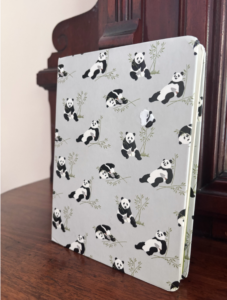
I am not sure what, exactly, provoked me that day (since I had exhausted all manners of expression for my grievances), but judging from other angry rants found in this deceptively cute, panda-covered journal, it probably had something to do with: A) My obsession with school, B) My enemies, let’s call them Kyle and Reese, C) My parents’ attempts to discipline me, and D) My conviction that the whole world was conspiring against me. These were heavy burdens for a sixth-grader to bear. Fortunately, the school year was almost over. Reform Jewish summer camp was just around the bend, and I was praying for change. Literally.

“God, if you can hear me, please let me have an amazing camp-experience,” I wrote a few weeks before the session started. “It’s my only escape.” Also, while I had His ear, could He make sure I got a really good part (preferably Belle) in the summer musical, Beauty and the Beast? The previous year, in Aladdin, I’d been relegated to some sadsack ensemble role that clearly did not make use of my incalculable dramatic potential. Please, Hashem!!
But God had His work cut out for Him.
During my first summer, I had established a reputation for myself as a puritanical hardass thanks to my clashes with the popular girls of Bunk 15. Let’s call them Samantha, Madison and Lindsey. Lindsey slept in the bunk bed next to mine, and every night she would amuse the other girls by pretending that she was singing Taylor Swift hits in her sleep. This enraged me. I hung up towels around my bed so I could silent-scream in private. Soon, the trio began to whisper that I was “gossiping” about them. I don’t think the counselors bought that story, though, since successful gossiping requires you to spread lies to many people, and I knew around three. I spent seven weeks in non-stop kvetch mode, writing pathos-ridden letters home, crying a lot, and making petty demands on God in a prior journal that I am scared to open. It got so bad that the camp director had to call up my parents on vacation.
Yet when the long-awaited last day came and my parents loaded up the car with all my musty-smelling camp stuff to take me home, something inexplicable happened: On my first night back in my own bed, I cried that I missed camp. Maybe I had been wrong all along! Send me back!
I don’t know how I got sucked back into another year. Maybe I’d been hoodwinked by ritual — the s’mores, the songs, the tie-dyed shirts, the crying around the lake as we promised to come back — or the fantasy that next year, I would finally be accepted. In any case, nostalgia had caused me to keep secrets from myself. “When does the memory keep secrets?” the Italian writer Alda Merini asks cryptically in her 1989 book Delirio amoroso, or Amorous Delirium, a collection of poems inspired by her experiences with love-induced madness. “When it forgets.”
I had forgotten, and now I was going to pay the price.
On my first day back, I arrived to find that all my complaining to the camp director had backfired: I’d earned an exile worthy of Napoleon, except instead of Elba, I was going to Bunk 20, where I knew nobody. I had no foes, and also no friends.
According to 12-year-old me, I spent the next seven weeks fighting back an unstoppable tide of hostilities. In reality, I probably spent just as much time swimming, kayaking, trying to play volleyball, hanging out with my new friends Lana, Hannah and Sabrina, painting clay pots, and pretending I wasn’t spending Shabbat services writing installments of a bleak tale called “Gertrude’s Life,” about a long-suffering Victorian girl with a mangled left leg. But 12-year-old me was fluent exclusively in “kvetch.” A couple of times a week, a cadre of rabbis with guitars tried to counteract my natural crankiness by teaching us key principles of Reform Jewish wisdom: Shalom (keeping calm), Tikkun Olam (repairing the world), and Hineini (present awareness). Unfortunately for the rabbis, I was too far gone. I had braces on my teeth and eczema on my skin, an intimidating combination of blood and steel.
You probably won’t be shocked to learn that I didn’t get Belle. Instead I got cast as something more fitting, the wicked crone who turns the Prince into the Beast to begin with. It seemed unfair to me that such an important catalyst didn’t have any lines, just menacing gestures. Later in the summer, our bunk went on a camping trip where I broke a glow-stick on myself and my sleeping mat, and I became convinced that I was going to die. I briefly developed “enamorous feelings” for a young fellow before concluding that “he was really into cursing and being a general idiot.” On the bus back from some field trip, a kid named J.T. said he wanted to kiss me, which was repugnant and secretly flattering.
And of course, I somehow still managed to scrap with my tormenters from the year before. On a visit to Bunk 18, the lair of my enemies and also a few friends, Madison told the counselors that she felt “uncomfortable” changing out of her swimsuit in front of me. For my part, I felt uncomfortable that she was framing me as a pervert.

Looking back on this journal, I may have had myself to blame for the isolation I spent so much time complaining about. How would anyone make friends with a 12-year-old nudnik who wrote things like “I had to go to the compost bin thrice during breakfast” and “I started off the morning by crying the equivalent of Taghaza, the city made of salt”? Even Job would not have had the patience.
One way or another, by summer’s end, I was ready to leave camp forever. Or so I claimed. “At the moment, our bunk is creating a plaque to commemorate the summer. Everyone’s laughing, sharing inside jokes I’ll never be a part of,” I wrote. “To be honest, I’m rather sick of this camp thing and going home in two days is perfectly fine with me. Camp days are too frivolous. I need something with which to occupy the mind.”
But if I wanted “something with which to occupy the mind,” I was about to get it. Two days later, I was back home. Camp was no longer tormenting me with its frivolity, and I missed it. Memory had worked its hazy rearview magic on my mind once again. I thought about my friends, about singing the evening prayer and swaying back and forth, about the wooden float we’d burned in the middle of the pond like a Viking ship to commemorate the summer. I thought about ice cream sandwiches. “It’s been so fun, and now it seems like it had all been a dream,” I wrote.
A day or so later, missing camp had become a dream, too. I never went back.
It’s been ten years since I was twelve. That time of life is increasingly dream-like. When I reread the cursed document that is my camp journal, I feel the misery. I feel it churn in my stomach sure as suspicious falafel. Yet in photos taken at camp, I see myself smiling, entwined with other girls, my braces glinting in the sun. I cannot tell which person is real. Both girls — the one in the journal and the one in the pictures — seem unknowable.
I don’t know if I’ll ever figure out what I really thought. Memory is made of such blobby, malleable stuff that you can’t touch it without changing it, reshaping it in some way. And since memories make up our “sense of self,” whatever that is, this must mean that we are constantly morphing, too.
The last thing I wrote about camp at the summer’s end was that it seemed like another life, “as if it had all happened to someone else.”
Maybe it did.
The post Are you there Hashem? It’s me, Clara appeared first on The Forward.
Uncategorized
Michigan’s El-Sayed doubles down: Israel ‘not an ally’
(JTA) — Abdul El-Sayed, the Democratic Senate nominee in Michigan, is doubling down on his view that Israel is not a U.S. ally as the Nov. 3 midterm elections draw closer.
El-Sayed, a vocal critic of Israel who faces former Republican Rep. Mike Rogers in one of the country’s most competitive Senate races, told ABC News on Monday that Israel is “not actually our friend.”
“An ally that takes your money to push you into wars you shouldn’t be fighting is not an ally,” said El-Sayed, referencing Israel’s reported lobbying of the United States to enter into a war with Iran.
He compared Israel with a friend who “keeps bumming off [your kid’s] money” and “talks about them behind their back and then gets them into fights with other friends.”
“What would you tell your kid to do with that friend? You’d probably tell them, maybe it’s not actually your friend,” he said.
El-Sayed made similar remarks in an interview with MS NOW on Thursday, saying that “the government of Israel has done nothing but use us” and “has done terrible things with our money.”
He added that he would continue to question whether Israel was an ally regardless of the outcome of Israel’s election on Oct. 27, as Prime Minister Benjamin Netanyahu, who has served as Israel’s leader for most of the past 18 years, seeks another term.
“Netanyahu is one part of it, but the Israeli military has done heinous things, like heinous things, full war crimes, genocide,” said El-Sayed. “So I think we got to just get serious about whether or not we as a country should be subsidizing that government.”
El-Sayed previously affirmed that he does not consider Israel an ally to the United States in his first bitter debate with Rogers on Oct. 8. The candidates will meet for a final debate on Wednesday.
He told MS NOW that he was “committed to the safety and security” of Jewish voters, some of whom have pressured him to moderate his views on Israel. “Now, we may have differences when it comes to Israel, but the things that unite us are a lot bigger,” he said.
This article originally appeared on JTA.org.
The post Michigan’s El-Sayed doubles down: Israel ‘not an ally’ appeared first on The Forward.
Uncategorized
Trump endorsement of Netanyahu blasted by liberal policy advocates, Democrats
(JTA) — A day after President Donald Trump endorsed Prime Minister Benjamin Netanyahu in the Israeli election eight days from now, U.S. policy analysts, Democratic lawmakers and liberal advocacy groups slammed the decision.
Trump announced his support for Netanyahu, who is running for reelection, in a Sunday Truth Social post that described the Israeli leader as “a Great Warrior Prime Minister” and a critical partner in eliminating the Iranian threat. Netanyahu has been trailing former IDF chief-of-staff Gadi Eisenkot in recent surveys.
Tali deGroot, vice president of political and digital strategy for the liberal Zionist group J Street, described Trump’s declaration as “an endorsement of endless war for Israelis,” in a statement sent to the Jewish Telegraphic Agency. She warned of “endless occupation and control of Palestinian life and land, and Israel’s growing isolation on the world stage.”
“The president is once again acting against the wishes of American taxpayers and choosing to uphold a failed, unpopular foreign policy that has brought devastation to Israelis, Palestinians and countless civilians,” deGroot added.
A spokesperson for the American Israel Public Affairs Committee, meanwhile, said that the lobby had no comment about the endorsement.
David Makovsky, director of the Program on Arab-Israel Relations at the Washington Institute for Near East Policy, criticized Trump’s decision, writing on X that “in one fell swoop, Trump has broken with the longstanding U.S. practice of avoiding explicit endorsements in Israeli elections.” The president, Makovsky added, went a step further by threatening to sever a partnership against Iran if Israelis choose a different leader.
“It is up to the Israeli people to choose their own leader and threatening that the U.S. will walk away from the conflict with Iran is beyond stunning,” Makovksy said.
Makovsky also pointed out that “a Trump endorsement is no electoral guarantee,” noting that Trump and Vice President JD Vance’s support for Viktor Orbán in Hungary did not end in a victory.
“The ultimate test is assembling a 61-seat Knesset majority,” Makovsky added. “Yet Netanyahu appears more focused on preventing an Eisenkot-led coalition from reaching that threshold than on demonstrating a viable path to 61 seats himself.”
Sen. Chris Van Hollen, a Democrat from Maryland, offered another scathing perspective, observing that “authoritarians of a feather flock together.”
“They started a war together,” Van Hollen stated. “They crack down on press freedom together. They lie about everything together.”
Rep. Analilia Mejia, a New Jersey Democrat running for reelection, said that the endorsement “tells us everything we need to know about both of these men.” She then went on to list Netanyahu, North Korea leader Kim Jong Un, Orbán and Russian President Vladimir Putin, adding that “this guy has a ‘type.’”
On the other side of the aisle, Rep. Carlos Gimenez, a Republican from Florida, reposted a video in which Netanyahu thanked Trump for his support. The congressman then added that “America will always stand with the Jewish State of Israel and our dear friend Prime Minister Netanyahu, who has championed our alliance for decades.”
Matt Brooks, CEO of the Republican Jewish Coalition, said he believes that “President Trump is incredibly popular with the people of Israel,” in a written statement to JTA.
“His support will carry considerable weight as Israelis make their choice for Prime Minister in a pivotal election this month,” Brooks added.
American Orthodox Rabbi Shmuley Boteach likewise celebrated the endorsement “by our great President Trump,” writing on X that he has “known and loved BIBI Netanyahu for some 35 years.”
Conservative radio personality Mark Levin described Trump’s Truth Social post as “an extraordinarily strong statement,” while accusing the opposition of “barking about election interference.”
“Trump makes clear it’s also in our national security interest for Netanyahu to remain PM,” Levin stated, calling complaints “unserious and a partisan political whine.”
Conservative influencer Evan Kilgore, on the other hand, fumed at Trump’s decision. Kilgore, whose X profile says “Christ is King,” announced that he is “so done with the GOP,” following Trump’s endorsement of Netanyahu. Kilgore described Trump as “TOTALLY fu*king subverted by Jewish and Zionist interests.”
Political analysts are divided as to whether Trump’s official support would have any sway on the results of an election 6,000 miles away.
Joyce Karam, editor-in-chief of the Washington-based site Al-Monitor, described the endorsement as a signal to both Israel and Iran that renewed escalation and a push for regime collapse could occur after the U.S. midterm elections. She also predicted that Trump’s backing could tip the balance in a tight race where neither side holds a majority.
However, Dov Waxman, director of the Israel Studies program at the University of California, Los Angeles, expressed doubt that support from Trump, who has become less popular in Israel, could significantly influence Netanyahu’s election chances.
“For a long time, most polls have shown his bloc falling well short of a parliamentary majority,” Waxman added.
This article originally appeared on JTA.org.
The post Trump endorsement of Netanyahu blasted by liberal policy advocates, Democrats appeared first on The Forward.
Uncategorized
Macklemore’s ‘Free Palestine’ tour will benefit group that called Oct. 7 a ‘prison break’
(JTA) — Macklemore, the rapper of hits such as “Thrift Shop” and “Can’t Hold Us,” is facing backlash from Jewish organizations over plans to donate proceeds from his forthcoming concert tour to the Palestinian Youth Movement, which described the Hamas-led Oct. 7 attacks on Israel as a “prison break.”
The rapper was dropped on Sept. 14 from an opening slot on Ed Sheeran’s U.S. stadium tour after making pro-Palestinian remarks onstage. He announced his “Free Palestine” tour on Sept. 24, pledging that all proceeds would benefit organizations supporting Palestinians. PYM is among 12 organizations named as beneficiaries.
The tour includes concerts in Dublin on Oct. 26, Paris on Oct. 29 and London on Oct. 30.
Macklemore received a surge of support after being dropped from Sheeran’s tour, with all of Sheeran’s remaining opening acts quitting in solidarity. He said on Instagram that the “Free Palestine” tour “sold out immediately.”
PYM is a grassroots movement of Palestinian and Arab youth in the United States, Canada and Britain. On Oct. 7, 2024, the first anniversary of the Hamas attacks, the group described the assault as a “prison break” and called the fighters “the men who broke through” in an essay published in The New Inquiry.
“Those fighters had trained for months, and now found themselves stepping foot onto the same hills and plains that their grandfathers and grandmothers had lived upon,” said PYM, without mentioning the killing and abduction of Israeli civilians.
PYM also said a week after the attacks, “Understand Palestinian resistance as fundamentally just and as a means of survival for our people; it will not stop in the weeks and months to come, and you must be prepared not to waver again.”
Jewish and pro-Israel groups have slammed Macklemore for supporting PYM. The Jewish Leadership Council, which represents British Jewish and pro-Israel groups, told The Jewish Chronicle, “When the PYM describes the 7 October massacre as a ‘prison break’, it risks legitimizing violence against Jews.”
The Israeli-American Council, which petitioned Sheeran to drop Macklemore, told Fox News Digital that “Live Nation and the concert organizers must now publicly explain their vetting process and ensure that concert proceeds do not benefit organizations that justify violence against innocent civilians.”
Macklemore, Live Nation and the Palestinian Youth Movement did not immediately respond to requests for comment.
This article originally appeared on JTA.org.
The post Macklemore’s ‘Free Palestine’ tour will benefit group that called Oct. 7 a ‘prison break’ appeared first on The Forward.
