


Uncategorized
As ‘Death of a Salesman’ returns to Broadway, the question remains — how Jewish is Willy Loman?
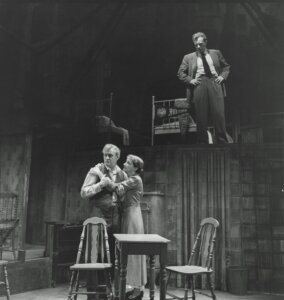
Arthur Miller’s 1949 play Death of a Salesman, currently on Broadway in a new production starring Nathan Lane as Willy Loman, was inspired by an uncle of Miller’s and a suicidal colleague of his father’s, both Jewish salesmen.
On the play’s 50th anniversary, Miller told an interviewer that Willy Loman and his family were indeed intended to be Jews. But, he added, they were oblivious to this identity since in postwar America, the Lomans were “light-years away from religion or a community that might have fostered Jewish identity.”
More to the point, in 1947, Miller had lectured at the Committee of Jewish Writers, Artists, and Scientists about a possible new Jewish literary movement in America. After the success of Focus, his 1945 novel about antisemitism, Miller opined: “Jewish artists and writers have it as their duty to address themselves in their works to Jewish themes, Jewish history and contemporary Jewish life.”
Yet despite this belief, Miller proceeded to explain that the Holocaust had temporarily made it impossible for him to write about Jewish life without being “defensive and combative” or to treat Jewish themes “in relation to antisemitism.” A delusional failure, Loman was no role model in his professional or family life, and presenting him as a Jew might have fed already-burgeoning antisemitism among audiences.
Miller would return to Yiddishkeit in his later plays After the Fall (1964); Incident at Vichy (1965); The Price (1968); Playing for Time (1980); and Broken Glass (1994), but Salesman reflected a cagier ethnic identity.
Even so, alert audiences picked up on Yiddishisms or Brooklyn Jewish inflections, such as when Loman’s wife Linda says: “Attention, attention must be finally paid to such a person.”
The literary critic Leslie Fiedler deemed these echoes of Yiddishkeit a symptom of Miller’s being “devious” in creating “crypto-Jewish characters” who are presented instead as generic Americans, supposedly to appeal to a wider American audience.
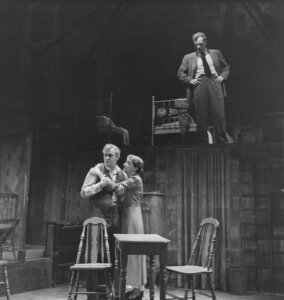
In a 1998 essay, the playwright David Mamet alleged that by not overtly dwelling on the characters’ Judaism in Salesman, Miller had shortchanged Jewish culture; the play is the “story of a Jew told by a Jew,” he wrote, but Loman’s fate is “never avowed as a Jewish story, and so a great contribution to Jewish American history is lost.”
To which Miller politely retorted that Mamet had discerned the Jewish content in the play, “so it couldn’t have been lost. I mean, what more could anyone want?”
What some observers wanted was a literal embrace of Jewish tradition, which they received when the Yiddish stage actor Joseph Buloff, best remembered for his role as a peddler in the Broadway premiere of the musical Oklahoma! and as a Russian agent in the 1957 MGM musical film Silk Stockings. In 1951, Buloff translated and staged Salesman in Yiddish, a version which has since been revived and performed widely.
The plangent tone of the Yiddish “Toyt fun a Salesman,” made it an audience pleaser, and the literary critic Harold Bloom, a native Yiddish speaker, considered the Buloff translation the “most satisfactory performance” he ever saw of Salesman.
Less internationally celebrated was a contemporaneous staging by The Habima Theatre, the national theater of Israel. Directed by the Czech Jewish theatrical maestro Julius Gellner, it starred a powerhouse cast led by Aharon Meskin, an acclaimed Othello, Golem, and Shylock. Linda Loman was played by Hanna Rovina, who was known as the First Lady of Hebrew Theater; she had previously appeared with Meskin in the Habima production of S. Ansky’s The Dybbuk, and their exalted, visionary scope suited the epic, oneiric moments in Salesman.
Yet Israeli audiences seemed to prefer Miller’s All My Sons to Salesman, reportedly because Loman was a schmendrick, a small-time loser, and his pathetic demise excluded him as an appropriate hero/martyr for the new Jewish state.
Unlike the tearful Yiddish-language Loman and exalted, mythical Hebrew version, both of which glorified Jewish identity, the original Broadway cast was more ambiguous. Loman was played by Lee J. Cobb (born Leo Jacoby) a bellowing bulvan of a performer whose one-note paroxysm riveted audiences with its grim weight. In a televised interview (see the 5-minute mark), the Jewish performer Zero Mostel later complained that even a failed salesman needed humorous charm, entirely missing from the doom-laden Cobb rendition.
Of course, Mostel had suffered during the House Un-American Activities Committee (HUAC) hearings in Washington, DC, at which Cobb and the Salesman stage director Elia Kazan were friendly witnesses, naming names of former friends to placate the government witch hunt, just a few years after Salesman premiered.
By contrast, Miller himself courageously confronted the HUAC and refused to yield to threats, winning admiration even from Jewish critics who did not always laud his work. To celebrate Miller’s 87th birthday, the sometimes waspish Robert Brustein proclaimed the playwright a “true public intellectual” who created “powerful plays, but also a shining moral example unmatched in American theater.”

This praise refutes decades of obloquy, often from fellow Jewish writers, some of whom oddly resented Miller for being married for a few years to Marilyn Monroe, who converted to Judaism before their wedding. Such personal attacks, like Loman, Miller and the play itself, now belong to the ages.
Miller’s play has also won applause for productions with African-American and international casts, including a celebrated staging in Beijing, which resulted in a book and documentary film on the topic. Miller, who traveled to China for the production, explained that the play’s filial theme was as poignant in Chinese tradition as it is for Jews. Indeed, Salesman in China, a 2024 Canadian play by Leanna Brodie and Jovanni Sy freshly revisits that historic production.
As the literary historian Leah Garrett has noted, Willy Loman and Salesman can be simultaneously Jewish and universal. Some theatergoers believe that the finest modern interpretation of the role was performed by Warren Mitchell, an English Jewish actor whose Loman at times sounded vaguely like the Jewish comedian George Burns (born Nathan Birnbaum).
The most powerful, yet nuanced, Loman I ever saw onstage was incarnated by a non-Jewish actor, George C. Scott, who had previously played the role of the biblical patriarch Abraham in the 1966 epic film The Bible: In the Beginning… After a Loman tirade just before intermission, the house lights went up and the audience at New York’s Circle in the Square Theater sat in stunned silence, riveted. The impact resembled that of a 1950 Berlin production at which the audience refused to leave the theater after the show was over.
This immense force of Miller’s play is not always conveyed on stage or screen, even when accomplished actors like Dustin Hoffman and Brian Dennehy have played Loman. But the drama’s inherent force shows how the play has survived triumphantly as an American Jewish literary achievement.
The post As ‘Death of a Salesman’ returns to Broadway, the question remains — how Jewish is Willy Loman? appeared first on The Forward.
Uncategorized
Instagram Pushes Antisemitic Videos to Hundreds of Millions of Users, Report Finds

Silhouettes of mobile users are seen next to a screen projection of the Instagram logo in this picture illustration taken March 28, 2018. Photo: REUTERS/Dado Ruvic/Illustration
Instagram actively recommends bigoted content to its users, according to newly published research from a leading antisemitism watchdog group.
The revelation followed two high-profile losses this week in lawsuits that charged billionaire Mark Zuckerberg’s Meta, which owns Instagram, with failing to protect children on its social media platforms.
On Wednesday, the Combat Antisemitism Movement (CAM) published new findings from its Antisemitism Research Center (ARC). The report, “Engineered Exposure: How Antisemitic Content Is Pushed and Amplified to Millions Across Instagram,” focused on tracking 100 antisemitic posts during a 96-hour period which Instagram directly pushed into users’ accounts through its own recommendation system.
CAM’s researchers found that these posts provoked 5.3 million likes and 3.8 million shares, which analysts estimate reached as many as 280 million users.
“Among the most disturbing findings is that the ARC researchers identified AI-generated ‘rabbi’ personas that were fabricated to push antisemitic tropes while projecting false religious authority,” CAM said in a statement announcing the report.
One bogus rabbi account CAM uncovered had collected more than 1.4 million followers. The report described how an account called Rabbi Goldman “pushes antisemitic conspiracy theories, including allegations of Jewish control of the global financial system, to a large audience, with some videos getting more than five million views.”
ARC identified 11 other fake rabbis, bringing the total followers for such accounts up to 2.1 million. According to the researchers, “each presents a distinct persona and voice, yet all promote narratives portraying Jews as obsessed with money, playing to classical antisemitic stereotypes.”
The report also documented substantial linking of Jews with occult themes including references to demons, Satan, 666, Moloch, freemasonry, the Illuminati, and especially the ancient Canaanite storm god Baal. The slander against Jews as secretly worshipping a deity who demanded child sacrifice and rivaled the God of Israel in the Bible has manifested elsewhere on social media. Far-right podcaster Candace Owens has claimed that the Star of David has “ALWAYS [sic] been associated with Canaanite cults and Baal worship.”
An important component of this new research is that rather than investigators searching for hateful content, they relied solely on “the standard use of Instagram over four days, via content actively suggested by the platform’s recommendation systems.”
“This distinction demonstrates that exposure to these narratives does not require users to seek out extremist material,” the researchers explained. “Instead, the platform itself can act as a vector, introducing and amplifying such content through its own distribution mechanisms.”
Through providing examples of the content analyzed, the researchers showed how conspiracy theories transition into calls for violence. One video discussed in the report blamed “the Rothschilds” and central banks as guilty of causing all global crises including wars, diseases, and 9/11. The video then “escalates into explicit eliminationist rhetoric, calling for their eradication as a solution. It uses the Rothschild family as a proxy for Jews and frames them as a singular, malevolent force controlling world events.”
CAM CEO Sacha Roytman said the report provided evidence “of a broad systemic failure on the part of Instagram and Meta.”
“When a platform actively recommends content that dehumanizes Jews to mass audiences, we are no longer talking about a simple oversight or a mistake in the algorithmic design. We are talking about infrastructure that normalizes hatred at scale that must be addressed immediately,” he added.
Regarding potential motivations for what might have inspired Zuckerberg to allow for such a proliferation of hate, the report noted in its introduction that Meta had been “generating substantial advertising revenue from engagement with the content in question.”
In 2025, Meta’s revenue reached $200.966 billion, an increase of 22.17 percent from 2024, when revenue hit $164.501 billion, a 21.94 percent increase from 2023’s $134.9 billion, which in turn had grown 15.69 percent from 2022.
Bloomberg currently ranks Zuckerberg as the fifth wealthiest person on the planet, with an estimated net worth of $211 billion. Earlier this month, he purchased a $170 million mansion in South Florida’s Indian Creek, noted as the most expensive sale in Miami-Dade County and listed as “the largest residence ever created on Miami’s most exclusive island.”
On Wednesday, Meta laid off 700 employees, largely those affiliated with the failed Reality Labs division, which burned through $80 billion in pursuit of creating the virtual reality platform Horizon Worlds. The platform will shut down on June 15.
Roytman said that Meta “must take a hard look at how its algorithms are promoting antisemitic content and put real, transparent safeguards in place to stop it.”
Meta may have additional motivation now to level up the safety protocols on its platforms following back-to-back decisions in a pair of lawsuits this week which, legal analysts suspect, may have now opened the floodgates for thousands of similar cases around the country.
On Tuesday in Santa Fe, jurors found Meta liable and imposed a $375 million fine for failing to prevent minors’ exposure to harmful sexual content including online solicitations, human trafficking, and explicit imagery.
“Meta executives knew their products harmed children, disregarded warnings from their own employees, and lied to the public about what they knew,” New Mexico Attorney General Raúl Torrez said in a statement following the verdict. “Today the jury joined families, educators, and child safety experts in saying enough is enough.”
Torrez vowed to go after Meta for more money and force changes to the platforms.
“New Mexico is proud to be the first state to hold Meta accountable in court for misleading parents, enabling child exploitation, and harming kids,” Torrez said. “In the next phase of this legal proceeding, we will seek additional financial penalties and court-mandated changes to Meta’s platforms that offer stronger protections for children.”
On Wednesday in Los Angeles, jurors found Meta and Alphabet (parent company of YouTube) liable for the addictive qualities of their platforms exacerbating the mental health problems of a young woman and awarded her $3 million in damages with $3 million more in punitive damages.
Omri Ben-Shahar, a law professor at the University of Chicago, told the Wall Street Journal that “what is new is the addiction element.” He warned “that could create a very broad liability. The notion of addiction, there is something very abstract about it.”
Meta and Alphabet both plan to appeal the ruling. Alphabet spokesman José Castañeda sought to distance the company from Meta (which jurors found more heavily liable at a 70-30 penalty ratio), saying “this case misunderstands YouTube, which is a responsibly built streaming platform, not a social media site.”
Previous legal challenges to social media and online video companies for failing to prevent exposure to harmful content have usually failed due to longstanding legal interpretations of Section 230 of the 1996 Communications Decency Act, which states that “no provider or user of an interactive computer service shall be treated as the publisher or speaker of any information provided by another information content provider.”
This statute has prevented plaintiffs from suing a website’s host the way they would an individual committing slander or a publisher engaged in libel. The legal innovation which allowed for success in these cases was lawyers’ decision to focus not on the content itself but on the design of the products which intended to hold users captivated, glued to their phones for hours.
“They knew,” said Mark Lanier, the lawyer for the 20-year-old plaintiff in the addiction case. “They targeted the children.”
Uncategorized
University of Wisconsin–Madison Denounces BDS Resolution Passed by Student Government

University of Wisconsin-Madison campus on May 1, 2024. Photo: USA TODAY Network via Reuters Connect
The University of Wisconsin–Madison’s student government on Wednesday passed a resolution which endorsed the boycott, divestment, and sanctions (BDS) movement and demanded the institution divest from companies involved financially with Israel, drawing a stern rebuke from the school’s administration.
As previously reported by The Algemeiner, the resolution accuses the Jewish state of “apartheid, genocide, and militarized violence … at the intersections of race, gender, religion, disability, and socioeconomic status.” It also compares Israel’s conduct in its defensive war against the terrorist group Hamas to the Rapid Support Forces of Sudan (RSF), a notorious paramilitary group responsible for a slew of war crimes and premeditated mass casualties of civilians.
After failing to reach the floor for a vote when the Associated Students of Madison (ASM) first considered it last week, it was approved during an evening session on Wednesday. The body has not yet released the final tallies of the vote, but the UW Madison administration confirmed that it passed in a statement which condemned the outcome.
The university also said it was “reviewing reports alleging that an online chat, including possibly some ASM representatives, used an antisemitic term in reference to limiting potential speakers at the March 18 ASM meeting” where the resolution was considered.
According to The Daily Cardinal, a campus newspaper, an SJP member told their contact in ASM via text message to slash the time allotted for public comment because the “proportion of Zios [sic] rises as the speaker list goes on.”
“Zio” is an antisemitic slur brought into prominence by former Ku Klux Klan leader David Duke. While the term, derived from “Zionist,” has generally been deployed by white supremacists and other far-right extremists, it has more recently been used as well by anti-Israel activists on the progressive far left to refer to Jews in a derogatory manner.
Noting that the resolution “issued a number of flawed, unrelated and illegal demands,” the administration said in Wednesday’s response to the vote that “Wisconsin state law prohibits state and local government agencies from adopting their own rules or policies that would involve them in a boycott of Israel” and that “ASM leadership was counseled by university attorneys on the clear illegality of that specific part of the resolution” but “nonetheless voted to pass it.”
The administration did not condemn BDS as matter of principle, however, but said that UW-Madison “condemns antisemitism in all of its forms” in regard to the “Zio” text message.
Formally launched in 2005, the BDS movement opposes Zionism — a movement supporting the Jewish people’s right to self-determination — and rejects Israel’s right to exist as a Jewish nation-state. It seeks to isolate the country with economic, political, and cultural boycotts. Official guidelines issued for the campaign’s academic boycott state that “projects with all Israeli academic institutions should come to an end,” and delineate specific restrictions that its adherents should abide by — for instance, denying letters of recommendation to students applying to study abroad in Israel.
Leaders of the BDS movement have repeatedly stated their goal is to destroy the world’s only Jewish state.
The apparent antisemitic undertones of the ASM vote at the University of Wisconsin-Madison underscore the reality of campus antisemitism and the degree to which it has changed Jewish student life.
According to a recent survey commissioned by the American Jewish Committee (AJC) and Hillel International, a striking 42 percent of Jewish students reported experiencing antisemitism during their time on campus, and of that group, 55 percent said they felt that being Jewish at a campus event threatened their safety. The survey also found that 34 percent of Jewish students avoid being detected as Jews, hiding their Jewish identity due to fear of antisemitism.
Meanwhile, 38 percent of Jewish students said they decline to utter pro-Israel viewpoints on campus, including in class, for fear of being targeted by anti-Zionists. The rate of self-censorship is significantly higher for Jewish students who have already been subjected to antisemitism, registering at 68 percent.
The survey, included in AJC’s new “The State of Antisemitism in America” report, added that 32 percent of Jewish students feel that campus groups promote antisemitism or a learning environment that is hostile to Jews, while 25 percent said that antisemitism was the basis of their being “excluded from a group or an event on campus.”
Jewish students endure these indignities while preserving their overwhelming support for Israel. Sixty-nine percent of those surveyed identified caring about Israel as a central component of Jewish identity and 76 percent agreed that calling for its destruction or describing it as an illegitimate state is antisemitic.
Follow Dion J. Pierre @DionJPierre.
Uncategorized
Iran Lowers Minimum Age for War Roles to 12, Sparking Outcry Over Child Soldier Use

Kids hold up an Iranian flag and chant slogans during a protest against the Israeli airstrikes on Iran, in Sana a, Yemen, June 20, 2025. Photo: IMAGO/Hamza Ali via Reuters Connect
The Iranian regime has lowered the minimum age for participation in war-related activities to just 12 years old, a move that will likely fuel the concerns of human rights groups, which have condemned Iran’s treatment of children.
In a televised interview with state media, Rahim Nadali, a cultural with Iran’s Islamic Revolutionary Guard Corps (IRGC) in Tehran, announced that the new initiative “For Iran” is recruiting participants to assist with patrols, checkpoints, and logistics.
“Since children are increasingly volunteering to take part, we have lowered the minimum age to 12,” Nadali said, urging young children to join the war effort if they wish.
Rahim Nadali, Cultural Deputy of the IRGC’s Tehran branch (Mar 26, 2026):
“12 and 13-year-old children wanted to participate in Basij checkpoints across the cities. We have lowered the age limit to 12 and above.” pic.twitter.com/lLZy9pU5xm— حافظه تاریخی (@hafezeh_tarikhi) March 26, 2026
Iran International first reported Nadali’s statement, which has since circulated on social media.
As part of the regime’s state media coverage of the US-Israeli war against Iran, this latest announcement has ignited mounting backlash over the use of minors in security‑related roles — a practice that is not new in Iran.
“Recruiting children into military activity is a violation of international laws and the international community must not stay silent,” Iranian-American activist Masih Alinejad posted on social media, along with video of Nadali’s comments. “This is the same regime that lectures the world about morality. But when it comes to survival? They’re willing to send children into danger.”
In the past, widely circulated social media images and videos have repeatedly shown children and teenagers in military-style uniforms cracking down on protests, including during the 2022 Woman, Life, Freedom uprising, which erupted nationwide after Mahsa Amini, a young Kurdish woman, died in a Tehran police station following her arrest for allegedly violating hijab rules.
Under international law, Iran’s move flagrantly violates the Convention on the Rights of the Child, which explicitly prohibits the use of children in military activities, marking a dramatic breach of its global obligations.
Human rights groups have also repeatedly accused Iranian security forces of killing child protesters during past crackdowns.
According to the Center for Human Rights in Iran, more than 200 children were killed during the nationwide anti‑government protests earlier this year, which security forces violently crushed, leaving thousands of demonstrators tortured or killed.
Amnesty International and Human Rights Watch have also documented cases of children being shot, detained, and abused during these latest demonstrations, noting that government forces have repeatedly targeted minors in ways that breach international law.
Iran has a long track record of widespread human rights abuses, including crackdowns on protesters, harassment of activists, threats to minorities, executions of children, violations of women’s rights, and dire prison conditions.
During the January uprising, at least 6,724 protesters, including 236 children, were killed, with another 11,744 cases still under verification, according to the Human Rights Activists News Agency (HRANA). Multiple other reports have estimated that the overall death toll may exceed 30,000.
As in past years, executions remain one of the starkest manifestations of human rights abuses in Iran, with at least 2,488 people executed last year, including 63 women and two children, 13 of them carried out publicly.
Tehran’s latest controversial move comes as Iran has reportedly slammed a US proposal to end the war as “one‑sided and unfair,” a rebuff that has cast doubt on the prospects for a negotiated ceasefire.
US President Donald Trump has warned the Islamist regime it must reach a deal or face a continued onslaught.
“They now have the chance, that is Iran, to permanently abandon their nuclear ambitions and to join a new path forward,” Trump said during a Cabinet meeting at the White House.
“We’ll see if they want to do it. If they don’t, we’re their worst nightmare. In the meantime, we’ll just keep blowing them away.”