


Uncategorized
As Greenpoint’s Jewish community grows, so does this shul’s Hebrew school
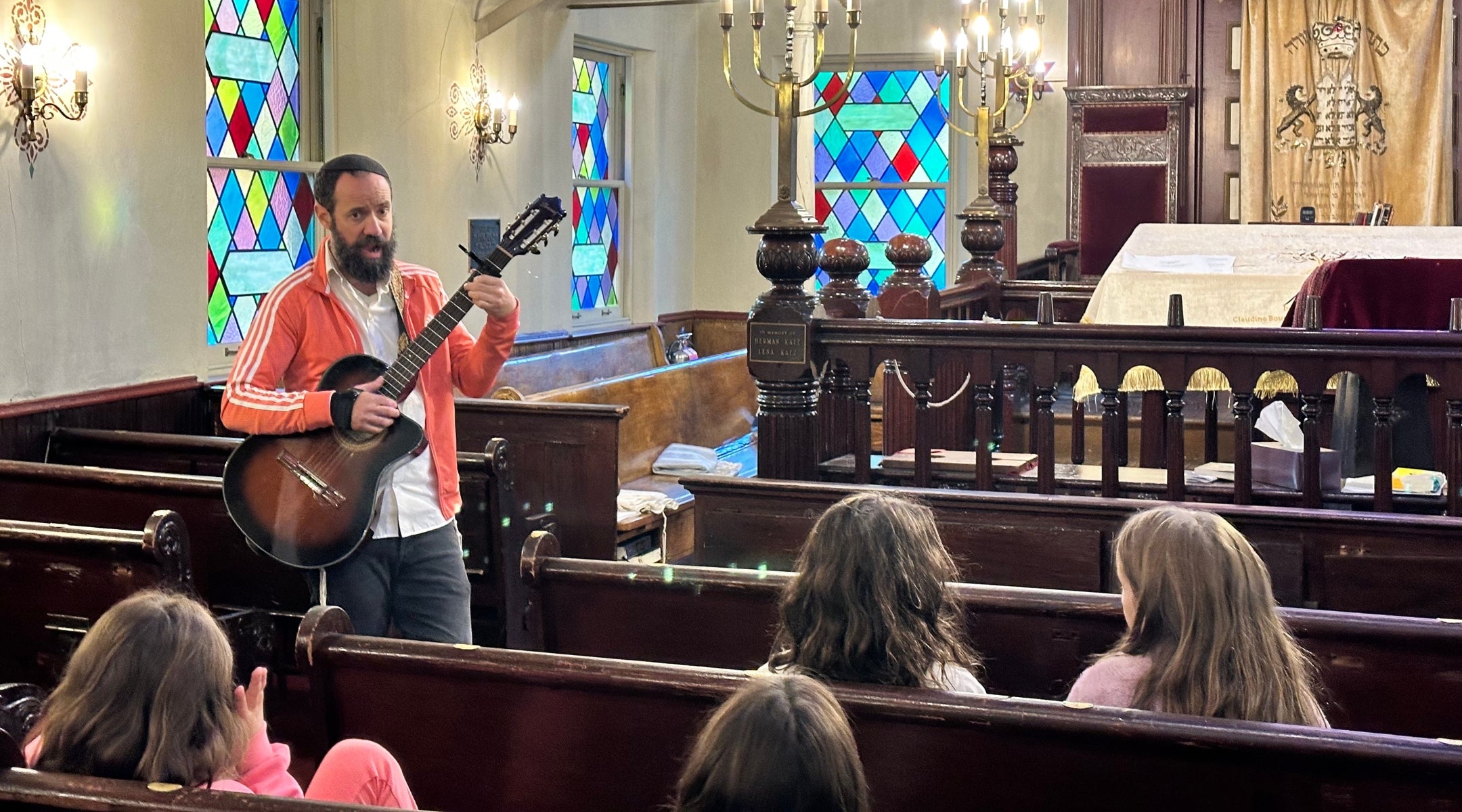
(New York Jewish Week) — Greenpoint, Brooklyn is known for many things: its extensive waterfront, a tight-knit Polish community and a vibrant arts scene.
One thing it’s not known for: a thriving Jewish community. But that’s rapidly changing.
The Greenpoint Shul — North Brooklyn’s only non-Haredi, brick-and-mortar synagogue — is today home to some 100 member families. That’s twice as many members as just 16 months ago, according to Rabbi Isaiah Rothstein, who has led the community since August 2024.
The congregation is looking to future generations, too: This school year, the Orthodox congregation officially added a Hebrew school serving some 30 children in grades kindergarten through 8. The school provides Jewish families an alternative to the only other option in the area, the Hebrew school that’s run by Chabad of North Brooklyn in nearby Williamsburg.
“I know the power and importance of having a youth department and it being a core pillar of building a thriving and growing community,” said Rothstein, who was previously the youth director at Young Israel of Stamford, Connecticut before assuming the helm of the Greenpoint Shul.
The Hebrew school was initially founded in 2019 by Yoni Kretzmer and his wife, artist Avital Burg, who are members of the synagogue and the parents of three children ages 8, 4 and 2. For five years, the school operated independently but borrowed the space inside the synagogue. As of this academic year, the school was officially “adopted” by the shul, which did not have a Hebrew school of its own.
“We saw that there’s nothing happening in North Brooklyn,” Yoni Kretzmer, who moved to Greenpoint from Israel with his wife in 2015, said of the local Jewish education scene. “So that was basically it — we started because we thought it was possible.”
Six years later, Kretzmer is now employed by the Greenpoint Shul, where one benefit he has seen so far is getting to exchange ideas with the rabbinic leadership team. He no longer has to independently collect tuition from parents, and he can provide students with supplies and snacks directly purchased from the synagogue budget.
“The way that we can present it now is as part of a much larger structure,” Kretzmer said. “When people [are] joining, they’re not only feeling that we’re using the shul, but that they’re part of a community center in the fullest meaning of the word.”
He added, “Now I can really be a teacher and the organizer, but I don’t have to be the accountant.”
With a focus on Torah and art, the school opened with about a dozen students — split into two groups, with Kretzmer teaching the older students, and Burg teaching the younger students — and grew via word of mouth. “It was mainly parents who brought other parents,” Kretzmer said. “So the connections were kind of within the neighborhood, of people who knew each other.”
The new school bucks multiple trends. Across the country, supplementary Jewish school enrollment is down by nearly half over the last two decades, a recent study found, and many of those that remain have reduced the number of days they operate. The Greenpoint Shul’s school holds classes on Tuesdays and Thursdays, though different children attend each day.
While enrollment declined early in the pandemic, “once it was deemed safe to return, then it really started growing,” said Kretzmer, who is now the youth director at Greenpoint Shul.
One recent arrival is Andrew Altfest, who moved to nearby Williamsburg in 2014 and enrolled his 5-year-old son, Alden, last year.
“We really like the values that are being taught,” said Altfest, a financial advisor who grew up Reform. “Those values, they range from everything: learning Torah stories, Jewish culture, ethics. And we value the diversity of the families of the kids that are there.”
Like so many parts of Brooklyn, Greenpoint has seen a wave of gentrification and development in recent decades. In Greenpoint, this change was spurred, in part, by a massive rezoning along the neighborhood’s once-derelict waterfront in 2005. While there is no reliable data on the neighborhood’s Jewish population — studies often lump Greenpoint with Williamsburg, which is home to a sizable Hasidic community — locals believe the number of Jews in Greenpoint has grown in recent years.
“Greenpoint is not a famously Jewish neighborhood in New York City,” said Greenpoint Shul president Daphne Lasky. “I think there are other things other than Jewish community that sometimes draw people to Greenpoint: the waterfront location, the scale of the buildings. There’s so much creative energy in the neighborhood. But then you end up with Jewish families who have those interests and they also want to come together around their Jewish life as well.”
As such, other Jewish institutions have grown to meet the needs of the area’s Jewish community. The Neighborhood: An Urban Center for Jewish Life, a Jewish cultural and events hub funded by UJA-Federartion of New York, was founded in 2022 expressly to serve Jews in both central and northern Brooklyn.
“We feel there’s a really significant demand,” said Neighborhood director Rebecca Guber. “Part of it, which is kind of hard to wrap your head around, is that in North Brooklyn, the only Jewish infrastructure is Orthodox and ultra-Orthodox, and that’s just not serving all members of the community.”
For now, at least, The Neighborhood does not have a physical space.
The Greenpoint Shul, meanwhile, has a long history in the neighborhood. Founded at the turn of the last century by German-Jewish immigrants as Congregation Ahavas Israel, the synagogue is in a landmarked Romanesque Revival building at 108 Noble Street whose cornerstone was laid in 1903. Today’s Greenpoint Shul is the result of multiple mergers between two neighboring Reform congregations and one Orthodox synagogue. Its prayer service is Orthodox; women sit upstairs in the balcony while men sit downstairs for prayer services. But the community is multicultural, multiracial and welcoming of all backgrounds, including many members who have recently converted to Judaism. While Orthodox families are likely to send their children to day schools and yeshivas, the Hebrew school is geared toward “children of all ages and backgrounds,” according to its web site.
“The congregation has gone through a lot of changes and growth — and shrinking and growing again — over the last 140 years,” Lasky said. “In particular, in the last 25 years or so, as Greenpoint has had its own renaissance as a neighborhood, there’s been more and more families moving into the neighborhood that need Jewish education for their children and Jewish connection for their children.”
Because of the new, formal relationship between the school and the shul, Rothstein said he’s already seen interest from prospective parents who would like to enroll their kids in the program next year. But the growth of a community isn’t just measured in sheer numbers — Rothstein added that, as a result of the Hebrew school, youth attendance at recent Sukkot and holiday events increased this year.
“We’ve seen, already, crossover, where it’s a pipeline to deeper engagement,” Rothstein said.
The post As Greenpoint’s Jewish community grows, so does this shul’s Hebrew school appeared first on The Forward.
Uncategorized
Oct. 7 changed Howard Jacobson. But his new novel is as defiant as ever.
Howard Jacobson is a rarity in British public life: vocally, unabashedly Jewish.
Jews have made fine contributions to British society, of course, but typically they haven’t done so with their Jewishness front and center, preferring to stow it away in the service of a vaguely-defined Britishness that still sees outward expressions of ethnic or religious identity as verging on indecorous.
For British Jews remain a tiny minority, just 400,000 or so in total. With nothing like the profile of, say, American Jewry, most Brits continue to view the British-Jewish community as little more than a small, faith-based group.
Yet Jacobson’s funny and discursive fiction has probed the relationship between Britain and its Jews so successfully that it’s earned him the nickname the ‘British Philip Roth’. (Jacobson has said he’d rather be known as the ‘Jewish Jane Austen’.) Often, he’s been the lone British representative of a kind of Jewishness organized not around superstition and routine, but humor and creativity — in short, the secular, cultural model. In 2010, his novel The Finkler Question, about, loosely, a non-Jew so fed up of being mistaken for a Jew that he decides to carry out a sweeping survey of Jewish identity, won the Man Booker prize.
Since Oct. 7, Jacobson has made no secret of both his anguish at the Hamas-led Oct. 7 attacks and his anger at what he sees as the excesses of the pro-Palestinian coalition. He has come out especially forcefully against some of the rhetoric at the London demonstrations that have been the centerpiece of the UK’s anti-Zionist movement. (A couple of his op-eds and interviews were perhaps more controversial than he had intended; in one piece for the Guardian, for example, Jacobson suggested that continued coverage of dead Palestinian children was a new form of ‘blood libel’ against Jews.)
His latest novel, Howl, gives vent to these same frustrations while adding the usual Jacobsonian literary flourishes: a prickly and well-read male Jewish protagonist; a long-suffering, non-Jewish spouse; frequent references to Jewish history; fizzing dialogue; and a darkly comic tone.
Howl — the title is a nod to the Allen Ginsberg poem — charts the descent into madness of Ferdinand Draxler, a Jewish headmaster at a primary school in leafy, diverse north London, who quickly unravels in the face of growing anti-Israel sentiment after Oct. 7. Though Ferdinand is certain that anti-Zionism is antisemitism repackaged, most everyone around him disagrees, including his colleagues, his wife and his brother, who after decades living in Israel as an Orthodox Jew has returned to England newly secular and left-wing. Most galling of all is the conduct of Ferdinand’s Oxford-educated daughter, Zoe: she’s become a regular attendee at pro-Palestinian demonstrations, and is on one occasion caught on live TV tearing down posters featuring photos of Israeli hostages.
As Ferdinand casts about for explanations — is it the universities? Identity politics? A lack of Holocaust education? Plain old Jew-hatred? — his behavior grows ever more erratic, and his ordered, rather British existence crumbles.
I spoke with Jacobson about the re-emergence, to his mind, of an ancient hatred after Oct. 7; the importance of Zionism as an idea; whether he and Ferdinand Draxler are kindred spirits; and why British Jews are typically happy with what he described as “self-abridgment.” The following conversation has been edited for length and clarity.
You said in an interview with The New Yorker last year, and I’m paraphrasing slightly, that when people denied that children were killed and women were raped on Oct. 7, that made you a different kind of person. So in what ways does this altered person, so to speak, show up in Ferdinand?
I certainly was a different person. The world changed the day after, and in many ways, it’s remained that different world now. A world in which people rejoiced in the pain and the suffering and the murder and the rape of other people, was not one I knew. I knew people didn’t like Jews much, but the degree to which they didn’t like Jews, the degree of it I only learned that day. Call me naive, but I didn’t know it was as bad as that. So that day was the new day.
I knew I had to write about it, because otherwise I would have gone mad. But I was in such a rage that the novel I started to write was a kind of madness. So I had to find a character who was a bit more lost, a bit less angry, a bit more confused, even more surprised than I was, and sweeter than me — a kinder, nicer me. One that still had to be astonished by what had happened, maybe even more astonished than me, but somehow or other in the way one could write about him, funnier about it, or gentler about it. That was how I felt I had to go.
Ferdinand repeatedly criticizes the reductive-ness, to his mind, of the protests. Their lack of nuance baffles him. At the same time, his beliefs are rigid and unbending. What would acceptable protest against the war look like for Ferdinand? And is the reader supposed to conclude that there are two, almost competing kinds of madness, Ferdinand on the one hand, the protests on the other, and that something more middle-of-the-road is impossible today?
The protests are madder. That has to be said. The protests are more mad because they are not perturbed or changed at all by any glimmer of light or any glimmer of argument with themselves. Ferdinand is. He’s battered as the novel goes on.
But he’s not happy with himself. And maybe the marchers aren’t happy with themselves. I tried very hard, the more I wrote this book, and the more time goes by, not to argue about the rights and the wrongs of war, because the rights and wrongs of war are, more often than not, evenly spread. And the minute you start defending one side, you look pretty foolish, because in a war the other side is rarely kind, the other side is rarely magnanimous. I don’t think there are any heroes in this war.
Still, why does Ferdinand never so much as attempt to get to grips with his daughter’s beliefs, much less those of the protest movement at large?
Let’s put that down as a failure of his, if you like, and it is a novel, and the character is allowed to have failings. It might be that I, as the novelist, have a greater failing than him in that I didn’t nudge him enough. I nudged him a bit: I had his wife try to encourage him to think about Zoe more, and she [his wife] introduces him to an Italian academic at one point, who says, ‘Never mind the rights and wrongs of it, you’re not making it any better calling them antisemites all the time, that’s going to do no good.’
But he can’t do anything about that because all he hears from their mouths is antisemitic gibberish. This is the problem for my kind of educated hero. Once you hear the gibberish, you can’t get past it. I found sympathy very hard to find for the protesters, and I’m afraid my hero suffers for being so close to me at that moment. So I’ll give you that.
‘Mutti,’ Ferdinand’s Holocaust-survivor mother, has, it turns out, embellished some of her experiences as a prisoner at Bergen-Belsen — notably in her best-selling memoir. What informed how you decided to depict Mutti?
I’ve met one or two female survivors, and they’re who I thought about when I was writing Mutti. Because whenever I’ve met a Holocaust survivor, I’ve wanted to fall in love with them. To feel swallowed up in pity for them. But bad experiences don’t necessarily make a good person. I didn’t want to make a bad person, but I wanted to make somebody who was not just a quivering heap, who does what real people do, and that is she embellishes a bit, lies a bit, she forgets a bit. I wanted a little bit of murkiness around it. I didn’t want anybody to be just a hero or a heroine of anything — on any side.
One of Howl’s more interesting contrasts is Ferdinand’s impassioned defense of Israel on the one hand, and his never having set foot there on the other. What was the rationale for creating a passionate defender of the Jewish State who’d never been there?
I wanted the idea. I wanted him to sort of be naive. I wanted his Zionism to be inexperienced, because I wanted it to be a love of the idea. So much of Zionism is an idea, and it’s very cruel when an idea has to be tested against actuality, because actuality is a swine like that.
Actuality will kill many of an idea, and I wanted him to have a kind of purity about it, an innocence about it, which doesn’t mean he’s right about it. And that’s what his brother laughs at and destroys. So I think I would have ruined it had Ferdinand gone to Israel. But I was very pleased when I came up with the idea, quite late in the novel, to have the brother come back.
Midway through the novel, there’s the following summary of British Jewry: “There’s an air of self-abridgement about them, as though being Jewish were a serious accident that had befallen them and about which they would rather not talk.” Why has Britain produced this kind of Jewishness?
The way we were brought up, we were few in number, and though we did not go around in terror we did go around with the consciousness of keeping a low profile. My father, who actually was not capable of keeping a low profile, because he was an old-fashioned Ukrainian, he was out of Dostoevsky, but he always said to the family, ‘schtum, you stay schtum.’
That was how we were brought up. Don’t make a noise. Don’t run around the streets waving flags. Keep it quiet. I think Philip Roth came over at one point and kind of looked around at English Jews and said, ‘This is the worst, most undistinguished, least forceful bunch of Jews I’ve ever met.’ [It’s worth noting that Roth had a long and often tumultuous relationship with English, Jewish actress Claire Bloom.]
We are still very, very quiet, and even, dare I say it, compared to the American Jews, I think quite Philistine. Because to make art, however quiet the art, is to put yourself forward. It’s to color yourself on the canvas. It’s to announce yourself on the page. “Look, we are here.” You can’t write a Jewish novel and not announce yourself on the page.
And it wasn’t just my dad who thought, schtum, schtum, it’s still British Jews today. Most of the Jews I went to school with went on to become doctors, went on to become lawyers. And they chose those safe careers not just because they were lucrative — and you can make the usual jokes — but because they didn’t need to declare themselves as Jewish within them. Very few went where I went. Almost nobody.
Ferdinand is fairly pessimistic about British Jewry’s future. Do you share this view? How will the current tumult, for lack of a better word, shape us?
I think it will make us less quiescent. I think it will make us realize we really do have to stand on our own feet. A lot of Jews I know have gone to Israel. But I have a feeling that, in the long-term, just as Trump has taught the Europeans that NATO has to defend itself, that Jews will feel they’ve got to defend themselves, and maybe Israel can’t help them. Israel never offered to come over with tanks. But maybe the idea of Israel as a bolt hole, that’s gone.
And how do you want this novel to be remembered?
I hope that my own contribution is the laughter. My contribution in this novel is not the truth I tell about Zionism and the rest of it. That’s not it. It’s the comedy. And I think I can say that some people have loved, or are loving, the book, and it’s the jokes. It’s that strength of mind that says even the worst things that are visited upon us, we will find a way of making funny.
Funny is a big and complex thing, a little word for a very complex thing. Comedy is understanding, it’s grasping, it’s an intellectual act as well as everything else. And that’s what we’ll do. We’ll become even better intellectuals, and let them do their worst.
The post Oct. 7 changed Howard Jacobson. But his new novel is as defiant as ever. appeared first on The Forward.
Uncategorized
Hamas Wants Guarantees of Israeli Troop Withdrawal Before Disarmament talks, sources say

The damaged Al-Shifa Hospital during the war in Gaza City, March 31, 2026. Photo: REUTERS/Dawoud Abu Alkas
Palestinian terrorist group Hamas has told mediators it will not discuss giving up arms without guarantees that Israel will fully quit Gaza as laid out in a disarmament plan from US President Donald Trump’s “Board of Peace,” three sources told Reuters.
Hamas’ disarmament is a sticking point in talks to implement Trump’s plan for the Palestinian enclave and cement an October ceasefire that halted two years of full-blown war.
A Hamas delegation met with Egyptian, Qatari and Turkish mediators in Cairo on Wednesday and Thursday to give their initial response to a disarmament proposal presented to the group last month, two Egyptian sources and a Palestinian official said.
Hamas conveyed several demands and amendments to the board’s plan, including an end to Israeli violations, implementation of all provisions and Israel’s withdrawal from Gaza, the two Egyptian sources told Reuters.
Hamas accuses Israel of breaking the ceasefire with attacks that have killed hundreds in Gaza. Israel says its strikes are aimed at thwarting imminent attacks by militants.
The sources said Hamas also sought clarification about what it described as Israel’s continued expansion of areas under its control. Israel retained control of well over half of Gaza after the ceasefire.
The sources said Hamas does not want to discuss disarmament before those issues are addressed.
Two Hamas officials declined to comment on the content of the meetings. Israel’s government did not immediately respond to a request for comment. Representatives for the Board of Peace did not immediately respond to requests for comment.
BREAKTHROUGH UNLIKELY
Another source with direct knowledge of the Board of Peace’s thinking said that Hamas’ response meant that talks over the group laying down its arms were unlikely to immediately lead to a breakthrough. The source said Hamas was supposed to meet with mediators again next week.
The US may move forward with reconstruction absent Hamas disarmament, but only in areas under complete Israeli military control, the source said. Funding pledges important for reconstruction, many of which were from Gulf Arab states, were being held up during the Iran war, the source added.
The Palestinian official close to the talks said Hamas was unlikely to reject the plan out of hand but “it will not say yes until the remarks and demands of Palestinian factions are addressed.”
Israel says it will not agree to withdraw from Gaza unless Hamas is fully disarmed first.
Trump’s top Board of Peace envoy in the Middle East, Nickolay Mladenov, said in a social media post on Wednesday that all mediating parties had endorsed the plan.
“(The) international community has supported it, now is the time to agree to the framework for its implementation. For the sake of both Palestinians and Israelis, there is not time to lose,” Mladenov said in a post on X.
Uncategorized
Leo, the First US Pope, Emerges as Pointed Trump Critic

FILE PHOTO: Pope Leo XIV speaks to the media as he leaves the papal residence to head back to the Vatican, in Castel Gandolfo, Italy, March 31, 2026. REUTERS/Remo Casilli/File Photo
Pope Leo last May became the first US leader of the global Catholic Church, but for the initial 10 months of his tenure he mostly avoided comment about his home country and never once mentioned President Donald Trump publicly.
That era has come to an end.
In recent weeks the pope has emerged as a sharp critic of the Iran war. He named Trump, for the first time publicly, on Tuesday in a direct appeal urging the president to end the expanding conflict.
It is a significant shift in tone and approach that experts said indicated that the pope wanted to serve as a counterweight on the world stage to Trump and his foreign policy aims.
“I don’t think he wants the Vatican to be accused of being soft on Trumpism because he’s an American,” said Massimo Faggioli, an Italian academic who follows the Vatican closely.
Leo, known for choosing his words carefully, urged Trump to find an “off-ramp” to end the war, using an American colloquialism the president and administration officials would understand.
“When (Leo) speaks, he’s always careful,” said Faggioli, a professor at Trinity College Dublin. “I don’t think that was an accident.”
Chicago Cardinal Blase Cupich, a close ally of Leo, told Reuters the pope was taking up the mantle of a long line of pontiffs who have urged world leaders to turn away from war.
“What is different… is the voice of the messenger, for now Americans and the entire English-speaking world are hearing the message in an idiom familiar to them,” said the cardinal.
POPE SAYS GOD REJECTS PRAYERS OF WAR LEADERS
Two days before appealing to Trump directly, Leo said God rejected the prayers of leaders who start wars and have “hands full of blood,” in unusually forceful remarks for a Catholic pontiff.
Those comments were interpreted by conservative Catholic commentators as aimed at US Defense Secretary Pete Hegseth, who has invoked Christian language to justify the joint US-Israeli strikes on Iran that initiated the war.
They also led to one of the Trump administration’s first direct responses to a comment by Leo.
“I don’t think there is anything wrong with our military leaders or with the president calling on the American people to pray for our service members,” White House spokesperson Karoline Leavitt said, when asked about the pope’s remarks.
Marie Dennis, a former leader of the international Catholic peace movement Pax Christi, said Leo’s most recent comments and his direct appeal to Trump “reflect a heart broken by unrelenting violence.
“He is reaching out to all who are exhausted by this unrelenting violence and are hungry for courageous leadership,” she said.
POPE RAMPING UP CRITICISM FOR WEEKS
Leo had previously taken aim at Trump’s hardline immigration policies, questioning whether they were in line with the Church’s pro-life teachings. In those comments, which drew backlash from conservative Catholics, he refrained from naming Trump or any administration official directly.
The pope also carried out a major shake-up of US Catholic leadership in December, removing Cardinal Timothy Dolan as archbishop of New York. Dolan, seen as a leading conservative among the US bishops, was replaced by a relatively unknown cleric from Illinois, Archbishop Ronald Hicks.
Leo has been ramping up his criticism of the Iran war for weeks.
He said on March 13 that Christian political leaders who start wars should go to confession and assess whether they are following the teachings of Jesus. On March 23, Leo said military airstrikes were indiscriminate and should be banned.
Cardinal Michael Czerny, a senior Vatican official, said the pope’s voice would carry weight globally because “everyone can perceive that he speaks… for the common good, for all people and especially the vulnerable.”
“Pope Leo’s moral voice is credible, and the world wants desperately to believe that peace is possible,” said the cardinal.
Leo on Thursday began four days of Vatican events leading up to Easter Sunday when he will deliver a special blessing and message from the balcony of St. Peter’s Basilica.
One of the most closely watched appointments on the Vatican’s calendar, the Easter speech is usually a time when the pope makes a major international appeal.