


Uncategorized
As the last generation of Holocaust survivors die, is AI the future of Holocaust education?
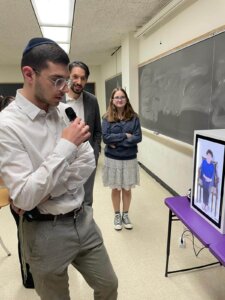
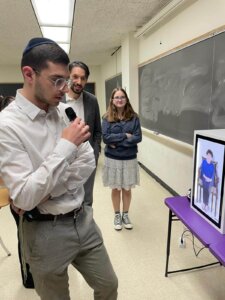
At a Brooklyn synagogue on a recent Monday afternoon, a video of Holocaust survivor Sonia Warshawski played on a two-foot-tall box. Seated in a leopard-print chair, her hands folded in her lap, Warshawski blinked and nodded her head expectantly on a continuous loop.
“Did anyone else from your family survive?” a Hebrew school student asked the AI-powered avatar.
The video cut to a separate clip. Warshawski said she and her sister had survived. Her brother, mother and father did not.
Warshawski, who survived three concentration camps and ran a tailoring shop in Kansas City until 2023, had made it part of her life’s mission to tell her story wherever she could. She spoke with students, filmed the 2016 documentary Big Sonia about her life, and was even a guest speaker at a local prison.
But Warshawski knew she wouldn’t live forever. So in 2021, with the help of the interactive media company StoryFile and her granddaughter’s production company, Inflatable Film, Warshawski recorded answers to hundreds of questions about her life, from “What do you remember about the death march?,” to “Why do you like leopard print so much?” Those answers were loaded into an AI-powered avatar of Warshawski that can converse through a video screen, which debuted as an exhibit at the Museum of Kansas City last year.
The technology also caught the attention of the Blue Card, a nonprofit that provides financial assistance to Holocaust survivors in need. The organization adapted it into a portable format and brought the virtual Warshawski to 20 schools and community centers across the New York area over the past year, with plans to expand nationwide. A parallel effort from the USC Shoah Foundation, called “Dimensions in Testimony,” also enables students to have conversations with virtual versions of Holocaust survivors.
The initiative reflects recognition that as survivors age, a model of Holocaust education built on firsthand testimony will be increasingly difficult to sustain. No lesson plan can match the impact of hearing directly from survivors, many of whom dedicate their golden years to speaking tours retelling their traumatic stories. But 90% of the world’s roughly 200,000 living Holocaust survivors are projected to die in the next 15 years. And for aging survivors — who have already lost so much of their lives to violence and deprivation — the weight of transmitting Holocaust memories to the next generation is a burden they cannot shoulder alone.
“It’s absolutely the future of Holocaust education,” said Masha Pearl, the Blue Card’s executive director. “It actually is as close as possible to hearing a live survivor speak.”
Warshawski’s story
Warshawski grew up in Międzyrzec, Poland, and was 17 years old when she and her family were forced into a ghetto. Sonia and her mother were deported to the Majdanek death camp, where she watched Nazis march her mother to her death via gas chamber. Warshawski was then sent to Auschwitz-Birkenau, where she was forced to spread her fellow prisoners’ ashes as fertilizer, and then to the Bergen-Belsen concentration camp, where she was shot in the chest on liberation day.
She recovered and met her husband, John, at the Bergen-Belsen displaced persons camp. The couple moved to Kansas City in 1948.
Using AI technology, students can ask the virtual Warshawski about all of those harrowing moments — with the added benefit that the real-life Warshawski only had to recall them once.
Many survivors “suffer from depression and PTSD, and it’s very difficult for them to recount these extremely painful experiences,” Pearl said. “This actually bypasses that in a way.”
The interactive element is also engaging for kids, Pearl said. At the Conservative synagogue Temple Sholom, after watching Big Sonia, nearly all 25 students ages 10 to 13 — half from the parochial school at the church across the street — raised their hands to ask the virtual Warshawski a question. A few students stayed after the programming had formally ended to ask more.
“It’s the same thing I heard from my uncle’s great grandpa,” said fifth-grader Noah Stein, who attends Hebrew school at Temple Sholom. “It’s amazing — I’ve never seen something like that.”
An imperfect technology
Warshawski, now 100 years old and still going strong, celebrated her birthday in November at a party with more than 1,000 people. But she doesn’t have as much energy as she used to and was unavailable to interview for this piece. So I interviewed her avatar instead.
My question — how she felt about her memory being preserved through AI — triggered an unrelated response.
“After we left [Majdanek], there were still people there, and I must tell you, one day when I was…”
“Can we pause this?” said Rechan Meshulam, special projects director at the Blue Card, who operated the technology at Temple Sholom.
Meshulam said the system had not matched my question to the correct response. She then manually selected the closest question, “Are you glad that you recorded this with StoryFile?”
“I feel this is a very important thing for the people in the world, not to forget and [to] read more about it. Read more history,” Warshawski said. “I’m very grateful that I had a chance to do it. I am thanking the Almighty for it, to give me the strength still to go on.”
The initial mismatched response illustrated the technology’s limits: Warshawski can only answer questions that StoryFile asked her during the original interview in 2021. If a question is similar enough, the AI is designed to redirect Warshawski to the appropriate answer. But this didn’t seem to work in practice. Whenever a student asked a question outside the suggested question bank, operators had to ask the student to rephrase — or pause Warshawski and jump in with their own knowledge about her story.
But according to Pearl, the limited scope of questions is a feature, not a bug. Limiting Warshawski to questions she actually answered prevents her words from being taken out of context or misconstrued, Pearl said.
“Sonia cannot tell you what the weather is today, what her thoughts are on politics — anything that’s really current,” Pearl said. “She can only speak to her experience.”
Not everyone draws the same line. Last year, a Utah-based tech startup called SchoolAI drew controversy for its AI-generated version of Anne Frank, which spits out responses that Frank never wrote herself. Henrik Schönemann, a German historian who tested the chatbot, found AI-Frank avoided holding Nazis responsible for her death and spun her story in an overly positive light.
“How anyone thinks this is even remotely appropriate is beyond me,” Schönemann posted to social media, adding that the technology “violates every premise of Holocaust-education” and amounted to “a kind of grave-robbbing.”
SchoolAI, which also offers the ability to chat with historical figures such as Alexander Graham Bell and Frederick Douglass, said it was implementing additional safeguards to help characters more directly address difficult questions.
I asked SchoolAI’s Anne Frank chatbot about how Frank feels about comparisons between ICE agents and the Gestapo. She didn’t take the bait.
“That’s a difficult question. When I lived in hiding, the Gestapo and police searched for people like us because of who we were, not because we had done anything wrong. I was always afraid,” AI-Frank wrote. “I believe it’s important to treat people with humanity and fairness, no matter their situation. What matters most is how we treat one another, especially those who are vulnerable.”
Yet even with careful control over the accuracy of testimony, some educators are uncomfortable with the idea of immortalizing Holocaust survivors in an interactive form.
In a research paper titled “Creating the ‘virtual’ witness: the limits of empathy,” Corey Kai Nelson Schultz argues that digital versions of Holocaust survivors can have the effect of undermining empathy. Viewers may treat the avatars more like virtual assistants than people, he wrote, and could be tempted to gamify the experience or test the technology’s limits.
Schultz told the Forward he prefers more traditional forms of Holocaust education — seeing artifacts like survivors’ shoes or toys, or watching video testimonies — mediums he believes better capture survivors’ humanity.
But the technology’s novelty was part of the appeal for Warshawski’s granddaughter, Leah, who directed Big Sonia — and said the AI component is just one more way to ensure her grandmother’s story lives on.
Warshawski “does authentically, passionately believe that everybody needs more education, and specifically, Holocaust education. And if this is the way to do it in the future, then so be it,” Leah told the Forward. “You know, ideally, everybody would be able to read more books.”
Pearl said the survivors she works with also have a different set of worries.
“We actually didn’t hear any ethical issues or concerns,” Pearl said. “The concerns that we heard were, Who will tell my story after I’m no longer here?”
The post As the last generation of Holocaust survivors die, is AI the future of Holocaust education? appeared first on The Forward.
Uncategorized
America’s oldest synagogue closed. Then an unlikely group tended its cemetery.
In 1833, Herald of the Times, a Newport, Rhode Island, newspaper, reported that the remains of Mrs. Rebecca Lopez had been brought from New York by steamboat and placed inside Touro Synagogue.
Dedicated in 1763, the building is now recognized as the nation’s oldest surviving synagogue. Newport had once been home to a thriving colonial Jewish community, but after the Revolutionary War and the city’s economic decline, that community had largely faded. The cemetery remained, and so did the synagogue. It was during that long interval of near-absence that Lopez’s funeral briefly reopened Jewish ritual life in Newport.
After prayers were read by Rabbi Isaac Seixas of New York, the body was carried to the cemetery on Touro Street, with “the clergy, town council, and a numerous concourse of spectators” joining the funeral procession. The paper noted that a Jewish ceremony had not been performed there “for the space of forty years.”
Newport’s Jewish burial ground dated to 1677. In 1822, Abraham Touro left money for the upkeep of the cemetery, the synagogue, and the street on which they stood. The fund was placed under trustees appointed by the Rhode Island legislature, and Newport’s Town Council was later authorized to use the interest for repairs.
While Newport’s Jewish population declined, the endowment ensured that the synagogue building and cemetery grounds continued to be maintained. In 1826, the Town Council reported that it had tried to repair the synagogue using the Touro fund, but could not proceed because it had not been able to obtain the keys from Shearith Israel in New York. Many of Newport’s former Jewish residents had relocated there, and the congregations had longstanding ties.
In 1842, the council contracted to enclose the synagogue lot with a substantial stone wall and an ornamental cast-iron fence, modeled on the fence around the Jewish cemetery. The work included a Quincy granite base and a gateway on Touro Street designed to correspond with the synagogue’s portico. The project cost $6,835.
The synagogue’s doors rarely opened, and often only for moments of mourning. In June 1854, Newport received the body of Judah Touro, one of the most prominent American Jews of his era, a native of the town and brother of Abraham Touro. The Herald of the Times reported that “the streets was [sic] crowded with people, the stores all closed, and the bells tolled.”
The City Council assembled at City Hall and marched in procession to the synagogue, where “thousands remained outside” during the service. At the funeral, Newport’s mayor, William C. Cozzens, spoke of the trust that had long existed between the city and local Jewish families, recalling that the synagogue and cemetery had been left in Newport’s care and maintained there “with ample means for their preservation.”
When Henry Wadsworth Longfellow visited Newport’s Jewish cemetery that same year, he wrote of the graves as “silent beside the never-silent waves.” He noticed, too, what endured there: “Gone are the living, but the dead remain,” he observed, “and not neglected.”
Newport’s preservation of Jewish sacred space was shared. Jews endowed these places and returned to bury their dead there. Christian officials repaired, protected, and publicly honored them. In this way, a Jewish inheritance was carried forward until communal life returned.
In 1883, Touro Synagogue was rededicated and a new Jewish community established in Newport. But even in the window of years when the congregation was gone, the dead were not abandoned.
The graves were kept.
The post America’s oldest synagogue closed. Then an unlikely group tended its cemetery. appeared first on The Forward.
Uncategorized
Milwaukee rabbi and son ordered to pay $1,000 to muralist who reportedly praised Hamas in court
(JTA) — A retired rabbi and his son were sentenced Wednesday in Milwaukee for having destroyed a local mural in 2024 that depicted the Star of David transforming into a swastika.
Rabbi Peter and Zechariah “Zee” Mehler were ordered to pay $1,000 total in restitution to Ihsan Atta, the property owner who had put up the mural. Peter, who pleaded no contest to a misdemeanor charge for criminal damage, was also fined $50, while Zee, who had pleaded guilty in December, was given a withheld sentence of 25 hours of community service.
The sentencing hearing took another turn when Atta, who is Palestinian, praised Hamas and walked out of the courtroom before being brought back in by deputies to finish the proceedings, according to local news reporters who were present. A transcript of the exchange could not immediately be obtained.
Zee Mehler told the Jewish Telegraphic Agency that, despite pleading guilty, he felt “vindicated.”
“What we did was illegal and needed to be answered for. But at the same time, what we saw was a very strong response from the city and the court that showed that they have no patience or time for this anti-Israel narrative,” he said. “They recognize the way that it has spread antisemitism, and they recognize the way that it’s caused so much global harm to the Jewish community.”
The case dates back to September 2024, when the Mehlers used a hammer and other tools to tear down Atta’s recently installed mural in full view of security cameras. They have long maintained that, while they understood it was illegal to destroy the mural, they did so out of concern for the safety of the local Jewish community.
Atta’s mural included the words “The irony of becoming what you once hated” surrounding a Star of David transforming into a swastika; the background of the mural appeared to depict scenes of destruction in Gaza. The Mehlers viewed the mural as incitement. At the time of their actions, it had already been condemned by local Jewish groups and the Milwaukee City Council.
In the courtroom, Zee, wearing long dreadlocks, escorted his father, who is 74 years old and has Guillain-Barre syndrome, in a wheelchair. Peter recently lost the ability to walk, his son said: “This has been a really rough few years for him.”
According to reports, circuit court judge Jack Dávila interrupted Atta when he began praising Hamas and instructed him not to make comments unrelated to the crime.
“We’re not going to solve the world’s problems with this hearing,” the judge reportedly told Atta, who apologized for his actions. In a video posted after the verdict, Atta called the proceedings a “kangaroo court” and stated, “We must have judges that are on the Epstein files, because we’ve got clowns running the courthouse.”
Atta’s actions in court, Zee Mehler said, meant “I didn’t really need to do much.”
“He was called to testify, and he absolutely buried himself,” Mehler said. “I can’t believe he said that he supports Hamas in a court, on the record. That’s a crazy thing to do.”
This article originally appeared on JTA.org.
The post Milwaukee rabbi and son ordered to pay $1,000 to muralist who reportedly praised Hamas in court appeared first on The Forward.
Uncategorized
Chicago’s new Jewish high school plucks leader from Florida day school
(JTA) — Months after unveiling plans for a new Jewish high school in downtown Chicago, the project’s founders have found their inaugural head of school and secured a still-under-construction building ahead of its first class, slated for fall 2027.
The Davis School this week announced the appointment of Richard H. Cuenca, the current head of school at the Posnack Jewish Day School in Davie, Florida, to lead the new high school.
“A transformative builder and disciplined leader, Dr. Cuenca brings extraordinary experience and a record of meaningful achievement,” the Davis Chicago Board of Trustees said in a statement. “Davis Chicago is committed to creating an academically rigorous, values-driven Jewish high school that prepares students for top universities, meaningful Jewish engagement, and leadership in the broader world.”
For Cuenca, the move to Chicago after leading Posnack since 2011 marks a chance to build a school from the ground up in one of the country’s largest Jewish communities. The launch of the Davis School was first reported by the Jewish Telegraphic Agency last summer.
“It’s going to be a unbelievable opportunity for the Jewish community and the Chicago greater community to be able to add another asset to this amazing city,” Cuenca told JTA. “A world class city deserves a world class college preparatory Jewish high school.”
The school, set to be the only non-Orthodox Jewish high school within city limits, will feature a mix of mandatory secular and Jewish curriculum with the goal of instilling “Jewish pride, support for the State of Israel, [and a] strong connection to their Jewish identity” in its students, according to Cuenca.
“If a kid’s taking AP calculus and they don’t identify with AP calculus, you know, that’s okay, right? You have to know calculus,” Cuenca said. “But in Judaic studies, it’s much more than just content knowledge. It’s also a sense of pride, of connection, of Jewish identity that gets solidified in very formative years of a teenager, so that by time they graduate, they know exactly who they are.”
Among the classes to be offered by the school will be an “Israel advocacy course,” which, according to Cuenca, will include a survey on the history of the biblical land of Israel through the creation of the modern Israeli state.
“When you have the true knowledge, when you have that, then that is a position of strength when an 18-, 19-year-old goes on a college campus and hears, you know, other things that deviate from that truth,” Cuenca said.
The lead-up to the school’s first class comes as both private and public schools in Chicago have faced allegations of antisemitism, spurring concern and desire for an alternative among some local Jewish parents.
But while some Chicago-area parents may be drawn to the school as a refuge from rising antisemitism, Cuenca said that was not the school’s focus. Instead, Cuenca said the school was intent on “lifting people up through Jewish learning.”
“We’re not trying to respond to antisemitism,” Cuenca said. “We’re trying to offer a school of excellence that we think contributes to the success of the overall city.”
That vision has been backed by significant investment in the school. In August, Tony Davis, a lead donor to the project and the co-founder and president of Linden Capital Partners, purchased a seven-story building on East Wacker Drive for $17.5 million to house the school.
The building, which will feature a 500-seat theater, a two-story library and fully kosher cafeteria facilities, was originally developed to house a high school campus for GEMS World Academy, a Dubai-based education provider.
“Our founding vision is anchored in academic excellence, elevated by exceptional Jewish scholarship, rigorous college preparation, and the vibrant energy of the city of Chicago,” Davis and his wife, Laura, said in a statement. “Our vision is bold, and Dr. Cuenca is the leader who will build our dream into a reality.”
This article originally appeared on JTA.org.
The post Chicago’s new Jewish high school plucks leader from Florida day school appeared first on The Forward.