


Uncategorized
Behind Ronnie Eldridge’s sweet, motherly face, one of the toughest political minds in NYC
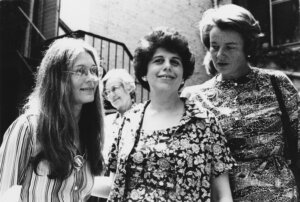
When news arrived that Ronnie Eldridge had passed away at the age of 95, I thought back to the mid-1980’s when I made a number of visits to the apartment on Central Park West that she shared with the legendary newspaper columnist Jimmy Breslin and their blended family of six kids. At the time I was doing stories for NPR about Breslin and his passionated denunciation of municipal authorities for their neglect of city’s homeless. Sometimes I’d record Breslin at home.
I couldn’t help noticing that almost every time I was in that apartment, Eldridge was on the phone with an autistic Jewish man named Ralph. I tend to notice things like that because my brother Michael, olav ha sholom, was autistic.
According to Daniel Eldridge, the eldest of the three Eldridge “kids,” his mother met Ralph at a Robert F. Kennedy presidential campaign event in 1968. Apparently, a campaign volunteer who was manning the door was giving Ralph a hard time.
Ronnie Eldridge intervened and declared that Ralph, who she had never met before, was her friend and he was to be allowed in. Daniel Eldridge told me his mother spoke with Ralph nearly every day after that.
Because my conversation with Daniel Eldridge was conducted on speakerphone, Eldridge’s granddaughter, Sophie Silberman, piped up.
“She looked after everybody with kindness and devotion,” Silberman said. “She knew that she was significant to Ralph and it didn’t take much to keep that part of his life alive and it meant the world to Ralph.”
Big shoes to fill
That kindness and devotion echoed in several recollections of Eldridge’s public life today.
Ruth Messinger, a former city council member who went on to lead the American Jewish World Service, told me that Eldridge “was very savvy.”
“She was a no-nonsense person,” Messinger said. “If there was an issue, if there was a problem, she would take it on. She was a seriously progressive presence for many, many years. She pursued the issues and stood up for justice.”
“She was just an institution all by herself,” said her successor in the New York City Council, Gale Brewer.
Eldridge represented an Upper West Side district in the Council for 12 years before being term-limited out of office. “Her shoes were very big shoes to fill,” Brewer said.
Eldridge was one of the sponsors of a 1992 law that required cameras be placed in facilities that house automated teller machines. She was motivated to win passage, having been held up using an ATM in her neighborhood.
Brewer is one of many public officials and activists who are remembering Eldridge’s advocacy on behalf of the most vulnerable members of society, including the LGBTQ community and women who have been abused by their spouses or boyfriends. She remembers Eldridge visiting incarcerated women who were doing time for crimes linked to their experience as battered women.
“She put that issue on the map,” Brewer told me.
The conscience of the Lindsay administration
Eldridge was one of the anti-war activists in the 1960’s who made mountains move on the national level. During the war in Vietnam she helped found the “Dump Johnson” movement, which in turn sparked President Lyndon Johnson’s decision to forego re-election in 1968. That prompted Robert F. Kennedy to enter the race. Eldridge was keen on RFK. She was a young mother in 1964 when she volunteered his campaign for the U.S. Senate.
During the ’68 presidential campaign, RFK said of Eldridge, “Behind that sweet, motherly face, Ronnie Eldridge has one of the toughest political minds in the city, if not the country.” She used the quote on a campaign poster for her unsuccessful bid to become Manhattan Borough President in 1977.
Eldridge’s activism also paid dividends on the local level. She served as the coordinator of Democrats for Lindsay and helped the Republican mayor win re-election in 1969 on the Liberal Party line. She was a political strategist for Lindsay and was known as the conscience of the Lindsay administration.
Around that time, she was part of a group that included the singer Harry Belafonte challenging the license of television station WPIX. The challenge dragged on for nine years but in 1978 an out of court settlement put about $10 million into the entity that challenged the license. I learned about all this when I asked Eldridge how she came to possess that very valuable Central Park West apartment.
A tabloid life
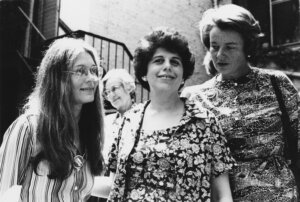
A number of Eldridge’s close friends have remarked that being married to Jimmy Breslin may’ve come with some perks, it must’ve been a challenge as well. For those of us who read Breslin religiously in the New York Daily News and New York Newsday, some of the gruff newspaper columnist’s more entertaining columns chronicled the foibles of the interfaith family’s Upper West Side life together.
This shtick inspired a pilot for a 1989 CBS sitcom about a NYC newspaper columnist and a mayoral aide. American Nuclear was co-written by Breslin but the network ultimately decided not to pick up the series.
In a 2004 for a radio documentary interview about her husband, I asked Ronnie Eldridge about having her domestic life portrayed in a tabloid
“The first time it happened everybody was hysterical,” she said. “I had a daughter in Paris. She called from Paris and was in tears. A daughter at college, she was also in tears. And my son in California said, ‘What’s going on?’ And then Jimmy’s family said, ‘Oh, just don’t pay any attention to it.’”
“When I was in the city council, I would just pretend that I didn’t read the paper. He would write articles. condemning and attacking colleagues of mine. I’d have to go into the city council and, see somebody that he’d just called unmentionable names. So, I just learned to leave it alone.”
A memorial service will be held for Ronnie Eldridge on Wednesday, March 11 at 4:30 p.m. at the New York Society for Ethical Culture, 2 West 64th Street in Manhattan.
The post Behind Ronnie Eldridge’s sweet, motherly face, one of the toughest political minds in NYC appeared first on The Forward.
Uncategorized
Israel’s best-case scenario in Iran may also be its worst
If the war in Iran ends with every objective achieved — and it won’t — Israel may still come to regret its victory. The warnings of an ancient Athenian writer, an early right-wing Zionist and an Orthodox Jewish professor of biochemistry illustrate why.
Since the Hamas attack of Oct. 7, 2023, Israel has dismantled nearly every adversary that once threatened it. Hamas can no longer effectively launch rockets. Hezbollah is degraded. The fall of Bashar al-Assad’s regime gave Israel an opportunity to destroy Syria’s weapons stockpiles. And now Iran: Ayatollah Ali Khamenei is dead, other key leaders have been assassinated, and the country’s ballistic missile and nuclear capabilities appear to be in tatters.
None of this is likely permanent. Hamas is regrouping, Hezbollah is launching rockets, Syria may yet radicalize, and Iranian regime change is a fantasy. But even if Israel really does defeat its foes, history teaches a painful lesson: it is victory, rather than defeat, that can set the stage for a country’s collapse.
An ancient analog for modern Israel
When the historian Thucydides documented the rise and decline of Athens some 2,500 years ago, he told a story that feels eerily applicable to Israel in 2026: that of a vibrant state poisoned by its own power.
Athens’ emergence as a military hegemon also marked the onset of its corruption and decline. Initial victories over strong enemies set the stage for later follies, arrogance, and cruelty. Flush with confidence, the Athenians embarked on the Sicilian Expedition and overextended catastrophically. Before that, even, they articulated a credo that almost perfectly encapsulates Israel’s current approach to the Palestinians: “the strong do what they can and the weak suffer what they must.”
This isn’t to say that any country should forego military power. But even right-wing architects of Zionism recognized that such power must eventually become a conduit to sustainable peace.
‘The iron wall’
In 1923, Ze’ev Jabotinsky, the ideological founder of the Zionist right, wrote a famous essay arguing that Palestinians would never voluntarily agree to convert what was then mandatory Palestine “from an Arab country into a country with a Jewish majority.”
Therefore, he wrote, a Jewish state “can proceed and develop only under the protection of a power that is independent of the native population — behind an iron wall.”
But while that part of Jabotinsky’s philosophy clearly aligns with that employed by today’s Israeli right, there are two crucial differences between the two.
The first is that Jabotinsky affirmed that it is “utterly impossible to eject the Arabs from Palestine” and that “there will always be two nations in Palestine” — a far cry from Israeli messianists’ current dreams of wholesale ethnic cleansing.
The second is that Jabotinsky saw the “iron wall” he envisioned as the first step to eventual agreement in which both sides “agree to mutual concessions.” Power was a precondition for safety, but eventually diplomacy would reap the fruits of long-term peace.
Yet in recent years, Israel has largely eschewed the second part of Jabotinsky’s vision in favor of a “strong do what they can” attitude towards the Palestinians — and the rest of the world.
A ‘secret-police state’
Which brings us to Yeshayahu Leibowitz, a brilliant and influential Orthodox Jewish philosopher and biochemist who foresaw the danger that a “might makes right” ideology would incur for Israel.
Leibowitz dared to challenge the euphoria of victory following the 1967 Six-Day War, in which Israel defeated a coalition of Arab armies and drastically increased its territory. Writing the following year, he warned that “a state ruling a hostile population of 1.5 to 2 million foreigners” — the Palestinians in Gaza and the West Bank — “would necessarily become a secret-police state, with all that this implies for education, free speech, and democratic institutions.”
Leibowitz was not naive: he firmly recognized the need to “continue to fortify ourselves in our Jewish state and defend it.” But he understood that the military victory of permanent occupation would erode Israeli democracy from within. Nearly 60 years later, Leibowitz is, sadly, vindicated: Settlers are on the rampage, public media and the judiciary are under attack, and some experts have suggested Israel can no longer be considered a true liberal democracy.
A deal in the works
Leibowitz warned that, under the wrong conditions, victory can corrode democracy. The question: Can the gains earned through military success ever justify that risk?
Some might argue that a potential Iran deal in the works would validate Israel’s strategy, because it shows that successful negotiation sometimes depends on military action. That is partially true. Israel has effectively negotiated with countries like Egypt after conflict. Long-term peace with Arab states has emerged precisely from the diplomacy that occurred after victory.
But we should be extraordinarily skeptical that Prime Minister Benjamin Netanyahu is the man to manage that process. Prime Minister Menachem Begin, who returned the Sinai to Egypt to secure peace, had to muster extreme political courage to go against settler elements within his Likud party. Netanyahu, on the other hand, has folded over and over again to the radical demands of his ultra-right wing coalition.
The man who at this very moment is allowing Hamas to regroup in Gaza because he is avoiding a postwar plan should not be trusted to manage any kind of victory with Iran.
The paradox of victory
What’s even more worrying is that the more successful the campaign in Iran is, the more the Israeli right will likely weaponize victory as proof that force is the only strategy that works for Israel, and that all external critics can be safely ignored.
They will be wrong. And we know that, because that’s exactly the same argument that the right offered during and after the Second Intifada: unilateral security, achieved through Israeli might.
The Oct. 7 attack showed the folly of that promise.
Israeli military strength has perhaps never been greater, and its regional foes have never been less powerful. And yet the country’s international standing is at historic lows, and its people are being harassed, injured and killed by Iranian ballistic missile launches that persist despite the country’s best defensive efforts.
No, Israel should not lay down its arms. No, peace with the ayatollahs was never possible. And yes, sometimes force is the only option.
But long-term security, like the kind we’ve seen Israel successfully build with some Arab states like Egypt, comes from resisting the temptations of radicalization that military success brings.
Israel’s current government lacks the wisdom to take advantage of those successes. It will, in fact, warp a win into a reason to double down on isolationist thinking that will push the country further away from liberal democracy.
In other words: victory in Iran — a best-case scenario for Israeli security in the short run — may turn out to be the worst-case scenario for Israeli democracy long-term.
The post Israel’s best-case scenario in Iran may also be its worst appeared first on The Forward.
Uncategorized
Hundreds of Diaspora leaders call for action against ‘Jewish-extremist terror in the West Bank’
(JTA) — Over 1,000 Diaspora Jews are petitioning Israeli President Isaac Herzog to intervene against settler violence in the West Bank, saying that the settlers are threatening Israeli security.
“Mr. President, the terror, death and destruction inflicted by Jewish-Israeli extremists against innocent Palestinians across the West Bank is an abomination,” says an open letter published Thursday. “It is not only morally shameful but a strategic threat to the future of Israel. It damages world Jewry and the relationship of future generations with Israel.”
The letter continues, “Sadly, based on events and on the statements of the most extreme coalition partners it can be concluded that the violence now engulfing the West Bank is not only condoned by the government but is in fact policy.”
The letter was organized by the The London Initiative, a liberal Zionist network founded earlier last year to “strengthen Israeli democracy, advance a fairer shared future for all citizens of Israel, revive hope in the prospects of achieving secure peace, and improve relations between all Israelis and world Jewry.”
It comes as violence against Palestinians in the West Bank — often unpunished by Israeli authorities — has reached new heights, with settlers allegedly killing seven Palestinians in the last month, including one on Thursday, and driving others from their homes.
The situation has grown so extreme that the Israeli army this week took the unprecedented step of diverting soldiers from Lebanon, where Israel is battling Hezbollah, to the West Bank. Both the chief of staff of the Israeli Defense Forces and the Central Command chief have warned in recent days that conditions in the West Bank are contributing to a dire manpower shortage in the army.
The issue has also ignited concern from the United States, and from Israel’s U.S. ambassador, Rabbi Yechiel Leiter, who told Ynet that he believed the situation was deterring some in Washington from supporting Israel. He called on the rabbis of the West Bank to constrain their disciples.
“I’m so angry about the issue of Jewish riots in Judea and Samaria,” Leiter said. “It’s a handful of a few hundred people who are staining an entire enterprise — and everyone is silent.”
The new letter signed by Diaspora Jews calls on Herzog to advocate for change with Prime Minister Benjamin Netanyahu and his far-right ministers who have not interceded to stop the violence. The signatories include prominent philanthropists including Charles Bronfman; liberal rabbis from multiple countries; and former British and Canadian ambassadors to Israel.
“Mr. President, Pesach is upon us. As we have for millennia, Jews everywhere will reflect on the promise of freedom and responsibilities of power,” the letter says. “We call on you to use your position to implore the government to put an end to the abomination of Jewish-extremist terror and the era of impunity for its perpetrators.”
The post Hundreds of Diaspora leaders call for action against ‘Jewish-extremist terror in the West Bank’ appeared first on The Forward.
Uncategorized
NYC Council approves ‘buffer zone’ legislation insulating houses of worship from protests
(New York Jewish Week) — The New York City Council passed legislation on Thursday aimed at protecting synagogues from disruptive protests, marking a decisive victory following a months-long push by Jewish and local leaders to strengthen safeguards around houses of worship.
The “buffer zone” legislation for religious institutions, which was introduced by Council Speaker Julie Menin following a pro-Palestinian demonstration outside of Park East Synagogue in November, was passed with a vote of 44-5, reaching a super-majority that will make it immune from a potential veto by New York City Mayor Zohran Mamdani.
The bill, which was altered from its initial format to exclude any mention of distance following concerns from the NYPD, will require NYPD Commissioner Jessica Tisch to “establish a plan to address and contain the risk of physical obstruction, physical injury, intimidation and interference in places of religious worship, while preserving and protecting the rights to free speech, assembly and protest,” Menin said during the introduction of the legislation.
“The increase in hateful acts around the city is absolutely abhorrent, and we have to do something about it,” Menin said.
Another measure included in the package of legislation, which would establish buffer zones for protests outside of schools, was also passed with a majority of 30 to 19, making it subject to a potential veto from Mamdani.
Mamdani has not confirmed whether he will pass the legislation. Ahead of the vote, Dora Pekec, a City Hall spokesperson, told the Jewish Telegraphic Agency in a statement that the mayor “wants to ensure both the right to prayer and the right to protest are protected here in New York City.”
She continued, “The Mayor is keenly aware of the serious concerns regarding these bills’ limiting of New Yorkers’ constitutional rights, and he will keep these concerns in mind for any bills that land on his desk.”
On the steps of city hall ahead of the vote, roughly three dozen protesters gathered as part of a demonstration organized by Jewish Voice for Peace NYC, Jews for Racial & Economic Justice and the New York Civil Liberties Union to object to the legislation.
Opponents of the legislation have said that it would have a chilling effect on First Amendment protections, including Donna Lieberman, the executive director of the New York Civil Liberties Union, who said during the demonstration that “this is no time for the political leaders of our city to be pressing for legislation that could put our right to protest in danger.”
“Let’s be clear, the rise of antisemitism is real, hate is real, and we must confront it,” Lieberman said. “But no speech zones, restricting speech and assembly are simply not the solution.”
Audrey Sasson, the executive director of Jews For Racial & Economic Justice, called on Mamdani to veto both pieces of legislation in a statement following the vote.
“We’re extremely disappointed that the City Council voted to pass Intros 001 and 175, bills that serve to generate headlines and convey concern, but not to materially make our city safer for all New Yorkers, including Jews,” Sasson said. “At best, the legislation changes little. At worst, it restricts New Yorkers’ free speech rights and empowers the NYPD to engage in discriminatory policing of protest outside houses of worship and educational facilities.”
But proponents of the bill have argued that it will offer an added layer of protection amid a rapidly escalating climate of antisemitism.
“The explosion of antisemitism in the past, let’s say four or five, six months, especially from Nick Fuentes becoming a major figure and Tucker Carlson going completely off on that has made the rhetoric so much more unstable that I think we just have to have a time where synagogues and all places of faith are protected,” Eitan Szteinbaum, a 25-year-old Jewish New York resident, said outside of City Hall.
Council Member Eric Dinowitz, who introduced the protest bill for educational sites, welcomed the outcome of the vote, saying, “I look forward to the conversation the mayor may want to have about how we protect our students’ safe access to schools.”
The passage of the bills was also welcomed by the Anti-Defamation League of New York and New Jersey, which wrote in a post on X that the measures were an “essential first step to keep Jews — and all New Yorkers — safe.”
“ADL’s most recent audit showed a record 976 antisemitic incidents in NYC, many of which targeted synagogues and Jewish institutions, demonstrating a clear threat to religious freedom,” the statement continued. ‘We are grateful to @SpeakerMenin not only for sponsoring this legislation, but for her entire five-point plan to combat antisemitism.”
Rabbi Marc Schneier, a vocal critic of Mamdani, also celebrated the vote in a statement.
“I am proud of NYC Council Speaker Julie Menin for taking action so quickly, especially as it was clear the mayor once again flip-flopped when it comes to protecting New York’s Jewish community, and New Yorkers of all faiths,” Schneier said. “No one should have to be worried about protesters harassing them when entering a house of worship.”
The post NYC Council approves ‘buffer zone’ legislation insulating houses of worship from protests appeared first on The Forward.