


Uncategorized
Bernie Sanders downplays Graham Platner’s Nazi tattoo: ‘There might be one or two more important issues’

After Graham Platner, the progressive Senate hopeful running in Maine’s Democratic primary, revealed this week that he had had a Nazi-inspired tattoo on his chest for nearly two decades, several of his allies on the left cut him loose.
One who hasn’t: Vermont’s Jewish senator, Bernie Sanders.
“I’m not overly impressed by a squad of media running around saying, ‘What do you think about the tattoo on Graham Platner’s chest?’” the elder statesman of the progressive movement told Axios this week. “Between you and me, there might be one or two more important issues.”
Sanders also said he “absolutely” stood by his endorsement of Platner. Axios plans to air its full interview with Sanders on Friday but released snippets of the conversation on social media.
Sanders has backed Platner, a Marine veteran and oyster farmer, since soon after the latter announced his Senate bid this August. Platner’s anti-establishment platform, which includes embracing many progressive policies Sanders helped popularize, had made him a rising star despite his lack of any political experience. Platner has also taken a hard line against Israel.
That popularity was shaken following the recent revelation of Platner’s old Reddit posts, in which he made comments disparaging various groups. In an effort to get ahead of the opposition, Platner then himself revealed that he sported a skull-and-crossbones chest tattoo resembling an S.S. Totenkopf. He said he paid for it in 2007 while “inebriated” with fellow Marines in Croatia, and claimed he hadn’t known it was affiliated with Nazis (though subsequent reporting has suggested he knew it was a Totenkopf).
“I’m not a secret Nazi,” Platner said on Monday. He initially did not apologize for or suggest he would remove the tattoo.
After the revelations, Sanders told Axios he was still “impressed by the guy.”
“He went through some very difficult experiences in the military as a machine gunner, seeing his friends killed, came out of the military, he will acknowledge, I’m not telling you what he doesn’t say, he had PTSD,” the senator said. “He went into a dark period in his life. I suspect that Graham Platner is not the only American to have gone through a dark period.”
Sanders then sought to draw a line between condemnation of Platner and the election of President Donald Trump. “I think as a nation, especially given the fact that we have a president who was convicted on 14 felonies, maybe we have to do a little bit of forgiveness,” he said.
He wasn’t the only prominent progressive Jew who has remained in Platner’s corner since the tattoo revelation. Jon Lovett, the co-founder of influential left-wing podcast “Pod Save America” and media company Crooked Media and a former Obama official, has accused Platner’s progressive critics of demanding “only perfect candidates off the Harvard Law conveyor belt.” (Platner revealed his Nazi tattoo on a “Pod Save America” episode.)
“Of course he SHOULD answer for that tattoo,” Lovett wrote in a follow-up post on X Wednesday. “He’s explained the story, how it wasn’t flagged as a hate symbol when he entered the army or when he received a security clearance. He’s apologized and covered it up. Maybe it’s not enough. Maybe you don’t believe him.”
Following pushback, Platner did cover up the tattoo with a different design he referred to as a “Celtic knot with some imagery around dogs.”
In a post and video he posted to social media Wednesday, the candidate lifted his shirt to reveal his new tattoo and expressed regret that the old one might have invited comparisons to Nazis.
“It’s come to my attention that it has a stark resemblance to a symbol that is used by neo-Nazis, and I want to say, that was not my intent at all. And the idea that I was going around with something like that utterly horrifies me,” Platner said. “I know that symbols like this can be incredibly damaging to people, and the idea that I had it all these years and it could have been read like that is incredibly troubling.”
He added, “I have lived a life dedicated to antifascism, antiracism and anti-Nazism. I think that racism and antisemitism are a long scourge on our society and a long scourge on our politics, and I think it has no place in our world.”
Platner quickly pivoted, accusing “the establishment” of trying to destroy his movement with distractions.
“Every second we spend talking about a tattoo I got in the Marine Corps is a second that we don’t talk about Medicare for All, it’s a second we don’t talk about raising taxes on the wealthy,” he said.
Another prominent Jewish senator, Majority Leader Chuck Schumer, responded to the revelations about Platner’s tattoo by making an endorsement in the race, which he had until this week avoided. He is backing Janet Mills, Maine’s former governor, saying she “is the best candidate to retire Susan Collins.”
A recent poll, conducted just before the tattoo revelations, found that Platner holds a wide lead over Mills among Democratic voters.
Platner’s opponents have started to riff on the controversy, as well: Jordan Wood, a former congressional aide also running in the primary, posted on social media to “fess up” that he, too, has a tattoo — of the symbol of Barack Obama’s presidential campaign. “I got this tattoo a few years ago as a reminder of what hope and a positive vision can do in our politics,” he said on Instagram. Adding a dig at Platner, he concluded, “And yes, I knew what it was when I got it.”
A defiant Platner has pledged to remain in the race. At a rally Wednesday evening in Ogunquit, he again said he hadn’t known the meaning behind his tattoo.
He added, “If they thought this was going to scare me off, if they thought that ripping my life to pieces, trying to destroy me, was going to make me think that I shouldn’t have undertaken this project, they clearly have not spent a lot of time around Marines.”
—
The post Bernie Sanders downplays Graham Platner’s Nazi tattoo: ‘There might be one or two more important issues’ appeared first on Jewish Telegraphic Agency.
Uncategorized
In her inspired and inspiring history of the Jewish Bund, Molly Crabapple has found her anti-Zionist heroes for our time

Here Where We Live Is Our Country: The Story of the Jewish Labor Bund
By Molly Crabapple
One World, 453 pages, $32
The week of Passover, north Brooklyn bus riders found something unusual at several bus shelters. Swapped out for paid ads were quotes including one translated from a 1938 essay in Tsukunft, a Yiddish literary monthly once published by the Forward Association.
“If a Jewish state should arise in Palestine,” it read, “its spiritual climate will be eternal fear of the external enemy (Arabs); eternal struggle for every bit of ground with the internal enemy (Arabs); and an untiring struggle for the extermination of the language and culture of the non-Hebraized Jews of Palestine. Is this a climate in which freedom, democracy and progress can grow?”
There are pithier anti-Zionist slogans graffitied in Brooklyn, but this quote was from Henryk Erlich, a leader of the Jewish Labor Bund, a staunchly anti-Zionist socialist party founded in Vilna in 1897 that became the most influential political party among prewar Eastern European Jews.
The bus shelter takeover was part of a guerrilla ad campaign for Here Where We Live Is Our Country: The Story of the Jewish Labor Bund, a new book by the artist, activist and writer Molly Crabapple. The campaign, which started the same week the Justice Department sued Harvard University, accusing it of tolerating antisemitism by failing to crack down on anti-Zionist student protesters, also included wheatpasted posters of a model in fishnets holding Crabapple’s book.
The Trump administration and leading American Jewish groups like the Anti-Defamation League and American Jewish Committee argue that opposing Zionism, defined as Israel’s right to exist as a Jewish state, is antisemitic; Crabapple’s response is a 400-page Jewish history lesson.

Before World War II, most Jews were not Zionists. Many Orthodox communities felt that forming a Jewish state was heresy, others thought the mass migration of 9 million Jews from a hostile Europe was impractical. The Bund’s opposition to Zionism was not religious or pragmatic; it was ideological. Bundists argued that the future of Jews was linked to all workers, and they should stay and fight repression in Europe, not leave. They called this form of solidarity doikayt, Yiddish for here-ness, as opposed to Zionism’s there-ness.
Crabapple places the Bund, initially an outlawed group in Tsarist Russia, at the center of both the failed 1905 and successful 1917 revolutions. In interwar Poland, as a legal party, it became the most powerful Jewish political movement, even winning seats in municipal elections, and during the Holocaust, Bundists became ghetto fighters and partisans. But the Bund was purged by Stalin, who killed Erlich four years after his Tsukunft essay, and decimated by the Nazis. In postwar America, the Bund was mostly forgotten.
Crabapple, a member of the Democratic Socialists of America and an Occupy Wall Street alumna, learned of the Bund through a watercolor by her great-grandfather the artist Sam Rothbort. The painting, set in the Belarusian shtetl of his youth, shows a young woman in a blue dress throwing a rock through a cottage window. The caption reads: “Itka, the Bundist.”
In her 2018 New York Review of Books essay “My Great-Grandfather the Bundist,” Crabapple recounts discovering that Rothbort’s activism in Tsarist Russia forced him to flee to New York in 1904.
Since the publication of her article, Crabapple spent six years learning Yiddish, visited the former centers of Eastern Europe Jewish life, and dug through obscure Yiddish socialist tomes to produce her book. During the same time, Hamas attacked Israel on Oct. 7, 2023 and Israel responded by killing over 70,000 in Gaza in attacks which many, including the Israeli human rights group B’Tselem, have called a genocide. At the time of this writing, Israel is occupying southern Lebanon and along with the United States is at war with Iran. For the first time, Gallup polls show more Americans sympathize with Palestinians than with Israelis, and an increasing number of younger Jews have rejected Zionism outright and are rediscovering the Bund.
Crabapple’s book is written for this moment. More than translating Bundist theory from Yiddish, she puts it into the language of today’s left. When Julius Martov declared in 1894 “that Jewish workers were oppressed both as workers and as Jews, as a race and a class,” Crabapple explains that he was invoking what the modern-day scholar Kimberlé Crenshaw calls “intersectionality” and was a form of “identity politics.”
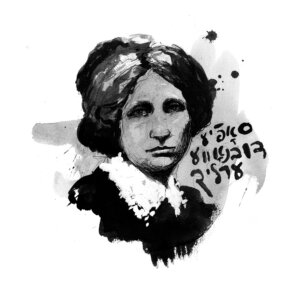
To tell the Bund story, Crabapple focuses on a cast of characters including Erlich’s wife, the poet and activist Sophia Dubnow; the militant leader Bernard Goldstein; the famous ghetto smuggler Vladka Meed (nee Feigele Peltel); and her own great-grandfather Sam Rothbort. In some instances, she relies on memoirs; for Rothbort, she interprets the hundreds of paintings and sculptures in her great-aunt’s Brooklyn home and pulls on genealogical threads from her mother’s shoebox of family papers.
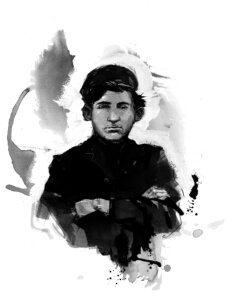
Crabapple, whose artwork is in the permanent collection of MoMA and the Rubin Museum, and has posters currently on display at the Poster House, introduces each character with an ink drawing portrait. Her artwork tends to lay bare her political perspective. She renders Donald Trump grotesque, while her sketches of Bundists are more similar to her portraits that glorify leftist icons like Luigi Mangione, the accused assassin of the United Health Care CEO Brian Thompson.
When asked in 2020 on the progressive Jewish podcast Treyf if progressives were engaging with a “romanticized fantasy of the Bund,” she didn’t disagree. “There’s actually a great value to simplified and aesthetic symbols in politics,” she said. “The fantasy of the Bund that I see is a muscly Jewish guy in a newsboy cap saying ‘fuck the Zionists’ with one middle finger while the other hand punches a Nazi.”
Here Where We Live Is Our Country is not a caricature of the Bund, nor a work of fan fiction; it’s a deeply researched portrait, but at its core lies this romantic vision. The Bund ran soup kitchens, sports programs and day camps, and promoted the Yiddish language, but Crabapple is most attracted to their street-fighting militancy. And her narrative can be one-sided. The Erlich quote in the book and on the bus shelter was part of a public debate with his father-in-law, the historian Simon Dubnow. Dubnow’s response goes untold.
But there are plenty of academic texts that dissect 90-year-old political debates. Crabapple’s book is different, and better for it. Here Where We Live Is Our Country reads like an epic novel with the Bundists as its tragic heroes.

Crabapple, as narrator, relates her experiences protesting at the 2011 Occupy Wall Street encampment, canvassing housing projects with the DSA, reporting from the West Bank and Gaza, and traveling through war-torn Ukraine. The personal interjections remind the reader that this is not a dispassionate history. Naomi Klein’s blurb praises the book as “a portal to an irresistible, lost world,” but Crabapple’s goal is not to write an elegy. She calls the Bund’s history a “candle to illuminate the tumultuous present” and hopes her book “serves as a guide to our urgent moment.” She decouples Zionism from Jewishness and shows that anti-Zionism alone is not antisemitic, but she leaves largely unresolved the question of what the Bund’s example demands of us today.
The Bund organized eastern European Jewish workers who lacked basic civil rights. Today’s challenge is less about Jewish empowerment, than it is about how Jews wield power, vis-a-vis the state of Israel and its military. In the book, however, Israel barely appears as an actual place where millions of Jews and Palestinians live. Instead, Israel is seen through the prism of its founding ideology, Zionism — one which pre-war Bundists argued adopted the worst quality of European ethno-nationalism.
As the Erlich quote argues, a Jewish state in Israel was destined to repeat endless cycles of violence and tribalism. In this view, the socialist kibbutzes that seduced leftists like a young Bernie Sanders or the overtures of peace and coexistence by Liberal Zionists like Yitzhak Rabin, are all illusions. For Crabapple, the inescapable reality of Zionism is instead the right-wing Benjamin Netanyahu, the violent settlers, and increasingly brutal wars and occupation.
The antidote is the Bundists’ concept of solidarity — where Jews join with the workers of the world but, unlike in Communism, hold on to their Jewish identity. One of the quotes Crabapple returns to several times is from the Socialist Congressman and Bundist ally Meyer London in 1905, where he inverts the story of Exodus: “Are you aware that in Russian Poland, thousands of our Jewish boys and girls are giving their lives for liberty? They pray to God, not to lead them again out of Egypt, but to help them to free Egypt.”
The quote, like Crabapple’s book, is poetic and noble. It goes against everything I learned in Hebrew School, yet somehow reflects Jewish values in its call to be empathetic to the oppressed, because we “were once a stranger in a strange land.”
Reflecting on a 1938 Erlich speech about the rise of Nazism, where he calls on Polish Jews to stand in solidarity with the same people who had carried out pogroms across their country, Crabapple writes: “This was it. There was only Egypt, the Bund knew, and they were stuck with the Egyptians. They were people first, not Jews or goys.” It is a beautiful and heartbreaking line, knowing what came next.
This tragic solidarity is presented as a point of inspiration, but how? The 2023 Jewish Voices for Peace cease-fire protest that filled Grand Central Terminal is offered as an example of Bundist-like solidarity in action, but Crabapple, who has supported a cultural boycott of Israel, stops short of prescribing what this anti-Zionism should mean today.
Vast numbers of Jews, including Bundists, did leave Egypt and cross into Israel — not not because of ideology or religion, but because of history. American labor leader David Dubinsky, who is featured in the book, was exiled to Siberia by the Tsar and escaped to New York, where he co-founded the Jewish Labor Committee in 1934, providing Bundists critical support during the Holocaust.
In his memoirs, Dubinsky recalls telling David Ben-Gurion after the war, “even though I am sympathetic to the creation of Israel, I am not a Zionist.” He then spent decades steering American labor to support Israel financially and politically.
Crabapple also includes Vladka Meed, the celebrated ghetto smuggler, drawing on her memoir Both Sides of the Wall, the proceeds of whose English edition were donated to the Ghetto Fighters’ House Museum in Israel, where Meed led groups of Americans on educational trips.
The historian David Slucki in his 2012 book, The International Jewish Labor Bund after 1945, finds that over time the Bund came to terms with the state of Israel; the Bund’s World Coordinating Committee accepted it as an important Jewish community, but not the sole political and cultural center, and eventually advocated a two-state solution.
It’s hard to imagine the Bund simply “Standing with Israel” today. But nearly half of Americans under 30 describe Hamas as a militant resistance group rather than a terrorist organization, and anti-Zionism has been taken up by far right antisemites. Crabapple doesn’t spell out what the Bundist response would be today; she leaves that to the reader. What she does is resurrect a buried political tradition in a way her Bundist heroes would appreciate: not just in book form, but in the streets for everyday Brooklyn bus riders.
The post In her inspired and inspiring history of the Jewish Bund, Molly Crabapple has found her anti-Zionist heroes for our time appeared first on The Forward.
Uncategorized
Long Island town ordered to pay $19M after blocking Chabad synagogue construction
(JTA) — After nearly two decades of legal sparring, a town on Long Island has been ordered to pay a local Chabad center $19 million, settling claims that officials unlawfully blocked the construction of a synagogue on its rabbi’s property.
Rabbi Aaron Konikov and Lubavitch of Old Westbury sued the Village of Old Westbury in 2008, after the village passed a law in 2001 governing places of worship as Konikov sought to build a synagogue on his property.
Local officials enacted the law two years after Konikov planned a ceremony to announce a new building on the land where he already operates a synagogue. They decreed that houses of worship could be built only on plots of 12 acres or more. Konikov owns a 9-acre plot.
In October, U.S. District Judge Gary Brown ruled that the 2001 ordinance “unconstitutionally discriminates against the free exercise of religion and is therefore facially invalid.”
Old Westbury agreed to pay the plaintiffs in the suit $19 million as part of a consent decree, which was signed by Brown on March 18, Newsday reported this week.
“This consent decree may not be modified, changed or amended except in writing signed by each of the parties approved by the court,” Brown wrote. “Each party participated fully in the negotiation and drafting of the terms of this decree, and any ambiguity shall not be construed against any party.”
Kornikov did not respond to requests for comment on Monday. But he may soon be switching into construction mode for his long hoped-for synagogue, for which preliminary plans show a 20,875-square-foot building and an adjacent parking lot.
The $19 million payment will be made by the village’s insurance providers, and Lubavitch of Old Westbury has until Jan. 15, 2027, to apply for a special-use permit from the village to build a synagogue, according to Newsday.
The ruling marks a notable victory for emissaries of the Chabad-Lubavitch movement, who have often been met with legal challenges when establishing centers. Last July, the Village of Atlantic Beach in New York agreed to pay Chabad of the Beaches $950,000 to settle a legal battle over the construction of a new community center.
This article originally appeared on JTA.org.
The post Long Island town ordered to pay $19M after blocking Chabad synagogue construction appeared first on The Forward.
Uncategorized
Iran claims synagogue in Tehran was ‘completely destroyed’ by US-Israeli strike
(JTA) — Iranian state media claimed on Tuesday that a synagogue in Tehran was “completely destroyed” by a U.S.-Israeli strike.
The claim was impossible to verify. Footage of the alleged attack on the Rafi-Niya Synagogue posted online showed open Hebrew prayer books scattered among the rubble of a building.
The synagogue was damaged when a nearby residential building in Tehran was attacked, according to Iranian news agencies. The Rafi-Niya Synagogue is located near Palestine Square, an epicenter of the Iranian regime’s anti-Israel propaganda.
The United States and Israel have been bombing sites in Tehran for more than a month since launching a war on the Islamic Republic regime. Israel emphasized that it does not target religious sites.
Homayoun Sameyah Najafabadi, the only Jewish representative in Iran’s parliament, condemned the attack in a video published by Iran’s official IRIB News outlet.
“The Zionist regime showed no mercy towards this community during the Jewish holidays and attacked one of our ancient and holy synagogues,” Najafabadi said. “Unfortunately, during this attack, the synagogue building was completely destroyed, and Torah scrolls remain under the rubble.”
About 8,000 Jews live in Iran and worship in dozens of synagogues. The war has exacerbated their delicate position, as they are technically granted freedom of religion but face peril if they demonstrate any connection to Israel or dissent against their government. Hundreds of Iranian Jews who have applied for refugee status because of religious persecution are trapped in the country after the United States halted refugee admissions.
The alleged attack comes one day after the Israeli Ministry of Foreign Affairs posted footage of an undetonated missile on a street, writing that an “Iranian regime missile struck next to a mosque in Israel.”
“A regime that targets civilians and sacred spaces of all religions has no red lines,” the ministry wrote in a post on X. “Nothing is off limits for them.”
On Tuesday, the Israeli prime minister’s office issued a statement about the alleged damage to the Rafi-Niya synagogue. “Iran is firing missiles at civilians, Israel is striking terror infrastructure,” it said. “Missiles on civilians versus precision strikes on terror targets. That’s the difference.”
This article originally appeared on JTA.org.
The post Iran claims synagogue in Tehran was ‘completely destroyed’ by US-Israeli strike appeared first on The Forward.