


Uncategorized
Bondi gunmen condemned ‘Zionist’ actions prior to attack and threw bombs that failed to detonate, police say
The two gunmen who opened fire on a Hanukkah celebration in Sydney, Australia last week, killing 15, recorded a manifesto video prior to the attack in which they condemned the acts of “Zionists.”
The description of the video, which was included in newly released documents from the Local Court of New South Wales on Monday, comes as one of the attackers, Naveed Akram, 24, currently faces 59 charges, including 15 counts of murder and one count of terror. His father, Sajid Akram, 50, was killed on the scene of the attack.
In the video, which was filmed in October and found on Naveed Akram’s cellphone, the pair sit in front of an Islamic State flag and four long-armed firearms and appear to recite a passage from the Quran. Later, the pair explain their motivation for the attack on Bondi beach, and condemn the acts of “Zionists,” according to the court documents.
“Police allege that the Accused and his father, S. Akram, adhere to a religiously motivated extremist ideology linked to the Islamic State,” the court documents read. “This is demonstrated by their videoed speech and use of Islamic State flags during the attack.”
During the attack, the pair also threw three pipe bombs and a “tennis ball bomb” that failed to detonate, according to the court documents. Another explosive device was also found on the trunk of their car.
The court document also alleges that the father and son had “meticulously planned” the attack for “many months,” detailing that the pair had engaged in: “Making an ISIS inspired video; Making of ISIS flags; Firearms Training; Making of pipe bombs and improvised explosive devices; Booking of accommodation as a staging post; and Transportation of firearms and ammunition for the attack.”
In October, the pair booked a house on Airbnb that was used as a “staging post” for the attacks and were also recorded conducting firearms training in a “countryside location” that police believe was in New South Wales.
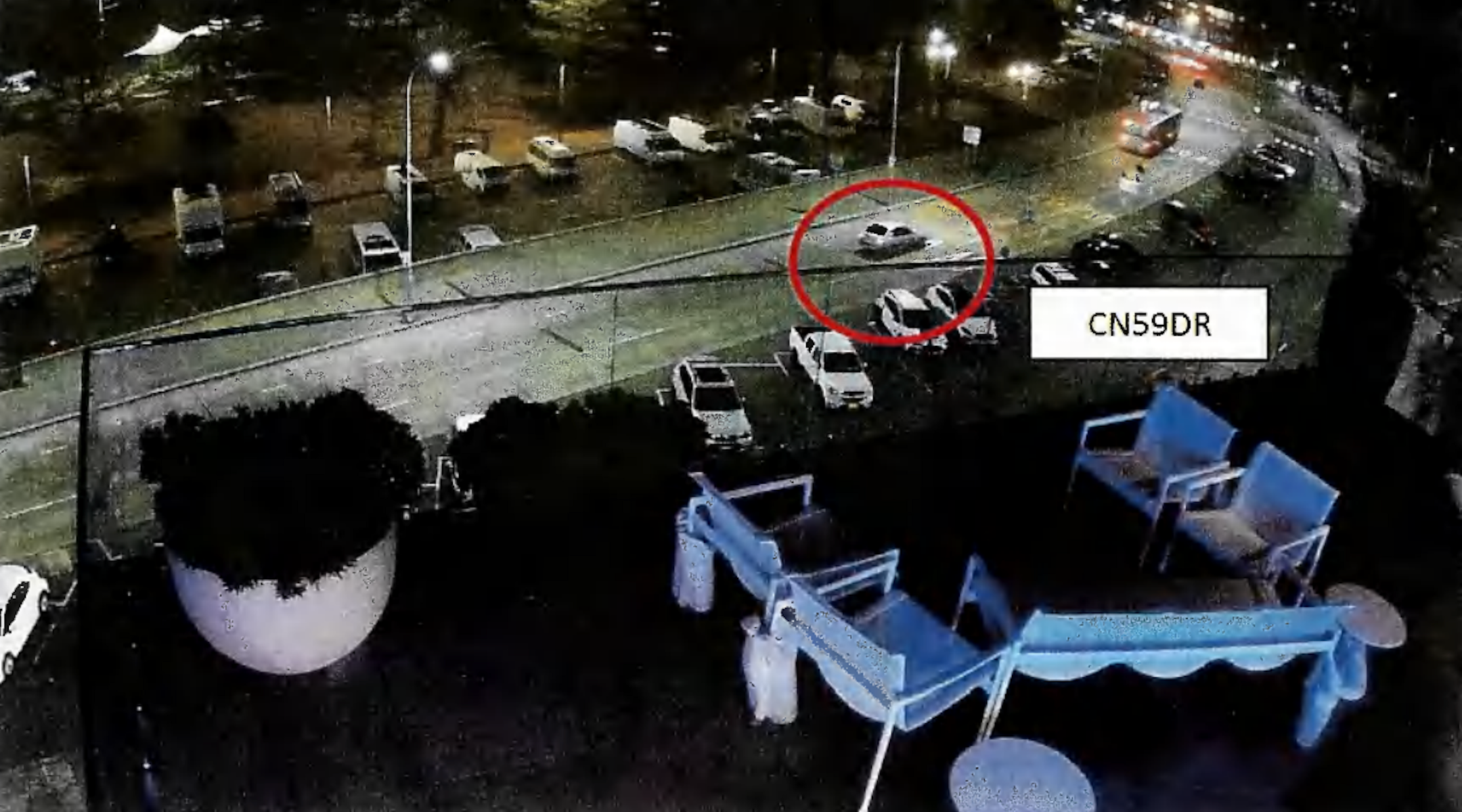
On Dec. 12, two days before the attack, the pair were also seen on CCTV footage driving to Bondi beach and walking along the footbridge from where they would later shoot at the Hanukkah event.

Naveed and Sajid Akram allegedly traveled to Bondi Beach on Dec. 12 to plan for the attack on the Hanukkah event days later, according to surveillance video shared by law enforcement. (Local Court of New South Wales)
“Police allege that this is evidence of reconnaissance and planning of a terrorist act,” the court documents said.
On Monday, Naveed Akram was transferred from the hospital where he had been healing from injuries sustained during the attack to the Long Bay Correctional Complex in Malabar, a high-security prison facility.
The parliament of New South Wales was also recalled on Monday to vote on new legislation that would limit gun ownership for non-citizens and reduce the number of firearms a person can legally own to four.
Sajid Akram was an Indian national who had been living in Australia on a resident visa and owned six firearms.
The new legislation would also ban the display of terror symbols and place restrictions on protests, including giving police the power to remove face coverings during protests. The state government has also vowed to ban the popular pro-Palestinian slogan “globalize the intifada.”
“We have got a responsibility to knit together our community that comes from different races and religions and places from all over the world. We can do it in a peaceful way,” New South Wales Premier Chris Minns told reporters outside of Parliament on Monday.
Australian Prime Minister Anthony Albanese was booed at a vigil on Sunday at Bondi beach for the victims of the attack, underscoring growing pressure on the Australian leader to call a Royal Commission, Australia’s highest level of inquiry, into the terror attack.
Albanese has so far dismissed calls for a Royal Commission, arguing that it would take too long, instead announcing a review of federal intelligence and law enforcement agencies.
“Emotions were raw and a lot of people in the community are hurting and angry, and some of that anger was directed towards me, and I understand that,” said Albanese at a press conference on Monday. “As Prime Minister, I feel the weight of responsibility for an atrocity that happened whilst I’m Prime Minister. And I’m sorry for what the Jewish community and our nation as a whole has experienced.”
This article originally appeared on JTA.org.
The post Bondi gunmen condemned ‘Zionist’ actions prior to attack and threw bombs that failed to detonate, police say appeared first on The Forward.
Uncategorized
Downed Planes Raise New Perils for Trump as Tehran Hunts for Missing US Pilot

Traces of an Iranian missile attack in Tehran’s sky, amid the U.S.-Israeli conflict with Iran, in Tehran, Iran, April 3, 2026. Photo: Majid Asgaripour/WANA (West Asia News Agency) via REUTERS
Two US warplanes were downed over Iran and the Gulf, Iranian and US officials said on Friday, with two pilots rescued and a third still missing and being hunted by Tehran’s forces.
The incidents show the risks still faced by US and Israeli aircraft over Iran despite assertions from US President Donald Trump and his Defense Secretary Pete Hegseth that their forces had total control of the skies.
The first plane, a two-seat US F-15E jet, was shot down by Iranian fire, officials in both countries said.
The second plane, an A-10 Warthog fighter aircraft, was hit by Iranian fire and crashed over Kuwait, with the pilot ejecting, two US officials said.
Two Blackhawk helicopters involved in the search effort for the missing pilot were hit by Iranian fire but made it out of Iranian airspace, the two US officials told Reuters.
The degree of injuries among the crew of the aircraft remained unclear. The status and whereabouts of the missing F-15E crew member was not publicly known.
Iran’s Revolutionary Guard Corps said it was combing an area near where the pilot’s plane came down in southwestern Iran and the regional governor promised a commendation for anyone who captured or killed “forces of the hostile enemy.”
Iranians, who have been pummeled by American air power for weeks, posted gleeful messages celebrating the plane downings. Iran’s Parliament Speaker Mohammad Baqer Qalibaf said on X that the U.S. and Israel’s war had been “downgraded from regime change” to a hunt for their pilots.
Trump has been in the White House receiving updates on the search-and-rescue operation, a senior administration official told Reuters. The Pentagon and US Central Command did not immediately respond to requests for comment.
NO SIGN OF END TO WAR
The prospect of a US service person being alive and on the run inside Iran raises the stakes for Washington in a conflict with low public support and no sign of an imminent end.
Iran has officially told mediators it is not prepared to meet with US officials in Islamabad in coming days and that efforts to produce a ceasefire, led by Pakistan, have reached a dead end, the Wall Street Journal reported on Friday.
The US and Israel opened the campaign with a wave of strikes that killed Iran’s Supreme Leader Ayatollah Ali Khamenei on February 28. The war has killed thousands and threatened lasting damage to the global economy.
So far, 13 US military service members have been killed in the conflict and more than 300 have been wounded, according to the US Central Command.
Iran has rained down drones and missiles on Israel. It has also taken aim at Gulf countries allied to the US, which have so far held back from joining the war directly for fear of further escalation.
In a security alert on Friday, the US embassy in Beirut said Iran and its aligned armed groups may target universities in Lebanon and urged US citizens in the country to leave while commercial flights are still available.
Israel has been waging a parallel campaign against Iran-backed Hezbollah in Lebanon after the militant group fired at Israel in support of Iran.
TRUMP THREAT TO STRIKE BRIDGES, POWER PLANTS
On Friday, as Trump threatened to hit its bridges and power plants, Iran struck a power and water plant in Kuwait, underlining the vulnerability of Gulf states that rely heavily on desalination plants for drinking water.
On Thursday, Trump posted footage on social media showing dust and smoke billowing up as US strikes hit the newly constructed B1 bridge between Tehran and nearby Karaj, which was due to open this year, and said more attacks would follow.
“Our Military, the greatest and most powerful (by far!) anywhere in the World, hasn’t even started destroying what’s left in Iran. Bridges next, then Electric Power Plants!” he wrote in a subsequent post.
On Friday, a drone hit a Red Crescent relief warehouse in the Choghadak area of Iran’s southern Bushehr province.
Kuwait Petroleum Corporation said its Mina al-Ahmadi refinery had been hit by drones. Other attacks were also reported to have been intercepted in Saudi Arabia and Abu Dhabi. Missile debris landed near the Israeli port of Haifa, site of a major oil refinery.
Oil markets were closed after benchmark U.S. crude prices gained 11% on Thursday following a speech by Trump that offered no clear sign of an imminent end to the war.
Uncategorized
US-Iran: Diplomatic Push Falters as Qatar Steps Back and Pakistan Talks Stall

Qatari Prime Minister and Foreign Minister Sheikh Mohammed bin Abdulrahman Al Thani speaks after a meeting with the Lebanese president at the presidential palace in Baabda, Lebanon, Feb. 4, 2025. Photo: REUTERS/Emilie Madi
i24 News – Diplomatic efforts to secure a ceasefire between Washington and Tehran appear to have reached an impasse, as key regional mediators pull back and broader talks stall.
According to reporting by The Wall Street Journal, Qatar has informed US officials that it does not wish to take a central role in mediating between the two sides. Officials familiar with the matter said Doha has made clear it is “not willing” to lead negotiations or act as the primary broker.
At the same time, Pakistan-led efforts to bring Iranian and American officials together have also stalled. Mediators say Tehran has refused to attend proposed meetings in Islamabad, calling Washington’s conditions “unacceptable,” further underscoring the widening gap between the two sides and the growing difficulty of restarting dialogue.
Despite the deadlock, diplomatic channels have not fully closed. Turkey and Egypt are continuing parallel efforts to revive talks, with discussions underway about potential alternative venues, including Doha and Istanbul.
US President Donald Trump downplayed the impact of recent military developments on diplomacy, including the destruction of a US fighter jet during operations in Iran. Speaking in a brief exchange with an NBC News journalist, he said: “No, not at all. It’s war. We are at war.”
He further fueled speculation with a cryptic social media post on Truth Social, writing: “Keep the oil, anyone?” criticising international allies on Friday over rising fuel prices. Trump appeared to mock allies such as the United Kingdom, writing that they should “keep the oil.”
Uncategorized
Report: Iran Retains Significant Missile Capability Despite Weeks of US-Led Strikes

Iranian missiles are displayed in a park in Tehran, Iran, Jan. 31, 2026. Photo: Majid Asgaripour/WANA (West Asia News Agency) via REUTERS
i24 News – Despite weeks of sustained airstrikes by the United States and its allies, Iran has reportedly managed to retain a substantial portion of its military capabilities, particularly its ballistic missile arsenal.
According to a report by The New York Times citing US intelligence assessments, Tehran has developed methods to mitigate the impact of the strikes, allowing it to preserve and restore key parts of its missile infrastructure.
While the Pentagon has claimed responsibility for striking more than 11,000 targets over five weeks and reducing the rate of Iranian missile fire, intelligence officials now caution that the actual damage may be more limited than initially assessed. Iranian forces are reportedly able to rapidly repair or reactivate missile launchers stored in heavily fortified or underground facilities, sometimes within hours of being hit.
Analysts also point to the widespread use of decoy sites, which may have drawn strikes away from operational assets. Many of the targeted locations are believed to have contained dummy installations, complicating efforts to accurately gauge the degradation of Iran’s ballistic capabilities. Combined with deep underground bunkers and dispersed storage networks, this approach is seen as enabling Tehran to maintain a higher level of readiness than publicly estimated.
US intelligence officials assess that this resilience reflects a deliberate strategy: preserving a credible long-range strike capability as both a deterrent and a bargaining tool in any future negotiations, while ensuring regime survival and continued regional influence.
Despite sustained air dominance claimed by Washington and its allies, Iran’s adaptive tactics continue to complicate battlefield assessments, leaving the true balance of power in the conflict uncertain.