



Uncategorized
China Signals Increased Support for Iran as US Prepares Potential Strike

An Iranian newspaper with a cover photo of an Iranian missile, in Tehran, Iran, Feb. 19, 2026. Photo: Majid Asgaripour/WANA (West Asia News Agency) via REUTERS
As the United States ramps up its military presence in the Persian Gulf amid rising tensions over Iran’s nuclear program, a symbolic move by China has fueled speculation that Beijing could arm Tehran with cutting-edge stealth aircraft, potentially challenging the US and Israel’s regional dominance.
Last week, a Chinese military attaché in Tehran — a senior official handling defense and military relations — presented Brigadier General Bahman Behmard, commander of the Iranian Air Force, with a scale model of China’s J-20 stealth fighter.
Even though no official contract has been announced, experts interpreted the Chinese gesture as a sharp warning to the US and close ally Israel amid mounting fears of renewed conflict in the Middle East.
If China were to supply fifth-generation jets to Iran, it would not only strengthen Tehran’s deterrence but also break Beijing’s previous stance of neutrality and limited diplomatic support, signaling a direct challenge to US sanctions.
However, it remains unclear whether China actually intends to sell the J-20 to Iran or if presenting its mockup was meant mainly to signal Washington that Beijing is prepared to support Tehran politically, technologically, and otherwise militarily.
While China has publicly urged de-escalation and restraint from both sides in the US-Iran dispute, its latest symbolic move sends a stark signal that Beijing may be prepared to directly challenge US influence in the region.
China’s advanced AI-driven satellites could also give Tehran a strategic advantage by providing the regime with precise intelligence on US military assets in the region, the Eurasian Times reported.
After repeated attempts at nuclear talks between the US and Iran have failed to yield meaningful results, Washington has deployed large numbers of troops and assets to the region in a bid to pressure Tehran back to the negotiating table more willing to make concessions.
With at least a dozen F-22s from Langley Air Force Base in Virginia and F-16s from bases in Italy, Germany, and South Carolina deployed to the Gulf, along with a significant fleet of fighter, surveillance, and intelligence aircraft, the US is marking the fastest military buildup in the region seen over the past month.
According to media reports, F-35 jets from the United Kingdom are also headed to Muwaffaq Salti Air Base in Jordan — a recent hub of US air operations — while a dozen US Navy warships are already active in the area.
Meanwhile, the USS Gerald R. Ford, the world’s largest aircraft carrier, entered the Mediterranean Sea on Friday, joining the USS Abraham Lincoln and the attendant ships that form its carrier strike group.
Advanced air defenses and radar systems have also been deployed to the region to help counter a potential Iranian response to any US military action.
Iranian Foreign Minister Abbas Araqchi said on Friday he expected to have a draft counterproposal ready within days following nuclear talks with the US this week.
US President Donald Trump said he was considering a limited military strike on Iran but gave no further details.
Asked if he was considering such a strike to pressure Iran into a deal on its nuclear program, Trump told reporters at the White House on Friday, “I guess I can say I am considering” it.
The US president was asked later about Iran at a White House press conference and added, “They better negotiate a fair deal.”
Two US officials told Reuters that American military planning on Iran has reached an advanced stage, with options including targeting individuals as part of an attack and even pursuing leadership change in Tehran.
Amid mounting regional tensions, Washington could launch military strikes as soon as Saturday, CBS News reported.
On Thursday, Trump warned that the Islamist regime must reach a “meaningful deal” in its negotiations with the White House within the next 10-15 days, or “bad things will happen.”
US and Israeli officials have argued that a deal should go beyond Iran’s nuclear program and include limits on its ballistic missiles and a cessation of support for terrorist groups across the Middle East. Iranian officials have said that both issues are firm red lines and that they only seek to strike a deal over the country’s nuclear program, although Tehran has publicly rejected a US demand of forgoing all enrichment of uranium.
In the past, particularly during last June’s 12-day war when the US and Israel struck the Iranian regime’s nuclear facilities, China — despite being a close ally and strategic partner of Iran — remained notably on the sidelines, offering only diplomatic support and statements of condemnation rather than any tactical or material assistance.
A key diplomatic and economic backer of Tehran, China has moved to deepen ties with the regime in recent years, signing a 25-year cooperation agreement, holding joint naval drills, and continuing to purchase Iranian oil despite US sanctions.
China is also the largest importer of Iranian oil, with nearly 90 percent of Iran’s crude and condensate exports going to Beijing.
Last week, the two allies — along with Russia — took part in the Maritime Security Belt 2026 joint naval drills in the Strait of Hormuz, delivering yet another symbolic show of force as regional tensions climb.
According to some media reports, China may be even helping Iran rebuild its decimated air defenses following last year’s 12-day war.
The Iranian regime has reportedly acquired China’s HQ-9B long-range surface-to-air missile systems and YLC-8B radar units, along with thousands of tons of sodium perchlorate, a chemical used to produce fuel for solid-propellant mid-range ballistic missiles.
Iran’s growing ties with China come at a time when Tehran faces mounting economic sanctions from Western powers, while Beijing itself is also under US sanctions.
Uncategorized
I run The Jewish Theological Seminary. Here’s the real story about President Isaac Herzog speaking at our commencement
Because there have been many public misstatements and mischaracterizations, I believe it is incumbent on me as chancellor of The Jewish Theological Seminary to clarify the facts about our invitation to Israeli President Isaac Herzog to serve as our commencement speaker this year.
Herzog’s leadership and public service reflect the core principles and values that underlie JTS’s enduring commitment to the state of Israel, and to a vision of Zionism that is central to our institution. His life and work, including his advocacy for strengthening Israel’s democracy and his defense of a two-state solution, align with JTS’s mission.
Our seminary’s leadership felt that awarding him an honorary degree, and having our students hear him speak directly to them, would be both a privilege and fully consistent with our love for Israel and the people of Israel. (Herzog can no longer attend the commencement in person, but will be delivering his commencement address virtually, and will receive his honorary degree in person at some date in the future.)
I am proud that JTS serves as a forum for respectful disagreement, which our choice of Herzog as speaker prompted. The Jewish world encompasses a wide range of perspectives, particularly regarding the political situation in Israel. That diversity of thought exists both within our classrooms and beyond. I welcome the voices of those who may disagree.
What is regrettable is the extent to which respectful disagreement has been drowned out by a public media spectacle.
After our initial announcement of Herzog as commencement speaker, six seniors in JTS’s undergraduate dual-degree programs with Barnard College and Columbia University wrote a letter expressing their opposition to our decision.
Those students’ concerns focused on the policies of the Israeli government in its recent wars, and in no way challenged the legitimacy of the state of Israel. They also asked some additional students and alumni of other JTS schools to sign on in support of their objections. This list of supporters included four rabbinical students, three of whom are first-year students.
As too often happens in such circumstances, the letter was shared more widely, without the students’ prior knowledge or consent. This was dismaying to several of the students, who had intended to hand deliver it to me to spark conversation. What should have been a private exchange between students and their administrators escalated in alarming ways.
The authors were publicly criticized, misidentified as rabbinical students, and labeled “anti-Zionist,” including by some parties who purport to care deeply about JTS. Calls were made for their expulsion, and unfounded accusations were directed at their characters.
Few individuals from the community called me for clarification about what was actually transpiring before rushing to judgment publicly. Absent was the principle of “dan l’chav zechut” — that we should assume the best unless proven otherwise. I was deeply saddened by the outcry.
Here’s what actually happened: After I was made aware of this letter, I invited the undergraduates who authored it to meet with me for an extended and honest conversation. What they said in that conversation made it clear that anyone who labels them as anti-Zionist is misguided.
Rather, they are thoughtful individuals whose consciences are deeply troubled by many of the actions of Israel’s current government. Our conversation gave us an opportunity to discuss the role of dissent within a committed community, the importance of understanding the totality of a public figure’s career rather than focusing on isolated statements, and the distinct responsibilities of the offices of prime minister and president of Israel.
We at JTS take our responsibility as educators seriously. First and foremost, we are here to teach our students to engage with difficult issues thoughtfully, navigate disagreement and move forward in constructive and meaningful ways.
But just as important is our obligation to support and defend them when they are portrayed unfairly in public forums by those who do not know them as we do.
We take equal pride in the students who wrote the letter raising concerns about Herzog’s role in commencement, and those who wrote a letter to me expressing strong support for it — a response I heard echoed by many.
As Noam Pianko wrote in the Forward, this kind of thoughtful and respectful exchange about Israel and Zionism at JTS is not new; it is part of a longstanding tradition and precisely the kind of engagement we should continue to foster. One of our students who favored Herzog’s appearance reflected that in our courses, “the focus is not on advancing a single vision of Zionism but on confronting the deep and often irreconcilable disagreements within it. We read competing Zionist thinkers … Each author offers fundamentally different answers to what a Jewish state should be and what it should prioritize.”
We hope the Jewish community joins us in taking pride in the thoughtful young people who are working to navigate a complex Jewish world. By embracing, supporting and educating them, we can help ensure they remain deeply connected to the Jewish community, continue to be nourished by it, and contribute to its future in meaningful ways.
The post I run The Jewish Theological Seminary. Here’s the real story about President Isaac Herzog speaking at our commencement appeared first on The Forward.
Uncategorized
US Sen. Rick Scott Asks Justice Department to Investigate ‘Antisemitic Activity’ in New York City
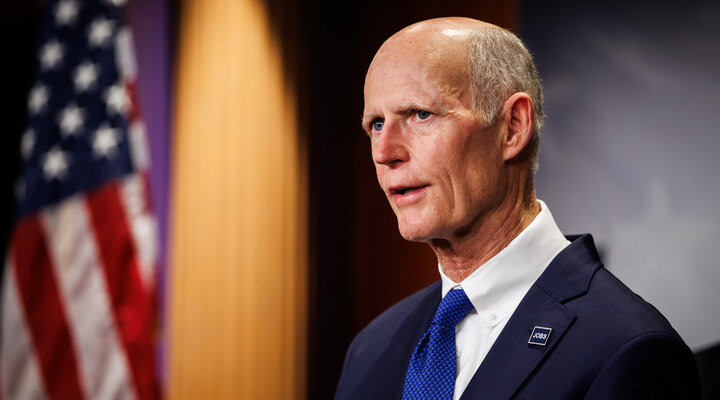
US Sen. Rick Scott (R-FL) speaks during a press conference at the US Capitol in Washington, DC on March 19, 2026. Photo: Samuel Corum/Sipa USA via Reuters Connect
US Sen. Rick Scott (R-FL) has called on the Department of Justice to investigate and, if warranted, prosecute what he described as a recent surge in “antisemitic activity” in New York City, according to a letter sent to top federal law enforcement officials on Wednesday.
In the letter addressed to Acting Attorney General Todd Blanche and Assistant Attorney General for Civil Rights Harmeet Dhillon, the Florida Republican thanked the Justice Department for opening investigations into recent incidents targeting Jewish New Yorkers, including unrest reported in Brooklyn earlier this week.
“The American people have watched mobs harass Jewish New Yorkers, intimidate individuals for supporting Israel, obstruct synagogues, express support for terrorist organizations, and spread vile antisemitic rhetoric,” Scott wrote.
On Monday, masses of anti-Zionists descended on the Flatbush section of Brooklyn to march through the streets of the heavily Jewish quarter and walk up to Young Israel of Midwood synagogue to protest its hosting an event promoting the sale of real estate they say is “stolen” for being located in Israel and the West Bank.
“Zionism will fall,” the activists chanted while others wielded signs proclaiming “Abolish Israel” and “no peace on stolen land.” One female activist ambushed a Jewish girl attempting to outpace the protesters to get home. According to reports, at least three demonstrators were arrested after attacking counterprotesters, and some of the anti-Israel activists could be seen holding flags and banners expressing support for Hamas and Hezbollah, both US-designated foreign terrorist organizations.
Scott argued that local public officials have failed to adequately confront antisemitism tied to anti-Israel demonstrations, singling out New York City Mayor Zohran Mamdani for criticism. The senator accused Mamdani of minimizing hostility toward Israel and claimed Jewish residents have been left feeling unsafe.
“Every American has a constitutional right to free speech and peaceful protest. But every American also has a right to freedom of religion, and a fundamental right not to be terrorized and attacked by rioters like those on the streets of Brooklyn,” he wrote.
Days before Monday’s demonstration, protesters gathered outside Park East Synagogue in Manhattan during a showcase called “The Great Israeli Real Estate Event 2026,” which included the marketing of properties in Israel proper as well as West Bank settlements. At the demonstration, activists held signs and chanted slogans that went beyond criticism of Israel, seemingly calling for the death and expulsion of Jews and, in some cases, support for US-designated terrorist groups.
“Death, death to the IDF [Israel Defense Forces],” “Rapists,” and “Settlers, settlers go back home, Palestine is ours alone” were among the insults screamed by the protesters, some of whom also waved flags belonging to Hezbollah.
The scene marked a return to the same synagogue that was the site of a contentious protest in November, where demonstrators chanted “We don’t want no Zionists here” and “Resistance, you make us proud, take another settler out,” among others. One speaker claimed, “It is our duty to make them think twice before holding these events! We need to make them scared.”
Scott’s letter comes amid heightened national tensions surrounding the Israel-Hamas conflict and a broader rise in reported antisemitic incidents across the United States. Federal and local authorities have increasingly faced pressure from lawmakers and advocacy groups to respond to threats against Jewish communities while balancing constitutional protections for political protest. Since the political rise of Mamdani, who was elected to office last year and inaugurated on Jan. 1, New York City has emerged as a new front in the political battleground between supporters and critics of Israel.
Scott acknowledged that Americans have a right to free speech and peaceful demonstration but argued that violence, intimidation, and vandalism targeting Jewish Americans “can never be tolerated.” He issued criticism of the leadership style of Mamdani, arguing that he has facilitated the rise of antisemitism by “systemically dismantling protections for Jewish New Yorkers via executive order.”
Since entering office, Mamdani has steadily rolled back a number of measures intended to protect Jewish New Yorkers from a surge in antisemitism. Immediately after his inauguration, Mamdani repealed the city’s recognition of the International Holocaust Remembrance Alliance (IHRA) definition of antisemitism. According to the definition, antisemitism “is a certain perception of Jews, which may be expressed as hatred toward Jews. Rhetorical and physical manifestations of antisemitism are directed toward Jewish or non-Jewish individuals and/or their property, toward Jewish community institutions and religious facilities.”
The widely accepted definition, which advocates say is a useful tool for matters such as hate-crime investigations and sentencing, provides specific, contemporary examples of antisemitism in public life, the media, schools, the workplace, and in the religious sphere. Beyond classic antisemitic behavior associated with the likes of the medieval period and Nazi Germany, the examples include denial of the Holocaust and newer forms of antisemitism targeting Israel such as demonizing the Jewish state, denying its right to exist, and holding it to standards not expected of any other democratic state.
Mamdani’s office has framed the move as an administrative reset rather than a targeted policy shift, saying the new mayor sought to begin his term with a clean slate.
However, Scott warned that action must be taken to counter what he described as New York City’s hostile climate toward its Jewish community.
“Antisemitism is rising nationwide. Federal law enforcement must make clear that this evil will not be tolerated. I urge a thorough investigation and, where warranted, prosecution to the fullest extent of the law,” he wrote.
A little-known politician before his rapid ascent into Gracie Mansion, Mamdani is an outspoken supporter of the boycott, divestment, and sanctions (BDS) movement against Israel. He has also repeatedly refused to recognize Israel’s right to exist as a Jewish state, falsely suggesting the country does not offer “equal rights” for all its citizens, and promised to arrest Israeli Prime Minister Benjamin Netanyahu if he visits New York.
Mamdani especially came under fire last summer when he initially defended the phrase “globalize the intifada” — which references previous periods of sustained Palestinian terrorism against Jews and Israels and has been widely interpreted as a call to expand political violence — by invoking the Warsaw Ghetto Uprising during World War II. However, Mamdani has since backpedaled on his support for the phrase, saying that he would discourage his supporters from using the slogan.
Since Mamdani assumed office, Jews have been targeted in the majority of all hate crimes committed in New York City, continuing a troubling trend of rising antisemitism following Hamas’s Oct. 7, 2023, massacre across southern Israel.
Over the past couple weeks, there have been multiple incidents of rampant swastika graffiti across the borough of Queens, highlighting the extent of the antisemitism crisis in the city home to the world’s largest Jewish population outside of Israel.
Uncategorized
Hezbollah Belligerence Prompts Fears of Assassination Campaign in Lebanon
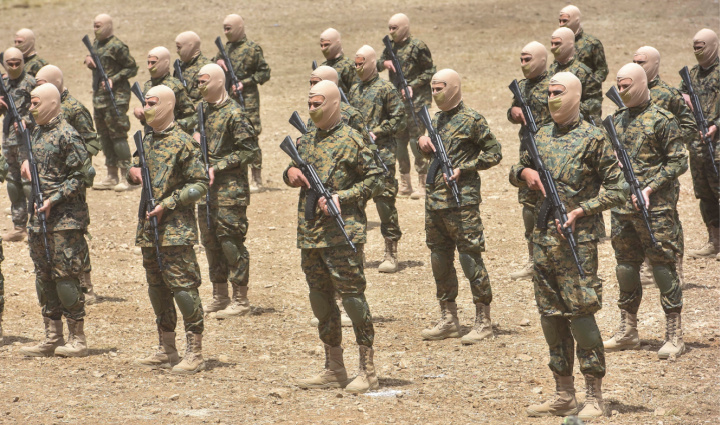
Lebanese Hezbollah fighters take part in cross-border raids, part of a large-scale military exercise, in Aaramta bordering Israel on May 21, 2023, ahead of the anniversary of Israel’s withdrawal from southern Lebanon in 2000. Photo: Fadel Itani/NurPhoto via Reuters Connect
As direct negotiations between Lebanese and Israeli officials resumed in Washington, DC on Thursday, fears continued mounting inside Lebanon that Hezbollah could unleash a new wave of political violence and destabilization efforts amid growing pressure to dismantle the Iran-backed terrorist group’s military grip.
According to a new report from the Meir Amit Intelligence and Terrorism Information Center (ITIC), an Israel-based research institute, concerns have intensified over Hezbollah’s escalating rhetoric and the prospect of internal unrest as the Lebanese government pushes to establish a state monopoly over weapons and curb the Islamist group’s influence across the country.
The Iranian proxy has accused Lebanese President Joseph Aoun and Prime Minister Nawaf Salam of betraying the “resistance” and collaborating with Israel amid ongoing direct bilateral negotiations, branding them “traitors” aligned with foreign interests.
At the same time, Lebanese officials have increasingly lashed out at Hezbollah, accusing the terrorist group, which Iran established inside Lebanon in the early 1980s, of dragging the country toward another devastating war and undermining Lebanon’s sovereignty and stability.
Against the backdrop of an increasingly hostile political climate, ITIC’s new report warns that Hezbollah could once again resort to political assassinations in an effort to block moves perceived as existential threats to the organization and restore its power.
According to Israeli intelligence assessments, the renewed direct negotiations with Israel could even place Aoun’s life at risk.
Experts point to Hezbollah’s Unit 121, a covert entity subordinate to the group’s leadership, which has been linked to a series of assassinations of Hezbollah opponents in Lebanon’s political and security arenas over the past two decades.
Given Hezbollah’s limited ability to exert broader influence within the Lebanese government — with its ministers accounting for less than a third of the cabinet — ITIC warns the group may increasingly rely on Unit 121’s operational capabilities and years of accumulated experience to drive internal destabilization and intimidate political rivals.
The terrorist group has repeatedly defied international calls to disarm, even threatening protests and civil unrest if the government tries to enforce control over its weapons.
According to a new report by the Israeli news outlet Walla, Hezbollah is now putting in place a plan of action to assert control over Beirut, the Lebanese capital, and push out more pragmatic political elements.
The group is also reportedly redistributing its forces across southern Lebanon and the Beqaa Valley, as its leadership believes Israel is preparing moves designed to divide the country, forcing a broader dispersal of its fighters accordingly.
With direct talks between Israeli and Lebanese officials resuming this week, Hezbollah has also called for a national referendum, arguing that the country’s leadership is ignoring a substantial segment of the population opposed to any future peace agreement with Israel.
“Joseph Aoun is one of the worst presidents to ever lead Lebanon because he is not a unifying figure. He ignores the concerns of a large segment of Lebanese society that rejects any peace with Israel,” senior Hezbollah official Nawaf al-Musawi told Qatari news channel Al-Arabi.
“It is a disgrace that such a handshake would be extended to someone whose hands are stained with the blood of our people while their homes are being destroyed,” he continued, referring to the possibility of a meeting between Aon and Israeli Prime Minister Benjamin Netanyahu.
“The negotiations they are now offering are an illusion. Our roadmap is resistance on the ground that will force the enemy to retreat,” al-Musawi further said. “We are staying here, defending Lebanon, and we will not commit political suicide through direct and humiliating negotiations.”
With the third round of negotiations taking place on Thursday in Washington, Beirut is reportedly insisting that a ceasefire must precede any future talks and is even considering delaying the process unless full de-escalation is secured in advance.
Lebanese officials have also reiterated that the decision to establish a state monopoly over weapons is final, though its implementation remains contingent on securing a broader security arrangement with Israel under US guarantees.
Meanwhile, Hezbollah chief Naim Qassem reiterated on Tuesday the group’s demand for an immediate end to direct negotiations between Israel and Lebanon.
“No external party has the right to interfere in the issue of weapons or the resistance. This is an internal Lebanese matter and has nothing to do with negotiations with the enemy,” the terrorist leader said.
“We will not surrender, and we will continue defending Lebanon and its people regardless of the sacrifices required. We will not abandon the battlefield, and we will turn it into hell for Israel,” he continued.
Israel has continued its military campaign in neighboring southern Lebanon to root out Hezbollah, with strikes reaching areas roughly 20 kilometers from Beirut over the weekend in one of the deepest escalations in months.
Over the past month, more than 45 Hezbollah infrastructure sites — including weapons depots, military facilities, and rocket launchers — have been struck, with the military also reporting that around 350 operatives have been killed and approximately 1,100 affiliated targets hit.
Israeli officials are now reportedly preparing for the possibility of a major expansion of ground operations in southern Lebanon after Israeli forces crossed the Litani River last weekend and began conducting covert operations deeper inside Lebanese territory.
Hostilities between Hezbollah and Israel reignited on March 2, when the terrorist group opened fire in support of Iran two days after the start of the joint US-Israeli military campaign against the Iranian regime.
Since then, Israeli forces have established a “buffer zone” initially extending 5 to 10 km (3 to 6 miles) into Lebanese territory, which officials say is meant to shield northern residents from Hezbollah attacks amid thousands of rockets and drones fired throughout the war.
Even though a US-backed ceasefire has sharply reduced violence, negotiations and prospects for lasting peace remain fragile, with Israeli forces still launching strikes while positioned in southern Lebanon to maintain its buffer zone and dismantle Hezbollah infrastructure.