


Uncategorized
Isaiah Zagar, renowned Jewish mosaic artist who created Philadelphia’s Magic Gardens, dies at 86
(JTA) — Isaiah Zagar, the famed Jewish mosaic artist whose shimmering, kaleidoscopic installations transformed streets and buildings across Philadelphia and founded the city’s Magic Gardens, has died.
Zagar died on Thursday of complications from heart failure and Parkinson’s disease at his home in Philadelphia. He was 86.
“The scale of Isaiah Zagar’s body of work and his relentless artmaking at all costs is truly astounding,” Emily Smith, the executive director of the Magic Gardens, told The Philadelphia Inquirer. “Most people do not yet understand the importance of what he created, nor do they understand the sheer volume of what he has made.”
Born Irwin Zagar in Philadelphia in 1939, Zagar grew up in Brooklyn, New York, where he received his bachelor’s in painting and graphics at the Pratt Institute of Art. “When you’re a Jew growing up in Brooklyn, they don’t name you Isaiah,” he told the Philadelphia Inquirer in 1980. “They name you Ira, or Irving or Irwin.”
In 1959, when Zagar was 19, he received a summer art scholarship to go to Woodstock, New York, where he encountered the works of famed “outside artist” Clarence Schmidt who would later become his mentor. During that summer, he also studied Jewish religious texts which later inspired him to change his first name to Isaiah, according to the Daily Mail.
In 1963, Zagar met artist Julia Zagar and the pair were married three months later and joined the Peace Corps as conscientious objectors to the Vietnam War.
Zagar and his wife moved to South Philadelphia in 1968, where she opened the Eye’s Gallery on South Street and he created his first art installation by embellishing the building’s facade.
Over the following decades, Zagar used broken tiles, mirrors and bottles to adorn roughly 50,000 square feet of walls and buildings across Philadelphia with his iconic mosaic art. In the late 1990s, transformed two empty lots near his South Philadelphia home into an immersive mosaic and sculpture installation that would later become the iconic Magic Gardens.
Zagar’s works are featured in the permanent collections of the Philadelphia Museum of Art and the Pennsylvania Academy of the Fine Arts. More than 200 of his mosaic pieces can also be found across several states and in Mexico and Chile.
In 2008, Zagar’s son, the filmmaker Jeremiah Zagar, released the documentary “In a Dream,” an intimate portrait of his father’s struggles with mental health and drive to build the Magic Gardens. He worked with a producer whom he met while in Hebrew class at the Jewish day school now known as Jack M. Barrack Hebrew Academy, according to a 2022 profile in the Philadelphia Jewish Exponent.
“Isaiah was more than our founder; he was our close friend, teacher, collaborator, and creative inspiration,” wrote the Magic Gardens in a post on Facebook. “He was unlike anyone we have ever met and will ever meet. Above all things, he was an artist. In his lifetime, he created a body of work that is unique and remarkable, and one that has left an everlasting mark on our city.”
Zagar is survived by his wife and two sons, Jeremiah and Ezekiel.
The post Isaiah Zagar, renowned Jewish mosaic artist who created Philadelphia’s Magic Gardens, dies at 86 appeared first on The Forward.
Uncategorized
Hen Mazzig, leading Israeli advocate, makes first Winnipeg appearance
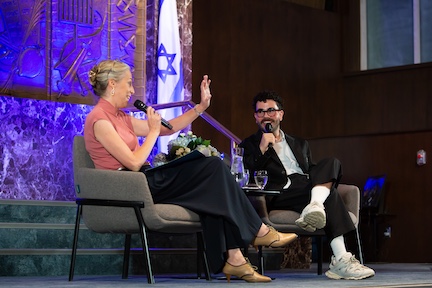
By MYRON LOVE On Tuesday, October 6, a large number of members of our community packed the chapel at the Shaarey Zedek Synagogue, eager to welcome Hen Mazzig in his first appearance in our community.
Over the past few years, the Israeli-born Mazzig – who was appearing at the invitation of our Jewish Federation and Combined Jewish Appeal team – has become one of Israel’s and the Jewish people’s leading advocates on the international stage. His online platforms reach as many 100 million viewers a month with a regular following of almost 1 million. He has been interviewed by numerous leading media outlets and has given addresses at close to 500 universities in recent years.
Mazzig’s presentation in Winnipeg (which was funded by the Asper Family and the Asper Foundation) took the form of a question and answer format with Sarah Mali, the Director General of JFC-UIA (Jewish Federations-United Jewish Appeal) Canada in Israel, asking the questions.
Mali , who was visiting Winnipeg for the third time in the past three years, began by expressing how honoured she felt about having the opportunity to converse with Mazzig – referring to Jewish Federation of Winnipeg President Carrie Shenkarow’s comments regarding Mazzig’s “devotion to Israel and the Jewish people”, his “deep sense of purpose, moral clarity” and “willingness to enter some of the most difficult spaces and conversations.”
The first question that Mali posed to Mazzig was related to his visit to the Canadian Museum of Human Rights and its controversial and one-sided take on the longstanding and ongoing Israeli-Palestinian conflict. She referred to a comment that Mazzig had made on X the day after visiting the museum, in which he wrote that while he “has no problem with people learning about Palestinian history,” he wished that “Palestine Uprooted” didn’t “distort the regional events, including the displacement of 800,000 people just like my grandmother, Hela, who became a refugee when Iraq turned on its Jewish community” post-1948.
“History can only lead to reconciliation when it is told honestly,” he observed. “Otherwise, it is just fuelilng an agenda.”
What most disturbed him about the exhibit, Mazzig told his audience, is that it erased his own family’s history. Expanding upon his family’s roots, he noted that his father’s family came to Israel from Tunisia and his mother’s side from Iraq. He spoke in particular about his maternal grandmother, Hela, who left behind “a beautiful civilization” – Jews had been living and thriving in Iraq since before the Roman destruction of Jerusalem 2000 years ago – to a new land (Israel), where she had to learn a new language (Hebrew) and rebuild her life.
Mazzig added that his grandmother is his anchor in life and the inspiration for all that he has accomplished.
Mali asked Mazzig about his ability to empathize with Palestinians. It was difficult to do, he answered. He got to know Palestinians, he recalled, during the Covid epidemic when he was serving as a medic with the Israel Defense Force and found himself responsible for helping Palestinians through that difficult time and transporting sick Palestinians to Israeli hospitals.
“Even though I fight so hard for Israel,” he observed, it doesn’t mean that I can’t feel empathy for anyone else.”
Mali asked Mazzig how October 7, 2023, changed him.
“I chose not to become a victim,” he said, “but rather to engage more with the world, bear witness, share our stories and talk about genocide. While I was actively advocating for Israel before October 7, I have been much more in demand since. I have become a lot more visible.
”I have found that a lot of people support us,” he continued. “They see what is happening and are on our side.”
On the other hand, he added, a lot of people don’t know anything about Israel. “It is a matter of education,” he said. “I encourage people to go to Israel and talk to Israelis.”
Mali’s last question was what Mazzig means when he writes that “I promise to love being Jewish ten times more than anyone hates me for it.” What does it mean to him to love and find joy and happiness in being Jewish”, she added?
It means cherishing our rich history, Mazzig responded, enjoying Shabbat dinners with family and friends, celebrating all of our holidays and traditions.
“The Jewish People have been through so much over the past 2000 years,” he said. “Many people have tried to destroy us, but we have survived. We are arisen from the ashes numerous time and continued to move forward. Not only are we still here but we have returned as an independent people living again in our ancestral homeland.”
Also addressing the audience at the Shaarey Zedek was Steven Shulman, the president and CEO of the Jewish Federations of Canada. Shulman heaped much praise on our Jewish community in Winnipeg.
“Winnipeg is special,” he noted, “not just in Canada but worldwide. Your CJA campaign continues to be the most successful in North America. You have an outstanding CEO (of the Jewish Federation of Winnipeg) in Jeff Lieberman, who is universally respected.”
He further praised Gray Academy and our community’s highly successful GrowWinnipeg campaign – which has attracted thousands of new families to our community over the past 25 years.
He noted that he was particularly impressed with how our community has come together to protest the biased Nakba exhibit at the Canadian Museum for Human Rights.
He also spoke of the many supporters that we have among non-Jewish Canadians – singling out, as an example, the police officer in Belleville who put his own life on the line protecting the city’s only Jewish congregation from a terrorist attack during yom tov services.
The last word went to Jeff Lieberman, who thanked all the members of our community who have contributed to the CJA campaign this year, as well as our many non-Jewish friends who continue to stand with Israel and the Jewish community.
Uncategorized
They met on a Birthright trip then married. Now this American Israeli couple’s internet fame has turned to infamy.
Ethan and Hila Klein first met at Yad Vashem — Israel’s Holocaust museum — in 2007, a meet-cute they recounted, giggling, years later for their millions of YouTube followers.
“I think I went up to her and said something like, ‘They had it coming, don’t you think?’” said Ethan, known for his edgy humor and infamous internet trends, including Vape Nation and Papa Bless. “No I didn’t say that. I wonder if you would have laughed though.”
They were on a Birthright trip, Ethan an American and Hila an Israeli soldier on leave to join the group. Soon after the trip ended, Ethan moved to Israel to be with Hila, and the two began making videos under the name H3H3 Productions (the H for Hila and the 3 standing in as an E for Ethan). They married, moved to America, and started a popular podcast.
A Jewish love story, until Thursday, when Hila, now mother to their three children, accused Ethan publicly of having a months-long affair.
“The betrayal I feel is immeasurable,” Hila said in an Instagram post. “My only family on this side of the world. How do I even begin to make sense of this?”
Ethan reposted her statement.
Their podcast is run by a handful of crew members who often chime in and participate in various skits and bits. The crew also shared a statement saying they stand with Hila and refuse to work with Ethan, though they added they don’t know what this will mean for the future of the show.
A couple roiled by Oct. 7
The left-leaning, secular couple’s videos and podcasts focused primarily on pop culture, internet drama and general politics, not Jewish or Israeli issues.
Both Ethan and Hila would make statements sometimes when tensions in Israel flared, and they would occasionally speak out against IDF actions that upset them.
In 2021, Ethan started a podcast with political commenter Hasan Piker, a controversial left-wing influencer, called Leftovers, a nod to their leftist politics.
Then came Oct. 7.
Ethan, an American Israeli dual citizen like Hila, was horrified by the attacks but quick to call the IDF genocidal in the aftermath. In their first episode together after Oct. 7, Ethan and Piker said the show would continue through their disagreements. The episode was tense, and it was their last.
As Piker’s rhetoric on Israel intensified and became at times antisemitic, the two began a nasty internet feud, culminating in a nearly five-hour livestreamed debate.
Piker posted about the news of the affair on X, sharing a video of Ethan and expressing disgust for men who cheat.
“Now this is a high caliber man [with] good morals,” Piker said sarcastically. He also posted “Judge me by my enemies” after sharing Hila’s statement.
Hila, who owns a makeup and clothing company, increasingly came under scrutiny by Piker and others after Oct. 7 for her service in the IDF. Artists refused to work with her. One model she hired publicly disavowed her after finding out she was Israeli.
The couple was harassed, sometimes online, sometimes in-person, as they attempted to take what they viewed as a nuanced stance in the aftermath of Hamas’ attack on Israel and the ensuing war in Gaza. The united front seemed to fortify their relationship, as Ethan, ever outspoken, routinely came to his wife’s defense.
Their show lost thousands of subscribers, but loyal fans stuck with them — fans who now say they are gutted and confused by the news of the affair. Many in disbelief noted that Ethan had Hila’s face tattooed on his arm less than two years ago as a surprise for her.
“The greatest thing a man can do for his children is to love their mother,” says the quote surrounding the tattoo.
The Forward attempted to contact the Kleins through their work emails and did not immediately hear back.
The post They met on a Birthright trip then married. Now this American Israeli couple’s internet fame has turned to infamy. appeared first on The Forward.
Uncategorized
These Jewish college students have some ‘nonnegotiables’ for El-Sayed
At the University of Michigan, first-year student Robert Kashan, 18, and sophomore Jacob Reich, 19, sat behind a large blue sign. “Some things are nonnegotiable,” it declared in all caps.
The sign laid out their requirements for any candidate seeking their support: a commitment to Jewish safety, “including for Zionist Jews,” and supporting Jewish statehood in Israel, among other positions.
“Zionism is a legitimate part of the Democratic coalition, and a lot of us are feeling less represented by the Democratic Party,” Kashan told the Forward.
The students are part of a broader “Nonnegotiable” movement in Michigan, a coalition of Jewish Democrats who are spelling out their dealbreakers for candidates ahead of the Senate election between Democratic nominee Abdul El-Sayed and Republican nominee Mike Rogers.
The movement has attracted national attention, with hundreds of rabbis across 34 states signing on to the “Nonnegotiable” demands. Meanwhile, about 20 students at the University of Michigan have publicly signed, while hundreds more offered support anonymously, according to Reich.
The “Nonnegotiable” supporters aren’t saying whom they’ll vote for if their concerns aren’t addressed — or whether they’ll vote at all. But they are pushing back against the assumption that Jewish voters will, as the saying goes, “vote blue no matter who,” urging El-Sayed to engage with their demands if he hopes to earn their support.
That’s in contrast with two other Jewish political camps, including a group called Michigan Jews for Democracy that endorsed El-Sayed. Their petition, which has garnered almost 1,000 signatures, notes that some signatories hold reservations about El-Sayed but are voting for him nonetheless as a check on President Trump.
“We understand that a vote is not a valentine; it’s a strategic chess move,” the petition reads.
A competing petition, dubbed “Michigan Jews Against Extremism,” has drawn hundreds of signatures from Michigan Jews who plan to vote for Rogers. That petition similarly emphasizes that Rogers voters may still have reservations about the candidate: “Our vote for Mike Rogers does not require that we agree with him on every issue or that we support President Trump,” it reads.
“Nonnegotiable,” meanwhile, rejects the idea that Jewish voters would have to choose between Zionist and Democratic values. Some have criticized the nonnegotiable movement for ignoring the reality of the electoral choice at hand. Others have called it “a veiled attempt to excuse the actions of Jewish Democrats who want to feel validated about voting for Mike Rogers.”
But Kashan and Reich, who met at Hillel and plan to major in political science, said the “Nonnegotiable” movement was the only way they could see themselves engaging in the election, as they felt increasingly pulled between their identities as Democrats and as Jews.
Some Michigan Jews have expressed alarm at El-Sayed’s questioning of whether Israel should exist as a Jewish state and his decision to campaign alongside controversial Twitch streamer Hasan Piker, who has been accused of antisemitic rhetoric. Rogers, who Trump has endorsed, earlier this week called El-Sayed “anti-Jew.”
In a letter to Michigan Jews, El-Sayed has vowed to “stand up against antisemitism and take the threat of violence against our Jewish community incredibly seriously.” He has also hired a Jewish liaison in the final weeks leading up to the election.
This will be the first election when Kashan, who just turned 18, is eligible to vote, and Reich’s first national election after voting in a local primary in his hometown of Palo Alto, California. For both, voting Democratic in their first major election had once seemed like a given.
“I’m a Jewish Democrat, and I want Democrats to take the Senate,” Reich said. “I want to vote for a Democrat in my own state.”
They’re still holding out hope that will happen — and that, with less than two weeks until the Nov. 3 election, El-Sayed will sign on to their petition.
And if he doesn’t? Neither student is ready to say.
The post These Jewish college students have some ‘nonnegotiables’ for El-Sayed appeared first on The Forward.
