



Uncategorized
Conservative Jewish groups hail Stephen Miller’s appointment to White House chief of staff
(JTA) — Right-leaning pro-Israel groups hailed President Donald Trump’s appointment of Stephen Miller as the next White House chief of staff, welcoming the Jewish aide’s appointment as a safeguard against antisemitism in an era marked by an increase in attacks on Jews and Israel. Liberal Jewish groups expressed alarm, saying his hardline politics endangered the community.
In a letter congratulating Miller, groups including the Combat Antisemitism Movement, the Louis D. Brandeis Center for Human Rights Under Law, the Zionist Organization of America expressed an interest in working with Miller to “hold institutions accountable when they fail to protect Jewish Americans from discrimination and harassment.”
The writers, who also included the American Association of Jewish Lawyers and Jurists, the Coalition for Jewish Values and the Israeli-American Civic Action Network, described Miller’s appointment as “a meaningful reflection of the longstanding contributions of Jewish Americans to public service.”
Just days after the Republican Party incurred massive losses in the midterm elections, Trump announced that he was replacing former chief of staff Susie Wiles with Miller, who had previously served as her deputy. In a Truth Social post, he described Miller as one of his “most trusted advisors.”
The chief of staff holds one of the most powerful White House positions, acting as a gatekeeper to the president and helping to shape his daily agenda.
Liberal Jewish voices warned that Trump’s promotion of Stephen Miller to the role of White House chief of staff could make Jewish communities more vulnerable.
“We expect this appointment to only reinforce some of the most dangerous ways the administration has normalized antisemitism and broader extremism,” Amy Spitalnick, CEO of the Jewish Council for Public Affairs, told the Jewish Telegraphic Agency, noting Miller’s embrace of anti-immigrant rhetoric popular on the far right.
Spitalnick said there is a throughline between the hard-line immigration policies Miller has shaped as a longtime confidant to Trump and the flourishing of antisemitism in recent years.
“At the core of the anti-immigrant agenda Miller has spearheaded are deeply antisemitic conspiracy theories about ‘replacement’ and ‘invasion’ that have already fueled a cycle of deadly violence targeting Jews and others,” she said.
The dueling sentiments from across the Jewish political spectrum were a signal of how divided the community has become during the second Trump term over the best means of combating antisemitism: Through aggressive policing of elite institutions, which Trump favors, or through opposition to what liberal groups say is the president’s systematic corrosion of civil rights protections.
The groups on the right that welcomed Miller’s appointment have generally been pleased by the steps Trump has taken to counter antisemitism on the left. In January 2025, Trump issued an executive order requiring new measures for combatting antisemitism. The Justice Department then launched a multi-agency Task Force to Combat Anti-Semitism. This past May, the department announced the formation of an Advisory Committee on Anti-Semitism, while emphasizing a “commitment to protecting Americans from unlawful discrimination and antisemitic threats.” Much of the focus has been on allegations of antisemitic harassment on university campuses.
While it’s unclear what Miller will do on these specific issues, his supporters see his key role as likely to strengthen such efforts.
Miller has longstanding links to Trump, including on a personal level. Miller’s wedding officiant at the Trump D.C. hotel was Rabbi Aryeh Lightstone, who was involved with the administration’s Abraham Accords to establish peaceful relations between Israel and several Arab neighbors.
But Miller’s critics have pointed out that he, along with Trump and other top Republicans have embraced troubling conspiracy theories that can be linked to Jews. Namely, that Democrats want to flood America with immigrants who are likely to vote against Republicans. At Trump’s October 2024 campaign rally at Madison Square Garden, Miller declared, “America is for Americans and Americans only.”
A more extreme version of the conspiracy theory, which blames Jews for organizing an “invasion” of people of color to replace whites, fueled a number of deadly attacks over the past decade, including the massacre at the Tree of Life synagogue in Pittsburgh in 2018.
The White House press office, which fields media communications for the chief of staff, did not respond to requests for comment.
Spitalnick also slammed the current administration for failing to “protect the civil rights of Jewish – and all – people,” by rolling back programs aimed at countering hate, including at the Office for Civil Rights in the Department of Education and extremism prevention programs at the Department of Homeland Security.
Spitalnick also referred to a 2019 letter sent by Jewish Democratic members of Congress urging Trump to dismiss Miller, who was his senior adviser at the time. The lawmakers argued that his “support for white nationalist and virulently anti-immigrant tropes is wholly unacceptable and disqualifying for a government employee.”
Regarding the current appointment, Spitalnick warned that Miller’s role could “make Jewish and so many other vulnerable communities less safe, instead of advancing the civil rights and pro-democracy policies we know are inherent to our security.”
“As the president and vice president are now seemingly pinning the U.S. election results on Israel, we should be concerned about further scapegoating of the Jewish and Israeli American communities,” she added.
The liberal pro-Israel lobby J Street, meanwhile, posted a Haaretz analysis that likened Miller to Itamar Ben-Gvir, a far-right minister in Prime Minister Benjamin Netanyahu’s coalition known for his extreme nationalistic rhetoric.
“Stephen Miller and Itamar Ben-Gvir both owe their prominence and access to power to their enablers – Trump and Netanyahu – and both traffic in racism and nativism to attempt to build power and incite fear,” the J Street post stated.
Robert Reich, U.S. secretary of labor in the Clinton administration, wrote in a Facebook post that Miller’s appointment was “not a positive development for anyone interested in mending our government or healing our nation.” Reich, who is Jewish and also served in the Ford and Carter administrations, expressed concern that Miller would have outsized influence on the president’s decisions.
“Miller is bigoted, xenophobic, and vicious — the architect and chief advocate of Trump’s loathsome immigration policy,” Reich stated, accusing him of conducting a “brutal Kristallnacht against undocumented immigrants.” Kristallnacht refers to the wave of deadly anti-Jewish violence in parts of Nazi-occupied Europe in 1938.
Katie Miller, who is also Jewish and married to Stephen Miller, defended her husband this weekend, after Michigan Democratic Sen.-elect Abdul El-Sayed called him a “broken man” on ABC’s “This Week with George Stephanopoulos.”
“Stephen has contributed far more to America at 41 than Abdul El-Sayed will in a lifetime,” she wrote on X, alongside a photo of Miller running around with their children.
This article originally appeared on JTA.org.
The post Conservative Jewish groups hail Stephen Miller’s appointment to White House chief of staff appeared first on The Forward.
Uncategorized
This year’s Hanukkah books serve up golems, holiday magic and dinosaurs

(JTA) — From a mischievous clay golem to a ring-tailed lemur who refuses to taste a latke, this year’s crop of Hanukkah books offers something to delight young readers of all ages.
The new titles range from lighthearted tales of family celebrations to the poignant, timely story of the Jews of Mariupol, Ukraine and the miraculous survival of the city’s menorah. Families across the diverse Jewish spectrum will find something to enjoy.
“Applesauce on Top”
Lina Schwarz; illustrated by Yuko Jones
PJ Library; ages 6 months–2
In this sweet rhyming board book, a little boy and his grandmother cook latkes and applesauce, counting apples and potatoes as they get ready to celebrate Hanukkah with their family. This new title from PJ Library will be distributed to 1-year-olds.
“I Will NOT Eat Latkes!”
Martha Seif Simpson; illustrated by Lisa Hunt
Apples & Honey Press; ages 4–6
In this lighthearted story, two animal pals celebrate Hanukkah together. Nosh, a koala, tries to persuade Potchky, a ring-tailed lemur, to taste a fried latke. Potchky, in a nod to Dr. Seuss’s “Green Eggs and Ham,” refuses, declaring that he only likes potato chips. As the story unfolds, kids hear the story of Hanukkah and the brave Maccabees. Finally, Potchky finds his courage and takes a bite — and loves the latkes.

“Charley and Seymour’s Hanukkah Miracle”
Melody Howard Ritt; illustrated by Nia Gould
Kar-Ben Publishing; ages 4–8
In this fun-filled Hanukkah tale, best friends Charley Chipmunk and Seymour Squirrel love their tradition of celebrating Hanukkah together. Seymour fries the latkes and asks Charley to bring the menorah and candles. But uh-oh: Charley remembers the menorah but forgets the candles. His backpack overflows with all kinds of things that begin with the letter “c,” even cantaloupe. But no candles. Seymour comes to the rescue, using the oil from frying latkes to kindle the menorah — just like in the Hanukkah story. This delightful book is now available in paperback through PJ Library.
“Hanukkah Night at the Construction Site”
Sherri Mandell; illustrated by Viviana Garofoli
Apples & Honey Press; ages 2–3
Toddlers who love trucks will be gleeful when the Hanukkah truck rolls into town in this latest addition to the popular Construction Site series. The entourage includes a large tractor carrying a large clay menorah, a mixer and excavator that serve latkes, chocolate coins, fried jelly doughnuts and gifts, and even a band. The back pages list all the types of trucks.
“Hear Me Roar! I’m a HANUKKAHsaur”
Naomi Gruer; illustrated by Mel Zohar
Kalaniot Books; ages 4–7
Miles is a young dinosaur enthusiast. On the first night of Hanukkah, his family doesn’t have the party Miles had hoped for, but he’s excited to put on his bright green dinosaur costume and roar as loudly as he can. Each night, Miles the dinosaur tries to help celebrate Hanukkah. When things go wrong and he makes a mess in the kitchen or drops things, his family encourages him to try again. On the last night, to his delight, his family throws a big Hanukkah party, with latkes, storytelling and sufganiyot, and all his friends. Zohar’s illustrations portray a diverse, multicultural celebration, including a child in a wheelchair.

“Harriet Hubbard and the Sold Out Hanukkah”
Bonnie Grubman; illustrated by Noa Kelner
Kar-Ben Publishing; ages 2–8
In this zany rhyming adventure, feisty Harriet sets out to her local market to buy all the fixings for a Hanukkah party. But all the shelves are bare — no potatoes for latkes, no chocolate gelt and no sufganiyot. She goes home disappointed but eager to set her table with some dates and raisins. To her surprise, her diverse group of friends arrives bearing everything needed for a festive Hanukkah party, including latkes and sweets. They sing and dance under the glow of the Hanukkah menorah.
“Mrs. Claus’s Noodle Kugel”
Janie Emaus; illustrated by Bryan Langdo
Sky Pony Publishing; ages 3–8
Interfaith families will welcome this addition to their family’s library. Two friends, Anna and Michael, get a letter from Mrs. Claus saying that Santa loved their latkes last Hanukkah and asking them to send the recipe. But the two sets of grandfathers have a different idea, each urging their grandkids to cook the other grandfather’s recipe — one for noodle kugel and one for Italian fettuccine noodles. The magical Mrs. Claus arrives on the scene, creating mayhem in the kitchen, with noodles flying out of the pot and Yiddish expressions sprinkled throughout. A team of elves gets things in order, and the sweet noodle kugel is a success. Kids will laugh out loud.
“Golem, Golem, Golem: Or How Hanukkah Was Saved”
Richard Ho; illustrated by Carmel Ben Ami
Roaring Brook Press; ages 3–6
A young boy turns his clay dreidel into a clay golem, the ancient Jewish mythical figure who acts as the Jews’protector when it isn’t getting into trouble. This boy’s golem causes more good-natured mischief, making a mess and eating all the Hanukkah treats. But trouble strikes when the golem accidentally breaks the family’s beautiful menorah. In a magical turn of events, the golem finds a way to make things right — and disappears. The family celebrates under the glow of their menorah. Lively illustrations depict a multicultural family.

“The Miracle Menorah of Mariupol”
Nancy Churnin; illustrated by Marissa Moss
Creston Books LLC; ages 7–11
In this true, poignant story set in modern-day Ukraine, we learn that for years the Jews of Mariupol gathered outdoors around the synagogue’s glistening golden menorah to retell the story of Hanukkah and the miracle of the oil. In the spring of 2022, to everyone’s horror, the beloved tradition came to an end with the Russian invasion. Andrei, a brave young boy, discovered that while the synagogue was destroyed in the bombing, the menorah had miraculously survived. Andrei cleaned the soot off the menorah and contacted the rabbi, who was in Israel for medical treatment. With the rabbi’s encouragement, Andrei gathered the city’s Jews who had not fled. Together, they lit the menorah, sang the blessings and found a deeper meaning in the Hanukkah miracle. At the book’s end, Rabbi Mendel Cohen recalls the tragic events and expresses gratitude for the young boy’s courage.
“Sharing the Light: A Hanukkah Story”
Jodie Sadowsky; photography by Alejandra Martinez
Lovery, Inc. ages 1 and up
Wren and her younger brother Rory discover ways to celebrate Hanukkah together, despite some light-hearted sibling rivalry. They cook a family recipe for latkes and enjoy a festive holiday.
This article originally appeared on JTA.org.
The post This year’s Hanukkah books serve up golems, holiday magic and dinosaurs appeared first on The Forward.
Uncategorized
This David Schwimmer sweater ad is playing on ‘Friends’ nostalgia. So why are commenters talking about Israel?
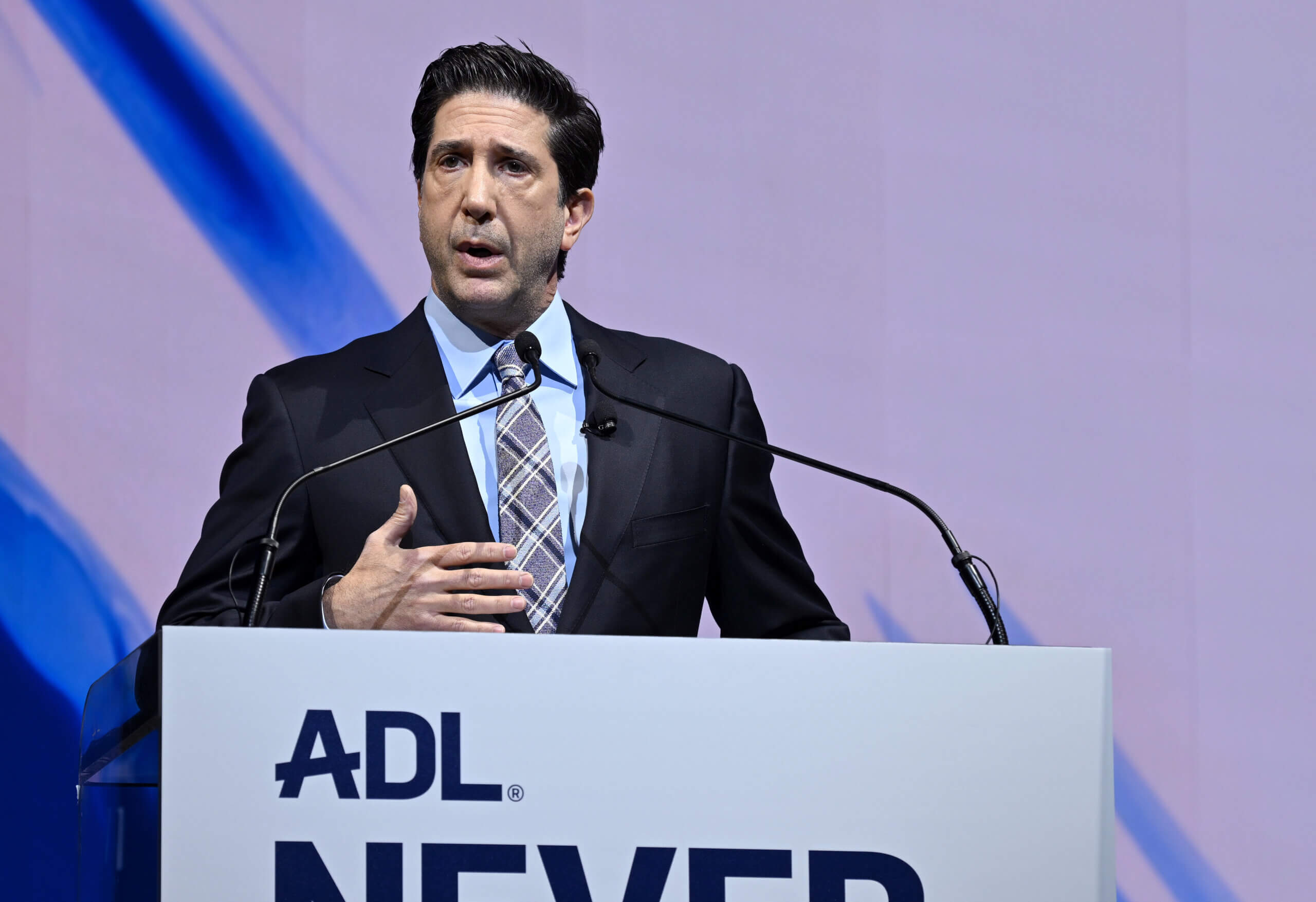
David Schwimmer, who played Ross on Friends, is tapping into some late ’90s and early 2000s nostalgia as the star in an ad this week marketing his “dream sweater” for Quince, a clothing and home goods store.
In the ad, Schwimmer, who is Jewish, sketches the perfect red sweater in a notebook while he sits in Central Park and then begins to see it on everyone: a man riding an electric scooter, an angry taxi driver who almost runs into him, a beautiful woman riding in the back of the taxi, even a dog.
The gag is a reference to the Friends episode “The One with the Red Sweater,” where Ross’ on-again-off-again girlfriend Rachel is pregnant and has not told the father, whose identity is a mystery to the group; Joey, Monica and Phoebe know that the father left a red sweater at the apartment, so when Ross stops by and is relieved to find his sweater, they figure out he’s the dad-to-be.
“I’ve been looking for this for like a month,” he says, just after making a reference to the Yiddish-named snack, Mashuga Nuts.
The episode and the ad are apolitical. So why then are some people planning to cancel their Quince orders and boycott the company?
Schwimmer, many of the commenters on the ad are saying, is a Zionist.
“I don’t approve of you featuring a Zio in your ad,” one Instagram user commented. “Please do better.”
Schwimmer on Israel, antisemitism
Schwimmer has been outspoken about antisemitism since long before the Oct. 7 Hamas attacks on Israel and the ensuing war in Gaza. Over the course of his career, he’s spoken at multiple Anti-Defamation League events and called for other people to stand against hate, routinely saying, “Silence is complicity.”
The actor appears to have never explicitly identified as a Zionist, and his statements have focused more on galvanizing support for Jews and Israelis — rather than on the Jewish state. But this is of little importance to his critics.

His relationship with the ADL, a staunchly pro-Israel organization, is damning enough for some. Schwimmer also starred in an Israeli commercial for Meitav, an investment management company. The move puts him at odds with the growing Boycott, Divestment and Sanctions campaign, which stands against any financial relationship with Israel or Israeli companies.
After Oct. 7, Schwimmer put out a statement calling the Hamas attack an “atrocity” and a “genocide,” adding that any attempt to justify what happened is “indefensible and antisemitic.” In the same statement, he also touched on Palestinian suffering:
“One can condemn Hamas and still object to the Israeli government’s policies regarding the occupation (as many Israelis do), still believe in the Palestinian people’s right to self-determination, and still mourn the loss of Palestinian civilians and the current destruction of their homes, schools, hospitals and places of worship.”
He’s also been vocal about sexual violence that occurred on Oct. 7, sharing the controversial New York Times piece headlined “Screams Without Words,” that investigated allegations of sexual assault committed by Hamas during the attack. Critics of the piece have questioned the validity of the reporting and argued that one of its reporters is biased toward Israel. The Times has stood by the piece.
Additionally, Schwimmer has criticized universities’ responses to pro-Palestinian protests on campuses that he said have veered into antisemitism.
Schwimmer spoke at a 2025 ADL summit about the backlash he’s gotten for his advocacy, noting that while he’s been “attacked” and “abandoned,” he’s found deep meaning in speaking out and has no plans to stop. He concluded his speech calling on fellow celebrities to do the same.
“You don’t have to say anything political,” Schwimmer said. “No one is asking you to solve the conflict in the Middle East. Just say that you stand with your Jewish friends, colleagues and neighbors against hatred and discrimination.”
The controversy isn’t bothering Quince.
“We’ve seen more than 8 million views across our social channels in the first 48 hours, alongside international press coverage and recognition from the marketing community for the creative,” said Dakota Isaacs, head of brand strategy and narrative, in an email to the Forward. “It’s been especially rewarding to see fans connect with the humor and nostalgia while discovering Quince.”
The post This David Schwimmer sweater ad is playing on ‘Friends’ nostalgia. So why are commenters talking about Israel? appeared first on The Forward.
Uncategorized
Why I urged my parents to avoid the counterprotest in Philadelphia
Parents usually tell their children whether they can go out, but last week, on a phone call with my parents, our roles reversed, and I urged them not to join a Philadelphia food crawl with their friends. The event was organized in response to a bicycle rally calling for the boycott of six restaurants, all Jewish-owned, to “show these zionist business owners that we see them for the disgusting humans they are.”
The counterprotest intended to show solidarity with these businesses by patronizing and protecting them on the day of the protest, given the hostile framing of the boycott against the restaurants and their Jewish owners. However, I was concerned that it would be co-opted by pro-Israel partisans, who not only would instrumentalize it for their own agenda — one which, in my view, is actively detrimental to the fight against antisemitism — but would also stoke chaos and violence. It’s a film that’s played out time and again, including when I was an undergraduate at UCLA: A call is put out that Jews are under attack, counterprotesters mobilize in response, and anger quickly morphs into belligerence, hostility, and violence.
Fortunately, it appears that no one was seriously hurt during Sunday’s bike rally and counterprotest. As I had feared, though, some demonstrators became aggressive as verbal confrontations and scuffles broke out across Rittenhouse Square. While it’s likely that some of the pro-Israel demonstrators were there for the sole purpose of displaying that they are not “Jews with trembling knees,” others ostensibly were there because, as the names of two of the organizations behind it would suggest, they want to StopAntisemitism and EndJewHatred.
If those were the goals, the demonstration was an unmitigated disaster. And much of the discourse surrounding the boycott laid the groundwork for failure.
To many Jews, it may seem self-evident that the boycott was illegitimate and antisemitic. For the protesters, though, there seems to be a genuine inability to understand how it could be. They also seem unable or unwilling to condemn antisemitism.
Anger at the protesters is understandable, but if the goal is to stop antisemitism and end Jew hatred, it is important to address the root of the problem, which starts with understanding why the protesters might have such a profound misunderstanding of antisemitism.
For several decades, following the Six-Day War of 1967 and the Cold War period, pro-Israelism has been a core, essential feature of hegemonic anti-antisemitism advocacy. Groups like the ADL have made the phenomenon of so-called “new antisemitism” – a term that explains hostility toward Israel by claiming that the nation is maligned out of bigotry, as the proverbial Jew among the nations – a central focus of their work, especially in times of increased Israeli-Palestinian conflict.
Though this is hardly “new,” the stakes and intensity of attacks against the “new antisemitism” have been raised in a post–Oct. 7, post–destruction of Gaza reality. In effect, this approach has been successful in as much as it has led to a public perception that the fight against antisemitism and the fight in defense of Israel are the same fight, and cannot be separated.
As a result, when anti-Zionist, pro-Palestinian activists are accused of antisemitism or expected to condemn it, they view it as purely cynical — an attempt to delegitimize their movement rather than a true objection to how they have treated or spoken about Jews. This very refusal to condemn antisemitism is often read as itself antisemitic by many Jews. This “acrimonious circle,” as philosopher Brian Klug described it 13 years ago, could go on forever.
As the acrimonious circle spins and spins, there are a few options that groups fighting antisemitism can consider:
- They can continue pushing pro-Palestinian activists to see both condemning antisemitism and supporting Israel as intertwined moral duties.
- They can insist on that interconnection, but tell pro-Palestinian activists to choose combatting antisemitism no matter what their beliefs about Israel are.
- They can accept that pro-Palestinian activists will rarely condemn antisemitism at their own initiative, and deploy tactics of intimidation, bullying, harassment, and/or violence against them.
- They can accept that pro-Palestinian activists will rarely condemn antisemitism at their own initiative, and present condemning antisemitism as a human-rights oriented stance, in line with standing up for all marginalized people, including Palestinians.
The first option is the one that organizations like the ADL have often chosen. In its statement about the bike rally and boycott, the group said that criticism of Israeli government policies are acceptable, but discrimination is not. Criticisms that the ADL considers ipso facto discriminatory, however, include claims that Israel has committed the crimes of genocide and apartheid. As a result, activists lend the ADL and groups like it no credibility and will dismiss any of their condemnations out of hand.
The third option is what the protest on Sunday became. Any Philadelphian can tell you that a brawl in the middle of Rittenhouse Square during an Eagles game is far from unusual. But the fighting in this instance broke out because of the boycott — one side driven by a fervor that they needed to defend Jews facing an existential threat from anti-Zionists, the other driven by a fervor that they needed to bring justice to a city ravaged by what protesters believe are business-owning war criminals.
The second option is a sensible demand from a moral perspective. However, it is not a strategic one. The hard truth is that for many, though certainly not all, pro-Palestinian activists, the cause comes before all else, including standing up against antisemitism.
Therefore, the only way forward for Jews is the fourth option: to frame the fight against antisemitism as a fight for the rights of all people. This is not a perfect solution — no solution could be. There will always be some unwilling to oppose antisemitism no matter what tactic is deployed. However, it will make plain that there is no contradiction between condemning antisemitism and supporting Palestinian rights, that in fact the task is to support human rights universally and to condemn all who violate these rights. That necessarily includes standing against Israeli war crimes and its regime of inequality, and that includes condemning those who hold Jews as Jews complicit for Israel’s actions and condemning those who harass, intimidate, and scrutinize Jewish business owners for their presumed political stances.
My parents, fortunately, decided to remove themselves from the chaos of this day and went to support the targeted businesses as regular patrons on other days throughout the week. I was pleased to see that our rabbi, who leads one of the largest synagogues in Center City, made a point of trying to de-escalate tensions and confrontations from within the Philadelphia Jewish community, as well as highlighting the strength and vibrancy of Philly’s Jewish life on its own terms.
These are important, positive things we can do in the short term. That said, if we want long-term change to come from the pro-Palestinian movement – and I think this moment requires it – anti-antisemitism groups that cannot meet the moment must step aside and make room for those that are capable and prepared to frame the fight against antisemitism as a fight for, not against, fairness, justice, and equality for all.
The post Why I urged my parents to avoid the counterprotest in Philadelphia appeared first on The Forward.
