


Uncategorized
Debunked Hamas Casualty Figures and Their Impact on Reporting

Palestinian gunmen stand guard on the day that hostages held in Gaza since the deadly Oct. 7, 2023, attack, are handed over to the International Committee of the Red Cross (ICRC), as part of a ceasefire and hostages-prisoners swap deal between Hamas and Israel, in Khan Younis, southern Gaza Strip, Oct. 13, 2025. Photo: REUTERS/Ramadan Abed
Since October 7, 2023, Hamas has shaped global public opinion through its propaganda warfare. The terrorist organization excitedly recorded and uploaded the atrocities committed against Israelis that day to social media platforms, and those who saw any trace of it were rightfully horrified.
But shortly after, when the images weren’t as fresh and no longer front-page news, Hamas turned to a new strategy — playing victim to the Israeli army. And since then, the media has run with it.
For instance, on October 17, 2023, reports claimed an explosion occurred inside the Al-Ahli Hospital. The media rushed to re-print Hamas’ claim that more than 500 people had been killed.
Evidence then came out that displayed it was a parking lot adjacent to the hospital that had been hit by a misfired Palestinian Islamic Jihad rocket, and the casualties were fewer than reported.
The media has continued this pattern since. Any death toll that the Hamas-run Ministry of Health (MoH) publishes is immediately reported on by Western media, oftentimes without any attribution to Hamas.
This has resulted in blood libels being printed on the front pages of newspapers, blaming Israel for targeting non-combatants, including women and children.
But the vast majority of the casualty numbers that have been used throughout the war have been purposefully misrepresented by Hamas.
As of December 2025, the Hamas-run MoH has claimed that over 70,000 people have died in Gaza since the start of the war.
But further analysis done by Salo Aizenberg, a board member of HonestReporting, displays that this includes the casualties of Hamas fighters, natural deaths, and internal fighting amongst Gazans.
While the analysis is based on informed estimates, and the precise toll may take years to verify, it nonetheless highlights the extent to which Gaza casualty figures have been misrepresented in media coverage over the past two years.
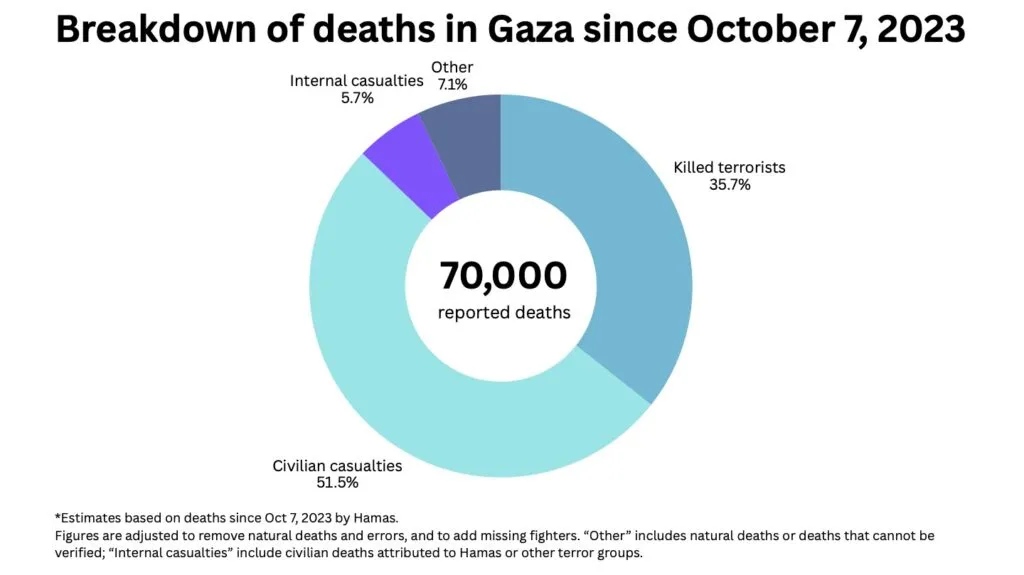
Although it is difficult to determine the exact number of terrorists killed by the IDF since the beginning of the war, estimates suggest the number to be more than 22,000 as of October 2025, not including those who were killed during the terrorist attacks on October 7. President Donald Trump has confirmed the number to be greater than 25,000, the number used in Aizenberg’s analysis.
Beyond combatants, throughout the war, there were likely to be around 11,000 natural deaths, based on pre-war patterns. Another 4,000 deaths were caused by internal fighting within Gaza from different factions, including firing on civilians at aid sites or executions of individuals Hamas deemed to be collaborating with Israel. An additional 1,000 estimated deaths can be attributed to errors in reporting.
After removing these casualty numbers from the total of 70,000, there are a remaining 54,000 deaths. Of the 54,000, one can reasonably assume that around 25,000 were terrorists, leaving 36,000 civilian casualties. While every innocent civilian casualty is a tragedy, this is nonetheless a remarkably low civilian-to-combatant ratio of 1.45:1, especially given the circumstances of urban warfare.
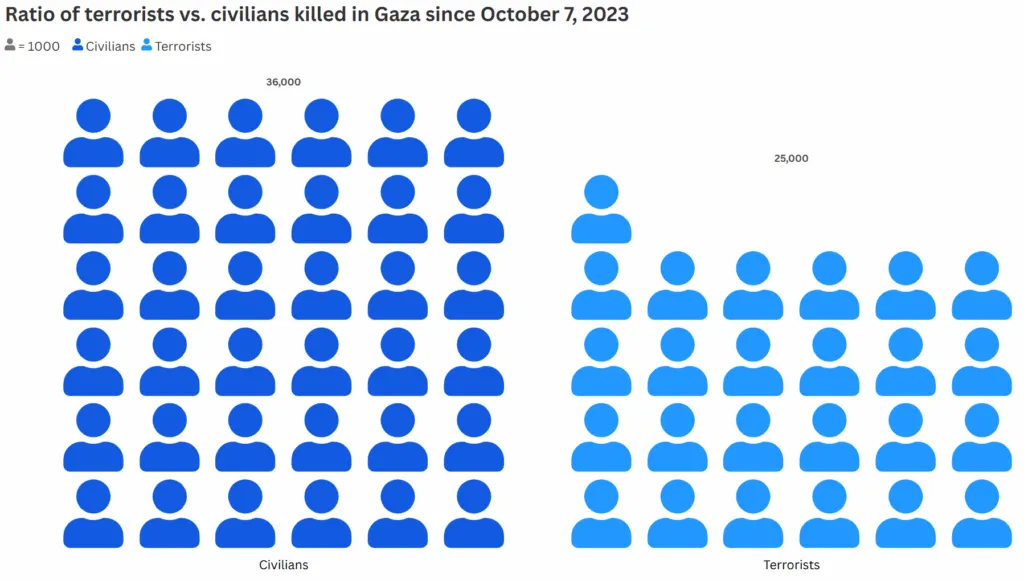
Visualization based on data by Salo Aizenberg.
These numbers entirely dispute the claims that the majority of deaths are civilians — a claim the media has previously made. One “investigative” piece done by The Guardian and +972 Magazine, published in the summer of 2025, claimed that 83% of casualties were civilians.
What the outlets willfully omitted, however, was that this figure counted only terrorists whom the IDF had identified before the war and could conclusively confirm as eliminated, excluding thousands of combatants who could not be identified during the fighting. By presenting this partial dataset as comprehensive, the article created a misleading impression that was then cited as authoritative.
This information is not necessarily new either.
A December 2024 report by the Henry Jackson Society found that 84% of the publications analyzed failed to make the critical distinction in total numbers between combatant deaths and civilian deaths, further illustrating the extent to which misleading casualty narratives have been allowed to take hold. The report also found that men of combat age were disproportionally represented, and natural deaths were included in casualty statistics.
Perhaps even more telling is the ratio between male and female casualties. Males of combat age (18-59) died at 3x the rate of women the same age, resulting in a 3:1 ratio. The 32,690 deaths of men of combat age account for 46.7% of total casualties.
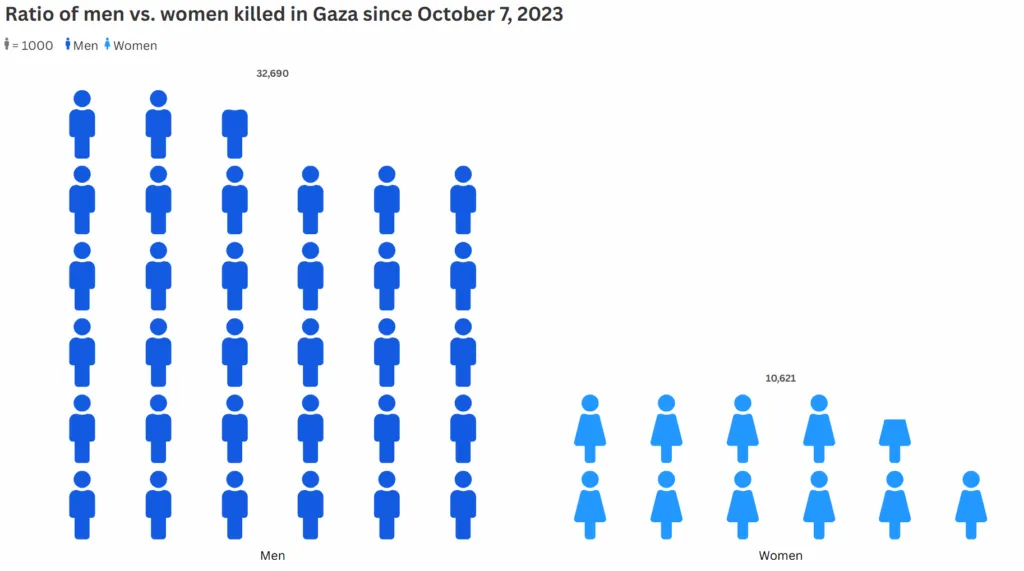
Visualization based on data by Salo Aizenberg.
Outlets, including the Associated Press, BBC, and Washington Post, have all previously parroted the claim that 70% of the casualties in the war were women and children. Naturally, it was based on falsified data, and the new casualty analysis once again disproves this claim.
Even after the UN walked back this percentage due to incomplete information, news outlets have continued to print that more than half of the casualties are women and children.
Throughout the two years of war, the media have repeatedly reprinted Hamas’ libels and casualty figures with little skepticism, allowing a terrorist organization to shape the narrative without rigorous analysis or verification.
Inflated civilian casualty claims will continue to distort public understanding of the war by obscuring the true civilian-to-combatant and male-to-female casualty ratios.
It is therefore only responsible journalism for every outlet that published Hamas’ casualty figures without questioning them to issue corrections and acknowledge that not every casualty during the war has been the result of IDF action.
The author is a contributor to HonestReporting, a Jerusalem-based media watchdog with a focus on antisemitism and anti-Israel bias — where a version of this article first appeared.
Uncategorized
Roald Dahl’s monstrous views have a seat at the table today
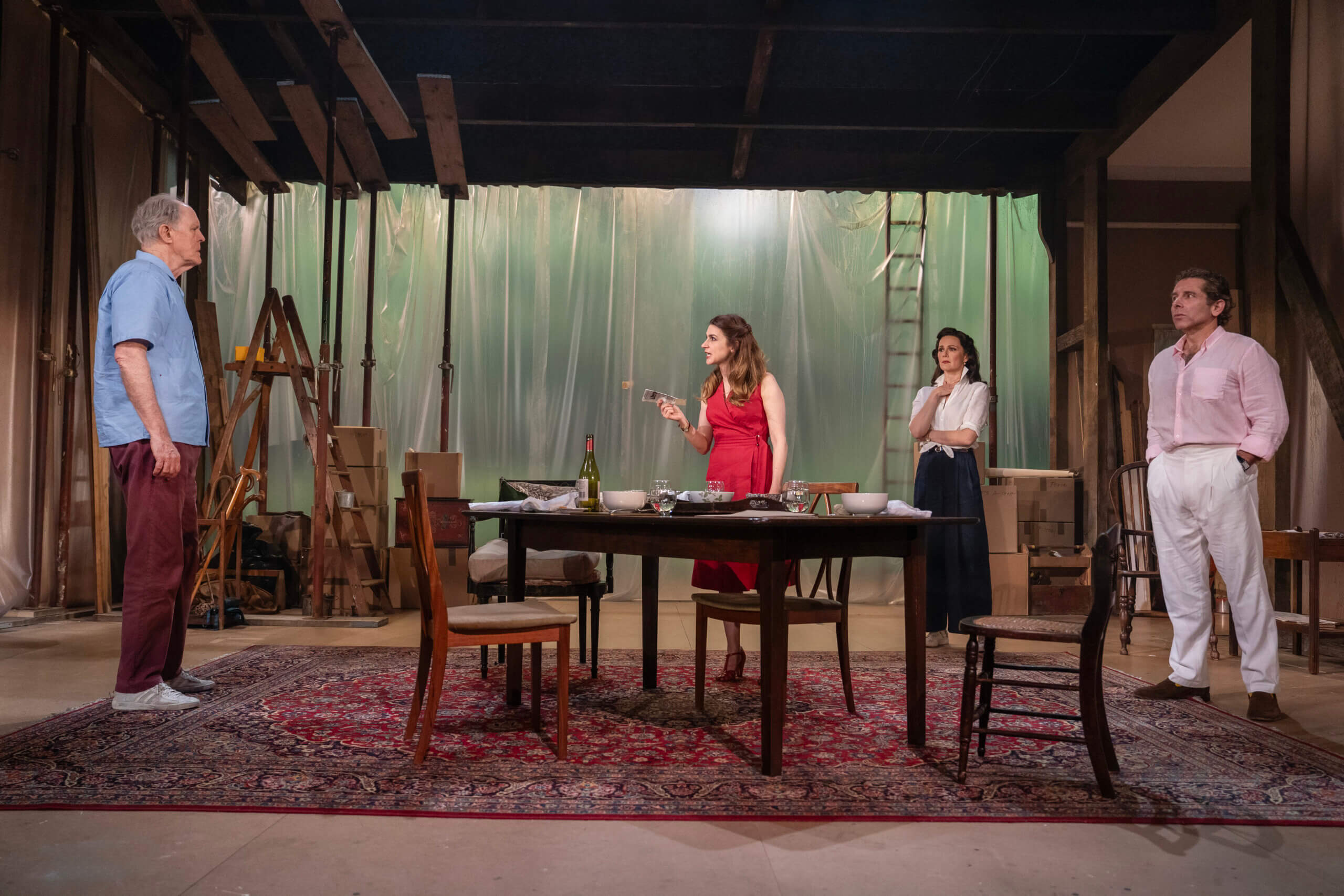
Roald Dahl’s house is falling down.
It’s 1983, and the children’s author’s Buckinghamshire estate is undergoing a gut renovation. Its exposed plumbing and naked beams bespeak an unseemly core behind the author’s facade of prickly charm, cracking after publication of his incendiary review of the book God Cried, about the 1982 Lebanon War. The article, which ran in the magazine Literary Review, crossed a then-clear line from legitimate critique of Israel into antisemitic tropes of the most noxious variety.
The play Giant, now on Broadway after an Olivier Award-winning run on the West End, imagines an afternoon in which Dahl’s publishers try to cajole him into an apology he’s determined not to make.
For the greater part of the first act in Mark Rosenblatt’s crackling script, the precise nature of Dahl’s comments remains obscure. We’re told that they were condemned in the press as “the most disgraceful thing to be written in the English language in a very long time.” They were so bad as to inspire a death threat credible enough to station a police constable outside Dahl’s home.
Finally, a Jewish-American sales director from Farrar, Straus and Giroux, who has arrived to do damage control, quotes Dahl’s remarks at length following a tense lunch of salad niçoise.
“Never before in the history of man has a race of people switched so rapidly from being much-pitied victims to barbarous murderers,” Dahl wrote of Israelis — or was it simply Jews? “Never before has a race of people generated so much sympathy around the world and then, in the space of a lifetime, succeeded in turning that sympathy into hatred and revulsion. It is as though a group of much-loved nuns in charge of an orphanage had suddenly turned around and started murdering all the children.”
Is it bad to say I’ve heard worse?
Were Dahl still with us, he would have an ideological home with certain members of Corbynite Labour and the Greens, to say nothing of Roger Waters. He would not run afoul of the “Zionists in Publishing” X account that tells consumers which authors are insufficiently critical of Israel; perhaps he would be marked on reading lists as an acceptable, pro-Palestinian alternative to J.K. Rowling.
Even the context of war in Lebanon that Dahl decried has currency, as Israel now trades fire with the remnants of Hezbollah and videos of demolished apartment blocks in Beirut proliferate online. More than 1,000 have died in airstrikes, more than 1 million are displaced and a possible ground invasion looms. (The play, written well before Oct. 7, and certainly before the latest offensive in Iran, suffers from a poignant prescience.)
Can a drama built around Dahl’s screed still work with the shift of the Overton Window toward a strident, existential questioning of Israel and its influence? Remarkably, it does.
The credit is shared. John Lithgow, playing his whole repertoire from Churchill and avuncular alien to Dexter’s Ice Truck Killer, is a rangy stick of dynamite. He pivots from boyish jokes to cruel barbs that catch on his victims like nettles.
Also in the cagey chess game are Aya Cash — as the invented American FSG envoy Jessie Stone — and Elliot Levey’s Tom Maschler, Dahl’s real-life British publisher, who was a Kindertransport child from Germany.
Maschler embodies a certain Jewish-English self-effacement, angling to keep the peace and resenting Israel as an impediment to his full acceptance as an Englishman — he thinks of the country as something he’s made to defend at parties.
Stone’s more forceful, American approach — calling out Dahl for lumping all Jews together as a “single organism” — rankles her host.
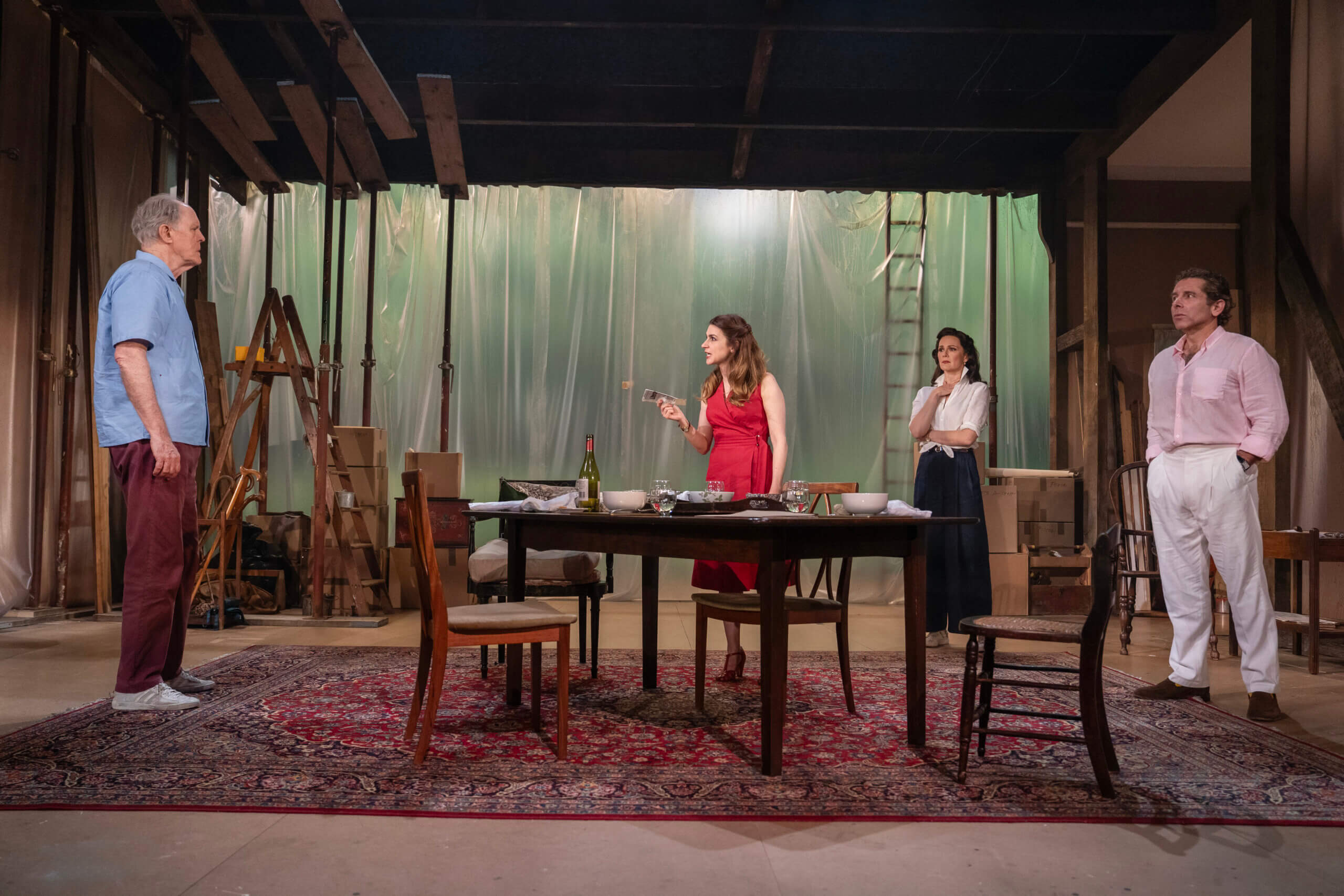
Dahl waxes Goebellsian, calling her “Stein,” and has her take dictation to a Holocaust survivor bookseller in the Hudson Valley who refuses to stock his work: “The kinder of his shtetl in upstate Noo Yoik will have to make do – no, survive on a strictly kosher diet of Laura Ingalls Wilder.”
Director Nicholas Hytner has staged a boxing match for today’s discourse, without changing a line from a pre-Oct. 7 script. What makes the work sing is its refusal to resort to caricature, humanizing Dahl through his fiancée Liccy Crossland (Rachael Stirling), the tragedies of his dead daughter and disabled son and, yes, his genuine concern and justified anguish for the Lebanese and Palestinians, particularly the children.
In a quieter moment, Dahl asks Stone if she read God Cried. She tells him she was moved by an image of a legless boy with crutches. (Dahl identifies him with ease, the victim of a penetration bomb near his school, and describes in typically gruesome fashion how “his arterial blood must have sprayed everywhere like a rogue garden hose.”)
“Why is that image not enough, on its own, for you to demand a halt?” he presses Stone. “And what’s wrong with insisting Jewish people, whose country it surely is, say ‘not in my name’? Surely it’s your voice we need above all?”
This cri de coeur is common now even in Jewish circles, but the sentiment is slippery when it hints at collective blame. After his encounter with Stone, Dahl clarifies his position in a verbatim interview, infamously opining that, when it comes to Jews, “even a stinker like Hitler didn’t just pick on them for no reason.”
That draws a gasp from the audience and a gobsmacked expression from Dahl’s housekeeper Hallie (Stella Everett).
But just how different is this claim to Ana Kasparian saying the goyim are waking up, Candace Owens claiming Satanic pedophile “Frankists” control the world, Young Republicans praising Hitler in group chats, Tucker Carlson platforming Holocaust deniers who suggest Winston Churchill was the real villain of World War II or Joe Kent writing in his resignation letter that the U.S. is continually drawn into wars “manufactured by Israel”? At a point, the figleaf of anti-Zionism proves flimsy. Older innuendos peek out from behind.
In the literary world of today, an audiobook narrator’s call for Zionists to kill themselves is not a cancellable offense — a Zionist moderating a book talk is. (But then, being a Palestinian critic of Israel can lead to a disinvitation to a book festival or reading series — that may be cancelled when other authors withdraw in solidarity.)
Now that we are further from the Holocaust, the carnage in Gaza was broadcast to our phones and the monoculture has atomized into internet echo chambers, Dahl’s review seems pedestrian if not quite mainstream. A cause célèbre in 1983 is now a viral retweet or a chart-topping podcast. His claim that “ancient wounds” didn’t make Jews wiser, but gave them a “partial sight” of their own trespasses sounds a lot like the thesis of Peter Beinart’s last book.
With Giant’s move to Broadway, a local analogy may be in order.
Earlier this month, New York Mayor Zohran Mamdani’s wife, Rama Duwaji, was revealed to have contributed freelance illustrations to a book of stories by young people in Gaza compiled by the Palestinian-American writer Susan Abulhawa. Abulhawa’s social media posts, which called Israelis “vampires” and “cockroaches” and refused to distinguish between Jews and Zionists, prompted Mamdani to call her words “reprehensible,” earning him grief from pro-Palestinian quarters.
What would the response be, had the First Lady of New York provided artwork on a book of Dahl’s and his comments came to light? Abulhawa cuts a different figure: She is the daughter of Palestinian refugees and writes movingly of her people’s suffering. Yet I suspect, like her, Dahl, would have his defenders.
Just as Dahl doubled down when reached for comment on his review — the occasion of his “Hitler stinker” quote — Abulhawa responded to Mayor Mamdani’s censure in an interview by claiming American Jews were the “most privileged demographic in this country” and “the resentment that they are seeing now is stemming from the world watching the so-called Jewish State commit a genocide.”
In other words, the logic follows, the world isn’t picking on Jews for no reason. The sleeping giant of this rationale — a proverbial light sleeper — has been awakened. Dahl, it seems, was just too early to rouse it.
The play Giant is now playing at the Music Box Theatre on Broadway. Tickets and more information can be found here.
The post Roald Dahl’s monstrous views have a seat at the table today appeared first on The Forward.
Uncategorized
New Report Reveals Rampant Human Rights Abuses in Iran as Activists Warn of Another Wave of Mass Executions

People attend Eid al-Fitr prayers, marking the end of Muslim holy fasting month of Ramadan, amid the US-Israeli conflict with Iran, in Tehran, Iran, March 21, 2026. Photo: Majid Asgaripour/WANA (West Asia News Agency) via REUTERS
A new report reveals the widespread scale of human rights abuses in Iran over the past year, as activists warn the regime may carry out another wave of mass executions to suppress growing opposition amid deepening unrest.
The Human Rights Activists News Agency (HRANA), an independent group monitoring Iran, released a report last week, timed for Nowruz, the Persian New Year, outlining a deeply concerning human rights situation over the past 12 months, citing crackdowns on protesters, harassment of activists, threats to minorities, executions of children, violations of women’s rights, and dire prison conditions.
According to HRANA’s Statistics and Documentation Center, 78,907 people were arrested on ideological or political grounds from March 2025 to March 2026, highlighting a pervasive climate of repression across the country.
But the report warns that the number of arrests is likely much higher, given the difficulty of tracking such cases — especially earlier this year during recent nationwide anti-government protests, which security forces violently crushed, leaving thousands of demonstrators tortured or killed.
HRANA reports that at least 6,724 protesters, including 236 children, were killed during these protests, with an additional 11,744 cases still under verification. Multiple reports have put the death toll at over 30,000.
During the regime’s violent crackdown, the group also recorded 25,877 people sustaining serious injuries, with 53,777 arrests occurring on just Jan. 8 and 9 alone.
On women’s rights, HRANA reports that 105 women were murdered, including seven so-called “honor killings” — murders committed under the pretext of preserving family honor — and documents 68 cases of rape or sexual abuse.
Recent media reports indicate that Iranian security forces raped and tortured medical staff who treated wounded anti-regime protesters during the country’s nationwide uprising in January, targeting them in a campaign of intimidation against those aiding demonstrators.
As in past years, executions remain one of the starkest manifestations of human rights abuses in Iran, with at least 2,488 people executed last year, including 63 women and two children, 13 of them carried out publicly.
According to a report by Harm Reduction International (HRI), a global organization tracking drug policy and human rights, 955 people were executed for drug-related offenses in 2025 — an average of roughly three per day — with over 1,000 more currently on death row.
Nearly one in four of those executed were from ethnic minority groups, more than one in five were foreign nationals, and the majority were poor, accused of minor drug offenses, and denied proper legal protections, the report notes.
As the regime continues its campaign of executions, the report says at least 222 children have been left without parents.
United Nations Special Rapporteur on human rights in Iran Mai Sato denounced the regime’s brutal treatment of individuals accused of drug crimes, highlighting the disproportionate impact on vulnerable families.
“Many of the drugs-related cases in Iran involve young fathers from minority ethnic backgrounds experiencing economic hardship who face not only execution but also confiscation of their limited assets – including family homes and farmland – devastating their families long after their execution,” Sato said in a statement.
According to HRI’s latest report, at least 65 executions were carried out in secret without prior notice, denying families the chance to say goodbye, and some occurred despite ongoing legal proceedings.
Iranian security forces also systematically used coercion and torture, while denying prisoners access to legal counsel, to force illegitimate confessions.
HRI also reports that under Iran’s Islamic Penal Code, the principle of elm‑e‑qazi — which allows judges to determine guilt based solely on circumstantial evidence without confessions or witnesses — is frequently applied arbitrarily.
With an increasing number of reports exposing the scale of systematic abuses across the country, human rights groups are warning that the death toll may climb sharply, with over 100 detainees at risk of execution.
Last week, three young Iranian men, including 19-year-old wrestling champion Saleh Mohammadi, were executed as the regime intensifies its crackdown on dissent, The Associated Press reported.
Mahmood Amiry-Moghaddam, head of Oslo-based Iran Human Rights, told the AP the executions are “intended to instill fear in society and deter new protests” amid deepening unrest.
On Monday, Iran’s judiciary confirmed that cases tied to the January protests have reached final verdicts and warned that those convicted would face no leniency.
Uncategorized
‘Verbal sparring’ at a conference for religious Jews breaking from Israel orthodoxy? That’s not what I experienced
To the editors:
The Forward‘s article about the recent Smol Emuni conference seems to describe a different event than the one that I attended. There were certainly different viewpoints among the people assembled at the gathering for religious Jews who, per the organization’s mission, seek “justice, equality, and dignity for Jews and Palestinians.” And there were views and perspectives shared that felt challenging or even difficult to hear.
But to assert, as the Forward‘s article did, that the conference was riven by strife and anger is simply not true.
The basis of the article’s claim, and the focus of a flurry of subsequent op-eds and blog posts, was Rabbi Saul Berman’s address to open the afternoon session. Berman used his remarks to criticize the Palestinian activist who had spoken in the morning; in doing so, he invoked a broad, monochromatic description of Islamic theology that felt out of place to some of us, including me.
Berman argued that Islamic Law prohibits any territorial concession, suggesting that Islamic law, but not Jewish law, continues to make peace impossible. The implication that Jewish theology has not blocked work toward peace is quite problematic, given the central role of religious leaders and communities in building settlements and in right-wing politics in Israel.
It is precisely this line of argument that many came to this conference to escape. In too many Jewish communities, it feels impossible to acknowledge the ways in which Judaism has contributed to Palestinian suffering and injustice. Smol Emuni was created in part to end that silence. That is why Berman’s words felt jarring.
But reading the Forward‘s article, one might think that Berman spoke with anger or that the audience actively derided him.
In fact, Berman spoke for close to 20 minutes. As far as I could see, everyone listened to him attentively. Most of the audience applauded when he concluded; I heard no boos. While a few people came and went during his remarks, as is the case at any such event, I saw no evidence that anyone “walked out in protest.”
One of the organizers did feel the need to note, after Berman concluded, that the conference organizers specifically did not share all of his views. She did so gracefully, while thanking him warmly for speaking and affirming her deep respect for him. I do not know how Berman felt, but he was not visibly angered and he stayed for the remainder of the program.
It was an awkward moment, to be sure, but not one of rancor or disrespect. It certainly did not define the conference, which elevated a range of important voices and viewpoints that I found both thoughtful and thought-provoking.
The post ‘Verbal sparring’ at a conference for religious Jews breaking from Israel orthodoxy? That’s not what I experienced appeared first on The Forward.