


Uncategorized
Faith heals the Deepest Wounds, Soothes the Greatest Woes
Across centuries, the Jewish people have experienced collective trauma, from the ancient exiles to modern-day tragedies. Despite these painful occurrences, Jewish tradition is a real treasure trove of healing through religious practices and teachings of the Torah. The Torah shows people how to process and move beyond suffering, and how the Bible can be a source of resilience and hope, even when all seems lost.
One of the greatest Jewish principles of practice is the practice of remembrance. The Torah calls the Jewish people to recall past suffering, not to dwell in sorrow, but in order to take the moment to derive lessons and strength from their adversity. This is reflected in such rituals as Passover, which celebrates the Exodus from Egypt and the liberation of the Jewish people from slavery. Likewise, Tisha B’Av is a day of remembrance for the destruction of the First and Second Temples. These rituals are not reminders of sorrow but tools necessary for transmitting the lessons of history to future generations. Through the practice of remembrance, Jewish communities are reminded time and again of the strength they have shown over the ages and the necessity to cultivate hope for the future.
Aside from the remembering process, the Torah also provides organized practices designed to assist an individual in coping with loss and suffering. The mourning practices, like Shiva, the seven-day mourning period, and Yahrzeit, the yearly observance of a loved one’s death, are a supportive mechanism whereby both the individual and society can cope with their loss. The practices are social in nature, reinforcing the idea that healing is as much an individual process as it is a social one. The social aspect of the practices creates solidarity and provides mutual support so that everyone mourns together.
Prayer and fasting are of profound significance in the Jewish healing environment. Yom Kippur and Tisha B’Av are such special days for soul-searching, repentance, and spiritual rebirth. On such days, the individual and collective seek forgiveness, atonement, and healing. These are spiritual exercises aimed at cleansing the soul and reconciling with God, an indication of the faith that, irrespective of the intensity of the agony, a path to spiritual healing always exists.
Community lies at the core of healing trauma within Jewish life. At the center of healing is the idea of Klal Yisrael—the Jewish peoplehood. In times of adversity, Jewish communities unite through acts of interdependence, prayer, and shared ritual. The communal care creates a basis of resilience, reminding individuals that they are not isolated in their suffering. In fact, the community’s strength can become a healing force, repairing the damage of trauma.
Chaya Lerner’s book, Torah of Trauma, explores the spiritual and psychological aspects of healing in the Torah. In her book, Chaya addresses how scriptural lessons can guide individuals and communities through healing from trauma and transforming it into what makes them stronger. Chaya utilizes ancient Jewish sources and modern therapy methods to explain that the Torah offers healing tools. Chaya’s work emphasizes that healing from trauma is not merely an understanding of the past but also the transformation of that understanding into a path forward. The book explores how Jewish heritage offers hope, healing, and a way to heal the spirit after suffering.
In an age where trauma manifests in so many different disguises, affecting so many individuals and communities, the Jewish approach to healing with the Torah is a sage one. Chaya Lerner’s Torah of Trauma is a guide for those willing to discover how scripture can heal emotional and spiritual hurts. By immersion in the Torah, remembering past struggles, and participating in communal rituals, the Jewish faith traces a path to resilience, hope, and spiritual rebirth. Through these sacred rituals, individuals and communities can transform their pain into power, emerging from trauma not just as a whole but more resilient than ever before.
Essentially, Jewish heritage teaches the realization that collective trauma does not characterize the people, but rather completes them. By accepting the teachings of the Torah, individuals and communities can heal, not only for themselves, but for society as a whole as well. The teachings given within the Torah are an eternal reminder of redemption, a reminder that there is always space for renewal and development, even in the darkest of sufferings.
The post Faith heals the Deepest Wounds, Soothes the Greatest Woes appeared first on The Forward.
Uncategorized
The photos may be black and white, but the klezmer world is drenched with color
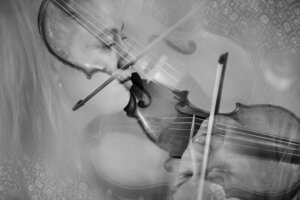
In Lloyd Wolf’s evocative photography exhibit, “A Joyful Noise,” you can almost hear the Klezmer music — plaintive and celebratory, earthy and devout, and always with a profound, but not easily definable, outpouring of Yiddishkeit.
Now showing at the Dr. Bernard Heller Museum at New York’s Hebrew Union College, the 45 images feature solo, dual and group portraits of Klezmer musicians performing from the mid 90’s through 2024.
They may be at a wedding, in concert, or practicing alone in a bucolic setting. In one humorous picture, six Klezmer musicians emerge from a row of porta-potties, instruments in hand. Most of the pictures, arranged chronologically, are in black and white.
“The trick in photographing music, which is invisible, is that it has to be translated into a visible form,” said the Dayton, Ohio-born Wolf during a phone conversation from his home in Arlington, Virginia. “You have to pick up on the energy. It’s like jamming, only it’s silent. I’m often up on the stage with the musicians, right up in their faces. Because they know me they’re not posing. I can photograph bad musicians but the picture is much better if the musicians are great. It just raises the level of what you do.”

Wolf, who grew up hearing classical music, show tunes, folk, and Gilbert & Sullivan, has always loved music and musicians and he has photographed many, including Brian Wilson, Wynton Marsalis and The Grateful Dead.
The genesis of the exhibit was Wolf’s stunning book, A Joyful Noise! Klezmer in Motion.
“I’ve worked with Lloyd on several prior exhibits, mostly issue-oriented ones, and knew his work to be very good as well as interesting,” said Nancy Mantel, the exhibit’s curator. “Anything happy at this time seems like a win. And it’s about music and memories — also good.”
“It was the perfect moment to present our exhibition to celebrate nearly four decades of a vital musical genre that has immeasurably enriched Jewish life,” added Jeanie Rosensaft, the museum’s director. “Klezmer has contributed greatly to the growing appreciation for Yiddish language and culture among younger generations.”
A way to engage with the world
Klezmer music emerged from the world of Ashkenazi Jews in pre-Holocaust Eastern and Central Europe. It has roots in both Hasidic rituals and the Jewish (and Romanian, Hungarian and Romani) folk music of the time. In the post- World War II years, Klezmer music largely disappeared, in part because it was a painful reminder of what had been lost. In the 80s and 90s, when ethnicity became cool, it enjoyed a renaissance that continues today.
According to Wolf, there are any number of reasons why young people are attracted to Klezmer, including the fact that it provides a way to celebrate and identify that feels authentic and fun.

“Most of their roots are in the Yiddish world of their immigrant ancestors from Eastern Europe,” he said. “Some of it perhaps has to do with political and cultural gaps that have grown between Diaspora Jews and what they see and feel going on regarding the policies and actions of the current Israeli government.”
Wolf’s favorite picture, and coincidentally mine as well, presents Klezmer musician Michael Winograd sporting a jaunty little hat and playing his clarinet on an otherwise empty Coney Island boardwalk against a backdrop of immobilized rides, the iconic roller coaster and parachute drop. All by itself, the setting brings to mind an old ethnic, Jewish New York fixed in time.
“There is an inherent energy in Coney Island and the architecture is coherent,” said Wolf. “It’s just fun to look at. As Duke Ellington said, ‘It don’t mean a thing if it ain’t got a swing.’ I took that picture because Mike said he needed a cover shot. It was a freezing day, but he took his coat off. I said, ‘start playing.’ It was winter and there were no people out. That made for a much better picture than if we had done it in the summer with all the people.”
When I asked him when he chooses to shoot in black and white as opposed to color, he explained that, while there is usually no set plan ahead of time, he generally prefers black and white, “for its simplicity. It takes it out of a specific time. It’s more abstract, more classic. If I want a picture to be of a specific time and place, I’ll shoot in color.”

Wolf calls himself a documentary photographer and says his aesthetic influences include Gordon Parks, Dorothea Lange and Weegee, whose work combines “meaningful artistry and committed documentary.”
Wolf is very much the social activist. His books depict such topics as the Vietnam Memorial, social diversity in Columbia Pike, and Jewish fathers and mothers.
He says his interest in Klezmer musicians and music was at once improbable and inevitable. But no one was more surprised than his mother, a Bronx-born daughter of Yiddish-speaking Eastern European immigrants who desired nothing more than to be a fully assimilated American woman devoid of any accent or rituals.
“She was shamed by her Christian neighbors into sending me to Hebrew School and I did have a Bar Mitzvah,” recalled Wolf. “But we were not observant.”
His father, a refugee from Nazi Germany was a proud German Jew, highly cultured, intellectual and accomplished. “A computer pioneer, he was the technical director for building the ARPANET, the system that evolved into the Internet,” Wolf said.

The Holocaust, indeed Jewish topics in general, were not discussed in Wolf’s home. A child of the 60s, Wolf came of age during anti-war protests, love-ins and Jimi Hendrix. He majored in political science at Goddard College, though he never had any real interest in pursuing that field as a carer, he said. “For me photography was the way to engage with the world.”
He earned his Masters in photography at Trinity College in Hartford where he started freelancing for local newspapers. One of his outlets was the B’nai B’rith Magazine, which marked a turning point in his life and career. An early assignment took him to Treblinka, Poland and Israel, where he met his father’s cousins who, like his father, were forced to flee their homes. But unlike his father they talked about the Holocaust.
“I learned from them, for the first time, what had happened,” he said. “When I came back home from Israel I started going to shul.”
A music beyond politics?
Wolf was first turned on to Klezmer music in 1992 when he was assigned to cover two of the new Klezmer revival groups: Kapelye and the Klezmatics.
“I met up with Kapelye at a rehearsal space in the Workman’s Circle building,” he wrote to me in an email. “I can’t recall any particular melody at this date but do remember being in awe of Adrienne Cooper’s deep, commanding, matronly voice and presence. The next night I was to meet a guy from the Klezmatics at the Bottom Line club, Frank London. Here was a Jew roughly of my generation, who fully expressed his passion and art in an explicitly ethnic context, and with great skill and brio. He and the other band members at the time delivered a masterfully exhilarating concert: Transcendent, beautiful, sweeping, a grand opening of the soul in sound.”

London played a central role at the exhibit’s festive opening night reception by leading a Klezmer concert, which was, London said, fueled by Wolf’s photography, but also by the other exhibit in the gallery — paintings that explored “Mothers, Prophets, Warriors: Women of the Bible.”
“Both Jewish, both joyous and we were part of the joyous noise,” London said. “Our music is celebratory. The musicians share a common language and repertory. Nobody had sheet music.”
Throughout the performance, which featured two clarinetists (including Winograd), Wolf was moving about and shooting away.
The audience seemed to be having a fine time. For much of the performance they silently emanated a collective satisfaction; midway through, an elderly woman moved to the back where, all by herself, she started dancing to the music.
Then, something else happened. A few women were up and dancing into the aisles. They held hands and moved around the chapel, swaying this way and that. Slowly others in the audience joined in — men and women, young and old, most able-bodied, some less so. Round and round they went.

“When people define Klezmer, they often talk about it as dance music,” said London. “Names of different tunes are often names of dances. Whenever we play this music in its unadulterated form it’s always to celebrate Yiddish Ashkenazi culture that is also universal. It is beyond politics.”
I don’t agree. For me, the wordless dancers exuded an unabashed, unapologetic and perhaps even defiant ethnic identification, joy and pride. It was a deeply moving and searing political statement.
After the concert, I went back to look at Wolf’s photographs. They worked wonderfully well all by themselves. Still, the music and dancing I had just witnessed shed a new, more complex light on the pictures. Either way, the images on the wall and those that I took from the recital lingered as I left the building and walked up Mercer Street back to the 8th Street subway station.
The post The photos may be black and white, but the klezmer world is drenched with color appeared first on The Forward.
Uncategorized
On Columbus Day, remember Abraham Zacuto, the Jewish astronomer history forgot
(JTA) — Every October, Christopher Columbus returns not only as history but as controversy. The voyages associated with his name transformed the world, but their legacy is inseparable from conquest, coercion and the destruction that followed European expansion.
Yet the same Iberian age also produced a quieter and far less controversial revolution: advances in astronomy, mathematics, cartography, instruments and practical navigation that made sustained oceanic voyaging possible. Its protagonists included scholars, translators, mapmakers, instrument makers and pilots whose names are far less familiar than those of the captains who commanded the ships.
Among them, one figure deserves particular remembrance on Columbus Day: Abraham Zacuto, a Jewish astronomer born in Salamanca around 1452. Zacuto belonged to the same Iberian world as Columbus, but experienced its monarchies very differently. In 1492, Columbus sailed west under the patronage of Ferdinand and Isabella. That same year, the Catholic monarchs ordered the Jews of their realms to convert or leave. Zacuto left Castile and continued his work in Portugal. The celebrated maritime discoveries and the expulsion of Iberian Jewry were therefore not distinct historical worlds; they unfolded under the same rulers, at the same moment, within the same culture of ambition, knowledge and power.
Zacuto stands out within that larger scientific story. He was a rabbi, astronomer, mathematician and historian whose astronomical work helped give oceanic navigation a new degree of precision and practicality. His contribution belongs not at the margins of the Age of Exploration but within the scientific infrastructure that made long-distance navigation increasingly systematic.
Around 1478, Zacuto completed his great Hebrew astronomical work, “Ha-Hibbur ha-Gadol,” the “Great Composition.” Working within a long scientific conversation that included Greek, Islamic, Jewish and Christian astronomy, he refined and organized astronomical calculations in forms of exceptional practical value.
After the expulsion from Spain, Zacuto entered Portugal at precisely the moment when the kingdom was pushing maritime exploration farther into the Atlantic and down the African coast. Zacuto’s pupil, José Vizinho, a Jewish adviser to Portuguese King John II, was associated with the practical Latin and Castilian presentation of Zacuto’s astronomical material. In 1496, Zacuto’s Almanach Perpetuum was printed at Leiria in four known issues – three with Latin preliminary matter and one with Castilian.
The importance of those tables was intensely practical. They supplied precise, ready-to-use values for the changing position of the sun through the year. For a pilot on the high seas in daylight, far from recognizable coastlines, this meant that a noon observation of the sun could be combined with solar-declination data to determine latitude — the ship’s north-south position. The difficult astronomical calculations had already been embodied in the tables. What remained aboard ship was an operational procedure: Observe the sun, consult the appropriate value and calculate latitude. That combination of precision and usability greatly facilitated daytime position-finding at sea. Solar tables derived from Zacuto’s work entered early Portuguese navigational manuals and became part of the practical scientific culture of oceanic travel.
The clearest measure of Zacuto’s importance may be what happened next. The Almanach did not remain a local Portuguese publication. Its tables were reprinted repeatedly in Venice in 1498, 1502, 1525 and 1528. A work first printed in Leiria moved into one of Europe’s great publishing centers and continued to circulate for decades. That publishing history alone tells us something about the standing Zacuto’s astronomy acquired.
Its reach extended farther still. Zacuto’s astronomical material was translated and adapted into Arabic. One Arabic version was produced, likely in Istanbul, in 1505-06; another, associated with Ahmad ibn Qasim al-Hajari in Morocco around 1624, survives in several manuscripts. The work of a Jewish astronomer writing in Hebrew in 15th-century Salamanca had crossed into Latin, Castilian and Arabic scientific cultures.
Zacuto’s name also became entwined with the memory of the great navigators. Accounts have long connected his tables with Columbus and Vasco da Gama, including the famous 1504 lunar eclipse in Jamaica. In this episode, Columbus intimidated Indigenous Jamaicans by predicting the disappearance of the moon, relying on Zacuto’s almanac, which he had on board. A manuscript connected with the Almanach also survives in Seville’s Biblioteca Colombina, the library created by Columbus’s son Hernando. Taken together, these associations reveal the stature Zacuto’s work acquired in the historical memory of the Age of Exploration.
Perhaps the most striking part of Zacuto’s story is what happened to the man himself. Portugal valued the kind of expertise he represented. Yet in December 1496, King Manuel I ordered Portugal’s Jews to leave unless they converted, and in 1497 the crown subjected the Jewish population to mass forced conversion. Zacuto left Portugal as well.
Exile did not end either his travels or his scholarship. From Portugal he moved through North Africa, including Tunis, before eventually reaching Jerusalem. There, late in life, he returned once more to the astronomical work that had made his name known across the Mediterranean, recalculating and updating his earlier tables for the Jewish calendar and the meridian of Jerusalem. The strongest recent reconstruction of his life places his death in Jerusalem in Tevet 5274, or late 1513 or very early 1514 — commonly given as 1514.
Zacuto’s story is therefore larger than a footnote to Columbus. It joins two strands of Sephardic history too often told apart: persecution and exile, and the transmission of knowledge, texts and technologies across borders.
Zacuto’s own tables and 15th-century procedures are now obsolete, but their underlying navigational logic endures. Modern celestial navigation still determines position by combining observations of the sun, moon, planets or stars with authoritative astronomical data. The U.S. Naval Academy requires all midshipmen to study navigation, and its current curriculum includes celestial navigation alongside electronic methods. The U.S. Naval Observatory still describes celestial navigation as a critical independent backup to GPS and other electronic systems. And the Nautical Almanac, first published in 1855, remains the standard U.S. Navy resource for marine celestial navigation. The instruments and calculations have changed, but the essential logic remains: Observe the heavens, consult reliable astronomical data and determine position.
Zacuto’s scientific reputation also survives in an unexpected place. In 1935, the International Astronomical Union formally adopted the name Zagut for a lunar crater honoring Abraham ben Shmuel Zacuto. Modern astronomy has, quite literally, written his name onto the Moon.
Columbus remains a household name because voyages leave dramatic images: ships, landfalls, encounters and conquest. The calculations, tables, instruments, translations and printed books that made such voyages possible are easier to forget. Remembering Zacuto widens the story: His tables brought greater precision and practicality to daytime navigation; his work crossed languages and continents; and his life traced the routes of Sephardic exile from Iberia to Jerusalem. The age of maritime discovery was also an age of scientific discovery, and some of the knowledge that carried Iberian ships across oceans was created by scholars whose communities those same monarchies expelled.
The views and opinions expressed in this article are those of the author and do not necessarily reflect the views of JTA or its parent company, 70 Faces Media.
The post On Columbus Day, remember Abraham Zacuto, the Jewish astronomer history forgot appeared first on The Forward.
Uncategorized
Recorded anti-Jewish hate crimes rise 10% in England and Wales
(JTA) — Hate crimes targeting Jewish people in England and Wales rose by 10% in the year ended in March, according to the latest data released by the British government.
Police-reported hate crime — including crime influenced by other factors such as race and sexual orientation — overall increased by 7% compared with the previous year, according to the Home Office data released last week.
British Foreign Secretary Ed Miliband posted on X on Monday, “Antisemitism has no place in our society. This morning, I hosted a crucial discussion with the J7 Global Task Force to discuss how we can work together across countries to stamp out the scourge of antisemitism.”
Following the meeting, the Board of Deputies of British Jews issued a statement explaining that Miliband and the task force had discussed, among other things, “the sharp rise in global antisemitism” and the “continued demonisation of Israel.” Representatives from the U.K., the U.S., Canada, Germany, France, Argentina and Australia make up the task force.
“In the meeting, the J7 proposed a new international intergovernmental ministerial task force on antisemitism, comprising the countries represented in the J7 and taking on the key themes discussed. We were pleased that the Foreign Secretary agreed to host an inaugural meeting of J7 countries’ ministers to start this process,” the statement sent to JTA said.
The Community Security Trust, a charity that protects the Jewish community and monitors antisemitism, said on X that the new data show “that antisemitic hate crime remains at an unacceptably high level.”
“As seen previously, Jewish people continue to experience by far the highest police-recorded rate per head of religious hate crime of any faith group,” CST said. “This shows the disproportionate scale of anti-Jewish hatred and its impact on Jewish life in Britain.”
Religious hate crime rose by 13% overall in the 12 months to March 2026, the report said. The overall figure rose from 10,067 to 11,419 offenses.
The two groups most affected were Jews and Muslims, the Home Office said. Religiously motivated hate crimes against Muslims increased 15%, the report found, with spikes reported around public protests in September 2025 and the start of the U.S. war with Iran in February.
The number of recorded offenses affecting Jews rose from 2,874 to 3,162 offenses, spiking after the attack on Heaton Park synagogue in Manchester last year on Yom Kippur.
Two men, Melvin Cravitz and Adrian Daulby, were killed on Oct. 2, 2025, after Jihad Al-Shamie, who was wearing a fake suicide bomb belt, drove into the gates of Heaton Park synagogue and began attacking congregants with a knife. Cravitz died from stab wounds; Daulby was fatally struck by a police bullet during the response.
A spate of violent antisemitic incidents followed this year, including the torching of four ambulances belonging to Jewish volunteer service Hatzola on March 23 and the stabbing of two Jewish men in separate attacks in Golders Green on April 29.
The Home Office figures, which do not include data from London’s Metropolitan Police Service because of a change in how it records crime, showed the second-highest level of religious hate crime directed at the Jewish community since the Home Office began keeping records in 2018. It was surpassed only by the year ending March 2024.
“In the last year, there were 117 police recorded religious hate crimes targeted at Jewish people per 10,000 population, the highest rate for any religious group. The next highest rate was for religious hate crimes targeted at Muslims, with 13 per 10,000 population,” said the Home Office.
The report was published on Oct. 8, at a time of heightened sensitivity. Eleven people were arrested at pro-Palestinian marches in London a day earlier, despite calls by the Metropolitan Police to avoid demonstrating on the anniversary of Hamas’ deadly 2023 raids inside Israel.
Police reported 20 arrests at Saturday’s pro-Palestinian protest in London, where many demonstrators were wearing kaffiyehs, waving Palestinian flags and brandishing banners.
The level of hate directed at the Jewish community has remained at an “elevated level” since the beginning of the Israel-Hamas conflict, the report stated.
The CST said, “There is an urgent need to reduce the amount of incitement connected to conflict overseas,” adding that “much more needs to be done across society to tackle this problem.”
Over the summer the government announced a major funding boost to support the Jewish community, promising £250 million ($335 million) over the next three years for increased policing and protection of Jewish communities.
More remains to be done, according to community organizations.
A spokesperson for the Board of Deputies of British Jews said the report’s publication “confirms the need for rigorous prosecution to ensure deterrence, and a whole of society approach to tackling hatred and extremism, and to stopping conflict in the Middle East being used to incite hatred against the Jewish community.”
The Campaign Against Antisemitism said the report was evidence that the British justice system was failing the Jewish community.
“Antisemites, emboldened by the Hamas terrorist atrocity three years ago, are not only not letting up in their hatred but are doubling down,” it said in a statement. “That’s because there is no real deterrent. So really these figures are most damning for the criminal justice system, which has utterly failed to defend British Jews.
“Even as conflict in the Middle East is easing off, antisemitism in the U.K. is rising, yet there have been essentially no changes in policing policy over the past three years and nobody has been held to account for this monumental failure,” the campaign said.
This article originally appeared on JTA.org.
The post Recorded anti-Jewish hate crimes rise 10% in England and Wales appeared first on The Forward.
