


Uncategorized
Fatah Glorified Munich Olympics Massacre Ahead of 2026 Winter Olympics
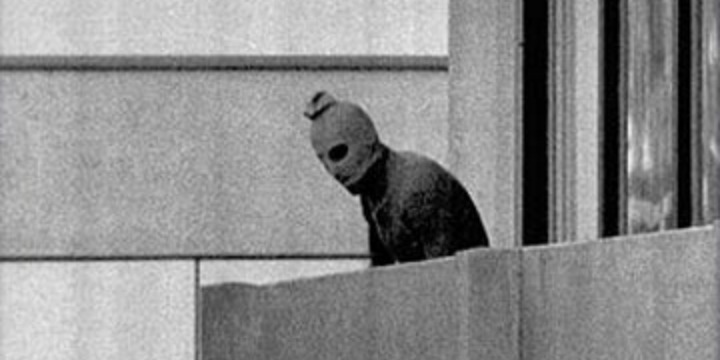
An image of one of the Palestinian terrorists who took part in the 1972 Munich Olympics massacre. Photo: Wikimedia Commons.
While the world was preparing to celebrate the Olympic Games in Italy, Fatah celebrated Olympic blood in Munich.
Just two weeks before the opening of this year’s Winter Olympics, Fatah — the Palestinian Authority (PA)’s ruling party — chose to revive and celebrate the most infamous act of Olympic terrorism in history: the 1972 Munich Olympics massacre, in which 11 Israeli athletes and coaches were murdered.
On its Facebook page, Fatah’s Commission of Information and Culture posted a segment from its Awdah TV channel, glorifying the massacre as “a surprise Israel had not experienced before” and recounting how terrorists, whom she called “self-sacrificing fighters,” infiltrated the Olympic Village, seized Israeli hostages, and issued demands.
Responsibility for the murders was subtly shifted away from the terrorists, while the operation was presented as daring and historic:
Fatah-run Awdah TV host:“In September 1972, Israel was about to receive a surprise it had not experienced before. Eight self-sacrificing fighters [i.e., terrorists] invaded the quarters of the Israeli sports delegation that was participating in the Olympic Games in the German city of Munich. They captured nine Israelis and demanded to release hundreds of Palestinian prisoners [i.e., terrorists] who were in the Israeli prisons in exchange for the release of the hostages. Israel refused to negotiate, and the hostages were killed.”
[Fatah Commission of Information and Culture, Facebook page, Jan. 22, 2026]
On the same day, Fatah’s Commission of Information and Culture also lionized the architect of the Munich massacre, Ali Hassan Salameh, as “The Red Prince.”
Fatah described him as a brilliant “security mind” and strategic genius whose operations allegedly “embarrassed Israel:”
Text on screen: “The Red Prince, the commander whom the Mossad pursued for years. Ali Hassan Salameh was not a shadowy figure, but rather a security mind who created a secret battle …
He joined Fatah in the mid-1960s and was among its first security personnel. He quickly stood out for his organizational wisdom and ability, and sensitive missions were entrusted to him … He led the security activity of the revolution outside Palestine and built a complex defense network that embarrassed Israel. He became a central target of the Mossad, and his name topped the assassination lists.
[Then Israeli Prime Minister] Golda Meir gave the order to eliminate him, and the pursuit after him crossed continents … On Jan. 22, 1979, the Mossad assassinated him in Beirut using a car bomb. His assassination did not put an end to his presence, rather it established his status as one of the most dangerous minds of the revolution. Ali Hassan Salameh, a security commander and one of the symbols of the hidden strugglewith the occupation.” [emphasis added]
Posted text:“The Red Prince Ali Hassan Salameh, the commander whom the Mossad pursued for years”
[Fatah Commission of Information and Culture, Facebook page, Jan. 22, 2026]
Even more than 54 years later, the PA’s ruling party still treats the Munich Olympics massacre as a legacy to be celebrated.
By deliberately highlighting this massacre just before the Milano Winter Olympics, Fatah yet again shows how it is proud to promote terrorists and terrorism.
Ephraim D. Tepler is a researcher at Palestinian Media Watch (PMW), where a version of this article first appeared.
Uncategorized
Iran Accuses US of Ground Assault Plans as Pakistan Hosts Regional Talks

Foreign Ministers Badr Abdelatty of Egypt, Prince Faisal bin Farhan Al Saud of Saudi Arabia, Ishaq Dar of Pakistan and Hakan Fidan of Turkey pose for a group photo during their meeting to discuss regional de-escalation, amid the U.S.-Israel conflict with Iran, in Islamabad, Pakistan, March 29, 2026. Photo: Muammer Tan/Turkish Foreign MinistryHandout via REUTERS
Iran said it was ready to respond to any US ground attack, accusing Washington of preparing a land assault while seeking talks, as regional powers met in Pakistan on Sunday to try to bring the two sides together.
The initial discussions in Islamabad with Saudi Arabia, Turkey and Egypt focused on proposals to reopen the Strait of Hormuz to shipping, sources familiar with the matter said. More talks will be held on Monday.
Iran’s effective blockade of oil and gas shipments through the strait since the US and Israel began attacking the country on February 28 is spreading economic pain around the world. Food and energy security and supply chains were among issues discussed in Pakistan, Egypt’s foreign ministry said.
As the conflict entered its second month, Israel‘s military said it had launched over 140 air strikes on central and western Iran, including Tehran, over the 24 hours to Sunday evening, hitting ballistic missile launch sites and storage facilities, among other targets.
A chemical plant in southern Israel near the city of Beer Sheva was hit by a missile or missile debris as Israel fended off multiple salvos from Iran, prompting official warnings to the public to stay away due to “hazardous materials.”
Another missile hit open ground near homes in Beer Sheva, located near several military bases, injuring 11 people.
The war has killed thousands of people and affected countries across the Middle East, with major aluminum plants in Bahrain and the United Arab Emirates damaged by air strikes over the weekend.
The UAE, which has faced more Iranian missile and drone attacks than any other country, is seeking reparations from Iran for attacks on civilians and vital facilities and clear guarantees to prevent any repetition, an adviser to the president said.
Pakistan has offered to host peace talks, but the United States, Israel and Iran have set out maximalist positions to end the warfare, complicating the path to a solution.
Iran’s parliament speaker Mohammad Baqer Qalibaf accused the US of sending messages about possible negotiations while at the same time planning to send in troops, adding that Tehran was ready to respond if US soldiers were deployed.
“As long as the Americans seek Iran’s surrender, our response is that we will never accept humiliation,” he said in a message to the nation.
Yemen’s Iran-aligned Houthis joined the conflict on Saturday launching their first attacks on Israel and raising the prospect they could target and thus block a second key shipping route, the Bab el-Mandeb Strait. Analysts say renewed attacks there would pile further pressure on the world economy.
US MARINES START ARRIVING IN MIDDLE EAST
Washington has dispatched thousands of Marines to the Middle East, with the first of two contingents arriving on Friday aboard an amphibious assault ship, the U.S. military has said.
The Washington Post quoted US officials as saying the Pentagon was preparing for weeks of ground operations in Iran, adding that it was not yet clear if President Donald Trump would approve such plans.
Reuters has reported that the Pentagon has considered military options that could include ground forces.
Trump faces a stark choice between seeking a negotiated exit or escalating militarily that risks a protracted crisis, and would likely weigh further on his already low approval ratings.
“President Trump has poor options all around to end the war,” said Jonathan Panikoff, former US deputy national intelligence officer for the Middle East.
“Part of the challenge is the lack of clarity related to what a satisfactory outcome would be,” Panikoff added.
Washington said last week it had offered a 15-point ceasefire plan, with a proposal to reopen the Strait of Hormuz and restrict Iran’s nuclear program, but Tehran has rejected the list and put forward proposals of its own.
ISRAEL HITS DOZENS OF TARGETS ACROSS IRAN
An Israeli official said Israel would continue carrying out strikes against Iran on what were described as military targets, adding there was no intention to scale back the campaign ahead of any possible talks between Washington and Tehran.
A building housing Qatar’s Al-Araby TV in Tehran was hit on Sunday, the semi-official Mehr news agency reported, with video showing walls and windows blown out of the multi-storey block.
“The missile hit. The ceiling and everything fell on our heads. Unfortunately, we couldn’t continue to work. It was a real miracle we survived,” said Al Araby camera operator Mohammadreza Shademan. “There was no military target here.”
With US midterm elections due in November, the increasingly unpopular war has weighed on Trump’s Republican Party. Demonstrators took to city streets across the US on Saturday in protests against the conflict.
Trump has threatened to hit power stations and other energy infrastructure if Iran does not open the Strait of Hormuz, though he has extended a deadline by 10 days through April 6.
A European diplomat warned that any further military escalation could make it harder to bring the two sides together, potentially delaying the possibility by weeks, if not longer.
Iranian threats against ships have kept most oil tankers from attempting the waterway. Iran has agreed to let an additional 20 Pakistani-flagged vessels pass through the strait, with two ships permitted to transit daily, Pakistan’s Foreign Minister Ishaq Dar has said, calling it a “harbinger of peace.”
Uncategorized
Pentagon Preparing for Weeks of Ground Operations in Iran

US Secretary of Defense Pete Hegseth holds a briefing with Chairman of the Joint Chiefs of Staff General Dan Caine, amid the US-Israeli war on Iran, at the Pentagon in Washington, DC, US, March 19, 2026. Photo: REUTERS/Evan Vucci
The Pentagon is preparing for weeks of ground operations in Iran, the Washington Post reported Saturday, citing US officials.
The plans could involve raids by Special Operations and conventional infantry troops, the Post reported. Whether President Donald Trump would approve any of those plans remains uncertain, according to the Post.
The Trump administration has deployed US Marines to the Middle East as the war in Iran stretches into its fifth week, and also has been planning to send thousands of soldiers from the US Army’s 82nd Airborne to the region.
Uncategorized
America’s oldest synagogue closed. Then an unlikely group tended its cemetery.
In 1833, Herald of the Times, a Newport, Rhode Island, newspaper, reported that the remains of Mrs. Rebecca Lopez had been brought from New York by steamboat and placed inside Touro Synagogue.
Dedicated in 1763, the building is now recognized as the nation’s oldest surviving synagogue. Newport had once been home to a thriving colonial Jewish community, but after the Revolutionary War and the city’s economic decline, that community had largely faded. The cemetery remained, and so did the synagogue. It was during that long interval of near-absence that Lopez’s funeral briefly reopened Jewish ritual life in Newport.
After prayers were read by Rabbi Isaac Seixas of New York, the body was carried to the cemetery on Touro Street, with “the clergy, town council, and a numerous concourse of spectators” joining the funeral procession. The paper noted that a Jewish ceremony had not been performed there “for the space of forty years.”
Newport’s Jewish burial ground dated to 1677. In 1822, Abraham Touro left money for the upkeep of the cemetery, the synagogue, and the street on which they stood. The fund was placed under trustees appointed by the Rhode Island legislature, and Newport’s Town Council was later authorized to use the interest for repairs.
While Newport’s Jewish population declined, the endowment ensured that the synagogue building and cemetery grounds continued to be maintained. In 1826, the Town Council reported that it had tried to repair the synagogue using the Touro fund, but could not proceed because it had not been able to obtain the keys from Shearith Israel in New York. Many of Newport’s former Jewish residents had relocated there, and the congregations had longstanding ties.
In 1842, the council contracted to enclose the synagogue lot with a substantial stone wall and an ornamental cast-iron fence, modeled on the fence around the Jewish cemetery. The work included a Quincy granite base and a gateway on Touro Street designed to correspond with the synagogue’s portico. The project cost $6,835.
The synagogue’s doors rarely opened, and often only for moments of mourning. In June 1854, Newport received the body of Judah Touro, one of the most prominent American Jews of his era, a native of the town and brother of Abraham Touro. The Herald of the Times reported that “the streets was [sic] crowded with people, the stores all closed, and the bells tolled.”
The City Council assembled at City Hall and marched in procession to the synagogue, where “thousands remained outside” during the service. At the funeral, Newport’s mayor, William C. Cozzens, spoke of the trust that had long existed between the city and local Jewish families, recalling that the synagogue and cemetery had been left in Newport’s care and maintained there “with ample means for their preservation.”
When Henry Wadsworth Longfellow visited Newport’s Jewish cemetery that same year, he wrote of the graves as “silent beside the never-silent waves.” He noticed, too, what endured there: “Gone are the living, but the dead remain,” he observed, “and not neglected.”
Newport’s preservation of Jewish sacred space was shared. Jews endowed these places and returned to bury their dead there. Christian officials repaired, protected, and publicly honored them. In this way, a Jewish inheritance was carried forward until communal life returned.
In 1883, Touro Synagogue was rededicated and a new Jewish community established in Newport. But even in the window of years when the congregation was gone, the dead were not abandoned.
The graves were kept.
The post America’s oldest synagogue closed. Then an unlikely group tended its cemetery. appeared first on The Forward.