


Uncategorized
He works at a Holocaust museum by day. How’d he end up in ‘Marty Supreme’?
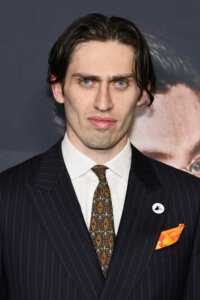
Heading into his audition for Marty Supreme, Isaac Simon was nervous. But not for the reasons you’d expect.
“I was taking a long lunch break from the museum,” he said, “and at the time I was three or four months into my job.”
Appearing in a Josh Safdie movie was something Simon, who runs internship programs at the Museum of Jewish Heritage, had genuinely never dreamed of. He wasn’t an actor, or an aspiring one. He’d never taken an acting class or been in front of a camera.
But two years after he was scouted at a baseball card convention, Simon was invited to try out for the role of Roger, a cocksure amateur who gets hustled on the ping-pong table by Timothée Chalamet’s Marty Mauser. Standing 6-foot-9 with ice-blue eyes, low eyebrows and flowing brown hair, Simon had the look, the paddle skills and, clearly, the temperament to land a pivotal part in an Oscar-bound — and richly Jewish — cinematic hit.
“I don’t get starstruck,” Simon, 31, said. “I get excited.”
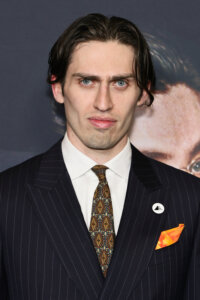
The slew of non-actors who feature in Marty Supreme alongside A-listers like Chalamet, Gwyneth Paltrow and Tyler, The Creator has already become part of the film’s lore. Safdie and veteran casting director Jennifer Venditti have a penchant for casting street regulars; among the first-timers in the movie are basketball legend George Gervin, viral TikTok and YouTube personas and the guy from Shark Tank.
But perhaps none had as personal a connection to the film’s story of post-war Jewish striving as Simon, a native New Yorker whose graduate study at Queens College focused on the development of Holocaust studies in the U.S. In Marty Supreme, which is loosely based on the story of real-life midcentury table tennis star Marty Reisman, one of the protagonist’s best friends is a Holocaust survivor; one of the film’s most arresting scenes is an Auschwitz flashback.
Simon’s day job is, of course, at the largest Holocaust museum in New York. The fateful coincidence of his casting, Simon said, was “like a bizarre lottery ticket I was able to cash in.”
A fateful encounter
The story of Simon’s star turn begins in the summer of 2022, when Venditti spotted him at a baseball card show in Long Island. Venditti was there with Safdie; Simon — then still in grad school — was there with his dad.
Venditti said they was there to cast extras and non-actors for a baseball-related movie, and asked if she could take a two-minute video of him talking about himself. He obliged, and in the recording told her where he was from (New York City) and what he was doing at the show (chasing the famously rare T206 tobacco card series).
“I thought to myself, ‘Wow, could I really have been at the right place and the right time for something I wasn’t even expecting?’” Simon recalled. Then two years passed, and the run-in faded from memory.
It was not until the summer of 2024 that he received an email from Venditti: “Isaac Simon audition opportunity – scouted at card show.” No script was provided and nothing about the project was disclosed — just a date and a location.
On his elevator up to the audition, he heard the hollow bouncing of a ping-pong ball. Having seen a headline about Chalamet being attached to a Reisman biopic a few days earlier, he realized what the next few minutes might entail.
“The first audition was a total blur,” Simon recalled. “I remember playing ping pong with the assistant casting director and he was like, ‘Oh you’re good!’” At a subsequent callback, he played out a few improv scenarios — some light trash talking, or being cheated in a game. A few weeks later, he got called in for costume fittings.
He hadn’t solicited any acting tips, or studied film prior to his audition. But his work at the museum, where he trains educators on how to teach the Holocaust in 90 minutes, had prepared him.
“Because teaching is a performance, there is sort of an inherent performative quality to the work I do,” Simon said. “And so I think that that lent itself well — or at the very least, it didn’t hurt — to the work I was being asked to do for Josh.”
‘Cast for a reason’
Having run through his lines with his dad and his girlfriend, Simon headed upstate that fall to play Roger — and play opposite Chalamet. (This time, he took two days off of work.)
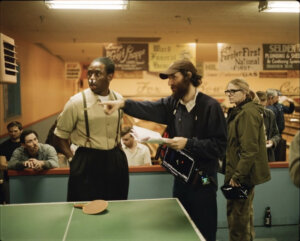
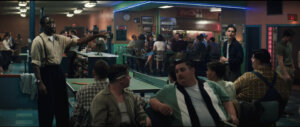
Roger, the reigning hotshot at a humdrum bowling alley, features in two scenes. In the first, he’s goaded into wagering $40 against Marty, who’s feigning amateurism, and loses. He reappears a few minutes as Marty fills up at a nearby gas station, realizing he was hustled by the reigning American champion; he and his pals want their money back.
Walking into the converted Bowlero where they shot the first scene, Simon was floored by the set. “Each individual looked like they were from the 1950s, and yet their outfit was distinctly their own,” he recalled. Miyako Bellizzi, the costume designer, had fitted him in a striped button-up and faded blue work pants; Simon’s hair was slicked back and to the side.
He hadn’t met Safdie before he got to set, and his cues from the Uncut Gems co-director were limited.
Over the course of his scenes, there were times when he wasn’t sure he was doing what Safdie wanted. Here, it was his inexperience that Simon drew on. “I kept reminding myself that I was cast for a reason, and I was cast as a non-actor for a reason,” he said, “and what I’m bringing to this experience is inherently different than what a trained actor would be. Therefore, if I were a trained actor, I would not be what Josh was looking for in the scenario.”
He didn’t have too much time to banter with the film’s stars during the shoot; most of his time on set was spent with other bit-players. But when the camera was shooting other actors, Safdie wanted to keep the sound of live table tennis in the background, so he had Chalamet and Simon play each other off-camera.
As to who had the upper hand? “We’re probably about even,” Simon said.
Jewish mythmaking
Even after the shoot, Simon couldn’t quite believe it was real. He told almost no one outside his family, superstitious that the scene would get cut. But then the premiere arrived. “It was surreal,” he said.
He’s now seen the film nine times — yes, all the way through — indulging friends who want to see it with him. And his acting has won some praise, with one X post calling it an “incredible underrated performance” liked more than 2,000 times.
Simon likes the movie, if you couldn’t tell, echoing its director and star in calling it a love letter to New York. The film, Simon said, touches on Jewish identity in a way that reminds him of his own family and their experience in this country.
“The way in which it captured intergenerational relationships in Jewish homes in post-war America, in New York specifically, felt very autobiographical for the way that my relatives talked amongst each other,” he said. “There’s a love there that transcends.”
As a Holocaust educator, Simon felt the movie handled that theme appropriately. He found the honey scene — an Auschwitz flashback too intense to explain here — moving, and the Holocaust humor tactfully dispatched. He loved the yiddish.
Yet Simon still couldn’t wrap his head around his own involvement in such a fitting project. His work passing on the history and memory of the Holocaust to future generations was already meaningful before he got an IMDB page.
“So to be cast in a film and have a speaking line,” he said, “and it just so happens that that film is also this incredibly Jewish film — which has direct references in the scene at Auschwitz — is equally bizarre, but also really beautiful, and oddly perfect.”
The post He works at a Holocaust museum by day. How’d he end up in ‘Marty Supreme’? appeared first on The Forward.
Uncategorized
The original anti-Zionists have been all but forgotten. Molly Crabapple wants to change that.
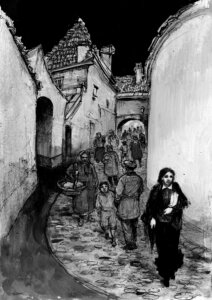
I first met nationally acclaimed artist and journalist Molly Crabapple in 2020 during the dark days of COVID. After discovering that we had both studied Yiddish at YIVO, albeit in different classes, we did a socially distanced fresh-air visit to Mt. Carmel, the Jewish cemetery in Queens where Sholem Aleichem is buried. Many tombstones there are inscribed not in Hebrew but in Yiddish. They include the graves of people who, in life, belonged to the Bund.
Founded in 1897 in Eastern Europe, the Bund was a socialist revolutionary group whose name, translated from Yiddish to English, is General Jewish Labor Union (“bund” is Yiddish for union). By the 1930s, Bundism in Poland, where most Ashkenazic Jews lived, had grown bigger and more politically powerful than Zionism. The group was a tireless promoter of Yiddish as the linguistic and literary underpinning of Jewish peoplehood. Bundists also fiercely opposed Zionism and a Jewish state; they believed in fighting for democracy and inclusion in the countries where Jews already lived.
The organization ended up being destroyed not just by the Nazi Holocaust but also by Stalinism. Except for people like me, who’ve been ensconced in the Yiddishist world, it is nearly forgotten today by all but a few academics. But by the time we met, Crabapple was writing a book about the Bund.
Almost six years later, she has finished it. Titled Here Where We Live is Our Country, it is part hefty historical documentation, part loving family memoir, and part literary nonfiction. Thoroughly engaging throughout, it moves back and forth from the author’s lefty-artsy life in contemporary New York City to earthshaking events in vintage Jewish Europe. Crabapple has disinterred the memory of a once-vibrant movement that waned even as its nemesis, Zionism, waxed.
I met her last month in her fifth-floor walkup apartment in Williamsburg to talk about how she made her book. Our conversation is edited for length and clarity.
Here Where We Live devotes significant space to the saga of your great-grandfather, Sam Rothbort. As a young man in 1904, he immigrated from the Pale of Settlement to New York City, under somewhat murky circumstances that he barely discussed after the move. In America, he made a living as a self-taught artist, including on a dairy farm in the Catskills, an egg farm in Long Island and in a big house near Sheepshead Bay in Brooklyn. But he died over a decade before you were born. When did you first realize he’d been an interesting guy who you wanted to tell the world about?
I was fucking born knowing he was interesting! My mother and my great-aunt and my dad told me about him constantly. I was surrounded by his paintings and stuff that he said. After he died, my great-aunt Ida still lived in his house. As a child, I would visit and it was exactly like when he was alive. I remember the pigments and oils still on the palette in the basement.
How did you find out he’d been in the Bund?
I’d always known he was involved in something illegal before he came to the United States. It was a cool family anecdote. In a book from 1952 that he published about his art, he wrote that as a teenager and young man he hadn’t known much about girls because “I was in the underground.” Another book, a catalogue of his art from a show, said he’d been in the Bund. My mom had a million of those catalogues in a bookcase, and I’d been looking at them since I was 11 or 12 years old. I also saw one of his watercolors, of a woman throwing a rock. He’d titled it “Itka the Bundist Breaking Windows.”
I had very little idea then of what “the Bund” was. But as an adult, one of my bad habits has been that sometimes when I get drunk, I Google things. That might be how I first understood.
From his own unpublished writing, you later found evidence suggesting that Sam might have fled to America at age 22 because he’d joined other Bundists in shooting a Tsarist policeman during a state-encouraged pogrom. You also read the yizkor book for Volkovysk, a town in what is now Belarus. It was Sam’s hometown. He is cited in the book as having helped produce its chapter about the Bund.
Look at this! [She walks me to her bedroom and points to an antique photograph on the wall.] When I was younger I’d always only thought of this as a very cool old picture that my mom had. But this same photo is in the yizkor book! It says it’s the members of the Volkovysk Bund in 1905. It’s Sam’s friends a year after he left for America. Look at this guy in the photo — he’s hot! Which one do you like the best?
The blonde.
Ugh!
I got really obsessed trying to track down these guys. When I went to the cemetery where my great-grandfather is buried I saw the tombstone of one of them. Later, in a box of family memorabilia, I found a photo of this same person in an old Yiddish news clip about people in New York City who were in the Workmen’s [now Workers] Circle’s Volkovysk branch. I asked the cemetery who was paying to maintain the grave. It was this guy’s grandson. I contacted him and he said his own father was still alive but very old. “Can you just ask him to look at this photo and see if that’s his dad?” I asked. I said I was writing about a revolutionary group. He says, “My grandfather never would have been involved in that! He was a truck driver.” And he hung up.
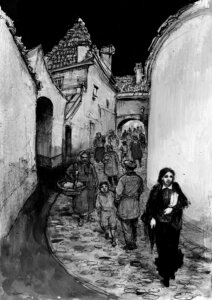
Why couldn’t the grandson entertain this history about his grandfather? Why did he not know it?
The Bund was an organization incredibly devoted to Yiddish language and literature. But it was also a socialist revolutionary political party. One thing I’ve noticed about how it has been written about is that certain things are de-emphasized and certain things emphasized. In the 1950s in the U.S. in the McCarthy years, Bundist survivors of the Holocaust were terrified they would be accused of being Communists, and deported. They had no faith that Americans would know the difference between a socialist and a communist. I think that sometimes the Bund’s’ Yiddishism is emphasized far more than the fact that they were revolutionaries. To focus on linguistic and cultural things is safe. To talk about revolutionaries as internationalists — and as people who always opposed Zionism — is dangerous.
Were you raised Jewish?
My father is Puerto Rican and a Latin American studies professor who’s a Marxist. He told me about Marx’s theory of surplus value when I was 6 years old. I’ve been a leftist in a leftist family all my life! My mother — Sam’s granddaughter — is very strongly culturally Jewish. When I was a child we’d do Hanukkah lights, and she made the best latkes. We were not religious, but I identify strongly as a secular Jew. I studied Yiddish in order to do research for the book. I’m not so good at Yiddish, but I can work my way through a socialist text using a dictionary.
I remember when we were at the cemetery and you were so excited about having just discovered that the political work of some Bundists in Poland was armed self-defense. They fought in militias, with their bodies and with weapons, to protect Jews from murderous pogroms, murderous Communist Party violence against socialists, and, finally, murderous Nazis. You called these militia members “thugs.”
I loved them!
You mentioned their resistance in a piece you wrote in 2018 for the New York Review of Books about the organization. I’ve heard that many people were astounded and very happy to learn about this self-defense and to discover the Bund.
Especially young Jews, like in their 20s. They had no idea that Jews had fought back in Europe even before the Holocaust, or they had only vague ideas about the Warsaw Ghetto uprising and that Bundists played a major role in it. It was very meaningful for them.
So much for the idea that only Zionists have been modern Jewish fighters.
Zionists have tried to say that they were the only tough Jews. Which is utterly untrue.
What do you think is most original about your book?
It’s very concerned with the emotional life of being in a movement. I think that sometimes the way that leftist movements are written about is as a series of conferences and decisions that are written down as texts, and people sign onto a resolution because that’s what they are thinking. The writing doesn’t show any awareness of emotional life. The love affairs, the gossip, the beefs that are going on, the thrill of thinking that you can change the world. I was much more concerned with that.
And as I worked on the book I quickly realized that I wasn’t just writing about the Bund. I was writing a history of the 20th century from the point of view of the defeated. The work was a form of necromancy. I would go to people’s graves and take dirt, and light candles in front of it and try to ask them if I could tell their story. At Ponary Forest, [near Vilna, where at least one prominent Bundist leader, a woman, was massacred by the Nazis in World War II and dumped into a mass pit] I went to the bottom with flowers and played Di Shvue [Yiddish for “The Oath,” the Bund’s anthem] on my phone.
What do you mainly hope that your book will accomplish?
I want leftists to know about something from our shared international history as leftists. I want young Jews to get to know their ancestors.
The Bund was anti-Zionist, of course, and many young American Jews are now also rejecting Zionism.
Yes. A lot of them were sold a bill of goods about their history, and when they reject that bill of goods, there’s a big hole in them. They don’t have any actual, positive Jewish history. They just have shit they’re ashamed of, because they realize [that Zionism] was actually a history of ethnic cleansing and apartheid. One of the things my book does is give them ancestors.
I’m an anti-Zionist. Whenever you have an ethnostate project, it always does unspeakable crimes. If Jewish institutions in America keep conflating Jews here with a state that is doing a livestreamed genocide and is now primarily known for the most heinous shit possible, it’s extremely dangerous for us Jews, as a small minority in America.
Some people internationally have been starting new Bund groups. What future do you see in that? And can you imagine Yiddish being resurrected as a secular Jewish language?
It’s hard to imagine huge numbers of people adopting Yiddish. But I think about a Jewish literary figure in the 1930s whom Isaac Deutscher quotes in his book The Non-Jewish Jew. He said that Yiddish was a dying language. But he didn’t mind, because Greek and Latin are dead languages, yet many people study them anyway, to access their linguistic treasures. And God bless everyone who’s doing leftist, anti-Zionist organizing and cultural work reclaiming our heritage! But is there a future for the Bund? The thing I’ve learned both from reading history and being a participant is, you never know what the spark is going to be. So you should always avoid making prognostications.
The post The original anti-Zionists have been all but forgotten. Molly Crabapple wants to change that. appeared first on The Forward.
Uncategorized
Georgia political candidate apologizes for Passover ad that featured challah

(JTA) — When readers of the Atlanta Jewish Times opened their Passover edition last week, they saw something surprising: a fluffy challah.
The leavened bread, forbidden for Jews to consume during the holiday, appeared in an ad placed by Nathalie Kanani, a candidate for state Senate in a Metro Atlanta district.
“Have a blessed Passover,” the ad said, over an image of a challah draped in an Israeli flag alongside two towering candles. “Wishing you a Passover rich in divine love and blessings.”
The ad quickly drew ridicule online, particularly after Greg Bluestein, a Jewish Atlanta Journal-Constitution reporter, tweeted about it on Saturday, writing, “It’s the thought that counts, I guess.”
That night, Kanani issued an apology, calling the inclusion of challah in the ad “an oversight that should not have happened” and saying that her campaign was instituting new processes to prevent similar snafus in the future.
“My intent was to honor our Jewish neighbors and friends. We are all human, and even with the best intentions, honest mistakes can happen,” she wrote. “I believe in meeting those moments with grace and using them to bring people of different cultures together, not tear them apart.”
Kanani added, “While this content was created by a consultant working with my campaign, I take full responsibility for everything shared in my name. We are implementing stronger review processes to ensure this does not happen again. As always, my campaign stands for inclusion, respect, and bringing all people together.”
The incident is also spurring potential reforms at the Atlanta Jewish Times. “The ad should not have passed proofing checks,” Michael Morris, the newspaper’s owner and publisher, wrote in an email to the Jewish Telegraphic Agency on Sunday.
Kanani’s apology earned the Democrat dozens of supportive comments on Facebook — as well as constructive criticism that highlighted the complexity of Jewish American identity.
“We all make mistakes and learn from the[m],” wrote one man. “If you want to honor your Jewish neighbors, however, you might also want to rethink using a foreign flag. While many (though not all) of us, myself included, feel close ties to Israel (if not its government and policies), American Jews are Americans, not foreigners.”
Another woman offered an opposing take. “If you want to reach out to the Jewish community then you need to hire a Jewish consultant for Jewish content. Not only was the picture a big gaffe that you are undoubtable being mocked relentlessly for, but the wording sounds Christian,” she wrote. “But I do appreciate the Israeli flag.”
Kanani’s ad is not the first Passover bread to ignite a social media firestorm: The sight of leavened bread at Christian seders, which have surged in recent years, has generated sharp criticism in the past.
Unlike the Christian seders, which are widely denounced as appropriative, Kanini’s ad also elicited appreciation at a time when antisemitism is making many American Jews feel insecure.
“Unpopular opinion: we shouldn’t dunk on non-Jews who are trying to be nice to Jews,” tweeted David Greenfield, the head of a Jewish anti-poverty organization in New York City.
Kanani is a former prosecutor who is running in the May primary against Kevin Abel, who says his values are rooted in his identity as a South Africa-born Jew whose grandfather escaped Nazi Germany. Abel has chaired the American Jewish Committee’s local antisemitism task force.
Esther Panitch, a Jewish member of the Georgia House, urged her followers to back Abel when criticizing Kanani’s ad.
“Bless her heart, someone put challah in a Passover ad. This candidate wants to be my senator,” she tweeted on Saturday. “As the only Jewish member of the Georgia General Assembly, I am available for holiday consults — or you could just consider a candidate who knows the difference, whose ad is just a few pages after this one.”
After Kanani’s apology, Panitch said she had heard from Kanani’s campaign.
“I appreciate Nathalie Kanani’s campaign reaching out and taking responsibility for the challah-in-a-Passover-ad mix-up,” she wrote on Facebook. “Mistakes happen. What matters is how you respond, and she responded with grace. This is how we build understanding across communities. My door is always open for holiday consults.  “
“
This article originally appeared on JTA.org.
The post Georgia political candidate apologizes for Passover ad that featured challah appeared first on The Forward.
Uncategorized
4 killed in Haifa strike as Trump issues ‘you’ll be living in Hell’ ultimatum to Tehran
(JTA) — Four people — including a couple in their 80s — were killed when an Iranian missile crashed into their home in Haifa on Sunday, in the latest direct strike in the month-old U.S.-Israeli war with Iran.
The missile was not intercepted because it had broken off from a larger munition, determined Israeli authorities, who said the people killed were not in their building’s bomb shelter at the time of the strike.
The strike brings the civilian death toll in Israel to 18 as uncertainty reigns about the future of the war, with U.S. President Donald Trump threatening multiple times over the weekend to pummel Iran imminently if it does not reopen the Strait of Hormuz to oil shipping imminently.
“Tuesday will be Power Plant Day, and Bridge Day, all wrapped up in one, in Iran. There will be nothing like it!!!” Trump wrote on Truth Social early Sunday. “Open the F–kin’ Strait, you crazy bastards, or you’ll be living in Hell – JUST WATCH! Praise be to Allah. President DONALD J. TRUMP.”
Iran offered no indication that it would meet Trump’s deadline, which comes as the president has extended previous deadlines for action by Tehran. A top Iranian official said the regime would respond “crushingly and extensively” to further attacks on civilian targets, including power plants and bridges. And a spokesman for the foreign ministry responded to questions about a reported framework for a ceasefire by saying, “Negotiations are in no way compatible with ultimatums, crimes, or threats of war crimes.”
The sparring comes after a dramatic weekend in the war. U.S. forces rescued an airman whose plane had been shot down during a commando raid in rural Iran, while Israel said it had killed the intelligence chief of the Islamic Republic Revolutionary Guards during a strike on an office building in Tehran.
This article originally appeared on JTA.org.
The post 4 killed in Haifa strike as Trump issues ‘you’ll be living in Hell’ ultimatum to Tehran appeared first on The Forward.