



Uncategorized
How a search for my Jewish Chicago led me to the Forward – and back home again
When I headed to New York for college, I knew I’d be leaving behind my peach-colored bedroom, Thursday nights watching Hill Street Blues with my parents and our cat Shayna, and the Belden Deli. But I didn’t realize that I would also be leaving behind my Jewish Chicago – and beginning a decades-long search to rediscover it.
At first I didn’t notice what I was missing, since I was focused mostly on what I was gaining. But over the years, I felt a quiet yearning that came back to me last week while sitting on a deck overlooking a cornfield in Sterling, Illinois, eating Leonard’s coffee cake with Margo Jakobs, whose son Nik is building a synagogue nearby, with a center to teach tolerance in honor of the family’s Holocaust history.
I was visiting the Jakobs family and farm as the Forward’s new editor-in-chief and chief content officer, and as the editor of a series of stories by Benyamin Cohen, who brought me to Sterling and has been writing about the family’s journey for more than a year. But I realized, in that moment, I was also there, unexpectedly, as a Chicagoan, who could taste my childhood in the sweet welcoming crumble on top of the coffee cake.
The Jewish Chicago that nurtured me wasn’t all lox boxes on Sunday mornings and Sam & Hy’s, but food was a focal point. My family didn’t go to temple regularly or observe Shabbat. We were light on ritual, heavy on schmaltz, with a container of it in the refrigerator at my grandparents’ home. But what we lacked in observance, we made up for in Yiddishkeit.
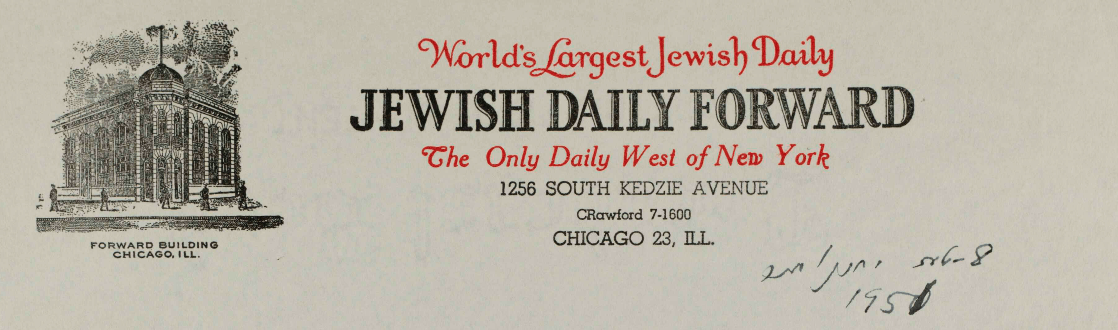
The Joys of Yiddish, Exodus, and The Jews of Chicago sat on our bookshelves just as the Forward sat in my grandparents’ home on Chicago’s West Side. The Forward’s Chicago paper was one of the larger local editions we published, with a building in my dad’s childhood neighborhood, not far from his high school, from the 1930s through early ‘50s.

After my dad and his five siblings left home, moved to the suburbs (Wilmette for us) and had children of their own, we gathered for Passover in West Rogers Park at my Aunt Shirley and Uncle Jack’s. The Seder was long, but after we avoided the gefilte fish and found the afikomen we would flee either upstairs to my cousin Suzy’s room to look at her books or downstairs to the basement to watch older cousins play pool or ping-pong until it was our turn. My Jewish Chicago was family. And a sturdy kind of faith that didn’t ask more of us than we could give.
We eventually moved from Wilmette into the city, where a very good friend – who played Golde in our high school production of Fiddler on the Roof – introduced me to a new Jewish world during Simchat Torah at Anshe Sholom on Melrose, next door to what was then the Lincoln Park/Lakeview JCC, where I went on to work as a camp counselor for several summers.
By the time I went to college, I was committed to learning Hebrew, davening regularly, and exploring a new Jewish landscape. But four years of Zabar’s and life on the Upper West Side did not make me a New York Jew. Living in North Carolina – even working at our synagogue there – didn’t make me a southern Jew. And living in Florida, with its ready supply of Vienna hot dogs, just made me miss Chicago – and long for a deli that served kishke, half-sour pickles, and hard salami.

It wasn’t until I was back in Chicago for work a dozen years ago that I began to understand what I had been missing. While I was in town for a journalism conference, my cousin Michelle took me to Mishkan Chicago for Rosh Hashanah. It was there that I found the Jewish soul of my family, the Jewish joy of my first Simchat Torah, and the Jewish heart of community.
In the years that followed, I, like so many people, explored Jewish life online. My husband and I joined Shabbat and holiday livestreams from our home in Virginia, watching services at synagogues across 35 states, including Mishkan Chicago once the pandemic made that possible. Mishkan began livestreaming weekly, and their morning minyan became a daily habit. My Jewish Chicago had come to me.
I also inched closer to it when I began talking with Jodi Rudoren and Rachel Fishman Feddersen in 2020 about joining the Forward. The more Jewish my life was becoming, the more important it felt to align my professional and personal commitments. After Oct. 7, it seemed particularly urgent. In June 2024, I became the Forward’s managing editor for audience.
There have been many moments since when I’ve felt grateful to be doing this work. One of the best bonuses has been to work alongside our Executive Editor Adam Langer (coincidentally, he’s editing this column), whose name I first knew not from the Forward, but as the author of Crossing California, one of the books that captures my Jewish Chicago best. He indulges my nostalgia – and fact-checks my memories – about the Chicago that once was. (Editor’s Note: Though Wilmette is located north of Chicago, true Chicagoans do not consider it part of the city.)
Last week, Benyamin and I and the Jakobs’ went from Sterling to Glencoe, for a public conversation with Margo and Nik about resilience, family and community. I was back in my Jewish Chicago again, and it felt like home.
The post How a search for my Jewish Chicago led me to the Forward – and back home again appeared first on The Forward.
Uncategorized
This 90-year-old Jewish performer and promoter is the Zelig of folk music
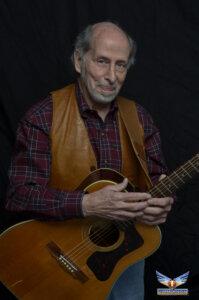
Harry Tuft was in a taxi with Judy Collins, who had her guitar with her. The cab driver looked back and asked if the two of them were folk singers. They replied in the affirmative.
“Folk music is dead,” the cab driver asserted.
“We kind of chuckled a little and said, ‘Oh, really, how come?’” Tuft recalled.
“Did you see Ed Sullivan last night?”
The passengers replied that they hadn’t.
“There was a group on there called The Beatles. Folk music is dead.”
To paraphrase Mark Twain, the reports of the death of folk music were an exaggeration.
“That was a time when, really, we didn’t know what was going to happen,” Tuft said during a recent Zoom interview from his home in Denver.
“I think it’s thanks to groups like Peter, Paul and Mary and maybe somebody like Joan Baez and Judy Collins and John Denver — people who were popular enough and smart enough to appeal to a larger segment of the population. They really kept folk music alive.”

The genre lived on, also, thanks to the efforts of the now-90-year-old Tuft, who was more than a bit player in the folk music revival during the 1960s. He founded the Denver Folklore Center in 1962 and, with others in 1979, founded the Swallow Hill Music Association, which presents concerts, teaches music classes for all ages and offers outreach programs. In 2012, Tuft was inducted into the Colorado Music Hall of Fame.
Tuft was also a link in the chain that led to Bob Dylan meeting the Beatles. He also may be the only nonagenarian who released an album this year.
“Friends, Lovers & Other Strangers” includes songs by artists like Bob Dylan and Paul Simon, as well as ones by some of Tuft’s friends. It also includes a cover of the Nat King Cole Trio’s “Nature Boy.”
“I grew up in Philadelphia listening to pop music of the day on radio stations WPEN and WIBG, and R&B stations at night,” Tuft writes in the album’s liner notes. “This song was popular across the board.”
Tuft’s paternal grandfather, Dr. Jacob L. Manasses, was the founder of Bushkill Farms Camp, a Jewish boys camp in the Pocono mountains. Tuft went to Indian Lake, another Jewish camp in the Poconos. A counselor at his camp played the ukulele. Tuft, who played piano and clarinet, soon acquired a ukulele. “I found out there was such a thing as a baritone uke and it turns out that the tuning of the baritone is the same as the four highest strings of the guitar, so I was already two-thirds of the way to a guitar,” he said. “It was very customary in those days for Jewish kids somewhere in their college years to go to Europe so I bought a Chimes guitar and carried it with me.”
Tuft intended to become a doctor like his father and paternal grandfather. But his grades weren’t good enough to get into medical school. Instead, he graduated from Dartmouth in 1957 with a degree in philosophy. He went to graduate school for architecture at the University of Pennsylvania with thoughts of being a city planner.
“But music won out,” said Tuft.
While at Dartmouth, Tuft met Pete Seeger at a folk club. Seeger met with the club members in the afternoon and performed that night.
“He was really intent on getting us as a group to go out into the community and see if we could find people who had songs to offer. He arrived in a blue Plymouth station wagon with his kids on a mattress in the back. His wife, Toshi, set up a display in the hall and sold Pete’s Folkways Records after the concert. Here was this icon, this important person in my musical life in the moment, and he was just getting along,” he said.
“He requested a large log, and did a song called ‘Didn’t Old John (Cross the Water).’ It included a place to swing the axe. Unfortunately, the podium was very slick and Seeger ended up chasing the log all over the ‘stage.’”
After graduating from Dartmouth, Tuft joined the growing folk music scene that was centered around the Gilded Cage in Philadelphia. There, he met his lifelong friend Dick Weissman, a banjoist and guitarist who was in the Journeymen with John Phillips, who would go on to found the Mamas and the Papas.
Tuft eventually ventured out to Colorado, where he auditioned at The Exodus, a Denver folk club.
Tuft was told about the owner: “If he was going to hire you he would be critical and if he was not he would be nice to you. And he was nice to me, so I knew that I wasn’t going to get a job there.
“I had a repertoire that was out of the ordinary, and I was never really attracted to the ‘quote’ popular folk songs,” Tuft said. “As a matter of fact, when it came to trying to make a living playing in the bars what they wanted to hear were the popular songs by the Kingston Trio or Peter, Paul and Mary or the Brothers Four, and I didn’t know those songs.”
“I’m a sucker for a story, I’m a balladeer. I love ballads. Quite often, I do ballads of 10, 12, 14 verses because I like the form so much.”
The Exodus owner said that he thought someone could make a part-time living opening a folklore center like Izzy Young’s Folklore Center in Greenwich Village. “I sometimes joke and say that he was right. I opened a full-time folklore center in order to make a part-time living.”
Tuft also sold records, instruments, strings and accessories and it was the strings and accessories that paid the rent.
The shop became a way station for up-and-coming folk musicians traveling between Chicago and the West Coast. When Bob Dylan made his first cross-country tour and played in Denver, he had his mail forwarded to Tuft’s store.
“Even then, he had an attitude about him,” Tuft recalled. “The following summer I saw him at the Kettle of Fish in the Village, and he grudgingly acknowledged that we had met.”
After a visit to Chicago’s Old Town School of Folk Music, he started a school for Denver musicians and soon branched out into promotion. His first job was for Joan Baez who sold out a 2,400 seat house in March 1964.
Baez was involved with Dylan at that time and wanted to get him to meet The Beatles, who were playing Red Rocks on August 26. Baez was scheduled to play at the venue a couple days earlier, so a plan was hatched for her to come out a few days early so that she could meet the lads and arrange for them to meet Dylan in New York, where The Beatles were going after Denver.
The day before The Beatles’ show, Tuft and Baez went to see A Hard Day’s Night. The musicians met before The Beatles show and Tuft recalled that Baez and the band members were deferential to one another. Except for Ringo, who wasn’t interested and was reading a comic book.
Tuft also brought the Mamas and the Papas to Denver’s Municipal Auditorium Theater with 7,600 seats in 1966. Richard “Dick” Lamm, a friend and lawyer, fronted him $5,000 for the guarantee. Lamm later admitted that he had absolutely no idea who the Mamas and the Papas were. “That showed the amount of trust he had in me,” Tuft said. “And he said he was nervous until a week before the concert until they were on the cover of Life magazine.” Lamm used his profits to fund his first run for the Denver statehouse.
Later, John Denver offered his services for a benefit Tuft organized and helped raise more than $40,000 for Lamm’s successful run for governor.
Folk music endures, Tuft said, “because the best of folk music involves music. And the best of music is melodic. And whatever it is in our physical makeup that involves not just the heartbeat, which is our basic rhythm, but something about our voice, maybe, and the way we speak and our desire to communicate that all put together leads to somebody creating a song about something that happened, and if the kernel of it, either the music or the words, or both are such that people like it and repeat it and you get musical history, and history of countries and our country in particular, of the songs.”
Tuft is already putting together his next album — a double album of cowboy and western songs, traditional on one side and contemporary on the other.
“I’m a song addict,” Tuft said. “And I like to think that I have pretty decent taste in songs. Nothing pleases me more than to be able to find a new song, make it my own, and pass it on and open it up to whatever audience I’m able to bring together.”
The post This 90-year-old Jewish performer and promoter is the Zelig of folk music appeared first on The Forward.
Uncategorized
Israel has a lot riding on Nvidia, whose CEO resigned today

Jensen Huang, who co-founded Nvidia and has run it for 33 years, resigned as chief executive on Thursday, ending a tenure that turned a maker of video-game chips into the engine of the artificial intelligence boom. The decision followed revelations of an affair with a businesswoman whom U.S. intelligence officials suspect of being a Chinese spy, and allegations of a second relationship, with an executive who reports to him.
Colette Kress, Nvidia’s chief financial officer, will serve as interim chief executive while the board searches for a permanent successor.
The turmoil is a Silicon Valley story with a significantIsraeli subplot. Nvidia employs roughly 6,000 people in Israel, including on 18 floors of office space in a Tel Aviv skyscraper. Israel is home to the company’s largest R&D hub outside of the U.S. As well, Huang has been the driving force behind a plan to build a giant new campus in the country’s north. Huang has courted Israel for years, and the open question now is what happens to that commitment without him.

Nvidia’s Israeli business traces back to 2019, when it agreed to buy Mellanox, an Israeli chip company, for $6.9 billion. Mellanox made the technology that lets thousands of chips in a data center work together as one machine. That technology is now central to how AI data centers are built.
Huang kept Mellanox in Israel, along with its patents and its sales. The Israeli teams’ work is now woven into Nvidia’s newest products, and includes building a chip meant to rein in AI tools that act on their own.
In the second quarter of 2026 alone, Nvidia’s Israeli operation booked $17.5 billion in sales, nearly a fifth of the company’s worldwide revenue and more than four times the sales of Teva Pharmaceuticals, the multinational Israeli drugmaker. Analysts credit Nvidia with largely driving a 13% jump in Israeli tax revenue, and its workforce there has roughly doubled since Oct. 7, 2023.
A personal stake
Huang’s attachment to Israel is not purely commercial. On Oct. 7, Avinatan Or, a chip engineer at Nvidia’s Israeli operation, was captured at the Nova music festival along with his then-girlfriend, Noa Argamani, in a video seen around the world. She was rescued eight months later. Or remained a hostage for 738 days.
Nvidia colleagues held vigils with his mother, Ditza, and Huang stayed in touch with the family throughout. When Or was freed in Oct. 2025, Huang wrote to employees that “Avinatan has come home.” Huang later hosted Or and Argamani at the company’s headquarters in California. This March, as the war with Iran broke out, Huang told Israeli employees that he was “very worried” about them.

Huang has called Israel a “second home” for Nvidia.
That attachment is intended to last. In December, Nvidia announced plans for a campus in Kiryat Tivon, near Haifa, reportedly second in size only to its Silicon Valley headquarters. Construction is set to begin next year, and the offices are expected to open by 2031, with room for up to 10,000 employees.
What lies ahead
The next CEO has become a question in Israel, too. Kress, 59, has been Nvidia’s finance chief since 2013. The board says it will look both inside and outside the company for a permanent chief executive.
Haaretz speculated Thursday that two Israeli executives could be potential candidates. Both men studied at the Technion in Haifa. Michael Kagan, who was born in St. Petersburg, Russia and moved to Israel with his family after high school, co-founded Mellanox in 1999 and has been Nvidia’s chief technology officer for six years. Johny Srouji, born in Haifa to an Arab Christian family, joined Apple in 2008 and now leads its hardware work, including the chips inside its products.
Nothing so far suggests Nvidia’s plans in Israel will change. The Israeli teams work on products the company depends on, and the new campus has long been in the works.
Nvidia’s stock has fallen by about a third since early October, a loss of more than $1.5 trillion in market value, and the company is due to report earnings on Nov. 17. The numbers will matter in Israel. So will something they can’t show: whether Nvidia’s affection for the country outlasts its last CEO.
The post Israel has a lot riding on Nvidia, whose CEO resigned today appeared first on The Forward.
Uncategorized
I. B. Singer predicted the war between Fascism and Communism
יצחק באַשעװיס איז אַרײַן אין דער ייִדישער ליטעראַטור אין 1925, װען ער איז געװען בלויז 21 יאָר אַלט. אַז ער איז באַרימט געװאָרן אין אַמעריקע, האָט ער ניט געלאָזט איבערדרוקן אָדער איבערזעצן זײַנע פֿריִערדיקע װערק, װאָס זײַנען דערשינען אין ייִדישע צײַטשריפֿטן אין פּױלן.
לעצטנס האָט מען זײ אָבער אָפּגעזוכט און איבערגעזעצט אױף ענגליש אונטערן קעפּל „אױפֿן עולם־התּועה“. די דאָזיקע אױסגאַבע איז אַ קאָלעקטיװער אױפֿטו פֿון אַ גאַנצער גרופּע רעדאַקטאָרן און איבערזעצער, אַרײַנגערעכנט דניאל קענעדי, יאַן שװאַרץ, ראָזע װאַלדמאַן, אַגניעשקאַ לעגוטקאָ און אַנדערע.
אין זײַנע דערצײלונגען פֿון יענער תּקופֿה מאָלט באַשעװיס אַ ברײטן לײַװנט פֿון ייִדישע צרות אין דער נײַ־אױפֿגעקומענער פּױלישער רעפּובליק. כּמעט אַלע העלדן זײַנע זײַנען יורדים, װאָס שלאָגן זיך מיט די ביטערע עקאָנאָמישע באַדינגונגען און פֿאַלן נאָך טיפֿער אין יסורים און נױט.
גימפּל בעדנער, דער העלד פֿון „אױף דער עלטער“, איז אַ מאָל געװען אַ װאַסערטרעגער, אָבער איצט האָט ער מער ניט קײן כּוח פֿאַר אַזאַ אַרבעט. די אײנציקע שטיצע זײַנע קומט פֿון זײַנע טעכטער, װאָס האַלטן אַ שאַנדהױז. קײן סך אָרט איז דאָרט ניטאָ, מוז ער נעבעך ליגן אין דעם אײגענעם בעט, װוּ זײַן טאָכטער „באַדינט אירע געסט“.
דוד סװירסקי, דער העלד אין „צוריקװעגס“, קערט זיך אום קײן פּױלן פֿון ארץ־ישׂראל. אַן אַמאָליקער ציוניסט, איז ער אַנטױשט געװאָרן אינעם ציוניסטישן חלום און מיד פֿון זוכן „עבֿודה“ בײַ די חלוצישע ייִשובֿים. אָבער קײן מזל אין דער אַלטער הײם האָט ער ניט. זײַן פֿאָטער שיקט אים אַװעק, און מיר געזעגענען זיך מיט אים װען ער לאָזט זיך זוכן גליקן בײַ זײַן מאַמעס משפּחה אין אַ פֿאַרװאָרפֿענעם שטעטל.
באַשעװיס מאָלט אַ רײַכע פּאַנאָראַמע פֿון ייִדישן פּױלן נאָך דער ערשטער װעלט־מלחמה. אים זײַנען גוט באַקאַנט סײַ די אָרעמע ייִדישע גאַסן פֿון װאַרשע סײַ די װײַטע פֿאַרװאָרלאָזטע שטעטלעך. ער לאָזט דעם לײענער ממש שמעקן דעם ריח פֿונעם ביטערן דלות און ייִאוש. עס איז ניטאָ קײן נס װאָס קען ראַטעװען זײַנע העלדן פֿונעם ביטערן גורל.
די אַלטע סטאַבילע װעלט אונטער דער שליטה פֿון די מעכטיקע אימפּעריעס, דער רוסישער און דער עסטרײַך־אונגאַרישער, ליגט אין חורבֿות. די נײַע פּױלישע מלוכה איז שװאַך און אָרעם און זאָגט ניט צו קײן צוקונפֿט פֿאַר ייִדן.
אין די װערק פֿונעם װאַרשעװער פּעריאָד פֿון 1925 ביז 1935 דערקענט מען בפֿירוש די השפּעה פֿון י. ל. פּרץ, סײַ אין די פּרטימדיקע, נאַטוראַליסטישע שילדערונגען פֿון די שטעטלעך און סײַ אין די פֿיגורן פֿון כּלערלײ מערקװירדיקע פּערסאָנאַזשן: מקובלים, משׂכּילים, חסידים, ציוניסטן, אַפּיקורסים און סתּם ייִדן פֿון אַ גאַנץ יאָר.
דאָס זאַמלבוך נעמט אויך אַרײַן אינטערװיוען מיט ייִדישע מחברים, װאָס באַשעװיס האָט געמאַכט פֿאַר דער װאַרשעװער צײַטונג „ליטעראַרישע בלעטער“.
הלל צײטלין באַגריסט באַשעװיסן אין זײַן דירה, װוּ ער לערנט חסידות מיט זײַנע תּלמידים. ער האַלט, אַז מחוץ פּרץ, אַנ־סקי און דער נסתּר האָט די ייִדישע ליטעראַטור ניט קײן אמתע דערגרײכונגען. צײטלין באַדױערט, אַז ער מוז ציִען פּרנסה פֿון דער ליטעראַרישער אַרבעט און באַקלאָגט זיך, אַז ער קען קױם קריגן אַ פּאָר גראָשן פֿאַר זײַנע װערק. אָבער פֿאַר לערנען נעמט ער ניט קײן געלט.
מלך ראַװיטש זעט אױס מער װי אַ דײַטש אײדער אַ ייִד, שרײַבט באַשעװיס. אַנשטאָט צו באַגריסן באַשעוויסן מיט אַ „שלום־עליכם“ װײַזט ראַװיטש אױפֿן זײגער, װײַל באַשעװיס איז אַ פּאָר מינוט שפּעט. נאָך אײדער באַשעװיס שטעלט אַ פֿראַגע, הײבט ראַװיטש אָן צו דערצײלן װעגן זײַן ליטעראַרישן װעג. ער גיט באַשעװיסן אַ גאַנצע דרשה װעגן זײַן „אידעאַליסטישן“ צוגאַנג צו ליטעראַטור: די אידײ איז דער עיקר, זי איז די „נשמה“ פֿון אַ קונסטװערק. פֿאַר ראַװיטשן זײַנען די װיכטיקסטע ייִדישע דיכטער פּרץ מאַרקיש און ה. לײװיק.
דער סאַמע לעבעדיקסטער שמועס האָט באַשעװיס מיט פּרץ מאַרקיש. ער כאַפּט מאַרקישן ממש אַ פּאָר שעה פֿאַר זײַן צוריקפֿאָרן קײן סאָװעטן־פֿאַרבאַנד אין יולי 1926. מאַרקיש איז אױפֿגערעגט, מסתּמא ווײַל ער מוז צוריקפֿאָרן, און „שרײַט“ זײַנע ענטפֿערס צו באַשעװיסעס פֿראַגעס.
ליטעראַטור איז פֿאַר מאַרקישן די „לעבעדיקע אָרגאַנישע ענערגיע“ װאָס פֿליסט פֿונעם יחיד צו דעם כּלל און צוריק. ליטעראַטור האָט ניט קײן צװעק, זי איז אַן אײביקער פּראָצעס פֿון װערן.
מאַרקיש טענהט, אַז די רעװאָלוציעס, מלחמות און פּאָגראָמען צװינגען מענטשן צו קערן זײערע פּנימער צו דעם רעאַלן לעבן. און איצט, האַלט ער, קומט די ייִדישע ליטעראַטור נענטער צו אָט דער נאַקעטער װירקלעכקײט.
עטלעכע חדשים נאָך מאַרקישעס אָפּפֿאָרן קײן סאָװעטן־פֿאַרבאַנד האָט זיך ישׂראל יהושע זינגער, באַשעװיסעס עלטערער ברודער, אומגעקערט קיין אַמעריקע פֿון אַ צװײ־חדשימדיקער רײַזע איבער „נײַ־רוסלאַנד“.
לױט זײַן אײַנדרוק, האָט די סאָװעטישע קונסט אָנגעװױרן דעם גײַסט פֿונעם ראַדיקאַלן אַװאַנגאַרד און האָט זיך אומגעקערט צום טראַדיציאָנעלן רעאַליזם. די דאָזיקע טענדענץ איז זינגערן געװען צום האַרצן װײַל ער איז אַלײן געװען אַן אָנהענגער פֿונעם רעאַליסטישן סטיל.
צום באַדױערן האָט דער איבערזעצער דאָ געמאַכט אַ פּאָר גרײַזן אין די נעמען פֿון סאָװעטישע שרײַבער: דער מחבר פֿון „גאַלאָפּ“ הײסט עזרא פֿינינבערג און ניט Feinberg, און איציק קיפּניס איז ניט קײן E. Kipnis. דערצו איז דער ענגלישער אױסלײג פֿון ייִדישע נעמען ניט אױסגעהאַלטן: איזי כאַריקס נאָמען שרײַבט מען סײַ Kharik סײַ Charik.
באַשעװיס האָט פֿאָרמולירט זײַן אײגענעם עסטעטישן אַני־מאמין אינעם עסײ „צו דער פֿראַגע װעגן דיכטונג און פּאָליטיק“, װאָס איז אַרױס אינעם קלײנעם ליטעראַרישן זשורנאַל „גלאָבוס“ אין 1932.
דאָס איז אַ װיכטיקער דאָקומענט אין דער געשיכטע פֿון דער ייִדישער ליטעראַטור, און עס קומט אַ ייִשר־כּוח די רעדאַקטאָרן און דער איבערזעצערין װעראַ סאַבאָ פֿאַר מאַכן דעם דאָזיקן מקור צוטריטלעך אױף ענגליש.
„דער גײַסט פֿון פּאָליטיק האָט אפֿשר נאָך קײן מאָל נישט אַזױ אַרומגעכאַפּט דעם מענטש װי הײַנט. […] די מלחמה צװישן װעלט־פּראָלעטאַריאַט און דעם פֿאַשיזם דערנענטערט זיך. אידעיִש איז די אַרמײ פֿון דער צוקונפֿטיקער װעלטשלאַכט שױן מאָביליזירט.“ אַזױ שטעלט באַשעװיס זײַן דיאַגנאָז דער תּקופֿה, װאָס װעט זיך ענדיקן מיטן חורבן.
באַשעװיס שרײַבט מיט לײַדנשאַפֿט און קלאָרקײט. ער איז אַ שאַרפֿער קריטיקער פֿון ראַדיקאַלע פּאָליטיקער, סײַ די רעכטע פֿאַשיסטן סײַ די לינקע קאָמוניסטן. סײַ די, סײַ יענע „צײלן שױן זײערע סטאַדעס און מ׳באַשטימט יעדן זײַן אָנטײל אין דעם צוקונפֿטיקן בלוטבאָד.“ די פּאָליטיקער פֿאָדערן, אַז אַ שרײַבער זאָל ענטפֿערן אױף דער פֿראַגע: „מיט װעמען גײסטו? פֿאַר װעמען ביסטו?“
אָבער דער קינסטלער, האַלט באַשעװיס, איז בטבֿע אַנדערש פֿון דעם פּאָליטיקער. דאָס איז „דער מענטשן, פֿאַר װעלכן די פֿלײש־אַריטמעטיק פֿון פּאָליטיקער איז פֿרעמד און עקלדיק“.
אַלע עכטע קינסטלער האָבן „אײן בשותּפֿותדיקע אײגנשאַפֿט: זײ האָבן אָפֿענע אױגן צו זען, װי אומגליקלעך דער מענטש איז. דערין באַשטײט זײער טאַלאַנט.“
ער איז געװען בטבֿע אַ פּעסימיסט, װאָס האָט ניט געגלױבט אין גליקלעכע חלומות. די סאַמע געלונגענע פּערסאָנאַזשן זײַנע האָבן ניט קײן מזל אין לעבן, סײַ אין פּױלן פֿאַרן חורבן און סײַ שפּעטער אין אַמעריקע. זײַנע ווערטער אין אָט דעם אַרטיקל דינען טאַקע ווי אַ שליסל צו באַשעװיסעס קינסטלערישן װעלטבאַנעם.
The post I. B. Singer predicted the war between Fascism and Communism appeared first on The Forward.
