


Uncategorized
How the Forward got a cameo in ‘Marty Supreme’
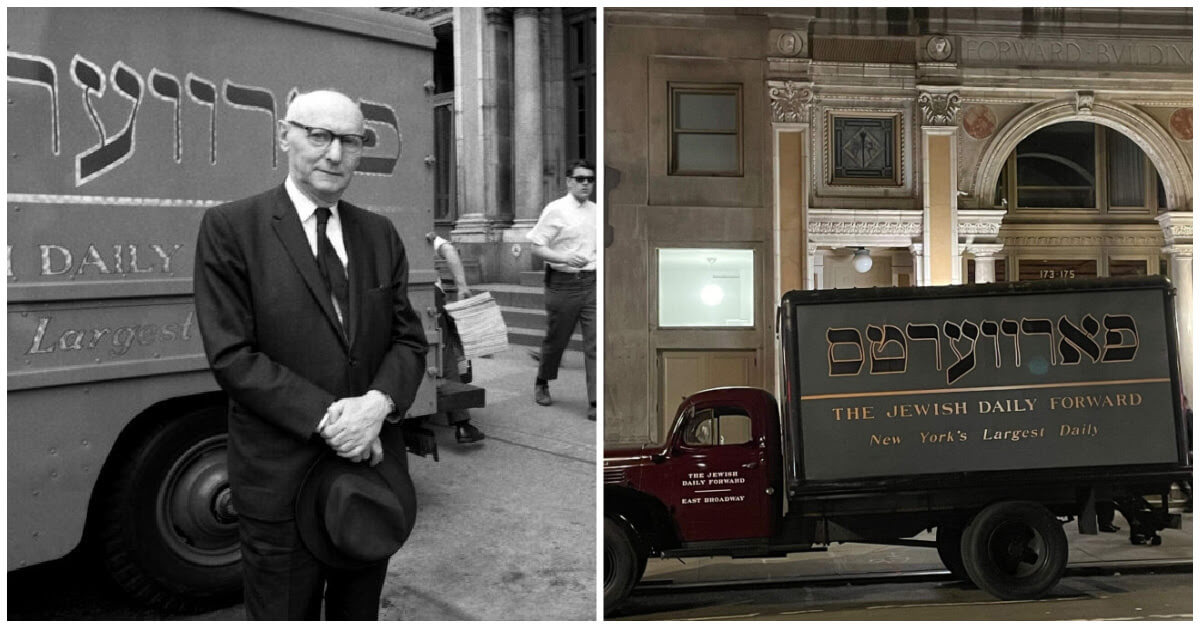
“The challenging thing about any film, for me, is you’re trying to build these worlds, so you’ve got to find the elements,” said Jack Fisk, production designer for Marty Supreme, and regular collaborator with big names including Terrence Malick, Paul Thomas Anderson, David Lynch and Brian De Palma.
“We’re trying to piece together bits of reality to tell our story, and that look right for the period,” Fisk said in a Zoom conversation, the day Marty Supreme got a Best Picture, Musical or Comedy, nomination from the Golden Globes. “So the challenge is to find them, that you can get to them reasonably and within the day, and that will fit in your budget.”
Often the on-the-ground reality of the filming location inspires the scene, but sometimes it gets in the way and forces the art department to get creative. Both were the case in a blink-and-you’ll miss it moment in Josh Safdie’s epic of a schvitzer table tennis champ.
While shooting a scene on location at Seward Park on the Lower East Side, the original Forward Building, with its historic preserved façade, loomed in the background. It fit the film’s early 1950s setting, and the biography of Marty Reisman, the real ping-pong pro whose 1974 book The Money Player inspired the film, and who grew up on East Broadway and learned the game at the Education Alliance in the neighborhood.
“Josh told me that, you know, ‘That’s this Jewish newspaper, it’s been here forever’” said Fisk.
It was more than a bit of trivia from a lifelong New Yorker. It was a fix to a problem: modern street signs opposite the park, which were decidedly out of place but which the city wouldn’t bother removing for a one-day shoot.
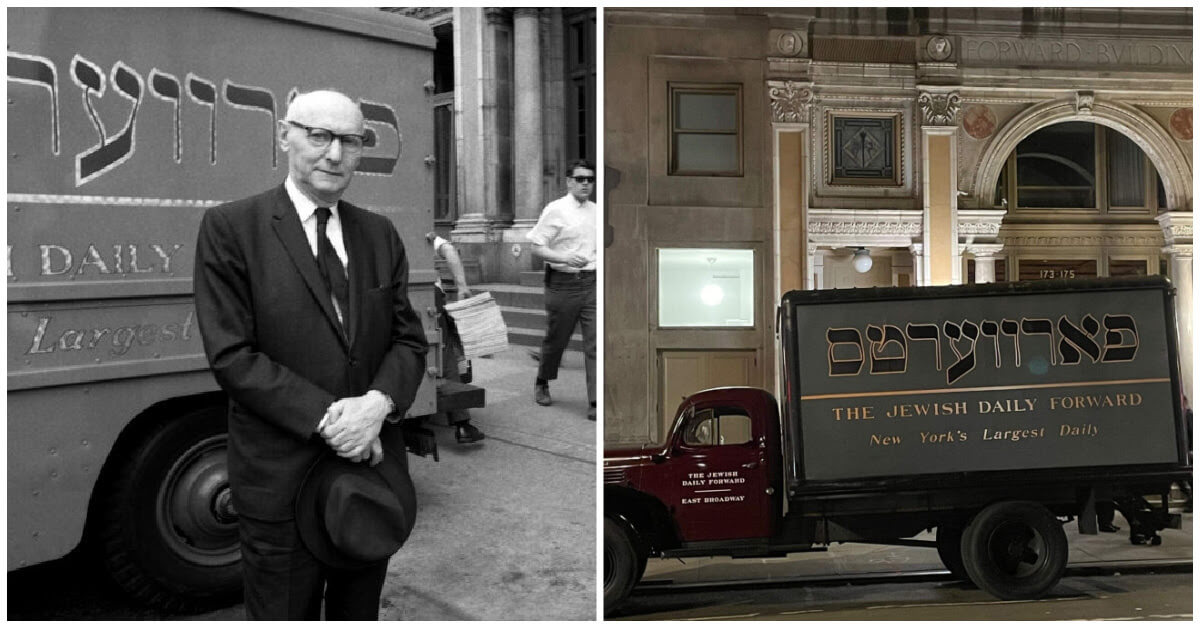
So Fisk and his team, drawing inspiration from the locale, built a Forward delivery truck to block out the signs. He even recalls printing up some papers. The graphic artists relied on reference photos to reproduce the font — painting the cargo bed immediately after a period-appropriate truck arrived. Fisk thinks it may have still been wet on shooting day.
Every time Fisk entered a neighborhood for this New York shoot — his first since 1974’s Phantom of the Paradise, directed by De Palma — he looked for traces of the past to take advantage of. (In the case of Phantom, Fisk opted to use the Brooklyn building of the Pressman Toy Corporation— a Jewish-owned outfit known for manufacturing Chinese Checkers and the family firm of Hollywood producer Edward R. Pressman — as a prison instead of filming in a real jail; Fisk said all the ones he scouted looked “too nice.”)
Recreating the lost world of Marty Mauser, played by Timothée Chalamet, posed its own challenges.
Central to the film, if only briefly seen in the final cut, is Lawrence’s Broadway Table Tennis Club on 55th St. The building was demolished, but Fisk, together with producer Sara Rossein (who is also Safdie’s wife), was able to get hold of blueprints and black-and-white photos through tax records, government archives and a magazine feature. Rossein’s discovery of a 16mm piece of film clued Fisk in on the color palette.
Fisk got his start in film working for B-movie maven Roger Corman (“Every other page there was a bare breast or something,” he recalled of the scripts) so he is no stranger to improvising on a shoestring. In fact, he relishes it. On Marty Supreme, as maximalist a picture as Safdie has ever made, the budget — despite being reportedly the most-expensive A24 production yet at around $60-70 million — often creaked, calling for some creative problem solving.
There’s a scene where Marty volleys an apple into a bowl in a building across from his hotel room. There wasn’t money to retrofit the room in the window, so the period stove viewers see is an image printed from a plotter — a massive printer — pasted to the wall. Norkin’s Shoe Shop, where Marty works, was an actual location on Orchard Street, but the crew built modular units of the storefront so they could move the shots away from a modern-looking hotel recently built nearby.
While Marty Supreme is largely rooted in New York, with some detours to New Jersey, London and Tokyo, there’s a memorable sequence set at Auschwitz, as former world champion tennis pro Bela Kletzki (Géza Röhrig) recounts his life in the camp.
“It’s kind of horrible and challenging at the same time,” Fisk said of recreating a part of the death camp. “Everybody’s knowledge of Auschwitz and concentration camps really helped make the set.”
The dimly lit barracks were built inside a house that doubled as the set for a farm in New Jersey where Marty tries to retrieve a lost German shepherd.
Fisk said Röhrig, who starred in the Auschwitz-set film Son of Saul and converted to Orthodox Judaism after a visit to the camp, was excited for the scene. (Fisk noted that Röhrig is part of his longtime collaborator Terrence Malick’s upcoming film, The Way of the Wind, where the actor will play Jesus, possibly the first Orthodox Jew to embody that role on the big screen.)
Fisk’s work on Marty Supreme has been noted in nearly every review — even the rare pan in Time singled out his production as “the best thing about the movie” — but it’s technically not his only film this year.
Springsteen: Deliver Me from Nowhere shows the Boss watching Malick’s Badlands on his home television; the crime drama was the inspiration for the singer’s album Nebraska, the making of which is the crux of the biopic. Fisk is grateful Badlands is still resonating, as it marked the beginning not only of his most prolific collaboration, but was the set where he met his wife, Sissy Spacek.
While Fisk is a sought-after talent for the ambitious auteurs looking to wind back the clock — his most recent credit is Martin Scorsese’s Killers of the Flower Moon, for which he was nominated for his third Oscar — his most personal connection was with David Lynch, his friend since high school.
Lynch died in January, during the production of Marty Supreme. Fisk was in Japan working on one of the last scenes soon after his passing, and was gratified to see people hosting film festivals in diners in Lynch’s honor.
Marty Supreme is the first film Fisk has done with Safdie, and while it is a relatively early work (Safdie is just 41, though this film is his seventh feature, and his second without his brother, Benny), the veteran production designer was impressed by his enthusiasm and his attention to detail.
“I always tried to prepare myself so I have a little bit more detail than he asked, which is very hard to do,” Fisk said.
It’s that eye for minutiae — and the need to block out the blight of modernity — that paved the way for the Forward’s brief cameo. Fisk, for his part, likes the look of the Yiddish.
“It’s so graphic and beautiful and you can move it around,” Fisk said of the truck. “The camera’s gonna miss it, you can just back it up five feet to see it.”
The post How the Forward got a cameo in ‘Marty Supreme’ appeared first on The Forward.
Uncategorized
Trump Says Gas Prices May Remain High Through November Midterm Election

U.S. President Donald Trump takes questions from reporters while Vice President JD Vance and Secretary of State Marco Rubio look on, as they attend a meeting with oil industry executives, at the White House in Washington, D.C., U.S., January 9, 2026. REUTERS/Kevin Lamarque
US President Donald Trump said on Sunday that the price of oil and gasoline may remain high through November’s midterm elections, a rare acknowledgement of the potential political fallout from his decision to attack Iran six weeks ago.
“It could be, or the same, or maybe a little bit higher, but it should be around the same,” Trump, who is in Miami for the weekend, told Fox News’ “Sunday Morning Futures With Maria Bartiromo” when asked whether the cost of oil and gas would be lower by the fall.
The average price for regular gas at US service stations has exceeded $4 per gallon for most of April, according to data from GasBuddy. Trump’s comments on Sunday came after weeks of asserting that the spike in prices is a short-term phenomenon, though his top advisers are cognizant of the war’s economic impacts, officials have said.
Earlier on Sunday, Trump announced on social media that the US Navy would blockade the Strait of Hormuz and intercept any ship that paid a crossing fee to Iran, after marathon talks between the US and Iran in Pakistan over the weekend did not yield a peace deal.
“No one who pays an illegal toll will have safe passage on the high seas,” he wrote on Truth Social.
Any US blockade is likely to add more uncertainty to the eventual resolution of the conflict, which is currently subject to a tenuous two-week ceasefire. The new tactic is in response to Iran’s own closure of the strait’s critical shipping lanes, which has caused global oil prices to skyrocket about 50%.
UNPOPULAR WAR HITS TRUMP’S APPROVAL
The war began on February 28, when the US launched a joint bombing campaign with Israel against Iran. The scope quickly expanded as Iran and its allies attacked nearby countries, while Israel targeted Hezbollah with massive strikes in Lebanon.
The war has buffeted global financial markets and caused thousands of civilian deaths, mostly in Iran and Lebanon.
Trump’s political standing at home has suffered, with polls showing the war is unpopular among most Americans, who are frustrated by rising gasoline prices.
The president’s approval rating has hit the lowest levels of his second term in office, raising concern among Republicans that his party is poised to lose control of Congress in the midterm elections. A Democratic majority in either chamber could launch investigations into the Trump administration while blocking much of his legislative agenda.
US Senator Mark Warner of Virginia, the ranking Democrat on the Senate Intelligence Committee, questioned the strategy behind Trump’s planned blockade.
“I don’t understand how blockading the strait is going to somehow push the Iranians into opening it,” he told CNN’s “State of the Union” on Sunday.
In a separate appearance on CBS’s “Face the Nation,” Warner said the blockade would not undermine Iranian control of the waterway.
“The Iranians have hundreds of speedboats where they can still mine the strait or put bombs against tankers in closing the strait,” he said. “How is that going to ever bring down gas prices?”
Although Trump has repeatedly said that the war would be over soon, Republican US Senator Ron Johnson of Wisconsin told ABC News’ “This Week” on Sunday that achieving US aims in Iran “could take a long time.”
“It’s going to be a long-term project,” said Johnson, who was not asked about Trump’s proposed blockade. “I never thought this would be easy.”
Uncategorized
Israel’s Ben-Gvir Visits Flashpoint Al-Aqsa Mosque Compound

Israeli politician Itamar Ben-Gvir walks inside the Knesset, in Jerusalem, Oct. 13, 2025. Photo: Chip Somodevilla/Pool via REUTERS
Israel’s far-right police minister Itamar Ben-Gvir visited the flashpoint Al-Aqsa Mosque compound in Jerusalem on Sunday, saying he was seeking greater access for Jewish worshipers and drawing condemnation from Jordan and the Palestinians.
The compound in Jerusalem’s walled Old City is one of the most sensitive sites in the Middle East. Known to Jews as Temple Mount, it is the most sacred site in Judaism and is Islam’s third-holiest site.
Under a delicate, decades-old arrangement with Muslim authorities, it is administered by a Jordanian religious foundation and Jews can visit but may not pray there.
Suggestions that Israel would alter the rules have sparked outrage among Muslims and ignited violence in the past.
“Today, I feel like the owner here,” National Security Minister Ben-Gvir said in a video filmed at the site and distributed by his office. “There is still more to do, more to improve. I keep pushing the Prime Minister (Benjamin Netanyahu) to do more and more — we must keep rising higher and higher.”
A statement from the Jordanian foreign ministry said it considered Ben-Gvir’s visit to be a violation of the status quo agreement at the site and “a desecration of its sanctity, a condemnable escalation and an unacceptable provocation.”
The office of Palestinian president, Mahmoud Abbas, said such actions could further destabilize the region.
Ben-Gvir’s spokesman said the minister was seeking greater access and prayer permits for Jewish visitors. He also said that Ben-Gvir had prayed at the site.
There was no immediate comment from Netanyahu’s office. Previous such visits and statements by Ben-Gvir have prompted Netanyahu announcements saying that there is no change in Israel’s policy of keeping the status quo.
Muslim, Christian and Jewish sites, including Al-Aqsa had been largely closed to the public during the Iran war. There was no immediate sign of unrest on Sunday after Ben-Gvir’s visit.
Uncategorized
Netanyahu Visits Troops Fighting Hezbollah in Southern Lebanon

Israeli Prime Minister Benjamin Netanyahu speaks during a press conference at the Prime Minister’s office in Jerusalem, Aug. 10, 2025. Photo: ABIR SULTAN/Pool via REUTERS
i24 News – Israeli Prime Minister Benjamin Netanyahu visited Israeli forces operating in southern Lebanon on Sunday as military operations against Hezbollah-linked targets continue.
Netanyahu toured forward positions alongside Defense Minister Yisrael Katz, Eyal Zamir, and Northern Command Commander Rafi Milo, meeting troops and receiving operational briefings from commanders on the ground.
Speaking to soldiers, Netanyahu praised their performance and said operations in the Lebanese security zone were ongoing.
“The war continues, including within the security zone in Lebanon,” he said, adding that Israeli forces were working to prevent infiltration attempts and neutralize threats such as anti-tank fire and missiles.
He described the northern campaign as part of a broader regional struggle involving Iran and its allies, saying Israel’s adversaries were now “fighting for their survival” following sustained Israeli military pressure.