


Uncategorized
How the UK Media and Establishment Fueled Attacks on Jews, Like the Yom Kippur Murders

People react near the scene, after an attack in which a car was driven at pedestrians and stabbings were reported at a synagogue in north Manchester, Britain, on Yom Kippur, Oct. 2, 2025. Photo: REUTERS/Phil Noble
On the holiest day in the Jewish calendar, Britain’s Jewish community was once again terrorized at what should have been the safest of spaces: a synagogue.
The Yom Kippur terror attack targeting worshippers at the Heaton Park Hebrew Congregation in Manchester was met with the usual chorus of hollow condemnation from politicians across the spectrum, accompanied by the same weary assurances that “the Jewish community will be protected.”
But this did not happen in a vacuum.
Just hours after the attack, British police confirmed that they were treating the incident as terrorism. The suspect was identified as Jihad al-Shamie, a Syrian asylum seeker who had been granted British citizenship. Yet even as the facts became clear, parts of the media and political establishment responded with familiar hand-wringing over how such an atrocity could have occurred — as though the answer wasn’t staring them in the face.
The Board of Deputies of British Jews put it bluntly, describing the attack as “sadly something we feared was coming.”
And indeed, it was.
For more than two years, the UK’s media and political class have helped fuel a hostile atmosphere, in which antisemitism has surged to levels unseen in decades. Since Hamas’ October 7 massacre, much of the British press has amplified narratives that demonize Israel while excusing or downplaying Palestinian terrorism — creating a climate where violence against Jews does feel almost inevitable.
A Rare Moment of Accountability
That climate was laid bare on live television.
During a Sky News segment following the Manchester attack, Lord John Woodcock — the government’s former independent adviser on political violence — directly confronted the network for its role in shaping public hostility toward Jews.
Woodcock, whose title in the UK’s House of Lords is Baron Walney, described the terror attack as “a product of the way in which Israel’s actions are seen and portrayed — I’m afraid to say it, by Sky News as well as other media outlets — as uniquely evil and worthy of a level of focus simply not afforded to other dire situations across the world.”
It was an extraordinary on-air moment of accountability — one that exposed a truth the media refuses to acknowledge.
MUST WATCH: @SkyNews won’t post this on their own social media because former UK govt advisor on political violence, @LordWalney, calls them & UK media out for portraying Israeli actions as “almost uniquely evil & worthy of a level of focus which is simply not afforded to other… pic.twitter.com/WrPgTat6Lk
— HonestReporting (@HonestReporting) October 2, 2025
Even as Woodcock pointed to the double standards and moral obsession that define coverage of Israel, the Sky News presenter attempted to push back, defending the network’s record. It was a revealing exchange: faced with criticism that was both factual and unanswerable, Sky News’s instinct was to deny, deflect, and preserve its self-image as neutral.
That, right there, is the problem.
When even undeniable evidence of bias is raised — when a former government adviser points out the disproportionate scrutiny applied to Israel — the British media refuses to reflect. It cannot see that its relentless framing of Israel as a moral pariah has consequences.
The Media’s Habit of “Both-Sidesing”
Almost as predictable as the politicians’ “shock” was the media’s reflexive attempt to “both sides” the story.
Reporting live from outside the synagogue, Sky News anchor Sarah-Jane Mee invited Akeela Ahmed, CEO of the British Muslim Trust, to comment on the attack. Incredibly, Mee suggested that the day’s events had “highlighted the vulnerabilities of different faith groups.”
“While Jews were targeted today,” she added, “we know Muslims could be targeted in these kinds of incidents.”
The remark was jaw-dropping. Muslims, she implied, might become victims in antisemitic Islamist terror attacks.
This is what moral relativism looks like.
“My heart goes out to everybody who was impacted”
Chief executive at British Muslim Trust Akeela Ahmed tells @skysarahjane she believes the increase in religiously motivated hate crimes comes from “misunderstanding and prejudice of people of faith”
Sky 501 and YouTube pic.twitter.com/ZTwyC6d343
— Sky News (@SkyNews) October 2, 2025
Instead of confronting the uncomfortable fact that Jews were targeted outside their own house of worship by a man radicalized by antisemitic ideology, the media rushed to dilute the specificity of the crime.
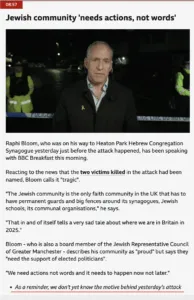
Reuters reported that the incident had “raised fears of more violence and division across faiths.” The BBC insisted for nearly 24 hours after the attack that the “motive” was unclear. Each time, the framing softened the reality: this was not an attack on “faith communities.” It was an attack on Jews.
Not on Muslims. Not on “believers.” On Jews.
Back to the Media
The press will condemn antisemitism in the abstract but refuses to recognize how its own reporting perpetuates it in practice. For years, journalists have blurred the line between criticism of Israel and vilification of Jews, normalizing the idea that Jewish collectivity — whether expressed through nationhood or worship — is suspect.
When headlines equate terrorists with their victims, when outlets question Israel’s right to defend itself but ignore Hamas’ atrocities, when Jewish suffering is minimized or reframed as a “clash of communities,” the result is not moral balance, but complicity.
The Manchester attack was not inevitable, actually, but it was predictable. And until Britain’s media acknowledges the role it has played in feeding the flames, the words “never again” will remain just that: words.
The author is a contributor to HonestReporting, a Jerusalem-based media watchdog with a focus on antisemitism and anti-Israel bias — where a version of this article first appeared.
Uncategorized
Chef Alon Shaya shares the stories, resilience and recipes of World War II survivors
(JTA) — In 2015, while visiting Israel’s Yad Vashem Holocaust Memorial, James Beard Award-winning chef Alon Shaya came face-to-face with a World War II artifact that moved him deeply.
It was a red cloth triangle — cut from a Nazi flag — embroidered with the names of a few dozen female prisoners at the Ravensbrück concentration camp.
In a place where they were starving to death, he learned these women had formed a clandestine “food” club. Together, they talked about recipes, their Friday night Shabbat candlesticks and cherished memories of home.
That red cloth was “100% the catalyst,” Shaya said, for his deep interest in food as “an agent of survival, defiance and bringing people together.”
Now, 11 years after that defining moment in Jerusalem, Shaya’s second book, “Memories of a Good Meal: Recipes of Resilience Inspired by Stories of World War II Survival,” is being published on Oct. 6. Co-authored with food historian June Hersh, the book gathers accounts from survivors and heroes of World War II, illustrating the outsized role that food — and the memory of it — played in human survival. While featuring 80 recipes, it functions as much as a history book as a cookbook.
“The recipes are there to support the stories,” Shaya said. “It’s not the other way around.”
Shaya and Hersh tell the stories of 10 distinct groups impacted by the war, including Jewish partisans, hidden children, Navajo code talkers, persecuted homosexuals, Japanese Americans, and Austrian and German Jews who built new lives in the Dominican Republic.
Alongside these narratives, the authors included family recipes preserved across generations. Where none survived or existed, Shaya crafted recipes using ingredients available to the book’s subjects during the war.
The opening chapter highlights a story particularly close to Shaya’s heart. In 2019, during a visit to the United States Holocaust Memorial Museum in Washington, D.C., Shaya was shown a tattered, 100-year-old, handwritten recipe collection from the Fenves family of Yugoslavia. Saved during the war by the family’s cook, Maris, the Hungarian-language notebook was eventually donated to the museum by survivor Steven Fenves.
Determined to bring those dishes back to life, Shaya worked with Fenves to translate the recipes, filling in missing elements like precise steps, exact measurements and oven temperatures.
“I really became a part of their family,” said Shaya, whose collaboration on what became known as the Rescued Recipes project has raised nearly $1 million for the Holocaust Museum to digitize historical documents and artifacts. “The family wouldn’t be here if Steven and his sister didn’t survive Auschwitz,” said Shaya.
Featured recipes from this chapter reflect the Hungarian culinary traditions of Fenves’s hometown of Subotica, including körözött (a spiced cheese spread) and authentic Hungarian goulash.
Other chapters explore how people sustained themselves despite meager resources. In the profile of Polish Jewish partisan Shalom Yoran — who subsisted largely on potatoes while hiding in the woods — Shaya developed recipes centered on the staple tuber, including Polish herring and potato salad, potato dinner rolls and potato, and pine nut doughnuts with blackberry caramel.
“Shalom’s wife, Varda, shared his story with us,” Shaya explained. “The partisans lived in a hole in the ground in the Polish forest through winters that reached minus-20 degrees, and they did that for four years. Potatoes were a huge part of their survival.”
For Sarah Pelz, executive editor at Harvest, the book’s publisher and the granddaughter of a partisan, the concept of the book resonated deeply, especially in the wake of the Oct. 7, 2023 Hamas attacks inside Israel. “The throughline here is the power of food and memory — the power of food to bring us together at a table, and to remind us who we are and where we come from,” she said in an interview.
“Alon’s message is powerful and necessary right now,” she continued. “He hopes that people will read this book, will cook from it, and that it will bring people together at the table, people of diverse backgrounds, people of diverse perspectives, that it will not just help to enlighten readers, to history and to what happened, but also help bring people together.”
In gathering these accounts across the globe, Shaya and Hersh faced a race against time, as most interviewees were well into their 90s or older. John Kinsel, one of the last living Navajo code talkers, was 107 years old when the authors visited him on the Navajo Nation reservation. His chapter details the vital role Native American Marines played by using their complex language to transmit secret Allied messages in the Pacific theater. The book features recipes inspired by Navajo traditions, including blue corn mush and stuffed pumpkin with stewed lamb.
Throughout the project, Shaya couldn’t help but draw parallels between past atrocities and modern struggles.
“One of the lessons that struck home the most for me is that people will persecute you for what you believe in and gather together and create laws to persecute you,” he said. “We saw it in what happened with immigration in the 1940s, and we see it with what’s happening in America today.”
He was also struck by the role of propaganda, promulgated then by Joseph Goebbels, Hitler’s chief propagandist, and today by bad actors on social media, in spreading hate and disinformation.
Some of the stories, like the meal prepared by nuns in a convent for a group of persecuted homosexual prisoners, seem almost cinematic in nature.
“I have definitely thought about turning these stories into a miniseries or a movie,” said Shaya. “Nobody has shown interest in it yet, but it is something that I think the more ways these stories can be shared, the better.”
Born in Israel and raised in Philadelphia, Shaya has become one of the country’s leading interpreters of Israeli and Middle Eastern cooking, with a distinctly Southern sensibility. His 2018 cookbook, “Shaya: An Odyssey of Food, My Journey Back to Israel,” blends memoir with recipes.
Shaya was committed to the latest book despite huge demands on his time. The chef and his wife, Emily, have two children, aged five and two. His Pomegranate Hospitality operates three restaurants, Saba and Safta’s Table in New Orleans, where he lives, and Safta in Denver. (Saba means grandfather and Safta means grandmother in Hebrew.) He is also involved in a variety of philanthropic work.
“The work I put into this book fills my heart and makes me feel good, like I’m doing something that builds me up and can have an impact,” said Shaya.
Shaya views the book as an educational tool.
“This book might engage a 13-year-old who really loves the chocolate cake recipe,” Shaya reflected. “If he or she hears the history behind that chocolate cake and delves into the history behind it, they learn that Austrian and German Jews took refuge in the Dominican Republic and wanted to keep their culinary traditions alive and need to use the local resources. That’s how a traditional Sacher torte-inspired tres leches cake came to be. Or a plantain latke, or matzo ball soup with avocado, lime and yucca.
“If those stories can come together and have that kind of impact on one 13-year-old in the world,” he added, “I will feel complete.”
This article originally appeared on JTA.org.
The post Chef Alon Shaya shares the stories, resilience and recipes of World War II survivors appeared first on The Forward.
Uncategorized
‘That’s a lie’: Israeli journalists clash with Irish football association ahead of tense rematch
(JTA) — Israel and Ireland’s UEFA Nations League rematch on Sunday ratcheted up tensions between the two teams, in a sports drama where emotions over the Gaza war have fueled theatrics as intense as the match itself.
During the 1-1 draw played in Serbia, Ireland’s captain declined, as in the last match, a pregame handshake with his Israeli counterpart, Irish players bowed their heads during the playing of the Israeli national anthem and the team donned black armbands to signal their disapproval of Israel’s actions in Gaza.
Israeli players also wore black armbands displaying “7/10,” in recognition of the anniversary of the Oct. 7, 2023, Hamas attack.
Tensions also spilled off the pitch.
Staffers for the Irish team abruptly cut short a Saturday press conference with Irish head coach Heimir Hallgrímsson after a tense back-and-forth between Israeli journalists and Ireland’s press officer, Kieran Crowley.
While both Hallgrímsson and Israeli coach Ran Ben-Shimon, in his separate meeting with the media, insisted their focus remained on the game itself, Ireland’s press conference took a turn when an Israeli journalist asked Hallgrímsson for his thoughts on the flydubai hijacking last week.
“What do you say about the people that you support? Their ideology is based on murder,” the reporter asked. “Just this week, one of them tried to kill 170 Israeli passengers, including 27 innocent children and thousands of others.”
Crowley interrupted, saying, “We are not doing any questions like this today. We are doing football questions.”
Another Israeli reporter then asked Hallgrímsson about his team calling Israeli players “monkeys” during the Sept. 27 match. Crowley again interrupted, saying, “That is completely untrue. … That’s a lie. You’ve just broadcast a lie.”
The press conference was then cut off, as the reporter argued with a staffer who confiscated the microphone. UEFA barred the two Israeli reporters from the postgame media gathering on Sunday.
The incident came after months of controversy leading up to the Sept. 27 match between the two sides, which Ireland faced intense pressure to boycott. Ireland has a long history of pro-Palestinian policies and anti-Israeli sentiment.
There were additional signs of tension on the field, with Ireland’s head of athletic performance, Damien Doyle, alleging that an Israeli player spat at him as the teams left the field at the end of the first half. Israel’s football association denied the accusation.
After the match, Hallgrímsson called on UEFA to ensure the two teams do not face each other in the future.
“That’s not ours to decide, that’s UEFA,” he said. “I wouldn’t want or wish any national team to go through what we have gone through these two weeks. UEFA needs to step in and do something.”
Hallgrímsson also indicated that he had made a “mistake” by sharing his stance on the war in Gaza. In the lead-up to the matches, he had told reporters, “We’re not playing with genocide, we’re playing against genocide. We’re playing against Israel, we’re not playing with Israel.”
On Sunday, Hallgrímsson added that “my feelings and my opinions should be set aside when I am spokesman for an organisation.”
Sunday’s game included Irish player Finn Azaz, whose mother has Israeli heritage, as a substitute.
This article originally appeared on JTA.org.
The post ‘That’s a lie’: Israeli journalists clash with Irish football association ahead of tense rematch appeared first on The Forward.
Uncategorized
How Jim Bakker sent a rabbi’s son to 52 churches
Jim Bakker convinced me to go to church.
Bakker died Monday at 86. For a stretch in the 1980s he and his wife, Tammy Faye, were on television every day, praying, singing and weeping, her in waterproof mascara, in front of as many as 13 million people. Then came the sex scandal, the hush money and the fraud trial.
And yet, he became my gateway into Christianity.
I’m an Orthodox rabbi’s son who grew up in the Bible Belt, which made me a spiritual window-shopper. My bedroom window looked out across the street at Cokesbury Methodist Church. Every Sunday morning, I watched the families climb out of their minivans in khakis and pastels, smiling like people who had never once wondered whether turning on a light switch counted as work on Shabbat.
We didn’t have cable. Regular TV in our house was already a negotiation, and a channel devoted to Jesus wasn’t even up for discussion.
Then I went off to college, moved out on my own, and one of my first acts of rebellion was ordering basic cable. I flipped on the Cartoon Network, a channel that showed animated classics around the clock, and wondered if this was what the Messianic age felt like.
On Sunday mornings, on channel after channel, I stumbled across pastors preaching to their congregations. What hooked me wasn’t the theology; the sermons seemed more like self-help seminars. It was the production. Where I came from, worship was a closed-door affair, in Hebrew, for members only. Here it was a show, with a band and cameras.
The format Bakker perfected inspired others: the tears, the house band, the host who knew exactly where the camera was. I couldn’t look away.
Heaven, with a gift shop
Bakker was born in Michigan in 1940 into a Pentecostal family, and he met Tammy Faye at Bible college. They married in 1961, after three dates, which, as a rabbi’s son who spent years in the dating trenches, I find both reckless and enviable. They drifted into television through Pat Robertson’s network, where they hosted a children’s show, and in 1976 they started their own ministry: PTL, short for Praise the Lord. At its peak, PTL drew as many as 13 million viewers a day and took in more than $100 million a year. Critics said PTL stood for “Pass the Loot.”
On 2,500 acres in Fort Mill, South Carolina, the Bakkers built Heritage USA, a Christian theme park with a hotel, water slides, skating and Bible study. They sold shares in it and offered lifetime vacations there to donors.
I’ll confess: I was jealous. Christians had a place you went to bring your family closer to God, with a gift shop and cotton candy. We had the Catskills and a very long buffet. I took this about as well as a kid whose neighbors have a swimming pool.
Then it all fell apart. In 1987 came the revelation of Bakker’s encounter with a church secretary, Jessica Hahn, and the $265,000 paid to keep it quiet. Fellow preachers lined up to condemn him, Jerry Falwell took over the ministry, and a federal inquiry followed. He was convicted of fraud in 1989 and sentenced to 45 years. He served five. Tammy Faye divorced him while he was in prison.
Bakker left prison in 1994, chastened. In a 1996 book called I Was Wrong, he wrote that Jesus had nothing good to say about money, a lesson he learned, as so many of us do, only after losing the water park. In 2003 he resurfaced in Branson, Missouri, hosting a new show from a café and selling viewers buckets of emergency food for the end of days.
The Jew on the Jumbotron
Soon, I had a plan of my own. I would spend a year going to 52 churches over 52 Sundays. Jewish tradition teaches that it’s verboten to go to church, especially during services. I planned to go as a journalistic endeavor and write a book about the experience.
Yet, I was still riddled with the guilt of my ancestors, so I went to my synagogue’s rabbi and asked his permission. To my surprise, he granted it on two conditions: I had to wear my press badge, so worshippers knew I was there to take notes and not to take part in prayer. The second condition was that I had to wear a yarmulke. People needed to know I was Jewish, the rabbi said. As if being short, bespectacled and named Benyamin Cohen didn’t already give that away.
Jim Bakker had put church on television. I was going to find out what happened when you stepped through the screen.
My wife, Elizabeth, a Christian minister’s daughter who had converted to Judaism, was still dripping wet from the mikvah and not exactly thrilled that her husband was going to spend a year in churches. She pointed out that I was about to become the first Orthodox Jew in history to qualify for a church loyalty card.
I started in the deep end, at New Birth Missionary Baptist Church, one of the country’s largest megachurches, home to 15,000 people on a typical Sunday. The sanctuary looked like a sports arena. A camera operator found me in the pews. Within seconds my shayna punim was 20-feet tall on Jesus’ Jumbotron for all to see. I had been there for all of five minutes and I was already outed as the Jew.
“Oh God,” I thought. “What if my dad could see me now?”
Watching church was Bakker’s big idea. At New Birth, the cameras roamed the pews and the congregation cheered at itself on the big screens. After years of watching church from my couch, I was the one in the shot.
I’d spent my childhood sure the grass was greener at the proverbial church across the street. It wasn’t. It was just better lit. Once the cameras and the choirs were gone, what I found were people trying, like me, to figure out how to believe, and some of them were doing it better than I was.
Hanging out with Jesus made me a better Jew, a sentence I never expected to write, and one my father never expected to hear.
The other Bakker
There was another Bakker I felt I knew.
I was born the same year as Jay Bakker, the son of Jim and Tammy Faye. He was 12 when his father was indicted. By 18, he’d co-founded Revolution, which eventually opened a branch in Atlanta, my hometown. The New York Times once described churches like it as meeting in “warehouses, bars, skate parks, punk clubs,” which is, to put it plainly, not where my synagogue held services.
In 2006, the Sundance Channel made a six-part series about him called One Punk Under God, and I was hooked. The camera was back on the Bakker family business, only now it followed the son, who seemed to be building the opposite of his parents’ church.
I felt a kinship with Jay that I couldn’t have explained then. We were both preachers’ kids, which meant your father’s job was also your religion, so you couldn’t be mad at one without it messing with the other. He titled his memoir Son of a Preacher Man, which is also what I called a chapter in mine.
His choices were harder than mine. My father never lost his congregation to a federal grand jury. While Jim Bakker went to Branson to sell apocalypse buckets and political prophecy, Jay went toward a gentler, more inclusive faith.
As I learned throughout my journey, a church built for television is only as strong as its ratings. The Jewish service I understand best would make terrible TV. On Yom Kippur we fast for 25 hours and act somberly. In the prayers, we confess in the plural, a whole congregation beating its chests together: we have sinned, not I.
Jim Bakker got me into church, and church sent me back to synagogue. Praise the Lord, as they used to say on his show. And, as we say in mine, amen.
The post How Jim Bakker sent a rabbi’s son to 52 churches appeared first on The Forward.
