


Uncategorized
If mollusks are kosher, the world can be your oyster

I’ve gone to work on an oyster farm on Block Island, a tiny dot of land midway between Long Island and Rhode Island, every May for the past few years.
If you are, like most people, unfamiliar with the mechanics of oyster farming, here’s what it looks like, at least on this farm. First, you toot around a saltwater pond in a glorified bathtub with a motor hanging off the back. From the boat, wearing chest waders, you hop in the water to unmoor dozens of giant floating mesh bags full of oysters from lines anchored in the pond. The bags are usually also bogged down with a mess of extraneous sea dwellers like kelp, mussels, green crabs and goopy creatures called sea squirts, so they’re heavy. You pile as many bags as you can into the boat, clamber back in — which is harder than it sounds, because your wader boots are probably stuck in the mud at the bottom of the pond — and bring those bags to a floating barge.
Finally, you dump the bag onto a muddy wooden table, pick out everything that isn’t an oyster, since all of those aforementioned sea critters will kill the prize bivalve, and chuck the extra stuff back into the pond. Then you hand-sort the oysters by size. You harvest ones that are big enough to eat — oysters take a few years to reach full size, and grow unevenly, so each bag always has a range of oysters — shovel the rest back in the bags, get back in the boat and tie them back onto the lines. Then you do it again. On a good day, you get through around 100 bags of oysters in a shift.
Bigger farms might have machinery to help sort the oysters; this farm does everything by hand. This may sound backbreaking, and it is, but it’s also a great break from desk work. A day spent out on the water doing repetitive physical labor is a kind of a reset. You can’t look at your phone with the wet, muddy oyster gloves on, and there’s barely service anyway. Plus you’d probably drop it in the pond, so it’s best not to try.

You may, at this point, notice that you’re reading a Jewish newspaper, that I’m a Jewish journalist, and that oysters are not kosher.
But what if I told you oysters were, in fact, kosher? That a rabbi once argued they are actually vegetables, by virtue of the fact that they “root” on rocks in the ocean? And that their shells are a form of scales, thus making them part of the kosher category of scaled and finned fish?
These are real arguments that were made around the turn of the 20th century by Rabbi Isaac Mayer Wise, the founder of Hebrew Union College in Cincinnati, the first American institution for Reform Jewish ordination.
The impetus for this Talmudic bit of logic was in large part a now-infamous feast that has come to be known as the “Trefa Banquet,” due to the amount of non-kosher food that was served. The menu included littleneck clams, shrimp salad, soft-shell crabs, a lobster bisque and frog legs in a cream sauce. Bordeaux wine and Champagne, also not kosher, were served alongside each course, and ice cream — real ice cream, made with dairy — followed with dessert, despite previous meat courses that included beef tenderloins and squab.
The occasion was a triple-header of religious Jewish events: HUC’s first ordination, a meeting of the Rabbinical Literary Association and the Union of American Hebrew Congregations, the previous name of today’s Union for Reform Judaism. And the discourse this meal set off about the place — or lack thereof — for kashrut in American Jewish life went on for years.
Despite the fact that oysters had not even been on the menu, in Jewish newspapers across the country, rabbis and laypeople wrote warring op-eds on the kosherness of oysters. Somehow, oysters became the symbol of what American Judaism would be. And, of course, what American Jews would eat.
The symbol of an oyster
I had never eaten an oyster until I lived in Seattle after college; for my first anniversary with a long-ago ex-boyfriend, we went to what was then the hottest restaurant in the city, an oyster bar. We were broke, but playing at a kind of sophisticated adulthood we hadn’t quite reached, and oysters seemed like the way to act out that sophistication.
Presented with a menu of oysters from across the country and not knowing where to begin, we got an array on the half shell, two each of a dozen types presented on a beautiful bed of ice with lemon and mignonette. Unsure how to slurp them out of the shell, I had to ask the waiter whether one chews oysters or just swallows. (You chew.)
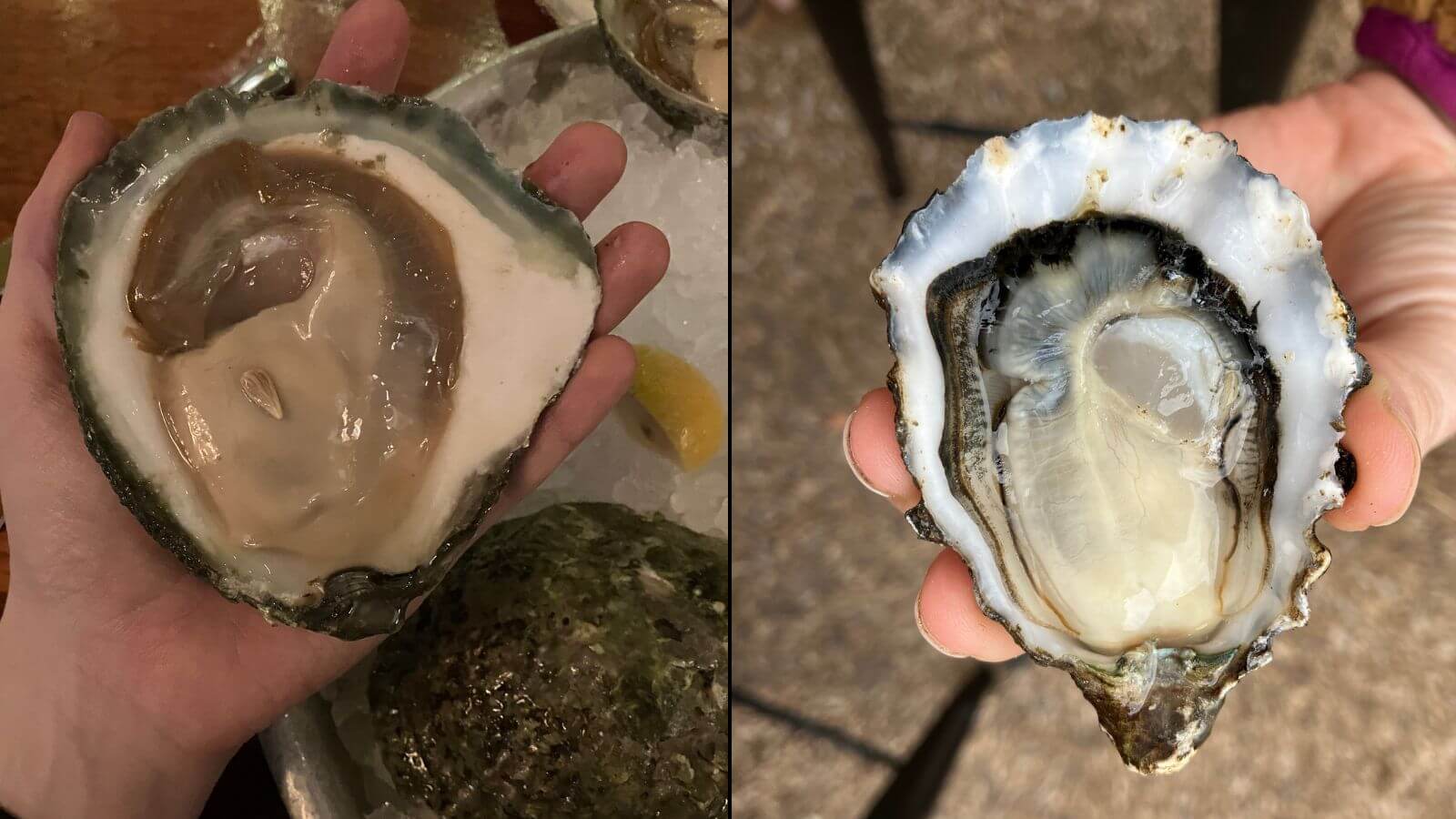
The first one tasted like a stormy ocean, another buttery and mild, a third one sweet and meaty. They were evocative, like eating the memory of a day at the beach.
Oysters, if you haven’t had them, have terroir in the same way as wine does. Just as grapes take on the characteristics of the soil they grew in, oysters taste different depending on the water they came from; even though there are only a few different species of the bivalve, there are countless variations. East Coast oysters tend to be sharp and briny and refreshing, while West Coast oysters are usually creamy and sweet. But past that, each one is completely unlike the next.
One oyster I had from Maine tasted like pennies. (Maybe that doesn’t sound appetizing, but neither does petrol, yet aged rieslings are prized for their petrol notes.) I’ve had oysters that tasted delicately vegetal, like a cucumber, or deeply umami like a mushroom.
When the Trefa Banquet occurred, oysters were in vogue across the U.S. And the occasion was a lavish and sophisticated one, almost a coming-out party for American Jewry. It was, after all, the celebration of the first class of rabbis ordained in the U.S., proof to the country that Jews were here to stay, and a statement to the rabbis and Jews of Europe that these American Jews were just as good, just as learned, as their European counterparts. In fact, perhaps more so — they were creating a new model of Reform Judaism, leaving the Old Country’s ways behind for a modern, American image of what it meant to be a Jew. The menu had to be the pinnacle of refinement.
Plus, these Cincinnati Jews had a bunch of New Yorkers in from the big city to impress. In a 2005 paper published in The American Jewish Archives Journal, rabbi and historian Lance J. Sussman argued that the menu, which included numerous French misspellings, may have been the caterer’s attempt to appeal to what he imagined were the more elevated tastes of the event’s East Coast guests.
Of course they served shellfish.
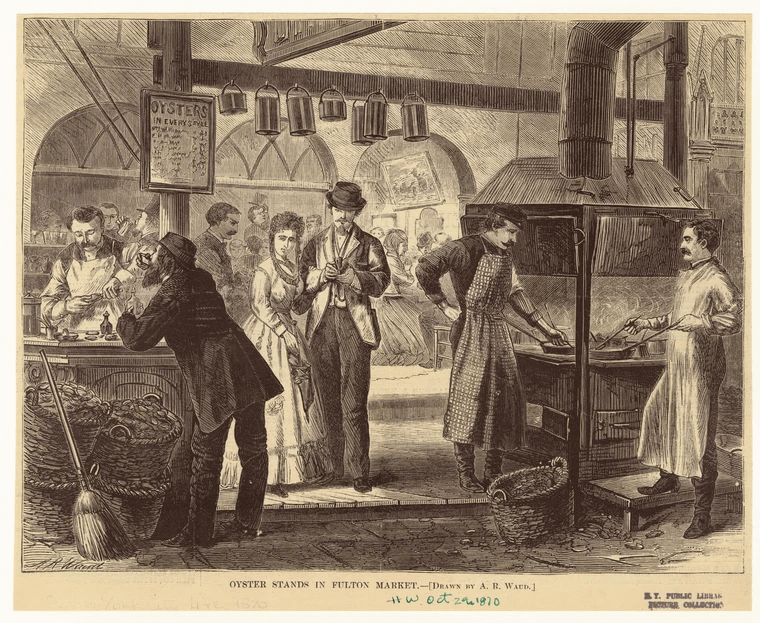
In 1883, the year of the banquet, America’s Jews were largely German immigrants. (Though newer waves of immigration had begun to bring in more traditionally observant Russian Jews fleeing pogroms.) Some of them had been associated with the Haskalah in Europe, a progressive Jewish education movement that advocated for secular education, modern dress and assimilation into wider society. By and large, these Jews were urban, educated and middle-class, having left the shtetl Judaism of their elders behind when they left the village.
These Jews began to develop a modernized form of Judaism, largely based in Germany. They changed the liturgy, axing concepts they found backwards, such as the idea that, in a coming Messianic era, Jews would return to Zion and resume sacrificing animals in a restored temple. They recited prayers in German instead of Hebrew and lightened many of the restrictions involved in observing Shabbat, kashrut and festivals. They took on a Christian aesthetic, exchanging synagogue chanting for an organ and choir. Sermons emphasized universal ethical themes instead of Jewish rituals. Some rabbis even argued for allowing both intermarriage and eating pork, though these topics remained hotly debated.
Once imported to the U.S., this newfangled Judaism got more popular.
“Part of the Reform ideology is to get away from all of the laws, all the do’s and don’ts of Judaism, which are considered primitive and superstitions almost,” said Jane Ziegelman, a Jewish food historian and curator of food talks at the Tenement Museum.
Instead, these Reformers wanted to turn Judaism into a more introspective, morally and socially focused religion. And thanks to its roots in the Haskalah, science was core to this new, modern Judaism. Oysters made for a perfect example. At the time, bivalves were considered an aphrodisiac and a health food, and they were both plentiful and popular. (So popular, in fact, that they got over-harvested, which is one of the reasons they’re so expensive today; the mountains of shells from the oysters eaten by New Yorkers were so large they posed a sanitation challenge.) These modernizing Jews understood kashrut to be, fundamentally, about health and ethics, which meant that anything healthy should be kosher.

“The idea was that the unhealthy categorization of the oyster had been proven wrong by modern science,” said Ziegelman.
American Reform Jews saw kosher rules, which they dismissively referred to as “kitchen Judaism,” as a contrast to their more noble pursuit of an intellectual, moral and scientific Judaism. Embracing the oyster was a way to live out their ideals about assimilation, modernization and religious ethics.
“It was the oyster because of its prevalence in American food culture,” Ziegelman told me. “To adopt the oyster was seen as both acculturation — that you really were American — but also you really were a modern person. You weren’t relying on these old kashrut superstitions.”
The shellfish scandal
Not everyone waxes poetic about oysters’ subtle marine nuances so much as their textural similarities to mucus. Personally, I don’t get that — I find them silky, or buttery, or meaty — but I get that oysters can seem a bit gross, and not just because of their texture.
Though on the farm, the oysters float on the surface of the water in bags, they are, at least naturally, bottom dwellers. They’re also “filter feeders,” which means they filter water for their food. This makes them an excellent resource in cleaning up polluted waterways — the Billion Oyster Project in New York City works restoring oyster reefs to the rivers around the city to help clean them and encourage biodiversity. But that also means that oysters aren’t always safe to eat because they’re consuming whatever bad stuff there is in the water. They can purify themselves given enough time in clean water, but they get polluted easily by their environment, perhaps one of the reasons they were originally forbidden under the laws of kashrut.
And even when they’re from clean water, there’s a lot to manage to make them safe. My partner and I run an oyster shucking side hustle with some friends, popping up at bars and events and turning out trays of raw oysters on the half shell. Preparing for each event takes many hours. You have to scrub the mud off each shell with a stiff-bristled brush. Then, since you want your oysters alive until you eat them lest they spoil, you pack them in coolers on ice — but you can’t bury them in too much ice lest they freeze to death. And since they’re salt-water dwellers, you have to drain the coolers regularly to prevent them from drowning in the freshwater ice melt.
On top of that, as a saying goes, oysters are best in the months that contain the letter R — September through April. Some of that is because they are plumpest during colder months when they build up their fat stores. But some of it is because colder waters reduce the risk that a raw oyster will carry a virus or bacteria like Vibrio or norovirus.
Today, farms take the temperature of their water daily and regularly test it for bacteria, so raw oysters aren’t particularly dangerous, but you can still easily get food poisoning from a mishandled oyster. As much as I love them, they’re work. I understand that, to some people, they’re not worth the risk — spiritually or physically.

Perhaps the subversive and literal danger of the oyster is what led to the legend that rabbis at the banquet threw down their napkins and stormed out. The public flouting of kashrut, at a religious event, could symbolize the end of Judaism. The Highland House Affair, as the feast is also known, has become infamous among Jewish historians and rabbis in the century since it occurred as a moment of schism. But in fact, most contemporaneous descriptions of the event make no note of any drama around the menu.
An account of the feast in The New York Herald briefly mentions the non-kosher menu, but does not say that any of the attendees were upset — in fact, to the author’s palpable distaste, quite the contrary. “Instead of rising in a body and leaving the hall, they sat down and participated,” they wrote of the rabbis in attendance.
Only one account at the time, written in New York’s Jewish Messenger by Henrietta Szold (who would go on to found the Jewish women’s society Hadassah) observed that some attendees hadn’t partaken of the food, though, she noted, it was only “a surprisingly small minority.”
“There was no regard paid to our dietary laws,” she wrote of the catering, “and consequently two rabbis left the table without having touched the dishes, and I am happy to state that I know of at least three more who ate nothing and were indignant but signified their disapproval in a less demonstrative manner.”

Wise, the Hebrew Union College founder who had organized the meal, at first defended it, saying he had hired a Jewish caterer who regularly served a Jewish association and had no idea the meal served would not be kosher. Eventually, however, Wise and his supporters changed their strategy and began to defend the non-kosher components. They railed against the idea of kashrut; one rabbi argued that it was the perfect occasion to put “kitchen Judaism to the antique cabinet where it belongs.”
When the 500 members of the Free Sons of Israel, a Jewish fraternal order that Wise belonged to, gathered and supped on oysters, the rabbi reprinted the menu in the newspaper he ran, The American Israelite. He repeated the tactic when another Jewish fraternal order put oysters on a meeting menu. Jews were not accidentally consuming oysters, he pointed out. This was how Jews were eating, and why should they pretend otherwise?
Yet ironically, given his vociferous rejection of tradition, Wise also provided Talmudic arguments as to why the meal may have in fact been kosher; even as he chose assimilation he used Jewish wisdom to justify his choice. In the pages of The American Israelite, he argued “that the oyster shell is the same to all intents and purposes as the scales to the clean fish” and referenced both Moses’ and Maimonides’ statements on the topic. Elsewhere, he called the oyster an “ocean vegetable” to explain why it might be kosher. (Today many vegans take a similar stance; oysters have no nervous system and some vegans are more willing to consume the bivalves than they are honey.)
Others wrote back, citing their own raft of Jewish sages. One B. Younker wrote in to The Jewish Voice to reference Talmudic debates over what constitutes a scale, concluding that the oyster’s shell does not count.
But amid the debate, everyone else kept eating oysters. Sussman’s article in The American Jewish Archives Journal notes oyster-filled menus from the double wedding of two rabbis, a synagogue dedication and a banquet for a Jewish fraternal order; the last even used the same caterer as the Trefa Banquet. Apparently, there was something to that luxurious menu they planned — it was impressive enough to earn them repeat customers.
Today, many Jewish historians look to the Trefa Banquet as the beginnings of the Conservative movement in Judaism, as some of those horrified Jews rejected the idea of kosher oysters and decided they needed to develop a middle ground between the Reform and Orthodox movements. The debate the banquet set off over kashrut, as well as Wise’s liberal interpretations of Jewish law, concerned some Jews who wanted to protect tradition. Soon after the great oyster debate began, the Jewish Theological Seminary, the flagship institution of the Conservative movement, opened its doors as a place to retain some amount of tradition in text and theology.
Fishy Jewish cooking

In my time manning the pop-up, I’ve come to believe that shucking an oyster is an art form. First, there’s the basic problem of opening the oyster. Usually that means inserting an oyster knife at the narrow hinge of the shell — though some people shuck from the side — and wiggling until you feel the point of the knife settle in deeper. Then you lever the knife down to pop the shell, slice along the flat top shell to separate the oyster, and then scoop the knife underneath the oyster to sever the adductor muscle. Personally, I prefer a Duxbury-style knife, which comes to a sharper point, but many people prefer the more classic New Haven-style knife, which curves slightly at the tip, providing a bit more leverage and a bit less likelihood of stabbing yourself in the palm.
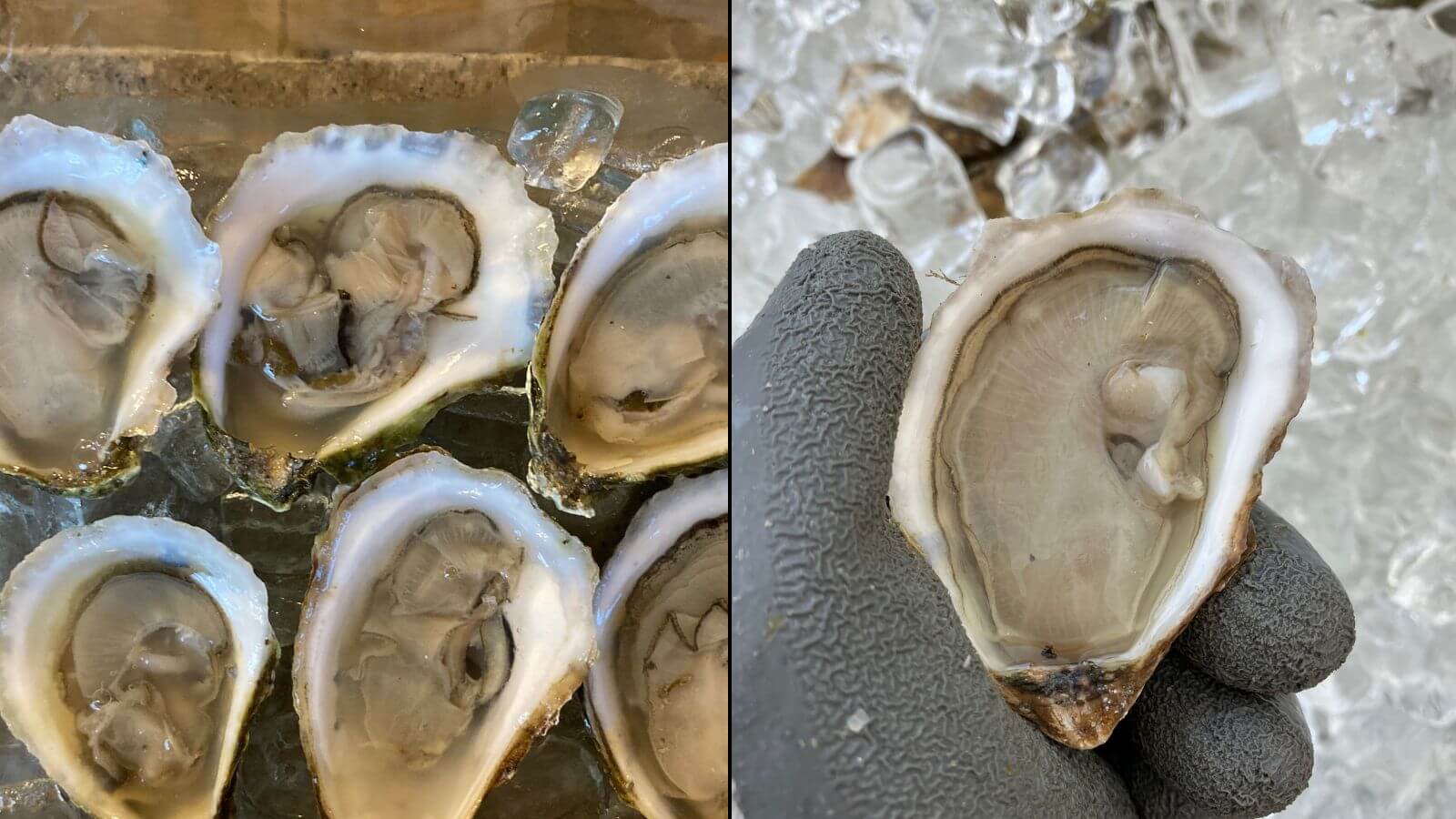
Every oyster is different, not only in taste, but in shape, so finding the right spot to pop open the oyster is difficult; it takes practice. And that’s just the first challenge. A well-shucked oyster must be clean, free of shattered shell or sand. Just as importantly, it cannot be pierced by the knife (“scrambled”) and should retain all the liquor inside the shell. Ideally, it’s served on pebble ice, not just cubes, so that it doesn’t tip over and spill.
There’s something meditative to running the oyster pop-ups, trying for the perfect shuck with every oyster. They’re rushed and busy and stressful — there’s always a line and shucking a dozen without scrambling or shattering is hard to do when you’re working fast. You have to reach a sort of zen state to fly through them, finding the right point on each shell to insert the knife, cleanly severing them from the shell and cleaning out any sand inside. No one wants that grinding sensation you get when you have a snack at the beach and feel the grit between your teeth. And you can’t appreciate the unique texture and taste of each varietal if they’re a scrambled mess inside.
The oyster should be a plump, pearly arc in the shell, with lacy frilled edges. It should be beautiful.
Apparently everyday Jews saw the beauty in the bivalve. They largely left the debates over kashrut to the pages of The American Israelite and continued to eat oysters by the bushel.
A 1911 blurb in the J. Jewish News of Northern California excitedly announced the beginning of oyster season, listing several of the area’s best “oyster houses,” as did Jewish newspapers across the country over the next few decades.
Jews even ran their own oyster stands. An 1892 article in the B’nai Brith Messenger wrote a brief piece marveling at the success of one Al Levy, whose Southern California oyster cart did so well he was able to open cafes and “cocktail rooms.” Despite Levy’s obvious disregard for kashrut, the piece notes that he “has been one of the most progressive, honored and beloved Jews in this community, popular alike among Jews and gentiles.”
Some of the most popular Jewish cookbooks from the era are full of oyster recipes, literally writing the bivalves into Jewish food history alongside kugel and latkes.
Aunt Babbette’s Cookbook, a Jewish cookbook that remained in print for 25 years, featured 11 oyster recipes in its fish section; the rest of the fish, all kosher, are given one preparation apiece. A dish that sounds an awful lot like kugel — though the cookbook doesn’t use that term — includes an option to add oysters. (Notably, other seafood like clams and shrimp are omitted from most Jewish cookbooks of the era.)
For all the enthusiastic embrace of oysters, though, there was still one line that wasn’t crossed: pork, which even the Trefa Banquet did not serve.
“The debate over selective kashrut centered on two issues: pork and oysters,” wrote Sussman, the rabbi and historian, and the line was drawn, for the most part, between the two. Pigs have long been a metonym for kashrut and Judaism, and centuries of antisemitic caricatures pictured Jews riding pigs. Eating pork, apparently, was instinctively understood by most American Jews as a step too far, a symbolic denial of identity.
The power of ‘kitchen Judaism’
The oyster has always been the perfect metaphor for American Jewish life.
There’s a Judaism of purity, hewing to the safety found in tradition: keeping kashrut, retaining a degree of separation from the rest of society. But most American Jews opted for a Judaism of experimentation, in which the rules get bent, reinterpreted and altered to adapt to the ways of a new culture and new country. It’s more dangerous; one might eat a bad oyster. But in the meantime one also gets to enjoy the good ones. Yet even as Jews debated how far Judaism could stretch and remain Jewish, they did so Jewishly. Even the Jews who, over a century ago, rejected Jewish tradition and embraced shellfish justified their choices with Talmudic citations and biblical exegesis. They used Jewish law to justify why Jewish law was wrong about the oyster. What debate could be more Jewish?
Food, since then, has become both more and less central to Jewish identity. Plenty of Jews now will eat bacon or ham, and a celebration of the Trefa Banquet’s centennial in 2018 served a menu of mostly pork, connecting to Judaism specifically through a rejection of its strictures. Kitchen Judaism has become aspirational instead of pejorative as food traditions have become a rich and beloved way to connect with Jewish identity. Meanwhile, the Reform tradition has actually tipped back toward kashrut observance; in 2001, at the Central Conference of American Rabbis, the Reform movement added in a recommendation that Jews follow “some element of Jewish dietary discipline.”

Through it all, the oyster has remained the perfect symbol of the decision confronting American Jews: How much should they assimilate to their new country, and how much tradition must they retain to stay Jewish?
This summer, I think I might have to miss the oyster farm; life has gotten in the way and I just don’t have the time. Still, I’m sure I’ll be shucking up trays for friends and customers somewhere (including at my Jewish wedding).
And most importantly, I’ll be carrying on the proud tradition of the oyster debate. I’ll admit that I don’t really buy the idea that shells are the same as scales, though I’m sympathetic to the idea that they should be categorized as vegetables. But the discussion I’m more interested in is how to eat them. The right answer is raw and plain. Maybe a drop of lemon. Maybe.
Cocktail sauce or horseradish or hot sauce, though? That’s heresy.
The post If mollusks are kosher, the world can be your oyster appeared first on The Forward.
Uncategorized
Instagram Pushes Antisemitic Videos to Hundreds of Millions of Users, Report Finds

Silhouettes of mobile users are seen next to a screen projection of the Instagram logo in this picture illustration taken March 28, 2018. Photo: REUTERS/Dado Ruvic/Illustration
Instagram actively recommends bigoted content to its users, according to newly published research from a leading antisemitism watchdog group.
The revelation followed two high-profile losses this week in lawsuits that charged billionaire Mark Zuckerberg’s Meta, which owns Instagram, with failing to protect children on its social media platforms.
On Wednesday, the Combat Antisemitism Movement (CAM) published new findings from its Antisemitism Research Center (ARC). The report, “Engineered Exposure: How Antisemitic Content Is Pushed and Amplified to Millions Across Instagram,” focused on tracking 100 antisemitic posts during a 96-hour period which Instagram directly pushed into users’ accounts through its own recommendation system.
CAM’s researchers found that these posts provoked 5.3 million likes and 3.8 million shares, which analysts estimate reached as many as 280 million users.
“Among the most disturbing findings is that the ARC researchers identified AI-generated ‘rabbi’ personas that were fabricated to push antisemitic tropes while projecting false religious authority,” CAM said in a statement announcing the report.
One bogus rabbi account CAM uncovered had collected more than 1.4 million followers. The report described how an account called Rabbi Goldman “pushes antisemitic conspiracy theories, including allegations of Jewish control of the global financial system, to a large audience, with some videos getting more than five million views.”
ARC identified 11 other fake rabbis, bringing the total followers for such accounts up to 2.1 million. According to the researchers, “each presents a distinct persona and voice, yet all promote narratives portraying Jews as obsessed with money, playing to classical antisemitic stereotypes.”
The report also documented substantial linking of Jews with occult themes including references to demons, Satan, 666, Moloch, freemasonry, the Illuminati, and especially the ancient Canaanite storm god Baal. The slander against Jews as secretly worshipping a deity who demanded child sacrifice and rivaled the God of Israel in the Bible has manifested elsewhere on social media. Far-right podcaster Candace Owens has claimed that the Star of David has “ALWAYS [sic] been associated with Canaanite cults and Baal worship.”
An important component of this new research is that rather than investigators searching for hateful content, they relied solely on “the standard use of Instagram over four days, via content actively suggested by the platform’s recommendation systems.”
“This distinction demonstrates that exposure to these narratives does not require users to seek out extremist material,” the researchers explained. “Instead, the platform itself can act as a vector, introducing and amplifying such content through its own distribution mechanisms.”
Through providing examples of the content analyzed, the researchers showed how conspiracy theories transition into calls for violence. One video discussed in the report blamed “the Rothschilds” and central banks as guilty of causing all global crises including wars, diseases, and 9/11. The video then “escalates into explicit eliminationist rhetoric, calling for their eradication as a solution. It uses the Rothschild family as a proxy for Jews and frames them as a singular, malevolent force controlling world events.”
CAM CEO Sacha Roytman said the report provided evidence “of a broad systemic failure on the part of Instagram and Meta.”
“When a platform actively recommends content that dehumanizes Jews to mass audiences, we are no longer talking about a simple oversight or a mistake in the algorithmic design. We are talking about infrastructure that normalizes hatred at scale that must be addressed immediately,” he added.
Regarding potential motivations for what might have inspired Zuckerberg to allow for such a proliferation of hate, the report noted in its introduction that Meta had been “generating substantial advertising revenue from engagement with the content in question.”
In 2025, Meta’s revenue reached $200.966 billion, an increase of 22.17 percent from 2024, when revenue hit $164.501 billion, a 21.94 percent increase from 2023’s $134.9 billion, which in turn had grown 15.69 percent from 2022.
Bloomberg currently ranks Zuckerberg as the fifth wealthiest person on the planet, with an estimated net worth of $211 billion. Earlier this month, he purchased a $170 million mansion in South Florida’s Indian Creek, noted as the most expensive sale in Miami-Dade County and listed as “the largest residence ever created on Miami’s most exclusive island.”
On Wednesday, Meta laid off 700 employees, largely those affiliated with the failed Reality Labs division, which burned through $80 billion in pursuit of creating the virtual reality platform Horizon Worlds. The platform will shut down on June 15.
Roytman said that Meta “must take a hard look at how its algorithms are promoting antisemitic content and put real, transparent safeguards in place to stop it.”
Meta may have additional motivation now to level up the safety protocols on its platforms following back-to-back decisions in a pair of lawsuits this week which, legal analysts suspect, may have now opened the floodgates for thousands of similar cases around the country.
On Tuesday in Santa Fe, jurors found Meta liable and imposed a $375 million fine for failing to prevent minors’ exposure to harmful sexual content including online solicitations, human trafficking, and explicit imagery.
“Meta executives knew their products harmed children, disregarded warnings from their own employees, and lied to the public about what they knew,” New Mexico Attorney General Raúl Torrez said in a statement following the verdict. “Today the jury joined families, educators, and child safety experts in saying enough is enough.”
Torrez vowed to go after Meta for more money and force changes to the platforms.
“New Mexico is proud to be the first state to hold Meta accountable in court for misleading parents, enabling child exploitation, and harming kids,” Torrez said. “In the next phase of this legal proceeding, we will seek additional financial penalties and court-mandated changes to Meta’s platforms that offer stronger protections for children.”
On Wednesday in Los Angeles, jurors found Meta and Alphabet (parent company of YouTube) liable for the addictive qualities of their platforms exacerbating the mental health problems of a young woman and awarded her $3 million in damages with $3 million more in punitive damages.
Omri Ben-Shahar, a law professor at the University of Chicago, told the Wall Street Journal that “what is new is the addiction element.” He warned “that could create a very broad liability. The notion of addiction, there is something very abstract about it.”
Meta and Alphabet both plan to appeal the ruling. Alphabet spokesman José Castañeda sought to distance the company from Meta (which jurors found more heavily liable at a 70-30 penalty ratio), saying “this case misunderstands YouTube, which is a responsibly built streaming platform, not a social media site.”
Previous legal challenges to social media and online video companies for failing to prevent exposure to harmful content have usually failed due to longstanding legal interpretations of Section 230 of the 1996 Communications Decency Act, which states that “no provider or user of an interactive computer service shall be treated as the publisher or speaker of any information provided by another information content provider.”
This statute has prevented plaintiffs from suing a website’s host the way they would an individual committing slander or a publisher engaged in libel. The legal innovation which allowed for success in these cases was lawyers’ decision to focus not on the content itself but on the design of the products which intended to hold users captivated, glued to their phones for hours.
“They knew,” said Mark Lanier, the lawyer for the 20-year-old plaintiff in the addiction case. “They targeted the children.”
Uncategorized
University of Wisconsin–Madison Denounces BDS Resolution Passed by Student Government

University of Wisconsin-Madison campus on May 1, 2024. Photo: USA TODAY Network via Reuters Connect
The University of Wisconsin–Madison’s student government on Wednesday passed a resolution which endorsed the boycott, divestment, and sanctions (BDS) movement and demanded the institution divest from companies involved financially with Israel, drawing a stern rebuke from the school’s administration.
As previously reported by The Algemeiner, the resolution accuses the Jewish state of “apartheid, genocide, and militarized violence … at the intersections of race, gender, religion, disability, and socioeconomic status.” It also compares Israel’s conduct in its defensive war against the terrorist group Hamas to the Rapid Support Forces of Sudan (RSF), a notorious paramilitary group responsible for a slew of war crimes and premeditated mass casualties of civilians.
After failing to reach the floor for a vote when the Associated Students of Madison (ASM) first considered it last week, it was approved during an evening session on Wednesday. The body has not yet released the final tallies of the vote, but the UW Madison administration confirmed that it passed in a statement which condemned the outcome.
The university also said it was “reviewing reports alleging that an online chat, including possibly some ASM representatives, used an antisemitic term in reference to limiting potential speakers at the March 18 ASM meeting” where the resolution was considered.
According to The Daily Cardinal, a campus newspaper, an SJP member told their contact in ASM via text message to slash the time allotted for public comment because the “proportion of Zios [sic] rises as the speaker list goes on.”
“Zio” is an antisemitic slur brought into prominence by former Ku Klux Klan leader David Duke. While the term, derived from “Zionist,” has generally been deployed by white supremacists and other far-right extremists, it has more recently been used as well by anti-Israel activists on the progressive far left to refer to Jews in a derogatory manner.
Noting that the resolution “issued a number of flawed, unrelated and illegal demands,” the administration said in Wednesday’s response to the vote that “Wisconsin state law prohibits state and local government agencies from adopting their own rules or policies that would involve them in a boycott of Israel” and that “ASM leadership was counseled by university attorneys on the clear illegality of that specific part of the resolution” but “nonetheless voted to pass it.”
The administration did not condemn BDS as matter of principle, however, but said that UW-Madison “condemns antisemitism in all of its forms” in regard to the “Zio” text message.
Formally launched in 2005, the BDS movement opposes Zionism — a movement supporting the Jewish people’s right to self-determination — and rejects Israel’s right to exist as a Jewish nation-state. It seeks to isolate the country with economic, political, and cultural boycotts. Official guidelines issued for the campaign’s academic boycott state that “projects with all Israeli academic institutions should come to an end,” and delineate specific restrictions that its adherents should abide by — for instance, denying letters of recommendation to students applying to study abroad in Israel.
Leaders of the BDS movement have repeatedly stated their goal is to destroy the world’s only Jewish state.
The apparent antisemitic undertones of the ASM vote at the University of Wisconsin-Madison underscore the reality of campus antisemitism and the degree to which it has changed Jewish student life.
According to a recent survey commissioned by the American Jewish Committee (AJC) and Hillel International, a striking 42 percent of Jewish students reported experiencing antisemitism during their time on campus, and of that group, 55 percent said they felt that being Jewish at a campus event threatened their safety. The survey also found that 34 percent of Jewish students avoid being detected as Jews, hiding their Jewish identity due to fear of antisemitism.
Meanwhile, 38 percent of Jewish students said they decline to utter pro-Israel viewpoints on campus, including in class, for fear of being targeted by anti-Zionists. The rate of self-censorship is significantly higher for Jewish students who have already been subjected to antisemitism, registering at 68 percent.
The survey, included in AJC’s new “The State of Antisemitism in America” report, added that 32 percent of Jewish students feel that campus groups promote antisemitism or a learning environment that is hostile to Jews, while 25 percent said that antisemitism was the basis of their being “excluded from a group or an event on campus.”
Jewish students endure these indignities while preserving their overwhelming support for Israel. Sixty-nine percent of those surveyed identified caring about Israel as a central component of Jewish identity and 76 percent agreed that calling for its destruction or describing it as an illegitimate state is antisemitic.
Follow Dion J. Pierre @DionJPierre.
Uncategorized
Iran Lowers Minimum Age for War Roles to 12, Sparking Outcry Over Child Soldier Use

Kids hold up an Iranian flag and chant slogans during a protest against the Israeli airstrikes on Iran, in Sana a, Yemen, June 20, 2025. Photo: IMAGO/Hamza Ali via Reuters Connect
The Iranian regime has lowered the minimum age for participation in war-related activities to just 12 years old, a move that will likely fuel the concerns of human rights groups, which have condemned Iran’s treatment of children.
In a televised interview with state media, Rahim Nadali, a cultural with Iran’s Islamic Revolutionary Guard Corps (IRGC) in Tehran, announced that the new initiative “For Iran” is recruiting participants to assist with patrols, checkpoints, and logistics.
“Since children are increasingly volunteering to take part, we have lowered the minimum age to 12,” Nadali said, urging young children to join the war effort if they wish.
Rahim Nadali, Cultural Deputy of the IRGC’s Tehran branch (Mar 26, 2026):
“12 and 13-year-old children wanted to participate in Basij checkpoints across the cities. We have lowered the age limit to 12 and above.” pic.twitter.com/lLZy9pU5xm— حافظه تاریخی (@hafezeh_tarikhi) March 26, 2026
Iran International first reported Nadali’s statement, which has since circulated on social media.
As part of the regime’s state media coverage of the US-Israeli war against Iran, this latest announcement has ignited mounting backlash over the use of minors in security‑related roles — a practice that is not new in Iran.
“Recruiting children into military activity is a violation of international laws and the international community must not stay silent,” Iranian-American activist Masih Alinejad posted on social media, along with video of Nadali’s comments. “This is the same regime that lectures the world about morality. But when it comes to survival? They’re willing to send children into danger.”
In the past, widely circulated social media images and videos have repeatedly shown children and teenagers in military-style uniforms cracking down on protests, including during the 2022 Woman, Life, Freedom uprising, which erupted nationwide after Mahsa Amini, a young Kurdish woman, died in a Tehran police station following her arrest for allegedly violating hijab rules.
Under international law, Iran’s move flagrantly violates the Convention on the Rights of the Child, which explicitly prohibits the use of children in military activities, marking a dramatic breach of its global obligations.
Human rights groups have also repeatedly accused Iranian security forces of killing child protesters during past crackdowns.
According to the Center for Human Rights in Iran, more than 200 children were killed during the nationwide anti‑government protests earlier this year, which security forces violently crushed, leaving thousands of demonstrators tortured or killed.
Amnesty International and Human Rights Watch have also documented cases of children being shot, detained, and abused during these latest demonstrations, noting that government forces have repeatedly targeted minors in ways that breach international law.
Iran has a long track record of widespread human rights abuses, including crackdowns on protesters, harassment of activists, threats to minorities, executions of children, violations of women’s rights, and dire prison conditions.
During the January uprising, at least 6,724 protesters, including 236 children, were killed, with another 11,744 cases still under verification, according to the Human Rights Activists News Agency (HRANA). Multiple other reports have estimated that the overall death toll may exceed 30,000.
As in past years, executions remain one of the starkest manifestations of human rights abuses in Iran, with at least 2,488 people executed last year, including 63 women and two children, 13 of them carried out publicly.
Tehran’s latest controversial move comes as Iran has reportedly slammed a US proposal to end the war as “one‑sided and unfair,” a rebuff that has cast doubt on the prospects for a negotiated ceasefire.
US President Donald Trump has warned the Islamist regime it must reach a deal or face a continued onslaught.
“They now have the chance, that is Iran, to permanently abandon their nuclear ambitions and to join a new path forward,” Trump said during a Cabinet meeting at the White House.
“We’ll see if they want to do it. If they don’t, we’re their worst nightmare. In the meantime, we’ll just keep blowing them away.”