


Uncategorized
I’m Palestinian. Here’s why Trump’s Gaza gambit might just work

It could also be just what the Middle East needs
After a century of Palestinian leaders rejecting a two-state-solution, Trump’s proposal could be a wakeup call that peace is the only solution
By DAOUD KUTTAB (February 21, 2025) This story was originally published in the Forward (https://forward.com/opinion/698785/gaza-palestine-israel-trump/). Click here to get the Forward’s free email newsletters delivered to your inbox.
One of the biggest obstacles to finding a peaceful solution to the Israeli-Palestinian conflict has been an overwhelming imbalance in direct international support. Armed with extensive international resources, especially from the United States, Israel has long been able to reject logical solutions while presenting the minimum justifications to placate international sponsors. Over time, this has led to resistance from Palestinians, which has produced an even more radical Israeli position, leading, after the horrific Oct. 7 attack, to the devastating violence of Israel’s war in Gaza.
Now, President Donald Trump’s administration has been called to help Israel out of the jam it finds itself in. Trump has, in classic fashion, delivered bombastic promises of peace and prosperity, much to the delight of Israelis, who have largely embraced his proposals for a mass relocation of Palestinians in Gaza and a U.S. takeover of the embattled strip.
But as the saying goes, be careful what you wish for. Once Washington finds itself more involved in the day-to-day management of the Palestinian-Israeli conflict, Trump might find that the result that will guarantee peace and tranquility is not necessarily that which Israelis — and certainly the Israeli right — are expecting.
That’s because Trump, who has a history of making grand promises and not fulfilling them, may find that it is easier to create a buffer between Israelis and Palestinians than to organize the displacement of an entire population and redevelopment of an area destroyed to rubble. And that kind of buffer, between a powerful militaristic occupier and a weak but resilient occupied, is exactly what the region needs.
And the U.S. is the ideal party to create that buffer, for two reasons.
First, it can provide what no other state in the world is able to: the security assurances that Israel and the Israeli people badly need. And second, whenever Israelis engage with Palestinians, they use their superior military and political power to insist on exaggerated demands. But when the U.S. is in the room — represented by officials not afraid to deploy their power — a more logical conversation takes place.
Security guarantees from the U.S. could go a long way in removing a major obstacle Israel has continuously presented in justifying its hesitancy about finding a long-term strategy to create a permanent peace solution and a Palestinian state. Past peace ideas have failed because the balance of power was always on the Israeli side, and despite its claims to want peace, Israel has never truly been willing to pay the price of that outcome — land — using security as an excuse. Providing Israelis with an iron-clad guarantee of security, possible with the deployment of U.S. or NATO forces, could finally shift the balance.
Successive U.S. presidents have failed to help Palestinians and Israelis reach peace, because they have refused to take the bold steps needed to act as honest brokers, and rejected the idea of acting as a temporary buffer and an insurer between the occupier and the occupied.
Trump has shown that an excess of restraint will not be his administration’s problem. When months of indirect negotiations between Israel and Hamas, with the engagement of former President Joe Biden’s administration, repeatedly failed to produce a ceasefire, the intervention of Trump’s incoming administration brought the deal to fruition. I do not doubt that continued U.S. engagement will also produce agreement on the critical second and third phases of the ceasefire deal, which will involve the release of all remaining hostages in Gaza — dead and alive — and end the 15-month war.
Yes, Trump has proclaimed a vision for the future of the region that is notably free of a Palestinian presence, let alone leadership. But once the leader of the U.S. and his aides roll up their sleeves and begin the nitty gritty process of trying to achieve peace in the Middle East, they will run into a truth that all others who have tried the same have faced, which is that to get anything done in the region, one must apply tough love policies to all sides — not just one.
For Palestinians, like me, inviting this intervention means making a bet: That Trump, once on the ground, will find it more expedient to scale back his plans. The president’s history of bluster — and of making big threats, but strategically accepting much smaller gains — makes that bet worthwhile.
Palestinians have seen in the Israeli settlement enterprise the best proof that Israel is not willing to relinquish land for peace — just the opposite. A shake-up is needed. And Palestinians have previously hoped that an international presence could provide that adjustment: As part of previous peace negotiations, some past Palestinian leaders, including President Mahmoud Abbas, have suggested stationing NATO troops in a future Palestinian state to reassure Israel. But those proposals, like so many others in this process, stalled.
If Trump is willing to genuinely engage, in a way that his predecessors were not, it might mean a major breakthrough that will change our region. The Trump administration can end this occupation and can bring peace through security if it wishes, and the world will applaud them if they do.
Daoud Kuttab is an award-winning Palestinian journalist and former Ferris Professor of journalism at Princeton University. His twitter handle is @daoudkuttab
The views and opinions expressed in this article are the author’s own and do not necessarily reflect those of the Forward. Discover more perspectives in Opinion. To contact Opinion authors, email opinion@forward.com.
Uncategorized
‘Sefer Elijah’ — probably the oldest proto-Ashkenazi text
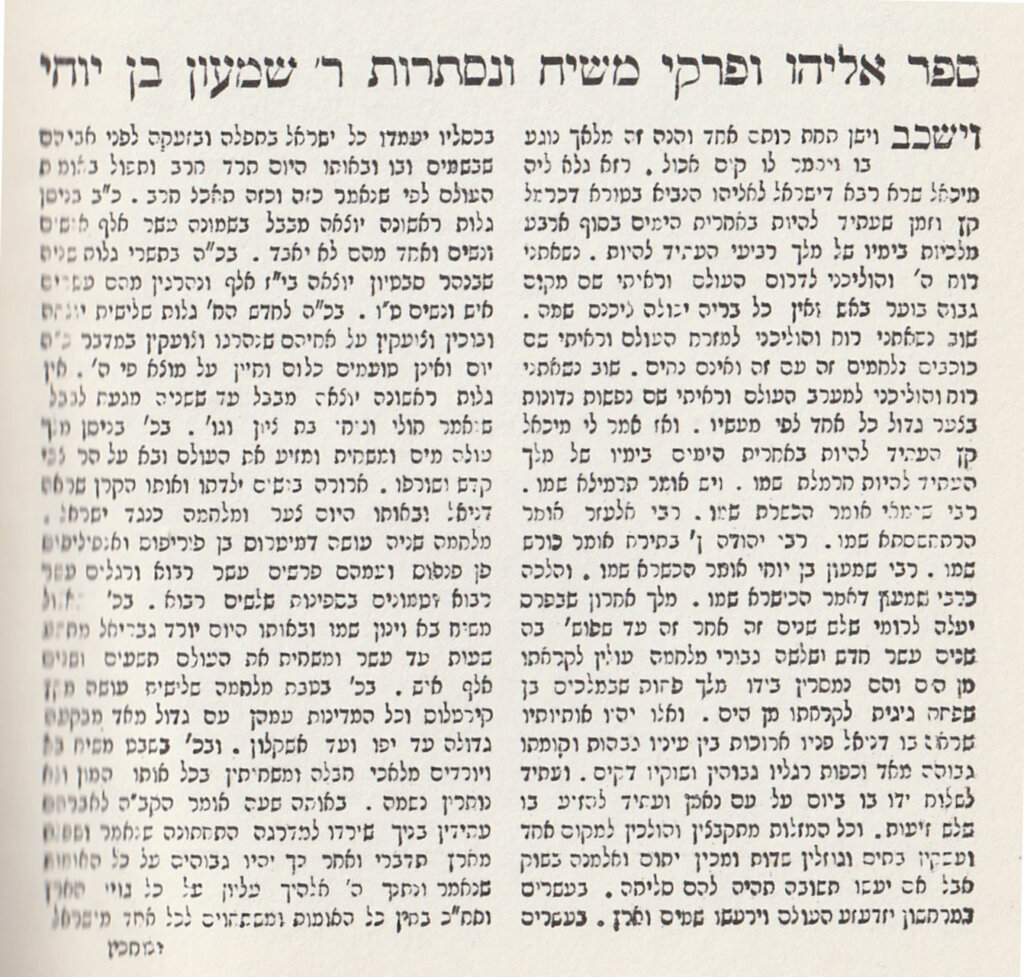
ס׳איז מעגלעך, אַז מיר האָט זיך אײַנגעגעבן צו אַנטדעקן דעם עלטסטן פּראָטאָ־אַשכּנזישן טעקסט, אָנגעשריבן אינעם פֿריִיִקן 9טן יאָרהונדערט. דאָס איז דער אוראַלטער אַפּאָקאַליפּטישער מדרש „ספֿר אליהו‟, אַ ספֿר וואָס איז מיר שוין לאַנג גוט באַקאַנט.
געשען איז עס אַזוי: ווען איך בין ערשט אָנגעקומען קיין אַמעריקע אין 1998 — אין וויליאַמסבורג — האָב איך זיך אַ דריי געטאָן אין די אָרטיקע ביכער־קראָמען און געקויפֿט די גאָר אינטערעסאַנטע מדרש־זאַמלונג „ילקוט הרועים‟, באַגלייט מיט גלענצנדיקע הסכּמות (רבנישע באַשטעטיקונגען), אַז דער ספֿר איז אָנגענומען ווי אַ הייליקער, אַרײַנגערעכנט אַ רעקאָמענדאַציע פֿון דעם דעמאָלטיקן סאַטמאַרער רבין משה טייטלבוים זצ״ל.

די זאַמלונג באַשטייט על־פּי־רובֿ פֿון טיפֿע קבלה־טעקסטן און עטלעכע אַפּאָקאַליפּטישע מדרשים וועגן דעם קץ־הימים — דעם סוף פֿון די טעג, די צײַט וואָס משיח דאַרף קומען — בתוכם דעם „ספֿר אליהו‟. אָט דער ספֿר און נאָך עטלעכע אין דער דאָזיקער זאַמלונג שילדערן די ביאת־המשיח נישט ווי אַ פּלוצעמדיקן גליקלעכן סוף פֿון אַלע ליידן אין דער וועלט, נאָר ווי אַ שרעקלעכן פּראָצעס, באַגלייט מיט חורבֿות און שוידערס. נישט נאָר בײַ די קריסטן איז פֿאַראַן אַזאַ מין ליטעראַטור. בקיצור, שטייט אינעם „ספֿר אליהו‟ געשריבן, אַז ווען משיח וועט קומען, וועט ער צונויפֿברענגען אַלע צדיקים — בסך־הכּל 30 טויזנט — אין אַ הימליש אָרט ווײַט פֿון אונדזער ערד, וועלכע וועט פֿאַרברענט ווערן מיט אַלע אירע איבעריקע זינדיקע תּושבֿים.
די אמונה, אַז דער נײַער משיחישער צוקונפֿטיקער ירושלים וועט אַראָפּקומען פֿונעם הימל און אַז די שטאָט האָט ווייניק צו טאָן מיט דער הײַנטיקער ירשולים, איז אַמאָל געווען אַבסאָלוט נאָרמאַל בײַ ייִדן, בפֿרט אין דער אַשכּנזישער וועלט. רש״י האָט, למשל, אויך אַזוי געגלייבט. אין דער שפּעטערדיקער צײַט האָט הרבֿ צבֿי־הירש קײַדאַנאָווער, דער מחבר פֿונעם פּאָפּולערן מוסר־ספֿר „קבֿ הישר‟, וועלכן ער האָט אַליין איבערגעזעצט פֿון לשון־קודש אויף ייִדיש, אַזוי געשריבן אינעם פֿריִיִקן 18טן יאָרהונדערט.
דער „ספֿר אליהו‟ בלײַבט כּמעט אומגעפֿאָרשט. הלל ניומאַן, אַ היסטאָריקער פֿונעם חיפֿהר אוניווערסיטעט, האָט באַמערקט, אַז דער דאָזיקער מדרש קלינגט ענלעך אויף דער קריסטלעכער אַפּאָקאַליפּטישער ליטעראַטור. עטלעכע אַנדערע פֿאָרשער האַלטן, אַז ס׳איז אָנגעשריבן געוואָרן בײַם אָנהייב פֿון דער איסלאַמישער תּקופֿה. לאָמיר זיך אָבער אַרײַנקוקן אין געוויסע פּרטים, וואָס די פֿאָרשער האָבן פֿאַרקוקט — און וואָס איך האָב אַליין ערשט באַמערקט נישט לאַנג צוריק.
אין אַ סך מדרשים ווערט דערמאָנט דער אַנטי־משיח מיטן נאָמען אַרמילוס. אין „ספֿר אליהו‟ ווערט אָבער זײַן נאָמען אויסגעלייגט ווי „הרמלת‟. ווײַזט אויס, אַז בײַ דעם מחבר האָט אַ תוו געקלונגען ווי אַ סמך, און דער הא איז בײַ אים געווען שטום. דעם נאָמען פֿונעם פּערסישן מלך אַרתּחשסתּא שרײַבט ער אויך ווי „הרתּחשסתּא‟. עס ווערט דערמאָנט עפּעס אַ ים־מאָנסטער — „גיגית‟; ווײַזט אויס, מיינט עס gigas אויף לאַטײַניש, אַ ריז. אַזאַ אַרויסרייד האָט געקאָנט נאָר זײַן בײַ פּראָטאָ־אַשכּנזים, וועלכע האָבן גערעדט אויף אַלט־פֿראַנצויזיש (צי, מעגלעך, אויף עפּעס אַ געמישטן דיאַלעקט, וווּ קיין הא־קלאַנג איז נישט געווען).
אינעם דאָזיקן מדרש שטייט געשריבן, אין געוויסע ווערסיעס, אַז די מלחמות פֿאַר דער ביאת־המשיח וועלן אָנהייבן די מלכים קוסטנטנוס און קרטילוס. אַזוי שטייט אין יהודה אבֿן־שמואלס (יהודה קויפֿמאַנס) זאַמלונג „מדרשי גאולה‟. אינעם חסידישן ספֿר, וואָס איך האָב, ווערט דערמאָנט נאָר „קירטלוס‟. ס׳איז קלאָר, מיין איך, אַז דאָ גייט די רייד וועגן דעם ביזאַנטישן מלך קאָנסטאַנטין דעם זעקסטן, מיט וועלכן קאַרל דער גרויסער האָט געוואָלט זיך מזווג זײַן, כּדי צו שאַפֿן אַ פֿאַראייניקט וועלט־מלכות, דורכן זיווג מיט קאָנסטאַנטיס מאַמע אירענע. קאָנסטאַנטינען האָט מען געשדכנט מיט קאַרלס טאָכטער ראָטרודע. אויב די דאָזיקע שידוכים וואָלטן געלונגען, וואָלט דעמאָלט אויפֿגעשטאַנען אַ נײַע גלאָבאַלע רוימישע אימפּעריע. קאַרל דער גרויסער האָט זיך אָבער סײַ־ווי־סײַ געהאַלטן פֿאַר אַ נײַעם רוימישן אימפּעראַטאָר. דער פּויפּסט לעאָן דער דריטער האָט אים געקרוינט מיט אַזאַ טיטל אין יאָר 800.
הגם קאַרל דער גרויסער האָט דערלויבט ייִדן צו וווינען אין זײַן קיניגרײַך און פֿאַרפֿלאַנצט דערמיט דאָס קערנדל פֿון דער אַשכּנזישער ציוויליזאַציע, ווערט אין אַ סך אַלטע מדרשים פֿאָרויסגעזאָגט, אַז די חבֿלי־המשיח, די צרות פֿאַר משיחס קומען, וועלן זײַן פֿאַרבונדן מיט רוים; דערפֿאַר האָבן ייִדן אויפֿגענומען זײַן אימפּעריע ווי אַ סימן פֿון אַפּאָקאַליפּטיש־משיחישע געשעענישן.
קאָנסטאַנטין דער זעקסטער איז געשטאָרבן בערך אין 805 (לויט אַנדערע קוואַלן אין 797) און קאַרל דער גרויסער — אין 814. באַקומט זיך, אַז דער „ספֿר־אליהו‟ מוז געהערן צו דער תּקופֿה, ווען זיי האָבן ביידע נאָך געלעבט.
וואָס עפּעס „קרטילוס‟? פֿאַרוואָס איז קאַרלס נאָמען אין אונדזער ספֿר אַזוי פֿאַרקריפּלט געוואָרן? ס׳קען זײַן, אַז אין זײַן אייגן לאַנד וואָלט געווען וויכטיק אויסצובאַהאַלטן זײַן נאָמען, די קריסטן זאָלן נישט וויסן, אַז בײַ ייִדן גייט אַרום אַזאַ געהיימער קלאַנג, אַז דער קיניג וועט מיט זײַנע מלחמות גורם זײַן די ייִדישע גאולה. מע קען זיך אַפֿילו משער זײַן, פֿאַרוואָס מע האָט אויסגענוצט אַזאַ שיפֿער: די אותיות טית און יוד קאָנען זײַן ראָשי־תּיבֿות פֿון זײַן טיטל imperator terrae.
ס’איז וויכטיק צוצוגעבן, אַז געוויסע קריסטלעכע שרײַבער האָבן געגלייבט, אַז קאַרל דער גרויסער וועט זיך אומקערן איידער יעזוס וועט זיך באַווײַזן צום צווייטן מאָל. אַזוי האָט געשריבן אינעם 11טן יאָרהונדערט דער מאָנאַך אַדעמאַר פֿון לימאָזש, פֿראַנקרײַך. אויב אַ טייל ייִדן האָבן געגלייבט אין עפּעס ענלעכס, וואָלט מען געקאָנט פֿאַרשרײַבן דעם „ספֿר אליהו‟ נאָכן טויט פֿון קאַרל דעם גרויסן.
ואַחרון אַחרון חבֿיבֿ, דער סטיל פֿונעם „ספֿר אליהו‟ איז וווּנדערלעך ענלעך אויף דער אַלט־בײַערישער אַפּאָקאַליפּטישער פּאָעמע Muspilli, פֿונעם 9טן יאָרהונדערט, וווּ דער הויפּטהעלד איז אויך אליהו הנבֿיא. עטלעכע שטיקלעך פֿון ביידע טעקסטן קלינגען כּמעט אידענטיש. ווײַזט אויס, אַז אונדזער מדרש געהערט טאַקע צו דער תּקופֿה פֿון קאַרל דעם גרויסן — צי, אפֿשר, מיט אַ דור־צוויי שפּעטער — ווען אַפּאָקאַליפּטישע געדאַנקען זענען געווען פֿאַרשפּרייט אויך בײַ די קריסטן.
דער אימאַזש, אַז דער אייבערשטער וועט אַוועקטראָגן די צדיקים אין עפּעס אַ הימלישער וועלט, ווען די גאַנצע ערד וועט ברענען, קלינגט ממש ווי דער גערמאַנישער מיטאָס וועגן דעם ראַגנאַריאָק, דעם סוף פֿון דער וועלט, אָפּגעשפּיגלט אויך אין Muspilli.
באַקומט זיך, אַז ייִדן אין דײַטשלאַנד האָבן נאָך מיט 1200 יאָר צוריק אַרויסגערעדט דעם תוו ווי „ס‟. צי האָבן אַ טייל פֿון זיי דעמאָלט שוין גערעדט אויף דײַטשיש, נישט אַלט־פֿראַנצויזיש? אין 838 האָט דער פֿראַנקישער גלח באָדאָ זיך מגייר געווען; זײַן ייִדישער נאָמען איז געווען אליעזר. ער האָט געדינט אינעם הויף פֿון קאַרלס זון לויִס דעם ערלעכן. ווײַזט אויס, אַז אַרום יענעם דײַטשיש־רעדנדיקן גלח איז שוין געווען בנימצא אַ גענוג גרויסע ייִדישע סבֿיבֿה, וועלכע האָט משפּיע געווען אויף זײַן באַשלוס צו ווערן אַ ייִד. אויף וועלכער שפּראַך זיי האָבן גערעדט, ווייסן מיר נישט גענוי, צום באַדויערן.
דער „ספֿר אליהו‟ איז, ווײַזט אויס, דער עלטסטער אָפּגעהיטער פּראָטאָ־אַשכּנזישער קוואַל. ביזן 11טן יאָרהונדערט איז אין ארץ־אַשכּנז בכלל נישט געווען באַקאַנט די גמרא. ווי מע זעט פֿון די אַשכּנזישע ספֿרים, אַז אַפֿילו שפּעטער זענען בײַ מיסטיש־געשטימטע דײַטשישע ייִדן געווען גאָר וויכטיק — אפֿשר, נאָך וויכטיקער ווי די גמרא — פֿאָלק־מעשׂיות, שפּרוכן און סגולות, וכּדומה. אַז זיי האָבן געשילדערט די ביאת־המשיח ווי אַ כּמו־קריסטלעך אַפּאָקאַליפּטיש געשעעניש, אויסגעמישט מיט אימאַזשן פֿון גערמאַנישער מיטאָלאָגיע, איז נישט קיין גרויסער חידוש. דער דײַטשישער פֿאָלקלאָר פֿאַרנעמט אַ גרויס אָרט אין דער אַלט־ייִדישער ליטעראַטור, ווי אויך, ווייניקער, אין ערנסטע ספֿרים. אַז אַזאַ קולטור־סינטעז האָט זיך שוין אָנגעהויבן אינעם 9טן יאָרהונדערט איז אָבער יאָ אַ חידוש.
The post ‘Sefer Elijah’ — probably the oldest proto-Ashkenazi text appeared first on The Forward.
Uncategorized
Roy Lichtenstein was far more than just a copyist, Roy Lichtenstein was far more than just a copyist

It’s easy to understand why the new Roy Lichtenstein exhibit at the Whitney Museum foregrounds the issue of copying, even to the extent of embracing it. Lichtenstein was — as his “Image Duplicator” from 1963 (included prominently here) shows — a constant and avowed copier. That’s by no means all he did, but he was famous for taking comic book art and making it epic. The issue was publicly and recently revisited by James L. Hussey and Jesse Finley Reed in their 2023 documentary Whaam! Blam! Roy Lichtenstein and the Art of Appropriation, in which researcher David Barsalou found hundreds of images which Lichtenstein used as source material.
Just for the sake of an in-your-face example of duplication, the Whitney owns the study for his massive 1964 World’s Fair mural “Girl in Window.” In addition to displaying that image in the exhibition gallery, the museum has mounted a spectacular replica of it on the outside of the building that is almost twice the size of the original. The 32-foot reproduction demonstrates the radical difference in scale between a comic panel and the monumental installation. It also has the effect of encouraging tourists on the High Line to visit “Roy Lichtenstein: Like New.”

The copying doesn’t stop there, it goes on and on. The most striking of the several works in the exhibition that were inspired by Lichtenstein’s practice comes from artist Alex Da Corte (also one of the curators). His large outside artwork “Hot Dog With Ketchup” traces directly back to Lichtenstein’s much smaller 1964 “Hot Dog.” Though the other work is smaller and located inside, Da Corte’s benefits from size, color, condiment, and location — his work sits opposite the hot dog vendors that cater to Whitney visitors and High Line walkers.
What the Whitney doesn’t mention, in its consideration of Lichtenstein’s art in the era of AI appropriation and TikTok culture, is that the mid-20th century was a time when people were already worried about copies. Jews and antisemites especially were extremely concerned with what it meant to take one thing and reproduce it. The question of mass production, reproduction and art had reached America as early as in 1917, when Marcel Duchamp took a mass-produced urinal and submitted it upside-down for a show in New York as “Fountain.”

That was already about a decade after the antisemitic Austrian politician Hermann Bielohlawek — a member of the Vienna City Council and ally of the Nazi-forerunner Karl Lueger — said “Culture is what a Jew copies from another.” (“Kultur ist was ein Jud’ von anderen abschreibt,” as quoted in David Nirenberg’s Anti-Judaism: The Western Tradition.) Once the slow trickle of emancipation legislation acknowledged that Jews should have the same rights as other citizens and were legally part of the European body politic, racist cultural arbiters were invested in disallowing them from European culture as an ersatz people just copying “real” Europeans.
So, yes, Lichtenstein owes a lot of his understanding of perception and practice to his professor Hoyt L. Sherman and the Flash Lab at Ohio State University, but the idea of aping and shaping culture from ready-made images is a larger topic. Perhaps too, it was a topic for which America — not immured in canonical European Christian art — had a specific role to play. When I arrived in the country late in the last millennium I was amazed that cooking recipes listed ready-made ingredients like cans of mushroom soup. But maybe there’s a liberation in that.
By Duchamp’s time, culture had crashed through the walls of decorum, but in the generations between him and Lichtenstein, technology had also moved on. While Lichtenstein was at grade school on 89th Street on the Upper West Side, Walter Benjamin was writing his prescient, seminal 1935 essay “The Work of Art in the Age of Mechanical Reproducibility,” which discusses, among other things, how contemporary image reproduction undermines the almost religious nature of art: Viewing a postcard of the Mona Lisa is not the same as experiencing it in person.

By taking ready-made images of everyday life from tins, comics, or — in one particularly heavy-handed instance — from Erle Loran’s book Cezanne’s Composition and pulling them back into the realm of art, Lichtenstein was joining an established conversation in parallel with the other preeminent Pop Artist, Andy Warhol. But, unless you are on the 7th floor where the museum is displaying Family Album, a small Warhol show, don’t mention that other “W” word at the Whitney this fall: The museum has gone big for this show. “Like New” is the first New York Lichtenstein retrospective it over 30 years, it is his centenary show (though three years late because of COVID), and Roy is the hometown hero, so gentrified downtown is all “L” all the time.
The closest the exhibition comes to including Warhol is displaying “Laughing Cat,” a 1961 painting that Lichtenstein included in a trade (with other art) for portrait commissions from his Pittsburgh peer in 1975. Little seen in the past 50 years, Lichtenstein’s “Laughing Cat” sits next to “Engagement Ring: just as it did in his breakthrough 1962 show at the Leo Castelli Gallery. At the press presentation, curators Da Corte and Meg Onli expressed their appropriate pride at recreating that show in a room inset into the spacious Whitney galleries.
It’s both breathtaking to be taken back to 1962 and also retro fun. Though it’s an actual reproduction of the gallery, the reproduced studio is radically different from the original, not just because it’s 64 years on and this time the setting is a museum, rather than a for-profit art gallery. But also, relatedly, because these pieces of art are not new but proven, even iconic. It’s worth comparing the Castelli Gallery to The Cavern where — at almost the same time as that show — four young Liverpudlians were working out the kinks in “Love Me Do,” one of their first songs fashioned from the chords of the American rock and R&B covers they loved.

Is any of this “Like New” as the title of the exhibition would have it? Certainly not in the sense that nothing in seeing this massive and beautifully spaced retrospective is like seeing the work as it was freshly made. Even the inclusion of four just-painted life-size murals, beginning with the bright, audacious Greene Street mural as you enter the exhibit does not make it “like new.”
However, the title works in the intended sense that Lichtenstein made existing things seem “like new.” He took ready-made images and techniques from the market and the culture around him and — to use the word coined by Viktor Shklovsky in the decade before Lichtenstein’s birth — “defamiliarized” them. So, in the sense that both Lichtenstein and the curators are presenting common, everyday, iconic things in an unfamiliar or strange way — yes.
The issue of copying is, to my mind, relatively trivial. AI has effectively stolen all the words and images that have ever been made without any compensation for the creators while using those words and images in exactly the same way that the creators intended them. Lichtenstein transformed the work he found.
In its review of Hussey and Reed’s film, the Guardian quoted Michael Daley, a cartoonist, talking about the feelings of those artists whose images Lichtenstein used: “Comic book artists are rightly aggrieved. Aside from outright plagiarisms, technically and artistically, they are generally far better draughtsmen than Lichtenstein.” But the review goes on to cite the authoritative answer of Bradford R Collins, author of Pop Art and professor of art history at the University of South Carolina. He defended Lichtenstein: “It’s not plagiarism. It’s appropriation,” he wrote. “With plagiarism, you’re stealing somebody’s work and using it for the same purpose they did. If Lichtenstein made comic books out of it, that would be stealing. But appropriation means you’re taking something and reusing it for a very different purpose, taking something out of a comic book and making it into a painting….I can understand why [Hy] Eisman [another cartoonist] would feel angry. I would feel the same way. But artistically, it’s not plagiarism.”

What’s perhaps more interesting about this is what came out of the experiment? What is of worth and what is of value? By taking us from the source material to an incredible array of Lichtenstein’s art, to art that uses Lichtenstein himself as a starting point, the curators give us space to ask those questions. They have seriously and playfully recreated the Castelli gallery, presented an Artist’s Studio (riffing off Lichtenstein’s series of the same name, itself an homage to Henri Matisse’s l’Atelier Rouge), dedicated an entire room to Lichtenstein’s only movie (Three Landscapes), an oval space to his Mirror series, and a large wall to his Rouen cathedral series that made Claude Monet pop in many senses of the term. They have stunningly displayed “Sunrise” (1965) in front of a vast window where the sun sets into the Hudson.
For my part, I don’t particularly consider Lichtenstein one of the true Greats. And, not least because of its tendency to drift into the spectacular or decorative, Pop Art often seems to lack substance. But that’s a matter of taste. I thoroughly enjoyed my 90 minutes at ‘Like New’ and, for the next seven months at least, can’t imagine a better place to go and argue about the significance of 20th century art.
The post Roy Lichtenstein was far more than just a copyist, Roy Lichtenstein was far more than just a copyist appeared first on The Forward.
Uncategorized
They want Jewish life without Zionism. Now they’re building the institutions to match.
(JTA) — One year after Jewish Currents editor-at-large Arielle Angel called for “new Jewish institutions” that have no attachment to Israel or Zionism, more than 100 Jews crammed into a Victorian house-turned-event space in central Brooklyn in hopes of creating them.
The event was billed as a bootcamp for people hoping to get fledgling Jewish groups off the ground. Sessions focused on topics like staffing and funding, as well as discussions about who, exactly, is welcome in a space that is “anti-Zionist,” “non-Zionist,” “diasporist” and the like.
Many of the groups represented on Monday were minyans, which host prayer services in locations like people’s apartments or community spaces. They sought practical guidance for building their institutions, but also for defining who to welcome as their ranks expand.
“If we’re doing things right,” Angel said, “many of these small minyans will be synagogues in a few years.”
Esti, 27, who declined to share her last name to maintain privacy, is involved in leading an anti-Zionist minyan in Brooklyn. She said she has heard from “so many” attendees that they were relieved to attend services in a space without an Israeli flag.
“People are like, ‘I never thought I could be in a Jewish space like this, I never thought I’d see queer people leading, I never thought I could be in a Jewish space where they’re saying Free Palestine,’” she said. The minyan averages about 50 attendees at Shabbat services, she said.
Some of the speakers at the workshop detailed how they have refused to compromise their organizations’ politics. One panel led by Rabbi Brant Rosen, who helped found the anti-Zionist synagogue Tzedek Chicago, and Rebecca Vilkomerson, the former director of the anti-Zionist group, Jewish Voice for Peace, focused on the process of setting an organization’s “political boundaries.”
Rosen spoke from his own experience, saying that Tzedek Chicago was presented as “consciously not an inclusive community.”
“In other words, this is what we stand for, it might not be for you, it might not be for everyone, and that’s OK. There are many places out there that you can choose,” he said. Rosen added that potential members were not forced to agree in order to join, but rather that they were faced with the question: “Given that these are our values, is this a community you want to belong to?”
Esti spoke to the Jewish Telegraphic Agency on the sideline of the Urbane Arts Club event, which JTA attended on the condition that attendees’ in-session remarks throughout the day were kept off the record, though panelists’ remarks were all on the record.
Americans’ support for Israel has dropped writ large amid its military campaign in Gaza and the war with Iran. A survey by the Jewish Federations of North America found that 37% of Jewish respondents said they identified as Zionist, while 7% labeled themselves anti-Zionist and another 8% said they were non-Zionist. Another 18% said they weren’t sure, while 30% said none of the labels described them.
According to an AP-NORC poll from earlier this year, support for Israel is a less significant component of younger Jews’ religious identity versus Jews older than 45.
“These groups are starting up because of demand,” Rabbi Alissa Wise told JTA.
Wise is a co-founder of the Jewish Diaspora Movement, the group behind Monday’s bootcamp, which is itself in its beginning stages. She has previously worked for JVPe and in October 2023 founded Rabbis for Ceasefire, which has protested for a Gaza ceasefire and an end to U.S. military aid to Israel.
While JVP “played a pivotal role in building Jewish life outside of Zionism,” Wise said there was still a major gap in religious and cultural Jewish institutions that reject Zionism.
In addition to the represented minyans, which facilitate prayer services, and the havurahs, which offer events such as Shabbat dinners and other holiday celebrations, Angel said some attendees were looking to start projects including summer camps, educational offerings and cultural projects such as theater collectives.
Jen Kaminsky, an attendee who is part of the Buffalo Jewish Collective’s leadership team, told JTA that her organization welcomes “a range of Jews, many of whom have not felt comfortable in legacy Jewish institutions.”
“We say that we welcome anti-Zionists and non-Zionists, and people who are questioning Zionism and people who have a range of relationships to Zionism,” Kaminsky said. “If you are comfortable with the values that we put out, or you’re comfortable being in a room where those values are the dominant values, we welcome you.”
Vilkomerson told the group that there should be an attempt to grow membership by engaging people closer to the center in “left-liberal coalitions,” but without making concessions on left-wing values. She put the concept into New York City political terms, pointing to the political alliance between the anti-Zionist Mayor Zohran Mamdani and the liberal Zionist Brad Lander.
“Brad, as a liberal Zionist, was able to partner with Zohran Mamdani — but Zohran set the terms of the campaign, not Brad,” she said.
Also on Monday, Lissy Romanow — a co-founder of the group IfNotNow, which describes itself as “anti-occupation” — gave a nuts-and-bolts session on the first steps of creating an organization, including how to concisely conceive of a group’s DNA and how to avoid burnout among volunteers.
As groups look to grow and achieve loftier goals like setting up permanent locations and hiring paid staff, one clear obstacle stands in the way: funding.
“There’s only so much money on the Jewish left,” Angel told JTA.
Any anti-Zionist group is highly unlikely to receive funds from one of the country’s many Jewish federations, which often maintain deep ties to Israel.
Three left-wing Jewish donors — Liana Krupp, Deborah Sagner and Kathleen Peratis — spoke on Monday about the limited landscape of funding for Jewish anti-Zionist organizations.
“If we don’t flip liberal Zionists we’re not going to grow, because that’s where the money is,” Peratis said.
Participants on Monday, whose groups are mostly volunteer-run, did not have any illusions about that landscape.
“For now, the goal is to keep doing Shabbat in a sustainable way on a regular basis,” Esti said. But she also shared her long-term vision.
“I think it would be amazing to have a brick-and-mortar shul, a place we could call our definitive home,” she said. “But that’s way, way far down the line.”
This article originally appeared on JTA.org.
The post They want Jewish life without Zionism. Now they’re building the institutions to match. appeared first on The Forward.
