


Uncategorized
America’s “Trump Doctrine” Will Reshape International Relations
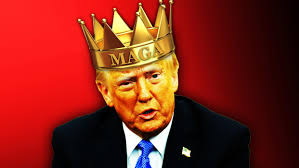
By HENRY SREBRNIK Donald Trump’s return to the White House marks the beginning of a new era on the global stage and is expected to bring significant changes to the international balance of power.
Trump capitalized on a sense of discontent that had been building since the end of the Cold War in the 1990s and was galvanized by the conflicts in Iraq and Afghanistan that followed the terrorist attacks of September 11, 2001.
Many of his advisers are part of a foreign policy movement on the Republican Party right who call themselves “restrainers” and are against what they consider America’s 21st century involvement in “forever wars.” For them, the neoconservative interventionists have overextended the country’s commitment abroad.
President Trump’s policy in his second term will continue to concentrate on distinct American interests. His America First emphasis means Trump is likely to reduce involvement in international institutions, while demanding that NATO and other allies take greater responsibility for their own defence.
The Middle East today features dangers and opportunities that were not present when he first took office eight years ago. The greatest danger remains Iran’s advances toward acquiring nuclear weapons. The best opportunities have emerged from Israel’s decimation of Hezbollah and Hamas, its successful attacks on Iran, and the collapse of Bashar al-Assad’s regime in Syria.
A year and a half ago, Iran’s foreign policy could possibly have been considered enormously successful. But since then, Israel has turned the tables. Hamas will not again pose a serious military threat to Israel. The Israelis have wiped out Hezbollah’s leadership and given Lebanon a chance to reclaim its sovereignty. And Assad’s regime is gone.
Weakening Iran will be a priority. Trump is expected to intensify the “maximum pressure” policy on Iran, including imposing additional severe sanctions and making a concentrated effort to ensure their enforcement. To stop Tehran’s nuclear ambitions may also require the credible threat of military action. He is likely to seek to strengthen the regional front against Iran, including close cooperation with Israel and the Gulf states.
Trump’s proposal that the United States “take over” and rebuild Gaza while its residents live elsewhere is far-fetched. But it might better be seen as a reflection of the fact that no realistic plan for Gaza exists. Since 2005, when the Israelis withdrew from Gaza, Washington has tried to buy off Hamas – and this culminated in the 2023 attacks. While the administration may continue to oppose Israel’s annexation of the West Bank, any future participation of Hamas in Palestinian self-government is unacceptable.
Trump will continue efforts to stabilize Lebanon, particularly following the election of Washington’s preferred candidate, Joseph Aoun, as its president. The U.S. will demand that the Lebanese armed forces prevent a renewed Hezbollah presence in the south and guard Lebanon’s borders to stop Iranian arms supplies from entering.
As for Turkey, relations may continue to be contentious, particularly regarding Ankara’s antagonism to the Kurds in northern Syria, its hostility toward Israel and support for Hamas, and growing closeness to Russia and China. Washington might try to influence the new Syrian regime, which, after all, seeks to consolidate its power and present itself as striving for a more Western-oriented approach. It will also be U.S. policy to maintain Washington’s partnership with the Kurdish-led Syrian Democratic Forces until the militia’s status and future safety are secured.
Finally, Trump’s policies will involve expanding the Abraham Accords, a highlight of his first term, by having Israel focus on advancing normalization with Saudi Arabia. Trump has also again designated the Houthis in Yemen as a foreign terrorist organization, which President Biden had revoked.
The confrontation with China will remain a central focus of Trump’s global policy, particularly in economic and technological aspects. Trump has sought to confront China over what he says is a number of economic abuses: intellectual property theft, currency manipulation, export and other subsidies, and economic espionage. He says aggressive action is required to protect American workers and to reduce the United States’ large bilateral trade deficit.
Tensions over Taiwan will continue to threaten regional stability in East Asia. It is likely that Trump does not want to be perceived as abandoning Taiwan and U.S. commitments to the island, but at the same time, he does not want Taiwan to drag the United States into a military conflict. He has observed that “Taiwan is 9,500 miles away” from the United States, while it’s “68 miles away from China.”
Trump has long been critical of American support for Kyiv and has moved to end Russia’s war against Ukraine. His statements suggest that he is not necessarily committed to preserving Ukrainian sovereignty within its internationally recognized borders and may be open to a deal that allows Russia to maintain its presence in occupied Ukrainian territories as well as legitimizing its possession of Crimea. He has told Europe that it cannot depend indefinitely on the United States and must do more to aid Ukraine.
He also wants Ukraine to supply the United States with rare earth minerals as a form of payment for financially assisting the country’s war efforts against Russia.
The world will be a very different place over the next four years. After all, as one newspaper put it, Trump was elected to “be a wrecking ball to the Beltway elites.”
Henry Srebrnik is a professor of political science at the University of Prince Edward Island.
Uncategorized
A town in the Alps that rescued Jews from the Nazis
Read the original Yiddish article here.
During a trip to the French Alps this year, I discovered a village with a fascinating Jewish history.
Saint-Martin-Vésubie sprawls across a mountain in southern France near the Italian border, its slopes dotted with colorful houses. A river runs through the center of town, lined with pine trees and ripening grapes.
On my first day there, the town’s tour guide, Anne Sivirine, told us that for a year during World War II, Saint-Martin-Vésubie actually served as a city of refuge for more than 1,200 Jews.
Among those refugees were Jews from Germany, Poland, Holland and Belgium, who had escaped to the zone libre, the French term referring to the territory in southern France, which, during the first two years of the war, was not yet occupied by the Nazis. My grandmother Feyge and her family had tried to flee Belgium for southern France, but due to various circumstances, didn’t manage and remained in the Belgian city of Antwerp.
In November 1942, the Nazis entered the zone libre, while their allies, the Italians, occupied the southeast region of France. Although the Italians administered their own “race laws,” the Jews in Italy, and for a while in southern France, weren’t in danger, and that was no small thing towards the end of 1942, when most Jews in Europe had already been murdered by the Germans.
Thanks to the efforts of Angelo Donati, an Italian Jew living in Nice at the time, the Italians agreed to establish a center for Jewish refugees in Saint-Martin-Vésubie where they could live a relatively normal life. Although prior to the war, only one Jewish family — the Levin-Drisdos — lived there, it soon became a fully Jewish shtetl.
At the beginning of 1943, in the middle of the war, Jews learned, prayed, worked, founded youth and sports organizations, and even married. The French residents, for the most part, were friendly to the Jews, and many provided food and other means of support. Such kindness towards Jewish refugees was rare then.
Those halcyon days ended in September when the Italians surrendered. The Germans occupied Italy, and within a few days — Saint-Martin-Vésubie too. When the Jews heard the news, local residents helped them escape to the mountains, where they aimed to sneak over the border into Italy. The days were cold and rainy, and the exodus from Saint-Martin-Vésubie became immeasurably difficult. (Even I, a tourist during peacetime, found climbing those hills very difficult.)
In Italy, hundreds of Jews found hiding places, but the Germans caught many of them. They, and those Jews who stayed in the village, especially the elderly and children, were deported to Drancy, the detention center near Paris, and from there to Auschwitz.
Even then, dozens of Jews remained in Saint-Martin-Vésubie, and local people continued to hide them. Not everyone in the village lent a hand, but most of them knew what was going on and kept silent. Only one Jew was actually handed over to the authorities: Gregoire Dridso, the patriarch of the Levin-Dridso family, who had lived there before the war began.
Years later, Yad VaShem designated 10 of the locals as Righteous Gentiles.
If you’ve never heard of this heroic, humble village, you aren’t alone. Even in Saint-Martin-Vésubie, the events of World War II weren’t publicly mentioned for years.
The reason for the silence was a practical one, Sivirine explained. “There were those who helped the Jews, and those who collaborated with the Nazis, and everyone needed to live together after the war. But one day a young woman overheard the old folks talking about ‘the hidden Jews’, and that opened up a Pandora’s box.”
Since then, the residents of Saint-Martin-Vésubie openly acknowledge what their town did to save the Jews. Aside from the main memorial in Saint-Martin-Vésubie, the village now has three others: one for the Jews who perished; a second one in honor of the Righteous Gentiles, and a third that describes how the townspeople risked their lives to help the Jews under the Nazis.
Since Saint-Martin-Vésubie began sharing this chapter of its history, several books have been published on the subject. The town itself released a book in French, called The Jews and the Righteous Ones of Saint-Martin-Vésubie. Later, historian Susan Ziccotti penned a book in English, Holocaust Odysseys: The Jews of Saint-Martin-Vésubie and their Flight through France and Italy. There were also three novels inspired by this chapter in the town’s history, including Wandering Star by French Nobel laureate writer J. M. G. Le Clézio.
Saint-Martin-Vésubie takes pride in something else, too. The town’s main church has a wooden statue of the Madonna that dates back to the Middle Ages, and is revered by its residents. Each year the townspeople carry it in a procession into the mountains, believing that the statue was created there.
About 10 years ago, the residents of Saint-Martin-Vésubie established a new tradition: Each year on Sept. 3, in memory of the Jews who escaped to the mountains, they march to the mountain pass at the border with Italy. There, at a marker honoring the Jews, they memorialize those who died and those who survived, thanks to the Saint-Martin-Vésubie residents at the time. Occasionally, the children or grandchildren of the rescued Jews participate.
In Italian and in French, the inscription says: “Through this mountain pass, in September 1943, hundreds of Jews from all over Europe passed through, seeking ways to save themselves from antisemitic predators.”
Then, movingly, the text adopts a different tone: “You, who’ve arrived here as a free person, need to remember that this is what could happen when equal rights aren’t extended to all.”
The post A town in the Alps that rescued Jews from the Nazis appeared first on The Forward.
Uncategorized
Trump may endorse Netanyahu. But loving Israel is not the same as loving Bibi.
President Donald Trump has raised the possibility of endorsing a candidate in Israel’s Oct. 27 election.
“I may be doing something,” he said when asked about it this week.
He did not say whom he might support, although his history with Benjamin Netanyahu makes the prime minister seemingly the likely possibility. I am here to urge him to think again, because the distinction between supporting Netanyahu and supporting Israel is no longer possible to ignore.
Trump is remarkably popular in Israel, where many believe he genuinely loves their country and its people. His recognition of Jerusalem as Israel’s capital, his support for Israeli security, his willingness to go to war against Iran and his manifest indifference to the global Palestinian propaganda machine have persuaded many that he is personally invested in Israel’s future. Netanyahu has turned that into a political asset, encouraging the impression that his personal relationship with Trump is the reason.
And it works. Some Israelis see Netanyahu more favorably because they believe Trump does. An endorsement would matter, and so would its absence. On March 25, 2019, Trump recognized Israeli sovereignty over the Golan Heights, two weeks before an Israeli election. Widely interpreted as a political gift, it reinforced Netanyahu’s claim that he alone could deliver extraordinary concessions from Washington. It helped Netanyahu cling to power (barely), and he returned the favor, all-but-directly endorsing Trump’s reelection a year later.
In principle, American presidents should stay out of other democracies’ elections. But such niceties, alas, belong to another era. Trump has interfered openly in elections in Hungary and Poland, attempting to elevate local right-wing populists. Expecting diplomatic restraint now is absurd. So a better question is simply whether he can be pried loose of Netanyahu, for the sake of Israel.
The election could hardly be more crucial. I believe it will determine whether Israel remains a prosperous, functioning democracy or continues down a path of institutional deterioration, international isolation and economic decline.
Netanyahu’s supporters credit him with confronting Iran’s Islamic Republic regime, Hezbollah and Hamas. But he has eliminated none of them, and his record includes the catastrophic security failure of Oct. 7, years of political polarization, attempts to weaken judicial independence and a coalition elevating some of the country’s most extreme political forces.
Netanyahu remains on trial for corruption, charges he denies. Critics point also to extravagant public spending associated with his personal lifestyle. The larger indictment, however, is not personal: his dependence on narrow coalition interests has made essential national reforms virtually impossible.
Any Netanyahu-led coalition – unless the opposition joins him – would depend again on far-right parties insisting on settlement activity deep in the West Bank – an issue causing considerable agitation in the United States — and protecting Jewish radicals who terrorize Palestinians there. That already led to deaths and risks sparking a third Palestinian intifada, according to Israel security officials. Trump, who prides himself on supposedly having ended eight wars, cannot be very happy with that.
No less consequential is Netanyahu’s dependence on ultra-Orthodox, or Haredi, parties.
Israel has long tolerated an arrangement under which the vast majority of Haredi men avoid military service, while many receive state support for religious study and emerge from schools that do not teach the mathematics, English and science required for a modern economy. This is unsustainable in a country whose security depends on a heavily burdened military and whose prosperity depends on a highly educated workforce.
The demographic implications are staggering. Haredim already constitute roughly one-sixth of Israel’s population, and their share is projected to grow dramatically, with birthrates approaching six children per family and sustained heavily by welfare. Unless employment, education and military-service patterns change, a shrinking proportion of Israelis will shoulder an ever-growing share of the tax burden, military service and economic productivity.
Even during three years of war – as other Israeli reservists served hundreds of days a year in Gaza and Lebanon – Haredi youth demonstrated with signs declaring: “We’d rather die than serve.” Outrage over this arrangement is boiling over across Israel and badly hurting Netanyahu, who is far behind in the polls.
Netanyahu cannot seriously reform the system because his survival depends on Haredi parties that make military exemptions, religious-school funding and sectarian privileges conditions of coalition participation.
The explosive growth of this community, absent reforms, will turn Israel into a hyper-religious country, risking the departure of the educated, modern and secular classes that account, overwhelmingly, for its prosperity. Internationally mobile, many are already disillusioned by the country’s political direction, repeated military service and an ever-heavier economic burden. It is a national emergency.
Israel must restore confidence in democratic institutions, address the consequences of the Gaza war, confront violent extremism in the West Bank, repair international relationships and establish a sustainable regional strategy. Another Netanyahu government would deepen the crisis in all of them.
Trump, if he loves Israel, cannot possibly love this direction of travel. His son-in-law Jared Kushner most assuredly would not.
There is a serious alternative. Gadi Eisenkot, a former chief of staff of the Israel Defense Forces, has emerged as a leading opposition figure. He lost his son Gal in combat in Gaza in December 2023 and has a reputation for personal integrity, seriousness and directness. His party is called Yashar, meaning straight or upright, a pointed contrast with the political culture of Netanyahu’s rule.
Sure, replacing Netanyahu would not automatically solve Israel’s problems. But an opposition government not dependent on Haredi parties could introduce universal service obligations, require a genuine core curriculum in publicly funded schools, restructure subsidies and redirect resources toward education, infrastructure and economic participation.
There is a chance that Netanyahu’s opponents may win more seats collectively without a comfortable governing majority. A narrow coalition could depend on parties with conflicting positions; Arab parties are legitimate democratic participants, but agreement on security and national policy would be challenging.
A Trump assist that enables Bibi to cut into his opponents’ lead would make that scenario more likely and diminish the chances for a more stable majority that could act decisively to save the country.
Trump likes to point to everything he has done for Israel: Jerusalem, the Golan Heights, the Abraham Accords and regional diplomacy. Many Israelis appreciate those achievements. But the country’s greatest danger may lie not only in the enemies surrounding it, but in the structural weaknesses accumulating within.
The question is whether Trump can distinguish the country’s long-term interests from the fortunes of a man he has repeatedly supported.
And there is one more thing. Trump likes winners. So much so that he once impugned Sen. John McCain’s Vietnam-era record of heroics, by actually saying: “I like people that weren’t captured.” Well, Netanyahu is so far behind in the polls, and with such overpoweringly good reason, that he is looking like a loser.
Continued association will not help the brand.
The post Trump may endorse Netanyahu. But loving Israel is not the same as loving Bibi. appeared first on The Forward.
Uncategorized
‘Sefer Elijah’ — probably the oldest proto-Ashkenazi text
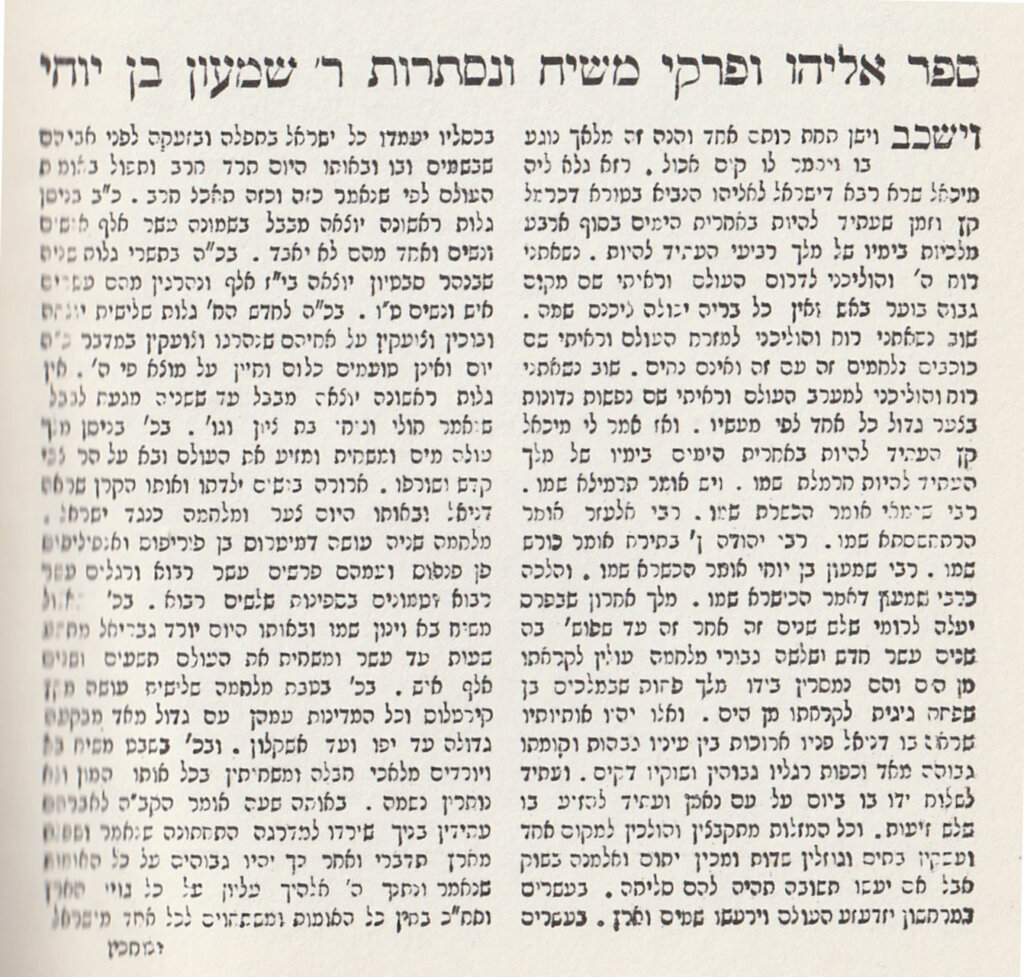
ס׳איז מעגלעך, אַז מיר האָט זיך אײַנגעגעבן צו אַנטדעקן דעם עלטסטן פּראָטאָ־אַשכּנזישן טעקסט, אָנגעשריבן אינעם פֿריִיִקן 9טן יאָרהונדערט. דאָס איז דער אוראַלטער אַפּאָקאַליפּטישער מדרש „ספֿר אליהו‟, אַ ספֿר וואָס איז מיר שוין לאַנג גוט באַקאַנט.
געשען איז עס אַזוי: ווען איך בין ערשט אָנגעקומען קיין אַמעריקע אין 1998 — אין וויליאַמסבורג — האָב איך זיך אַ דריי געטאָן אין די אָרטיקע ביכער־קראָמען און געקויפֿט די גאָר אינטערעסאַנטע מדרש־זאַמלונג „ילקוט הרועים‟, באַגלייט מיט גלענצנדיקע הסכּמות (רבנישע באַשטעטיקונגען), אַז דער ספֿר איז אָנגענומען ווי אַ הייליקער, אַרײַנגערעכנט אַ רעקאָמענדאַציע פֿון דעם דעמאָלטיקן סאַטמאַרער רבין משה טייטלבוים זצ״ל.

די זאַמלונג באַשטייט על־פּי־רובֿ פֿון טיפֿע קבלה־טעקסטן און עטלעכע אַפּאָקאַליפּטישע מדרשים וועגן דעם קץ־הימים — דעם סוף פֿון די טעג, די צײַט וואָס משיח דאַרף קומען — בתוכם דעם „ספֿר אליהו‟. אָט דער ספֿר און נאָך עטלעכע אין דער דאָזיקער זאַמלונג שילדערן די ביאת־המשיח נישט ווי אַ פּלוצעמדיקן גליקלעכן סוף פֿון אַלע ליידן אין דער וועלט, נאָר ווי אַ שרעקלעכן פּראָצעס, באַגלייט מיט חורבֿות און שוידערס. נישט נאָר בײַ די קריסטן איז פֿאַראַן אַזאַ מין ליטעראַטור. בקיצור, שטייט אינעם „ספֿר אליהו‟ געשריבן, אַז ווען משיח וועט קומען, וועט ער צונויפֿברענגען אַלע צדיקים — בסך־הכּל 30 טויזנט — אין אַ הימליש אָרט ווײַט פֿון אונדזער ערד, וועלכע וועט פֿאַרברענט ווערן מיט אַלע אירע איבעריקע זינדיקע תּושבֿים.
די אמונה, אַז דער נײַער משיחישער צוקונפֿטיקער ירושלים וועט אַראָפּקומען פֿונעם הימל און אַז די שטאָט האָט ווייניק צו טאָן מיט דער הײַנטיקער ירשולים, איז אַמאָל געווען אַבסאָלוט נאָרמאַל בײַ ייִדן, בפֿרט אין דער אַשכּנזישער וועלט. רש״י האָט, למשל, אויך אַזוי געגלייבט. אין דער שפּעטערדיקער צײַט האָט הרבֿ צבֿי־הירש קײַדאַנאָווער, דער מחבר פֿונעם פּאָפּולערן מוסר־ספֿר „קבֿ הישר‟, וועלכן ער האָט אַליין איבערגעזעצט פֿון לשון־קודש אויף ייִדיש, אַזוי געשריבן אינעם פֿריִיִקן 18טן יאָרהונדערט.
דער „ספֿר אליהו‟ בלײַבט כּמעט אומגעפֿאָרשט. הלל ניומאַן, אַ היסטאָריקער פֿונעם חיפֿהר אוניווערסיטעט, האָט באַמערקט, אַז דער דאָזיקער מדרש קלינגט ענלעך אויף דער קריסטלעכער אַפּאָקאַליפּטישער ליטעראַטור. עטלעכע אַנדערע פֿאָרשער האַלטן, אַז ס׳איז אָנגעשריבן געוואָרן בײַם אָנהייב פֿון דער איסלאַמישער תּקופֿה. לאָמיר זיך אָבער אַרײַנקוקן אין געוויסע פּרטים, וואָס די פֿאָרשער האָבן פֿאַרקוקט — און וואָס איך האָב אַליין ערשט באַמערקט נישט לאַנג צוריק.
אין אַ סך מדרשים ווערט דערמאָנט דער אַנטי־משיח מיטן נאָמען אַרמילוס. אין „ספֿר אליהו‟ ווערט אָבער זײַן נאָמען אויסגעלייגט ווי „הרמלת‟. ווײַזט אויס, אַז בײַ דעם מחבר האָט אַ תוו געקלונגען ווי אַ סמך, און דער הא איז בײַ אים געווען שטום. דעם נאָמען פֿונעם פּערסישן מלך אַרתּחשסתּא שרײַבט ער אויך ווי „הרתּחשסתּא‟. עס ווערט דערמאָנט עפּעס אַ ים־מאָנסטער — „גיגית‟; ווײַזט אויס, מיינט עס gigas אויף לאַטײַניש, אַ ריז. אַזאַ אַרויסרייד האָט געקאָנט נאָר זײַן בײַ פּראָטאָ־אַשכּנזים, וועלכע האָבן גערעדט אויף אַלט־פֿראַנצויזיש (צי, מעגלעך, אויף עפּעס אַ געמישטן דיאַלעקט, וווּ קיין הא־קלאַנג איז נישט געווען).
אינעם דאָזיקן מדרש שטייט געשריבן, אין געוויסע ווערסיעס, אַז די מלחמות פֿאַר דער ביאת־המשיח וועלן אָנהייבן די מלכים קוסטנטנוס און קרטילוס. אַזוי שטייט אין יהודה אבֿן־שמואלס (יהודה קויפֿמאַנס) זאַמלונג „מדרשי גאולה‟. אינעם חסידישן ספֿר, וואָס איך האָב, ווערט דערמאָנט נאָר „קירטלוס‟. ס׳איז קלאָר, מיין איך, אַז דאָ גייט די רייד וועגן דעם ביזאַנטישן מלך קאָנסטאַנטין דעם זעקסטן, מיט וועלכן קאַרל דער גרויסער האָט געוואָלט זיך מזווג זײַן, כּדי צו שאַפֿן אַ פֿאַראייניקט וועלט־מלכות, דורכן זיווג מיט קאָנסטאַנטיס מאַמע אירענע. קאָנסטאַנטינען האָט מען געשדכנט מיט קאַרלס טאָכטער ראָטרודע. אויב די דאָזיקע שידוכים וואָלטן געלונגען, וואָלט דעמאָלט אויפֿגעשטאַנען אַ נײַע גלאָבאַלע רוימישע אימפּעריע. קאַרל דער גרויסער האָט זיך אָבער סײַ־ווי־סײַ געהאַלטן פֿאַר אַ נײַעם רוימישן אימפּעראַטאָר. דער פּויפּסט לעאָן דער דריטער האָט אים געקרוינט מיט אַזאַ טיטל אין יאָר 800.
הגם קאַרל דער גרויסער האָט דערלויבט ייִדן צו וווינען אין זײַן קיניגרײַך און פֿאַרפֿלאַנצט דערמיט דאָס קערנדל פֿון דער אַשכּנזישער ציוויליזאַציע, ווערט אין אַ סך אַלטע מדרשים פֿאָרויסגעזאָגט, אַז די חבֿלי־המשיח, די צרות פֿאַר משיחס קומען, וועלן זײַן פֿאַרבונדן מיט רוים; דערפֿאַר האָבן ייִדן אויפֿגענומען זײַן אימפּעריע ווי אַ סימן פֿון אַפּאָקאַליפּטיש־משיחישע געשעענישן.
קאָנסטאַנטין דער זעקסטער איז געשטאָרבן בערך אין 805 (לויט אַנדערע קוואַלן אין 797) און קאַרל דער גרויסער — אין 814. באַקומט זיך, אַז דער „ספֿר־אליהו‟ מוז געהערן צו דער תּקופֿה, ווען זיי האָבן ביידע נאָך געלעבט.
וואָס עפּעס „קרטילוס‟? פֿאַרוואָס איז קאַרלס נאָמען אין אונדזער ספֿר אַזוי פֿאַרקריפּלט געוואָרן? ס׳קען זײַן, אַז אין זײַן אייגן לאַנד וואָלט געווען וויכטיק אויסצובאַהאַלטן זײַן נאָמען, די קריסטן זאָלן נישט וויסן, אַז בײַ ייִדן גייט אַרום אַזאַ געהיימער קלאַנג, אַז דער קיניג וועט מיט זײַנע מלחמות גורם זײַן די ייִדישע גאולה. מע קען זיך אַפֿילו משער זײַן, פֿאַרוואָס מע האָט אויסגענוצט אַזאַ שיפֿער: די אותיות טית און יוד קאָנען זײַן ראָשי־תּיבֿות פֿון זײַן טיטל imperator terrae.
ס’איז וויכטיק צוצוגעבן, אַז געוויסע קריסטלעכע שרײַבער האָבן געגלייבט, אַז קאַרל דער גרויסער וועט זיך אומקערן איידער יעזוס וועט זיך באַווײַזן צום צווייטן מאָל. אַזוי האָט געשריבן אינעם 11טן יאָרהונדערט דער מאָנאַך אַדעמאַר פֿון לימאָזש, פֿראַנקרײַך. אויב אַ טייל ייִדן האָבן געגלייבט אין עפּעס ענלעכס, וואָלט מען געקאָנט פֿאַרשרײַבן דעם „ספֿר אליהו‟ נאָכן טויט פֿון קאַרל דעם גרויסן.
ואַחרון אַחרון חבֿיבֿ, דער סטיל פֿונעם „ספֿר אליהו‟ איז וווּנדערלעך ענלעך אויף דער אַלט־בײַערישער אַפּאָקאַליפּטישער פּאָעמע Muspilli, פֿונעם 9טן יאָרהונדערט, וווּ דער הויפּטהעלד איז אויך אליהו הנבֿיא. עטלעכע שטיקלעך פֿון ביידע טעקסטן קלינגען כּמעט אידענטיש. ווײַזט אויס, אַז אונדזער מדרש געהערט טאַקע צו דער תּקופֿה פֿון קאַרל דעם גרויסן — צי, אפֿשר, מיט אַ דור־צוויי שפּעטער — ווען אַפּאָקאַליפּטישע געדאַנקען זענען געווען פֿאַרשפּרייט אויך בײַ די קריסטן.
דער אימאַזש, אַז דער אייבערשטער וועט אַוועקטראָגן די צדיקים אין עפּעס אַ הימלישער וועלט, ווען די גאַנצע ערד וועט ברענען, קלינגט ממש ווי דער גערמאַנישער מיטאָס וועגן דעם ראַגנאַריאָק, דעם סוף פֿון דער וועלט, אָפּגעשפּיגלט אויך אין Muspilli.
באַקומט זיך, אַז ייִדן אין דײַטשלאַנד האָבן נאָך מיט 1200 יאָר צוריק אַרויסגערעדט דעם תוו ווי „ס‟. צי האָבן אַ טייל פֿון זיי דעמאָלט שוין גערעדט אויף דײַטשיש, נישט אַלט־פֿראַנצויזיש? אין 838 האָט דער פֿראַנקישער גלח באָדאָ זיך מגייר געווען; זײַן ייִדישער נאָמען איז געווען אליעזר. ער האָט געדינט אינעם הויף פֿון קאַרלס זון לויִס דעם ערלעכן. ווײַזט אויס, אַז אַרום יענעם דײַטשיש־רעדנדיקן גלח איז שוין געווען בנימצא אַ גענוג גרויסע ייִדישע סבֿיבֿה, וועלכע האָט משפּיע געווען אויף זײַן באַשלוס צו ווערן אַ ייִד. אויף וועלכער שפּראַך זיי האָבן גערעדט, ווייסן מיר נישט גענוי, צום באַדויערן.
דער „ספֿר אליהו‟ איז, ווײַזט אויס, דער עלטסטער אָפּגעהיטער פּראָטאָ־אַשכּנזישער קוואַל. ביזן 11טן יאָרהונדערט איז אין ארץ־אַשכּנז בכלל נישט געווען באַקאַנט די גמרא. ווי מע זעט פֿון די אַשכּנזישע ספֿרים, אַז אַפֿילו שפּעטער זענען בײַ מיסטיש־געשטימטע דײַטשישע ייִדן געווען גאָר וויכטיק — אפֿשר, נאָך וויכטיקער ווי די גמרא — פֿאָלק־מעשׂיות, שפּרוכן און סגולות, וכּדומה. אַז זיי האָבן געשילדערט די ביאת־המשיח ווי אַ כּמו־קריסטלעך אַפּאָקאַליפּטיש געשעעניש, אויסגעמישט מיט אימאַזשן פֿון גערמאַנישער מיטאָלאָגיע, איז נישט קיין גרויסער חידוש. דער דײַטשישער פֿאָלקלאָר פֿאַרנעמט אַ גרויס אָרט אין דער אַלט־ייִדישער ליטעראַטור, ווי אויך, ווייניקער, אין ערנסטע ספֿרים. אַז אַזאַ קולטור־סינטעז האָט זיך שוין אָנגעהויבן אינעם 9טן יאָרהונדערט איז אָבער יאָ אַ חידוש.
The post ‘Sefer Elijah’ — probably the oldest proto-Ashkenazi text appeared first on The Forward.
