



Uncategorized
Important North Carolina Democrats Said Zionists Are Nazis — Many People Are Okay With It

Anderson Clayton, chair of the North Carolina Democratic Party, speaks after Democrat Josh Stein won the North Carolina governor’s race, in Raleigh, North Carolina, US, Nov. 5, 2024. Photo: REUTERS/Jonathan Drake
The North Carolina Democratic Party is at war with itself over Israel and antisemitism.
Earlier this month, I reported that leaders from the North Carolina Democratic Party’s (NCDP) Muslim Caucus had recently made hateful posts on social media. Elyas Mohammed, president of the caucus, described Zionists as “Nazis” and “a threat to humanity.”
Jibril Hough, first vice president of the same caucus, said “Zionism is a branch of racism/white supremacy and must be fought with the same intensity.” He described Zionists as the “worst of humanity.”
This month, Hough posted that Jeffrey Epstein could be alive and in hiding in Israel as part of a US/Israel conspiracy.
Now, two prominent North Carolina Democratic leaders have strongly condemned the statements by Muslim Caucus leaders.
Gov. Josh Stein told Jewish Insider (JI), “Antisemitic comments and conspiracy theories have no place anywhere, including in the North Carolina Democratic Party.”
Former Gov. and current Senatorial candidate Roy Cooper (D) told JI, “These reprehensible posts were an unacceptable expression of antisemitism and I condemn them in the strongest of terms.”
Stein and Cooper’s comments came promptly after many letters were sent by community members, including a powerful letter co-signed by the four local Jewish Federations directed to Gov. Stein and party officials. The Federations explained:
As Jews in North Carolina who support the existence of the State of Israel, and who represent broad cross-sections of our state’s Jewish population, we find this language hate-filled, insensitive, inflammatory, and threatening. It is incompatible with the standards of responsible civic leadership and it should disqualify any individual from holding a leadership role within a political party structure. Immediate corrective action is required.
The American Jewish Congress thanked Stein and Cooper for “making clear that antisemitism and conspiracy theories are unacceptable in the North Carolina Democratic Party.” The NCDP Jewish Caucus also thanked Stein and Cooper.
Mohammed and Hough responded by quickly doubling down on their statements, likely knowing that many in the party would support them.
Mohammed pinned (placed) his post calling Zionists “Nazis” to the top of his Facebook account.
Hough shared The Algemeiner column reporting his comments to social media, proudly quoting himself saying Zionists are the “worst of humanity.”
Rather than apologize, the Muslim Caucus issued a statement defending Mohammed, proclaiming, “We will not be silenced.” The NCDP Arab Caucus also re-posted a statement defending Mohammed.
Last week, the Jewish Democrats were asked on Facebook, “Do you accept Zionists?” Without answering directly, the Jewish Democrats of NCDP responded, “we accept everyone who treats human beings with dignity.” These comments were then promptly removed or hidden from public view.
Rev. Dr. Paul McAllister is chair of the NCDP’s Interfaith Caucus. The day after Stein and Cooper forcefully rejected Mohammed and Hough’s comments, McAllister posted a photo of himself on social media standing with Hough.
This comes as no surprise. McAllister is well known as a man who promotes hatred towards Israel. For example, McAllister endorsed and spoke on a panel, “The Genocide in Palestine,” which prominently featured Leila Khaled on the flyer. Khaled is a convicted hijacker and member of the Popular Front for the Liberation of Palestine, designated as a terrorist organization by the US government.
A small Jewish, anti-Israel subgroup of McAllister’s Interfaith Caucus posted on social media, “WE STAND IN SOLIDARITY WITH ELYAS MOHAMMED.”
This subgroup, or sub-caucus, calls itself Jewish Democrats of NCDP and is openly referred to by supporters as the “non-Zionist caucus.”
Many Democrats believe this non-Zionist group was created to confuse the public into believing that Jews in North Carolina do not support Israel. The confusion is real and likely widespread.
For example, in a recent social media post, a commenter expressed confusion trying to distinguish between the much larger NCDP Jewish Caucus — which represents broad Jewish interests and statewide constituencies — and the very small Jewish Democrats of NCDP, which is the anti-Zionist sub-caucus.
Jewish Democratic leaders across the state have told me they believe the NCDP is violating its own rules by essentially allowing two Jewish caucuses. The NCDP’s Plan of Organization clearly states, “The party will recognize a single auxiliary or caucus for any specific purpose.”
Democrats point out that, for example, there are not two African-American caucuses or two LGBTQ caucuses that are trying to push different viewpoints. Democrats emphasize this is another example of how state party leaders implicitly allow, or even encourage, targeting and demonization of Israel and Zionists.
Jeffrey Bierer is a current member of the Democratic Party’s State Executive Committee. Speaking for himself and not any organization, he told me, “At least four of us [Jewish Caucus members] paid dues to the Interfaith Caucus and we never received any confirmation or information back.”
Bierer also told me he paid separate dues to the Interfaith Caucus’ Jewish Democrats group with the same result.
Bierer said, “We were 100% friendly and respectful and said we would like to get involved. We didn’t get any response. Zero response.”
I reached out to the Jewish Caucus regarding this issue. They provided me a statement that began:
In an effort to bridge religious and political divides, a few of our members attempted to join the NCDP Interfaith Caucus. Initially their membership fees were accepted, then when those members inquired about the lack of regular communication and meeting times, their money was later returned.
It is evident that the North Carolina Democratic Party should investigate this potential discrimination against Jewish members and members who identify with Israel.
The Muslim Caucus is newly formed and currently in the review process seeking “final approval” by the NCDP. The Muslim Caucus is prominently displayed on the NCDP’s website featuring Elyas Mohammed under the heading, “OUR PEOPLE.”
According to the NCDP’s Plan of Organization, caucuses are not just advocacy groups — they are included in, and contribute to, significant decision making and planning within the party.
The document explains, “Caucuses shall be represented on the NCDP Executive Council, the NCDP State Legislative Policy Committee and the Platform and Resolutions Committee by the State President or designated representative and participate in strategic planning for the NCDP.”
I have contacted State Chair Anderson Clayton and First Vice Chair Jonah Garson twice over the past few weeks, sending them quotes, links, and screenshots regarding the comments from Muslim Caucus leaders. They have not responded. Unlike Stein and Cooper, Clayton and Garson have not publicly denounced the comments made by caucus leaders.
Antisemitism within the NCDP is a systemic problem that goes well beyond a few caucus leaders. The NCDP has been targeting Israel for years. For example, on Saturday, June 28, 2025 — during Shabbat — the party passed six anti-Israel resolutions. One of these resolutions even accused Israel of taking “Palestinian hostages.”
Clayton has appeared in smiling photographs with Mohammed and Jibril over the past few years. It is expected and normal that a chair of a state party stands with caucus leaders. But now that Mohammed and Jibril have clearly distinguished themselves as hateful and have targeted a large share of the Jewish Democrats in North Carolina who believe Israel has a right to exist, it is also expected that Clayton and Garson publicly denounce these hateful statements. They have not.
Their silence sends a message that Jewish members of the North Carolina Democratic Party, and all members who support Israel’s right to exist, are not valued or respected.
Rabbi Emeritus Fred Guttman of Temple Emanuel in Greensboro, who formerly served on the executive committee of the state’s Democratic Party, explained:
What has occurred demonizes Jewish supporters of Israel and increases the risk of violent acts against Jews in North Carolina. This is extremely serious…Those in leadership positions should continue to speak out clearly and condemn it…Leadership carries responsibility, and failure to address antisemitism undermines the safety and integrity of the community. We certainly do not need a repeat in North Carolina of tragedies such as Bondi Beach, Manchester, England, or the Tree of Life synagogue in Pittsburgh.
The North Carolina Democratic Party should take prompt action to unequivocally demonstrate that antisemitism, and discrimination against Jews and those who identify with Israel, will not be tolerated. Jewish safety — and equal treatment for all — depends on it.
Peter Reitzes writes about antisemitism in North Carolina and beyond.
Uncategorized
At this interfaith calligraphy class, the lines between Jew and Muslim blur
“So…are you Middle Eastern?”
I had just walked into the American Sephardi Federation office in lower Manhattan, where 20 Muslim and Jewish young people gather twice a month to learn Arabic and Hebrew calligraphy together. I was clearly the newbie, and one of the participants was sussing me out.
“I am,” I replied.
“Fully?” he asked.
I gave my usual spiel, explaining my Iraqi and Iranian background.
“Sick,” he said. “I’m only half.”
It struck me then that neither of us had any idea whether the other was Muslim or Jewish.
As I broke bread with the group, we chatted over an odd but familiar spread of kosher pizza and Gojeh Sabz, golf-ball-sized and very tart plums – a common Middle Eastern fruit many of us grew up eating. Somehow, religion didn’t really come up.
Eventually, felt-tipped multicolored calligraphy pens were passed around, and we began learning to write Hebrew letters — letters I had been perfecting since I embarked on my Hebrew School journey as a fourth grader. I was terrible. My reyshes weren’t swooping as they should, my khafs were somehow uneven and my yuds looked suspiciously like daleds.
Across the table, a young man who had introduced himself to me minutes before as Mohamad from Saudi Arabia had effortlessly filled the page with elegant Hebrew letters. He noticed my frustration. “Don’t worry,” he said. “I’ve done this like a million times. You’ll get it.” 
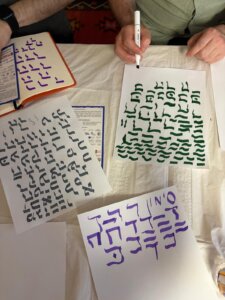
The person at the helm of this unusual form of interfaith exchange is Ruben Shimonov, a 39-year-old Sephardic polymath. I first discovered Ruben’s work when I saw an exhibit of his calligraphy blending Hebrew, Arabic and Farsi at the Museum of Jewish Heritage. I assumed he was a full-time artist, but soon learned that his main gig is serving as an educator and interfaith organizer. He mentors dozens of Sephardic college students, hosts LGBTQ+ Sephardic Shabbats. Now, he leads Sacred Scripts in NYC, a new six-month-long cohort-based interfaith calligraphy fellowship where Jewish and Muslim community leaders learn the intertwined history and etymology of Hebrew and Arabic.
Shimonov was born in Uzbekistan, a Muslim-majority country. For him, that background makes interfaith work feel like an extension of his upbringing.
“As a Jew from a community whose culture was shaped by Islamic cultures and histories, it is a natural expression of my Jewish identity to be in interfaith spaces,” he told me. “It’s not something I do because it’s cool or sexy or whatever. I just feel at home, because these are my people. This is my own background.”
From a young age, he was drawn to language, inspired in equal measure by the Hebrew letters he learned for his bar mitzvah and the Arabic script that adorned the mosques and architecture of his hometown.
Eventually, he taught himself calligraphy in three languages and came to see it as a powerful tool for the interfaith work he was already doing — organizing gatherings such as iftars in synagogues and seders in mosques through the Muslim Jewish Solidarity Committee. Over the past decade, Shimonov has led more than 100 interfaith calligraphy workshops around the world, highlighting the deep historical and linguistic connections between Hebrew and Arabic.
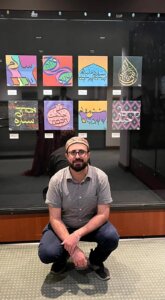
This year, Shimonov launched Sacred Scripts alongside his longtime partners at the Muslim American Leadership Alliance (MALA), drawing fellows from networks he and MALA have built over the years. The program brings together young artists and community leaders — many with Middle Eastern backgrounds — who they feel stand to benefit from sustained engagement. Over the course of six months, fellows study calligraphy and the histories of the languages, while connecting over shared meals and cultural outings. This month, they are attending a concert focused on Jewish and Muslim music from the Maghreb.
After Oct. 7, Shimonov said, he witnessed fractures between many Jewish and Muslim organizations that had been working together on interfaith initiatives. “That sense of betrayal and hurt was very real,” he said. “But if the only times you meet are when things are bad, what do you expect? I think the secret sauce to all this stuff is you’ve got to be in it for the long haul.”
The Sephardic connection
During each session, we practice writing while Shimonov lectures on the connections between the two languages. Shiminov gives each language its due, devoting several sessions to studying each before bringing them together.
Eventually, we learn the same words in Hebrew and Arabic — beit and bayt for home, Shabbat and al-sabt for Saturday — the list goes on. Before tackling day one of learning the Arabic alphabet, we practiced writing the phrase Bismillah ir-Rahman ir-Rahim, which appears at the beginning of every surah in the Quran, into Hebrew. Translated word-for-word, it sounds remarkably similar.
For Shimonov, that overlap is the point. He believes strongly that Sephardic and Mizrahi Jews occupy a unique place in interfaith work because of the seemingly endless cultural similarities they share with Muslims from the Middle East and North Africa.
That sensibility is reflected in the space itself. The fellowship is hosted at the American Sephardi Federation, a Jewish institution that looks more like a place to sip chai and do a close reading of Rumi’s greatest hits. The floors are covered with embroidered rugs, the walls are lined with ouds, a pear-shaped Middle Eastern instrument, and endless shelves are packed with rare books in Hebrew, Arabic and Farsi.
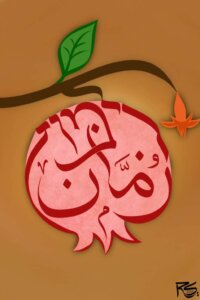
Because of these connections, the days focused on Arabic study are more Jew-y than one might expect. Shimonov takes care to highlight Jewish history in the Middle East, explaining how Iraq — not Europe — was the world’s foremost hub of Jewish life for centuries, where many Jews only spoke Arabic because Hebrew wasn’t widely taught, and presenting pivotal Jewish texts written in Judeo-Arabic.
In Shimonov’s Sephardic approach, the aim is less to “build bridges” — a phrase that has become a catch-all interfaith mantra — than to reveal how much was never separate to begin with.
Ali Saracoglu, a Muslim participant in the fellowship and an artist from Izmir, Turkey, said Sacred Scripts reshaped his understanding of Jewish identity.
When he moved to the United States, his primary exposure had been to Ashkenazi Jewish communities. “When you open the conversation to Sephardi and Mizrahi Jews, you encounter people from Uzbekistan to North Africa to descendants of communities from Spain,” he said. “You start to see a much more global form of Judaism.”
Saracoglu joked that within the group, it was often impossible to tell who was Jewish and who was Muslim unless it came up in conversation.
Nora Monasheri, a 23-year-old Iranian Jew, said that after Oct. 7, she had participated in countless interfaith dialogues at her alma mater, Binghamton University. “I felt like I’d been there, done that on campus,” she said, lamenting that such gatherers were “always very focused on Israel and Palestine, and it felt very forced.”
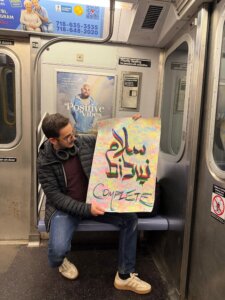
For her, creating calligraphy rather than debating peace agreements from the ’90s is a welcome change.
“I found that some of our most important words in Hebrew are the same in Arabic — faith, charity, blood — So instead of debating each other, we’re discovering this shared history, tradition, and spirituality together.”
For Saracoglu, the program’s artistic aspect is particularly powerful. He first met Shimonov at a one-off interfaith calligraphy workshop two years ago, an experience that stayed with him as an artist. He has been creating ebru, the traditional Turkish art of marbling, since the age of five, and now practices it in his New York City apartment. In a recent series he calls “One Word: Peace,” he layers his marbled designs with calligraphy by both Jewish and Muslim artists — often including Shimonov himself.
During one session, Shimonov read aloud from a Judeo-Arabic translation of the Torah, explaining that many Jews in the Arab world historically translated religious texts into Arabic because many did not understand Hebrew. The word for God was therefore transcribed as the Arabic word, Allah.
I chimed in that my own Jewish parents say “Inshallah” all the time when they simply mean “God willing.” My non-Sephardic friends always found this bizarre, but among this crowd, it barely required explanation.
As he read from the Torah, one Muslim fellow suddenly interrupted.
“It sounds like the Quran!”
The post At this interfaith calligraphy class, the lines between Jew and Muslim blur appeared first on The Forward.
Uncategorized
Debating Zionism is good for Jews, actually
A group of Jewish Theological Seminary students were furious with the chancellor’s position on Jewish statehood. In protest, they draped flags around campus before graduation, which the administration removed before the ceremony.
The year was 1948. The flags were Israeli. And the dissenting students were protesting Chancellor Louis Finkelstein’s refusal to make support for Jewish statehood part of academic commencement. Some students even arranged for the bells at nearby Union Theological Seminary to play “Hatikvah,” the Israeli national anthem, after JTS officials declined to include it in commencement.
As a historian of American Zionism, I have been thinking about that episode while reading the many vitriolic reactions to a few JTS undergraduates who spoke out in opposition to the seminary’s decision to welcome Israeli President Isaac Herzog as this year’s graduation speaker. Once again, a JTS commencement has become a battleground over Israel, but the sides are now reversed.
Reasonable people can disagree about whether this was the right moment to extend an invitation to Herzog to speak at commencement. What deserves attention is the outraged reaction to a group of students raising objections, and the speed with which those students’ concerns have been cast as a deviation from the historical contours of mainstream American Jewish politics.
A recent Times of Israel blog post, for example, argued that the mere fact that JTS students raised concerns about Herzog was a rupture with Judaism. “Jewish survival without sovereignty is fragile,” wrote the author, Menachem Creditor, adding that “the founders of JTS did not need to debate the necessity of Jewish self-determination,” and that Herzog “represents the state of Israel and the Jewish people.”
These claims erase JTS’s long and sophisticated engagement with Jewish nationalism and the conception of Jewish peoplehood. Reading American Zionism backward risks collapsing peoplehood and statehood, and creating traditions to ratify present assumptions out of a past that never existed.
The relationship between Zionism and JTS was nuanced from the start. Both founding president Sabato Morais and the seminary’s third chancellor, Cyrus Adler, opposed Zionism on religious grounds. Morais believed the restoration of Jewish sovereignty could only come through divine intervention at the dawn of a messianic era. Adler thought of the growth of a non-religious community in the land of Israel “as the greatest misfortune that has happened to the Jews in modern times.”
Solomon Schechter, as chancellor, brought a measure of support for the Zionist movement to JTS; shaped by the cultural Zionism of Ahad Ha-am, Schechter insisted that Zionism transcended statehood. Its primary aim, he argued, was the national regeneration of global Judaism, not the creation of a secular state that would hollow out Jewish life from within.
And the controversies over the 1948 graduation exercises revealed how far Louis Finkelstein stood from political Zionism, even after the establishment of Israel. Where some Zionists celebrated sovereignty, Finkelstein remained focused on the Jewish character of the land and its people. That orientation drew him toward Judah Magnes’s binational vision — that of a federated framework in which Jews and Arabs would each hold recognized rights and a measure of national autonomy within a single shared political entity.
This reticence to conflate Judaism, Zionism and Jewish sovereignty was not limited to the seminary’s chancellors.
Henrietta Szold, JTS’s first female student, a central figure in its intellectual orbit, and the founder of Hadassah, similarly supported a binational vision from her new home in Jerusalem. Mordecai Kaplan — a longtime JTS faculty member, committed Zionist, and one of the most influential American Jewish thinkers of the 20th century — expressed concern throughout his career about the mistake of equating Jewish nationhood with Jewish statehood. In Judaism as a Civilization, he called for a “more ethical conception of nationhood fundamentally as a cultural rather than as a political relationship.”
After Israel’s founding, Kaplan went further, arguing to David Ben-Gurion in 1958 that “the basic assumption that the state of Israel is a Jewish state is itself open to question.” The Israeli government’s task, he insisted, was to establish “a modern state, not a Jewish state, an Israeli state, not a Jewish state.”
These questions did not disappear even as JTS evolved under new leadership.
Gerson Cohen, whose chancellorship beginning in 1972 marked a shift toward a more pro-statist posture, embraced the state’s significance for Jewish life and identity in ways his predecessors had not. Yet even Cohen insisted that commitment to Judaism must rest “not on political statehood or upon geography but solely on the idea of covenant and commitment to ethos.” He argued that a flourishing diaspora was a necessity for Jewish civilization as a whole, not adjunct to Israeli interests.
His successor, Chancellor Emeritus Ismar Schorsch, was more direct, saying in a recent warning that Jews must ensure that “Judaism qua religion is not submerged and shredded by the power of the Jewish state.”
One can disagree with any of these perspectives. In fact, the disagreement itself is the point.
The leaders who built JTS debated Jewish self-determination, Zionism and statehood while living through the Holocaust, the collapse of European Jewish life, existential danger in Palestine, and the precarious birth of the state of Israel. They were not naïve about antisemitism, indifferent to Jewish survival, or ignorant of Jewish sources. Nor were they unsophisticated about Zionism.
Instead, they offered a more demanding account of Zionism: one that affirmed a Jewish homeland and insisted that Jewish power remain answerable to Jewish ethics, all without diminishing Jewish life in the diaspora.
This is precisely the perspective that has been crowded out of our contemporary discourse, not because these questions were answered, but because the space to ask them has collapsed. As the boundaries of acceptable Zionist discourse have narrowed, issues that arose from within Zionism itself — the potential dangers of equating the Israeli state with the Jewish people, the risks of elevating political statehood above other ethical and communal commitments, and the need to have diaspora Jewish life be seen as carrying independent religious and moral weight — have come to be treated as anti-Zionist rather than part of a living internal debate.
The furor over the JTS undergraduates’ letter objecting to Herzog is a troubling sign that, across American Jewish life, it has become harder to think honestly about the risks of treating support for the state of Israel not merely as a Jewish commitment, but as one that takes precedence over other all other Jewish commitments. When the past is rewritten so that the equation of peoplehood and statehood appears inevitable, American Jews are left with a false choice: either embrace the state as an unquestioned and unquestionable expression of Jewish identity, or abandon Jewish life altogether.
JTS has offered its students a richer education because, in its halls, the relationship between the Jewish people and the Jewish state has been debated and contested. That discourse is not a failure of Jewish commitment, but an expression of it. The sustained engagement with the hardest questions of Zionism is one of the best things JTS has given American Jewish life, and one of the most important gifts it still has to offer.
The post Debating Zionism is good for Jews, actually appeared first on The Forward.
Uncategorized
ICC Prosecutor Karim Khan Sidesteps ‘Genocide’ Accusations Against Israel

International Criminal Court Prosecutor Karim Khan speaks during an interview with Reuters in The Hague, Netherlands, Feb. 12, 2024. Photo: REUTERS/Piroschka van de Wouw
Karim Khan, the embattled chief prosecutor of the International Criminal Court (ICC), has cast fresh doubt on accusations that Israel committed “genocide” in Gaza, arguing in a new interview that no legal conclusion has yet been reached in the ongoing legal battle.
In a lengthy interview with anti-Israel journalist Medhi Hasan this week, Khan refused to engage in the popularized rhetoric labeling Israel’s military campaign against Hamas terrorists in Gaza as genocidal, even as pressure mounts on the ICC by activists to pursue more sweeping charges against Israeli officials.
When asked directly whether Israel’s conduct amounted to genocide, Khan emphasized the need for sufficient evidence to level charges against Israeli officials and that prosecutors must follow evidence and legal standards rather than political narratives.
“So, you’re not ruling out that there could be a warrant in the future?” Hasan asked.
“Everything is a function of evidence,” Khan responded, arguing that accusing Israel of genocide for political purposes would be “reckless.”
“You’re saying in the past three years there hasn’t been evidence of genocide in Gaza?” Hasan asked, visibly flummoxed.
Khan lamented the “suffering” in Gaza but reaffirmed that the ICC could not proceed in making final judgements about the nature of Israel’s military operations in Gaza without sufficient evidence. He asserted that officials within the ICC are vigorously analyzing the case and that he cannot reveal more about the nature of the investigation.
“So, genocide is not off limits?” Hasan pressed.
“No crime is off limits if the evidence is there,” Khan responded.
Khan has come under fire for making his initial surprise demand for arrest warrants for Israeli Prime Minister Benjamin Netanyahu and his former defense minister, Yoav Gallant, on the same day in May 2024 that he suddenly canceled a long-planned visit to both Gaza and Israel to collect evidence of alleged war crimes. The last-second cancellation reportedly infuriated US and British leaders, as the trip would have offered Israeli leaders a first opportunity to present their position and outline any action they were taking to respond to the war crime allegations.
Nonetheless, Khan’s latest remarks are likely to reverberate through international legal and diplomatic circles, where the genocide accusation has become one of the most contentious aspects of the war between Israel and Hamas. Over the past two years, an array of humanitarian organizations and human rights experts have accused Israel of “genocide” in Gaza. These accusations have been controversial and widely contested, with critics alleging these groups and individuals lack sufficient evidence.
Khan’s comments come as the ICC faces intense scrutiny over its investigation into the conflict. In November, the ICC issued arrest warrants for Israeli Prime Minister Benjamin Netanyahu, his former defense minister, Yoav Gallant, and now-deceased Hamas terror leader Ibrahim al-Masri (better known as Mohammed Deif) for alleged war crimes and crimes against humanity in the Gaza conflict. The ICC said there were reasonable grounds to believe Netanyahu and Gallant were criminally responsible for starvation in Gaza and the persecution of Palestinians — charges vehemently denied by Israel, which has provided significant humanitarian aid into the war-torn enclave throughout the war.
US and Israeli officials issued blistering condemnations of the ICC move, decrying the court for drawing a moral equivalence between Israel’s democratically elected leaders and the heads of Hamas, the Palestinian terrorist group that launched the war in Gaza with its massacre across southern Israel on Oct. 7, 2023.
Israel says it has gone to unprecedented lengths to try and avoid civilian casualties, noting its efforts to evacuate areas before it targets them and to warn residents of impending military operations with leaflets, text messages, and other forms of communication.
Another challenge for Israel is Hamas’s widely recognized military strategy of embedding its terrorists within Gaza’s civilian population and commandeering civilian facilities like hospitals, schools, and mosques to run operations and direct attacks.
The ICC has no jurisdiction over Israel as it is not a signatory to the Rome Statute, which established the court. Other countries including the US have similarly not signed the ICC charter. However, the ICC has asserted jurisdiction by accepting “Palestine” as a signatory in 2015, despite no such state being recognized under international law.
Genocide is among the most difficult crimes to prove under international law because prosecutors must establish specific intent to destroy, in whole or in part, a national, ethnic, racial or religious group.
Hasan, one of the most prominent anti-Israel critics in media, has spent the past two years unleashing an unrelenting barrage of criticism against the Jewish state, repeatedly accusing the Israeli military of pursuing a “genocide” in Gaza.
In the interview, Khan also forcefully denied allegations of sexual misconduct that have engulfed his office in recent months, accusing critics of politicizing the claims amid the ICC’s high-profile investigations into Israel, Russia, and other global conflicts. He dismissed suggestions that his pursuit of Israeli leaders was intended to distract from the allegations against him, saying that he did not have evidence to substantiate the claim.
Khan further alleged that senior Western officials attempted to pressure the ICC over its investigation, including what he described as warnings from prominent American and British political figures about the geopolitical consequences of targeting Israeli officials.
The ICC’s investigation has placed the court at the center of an increasingly bitter international divide over the Gaza war. Khan’s comments won’t settle the debate, but the ICC prosecutor appeared to signal a more cautious legal approach than some of Israel’s fiercest critics have demanded.