


Uncategorized
In Michigan, a Black conservative group pushes Jewish and pro-Israel messaging
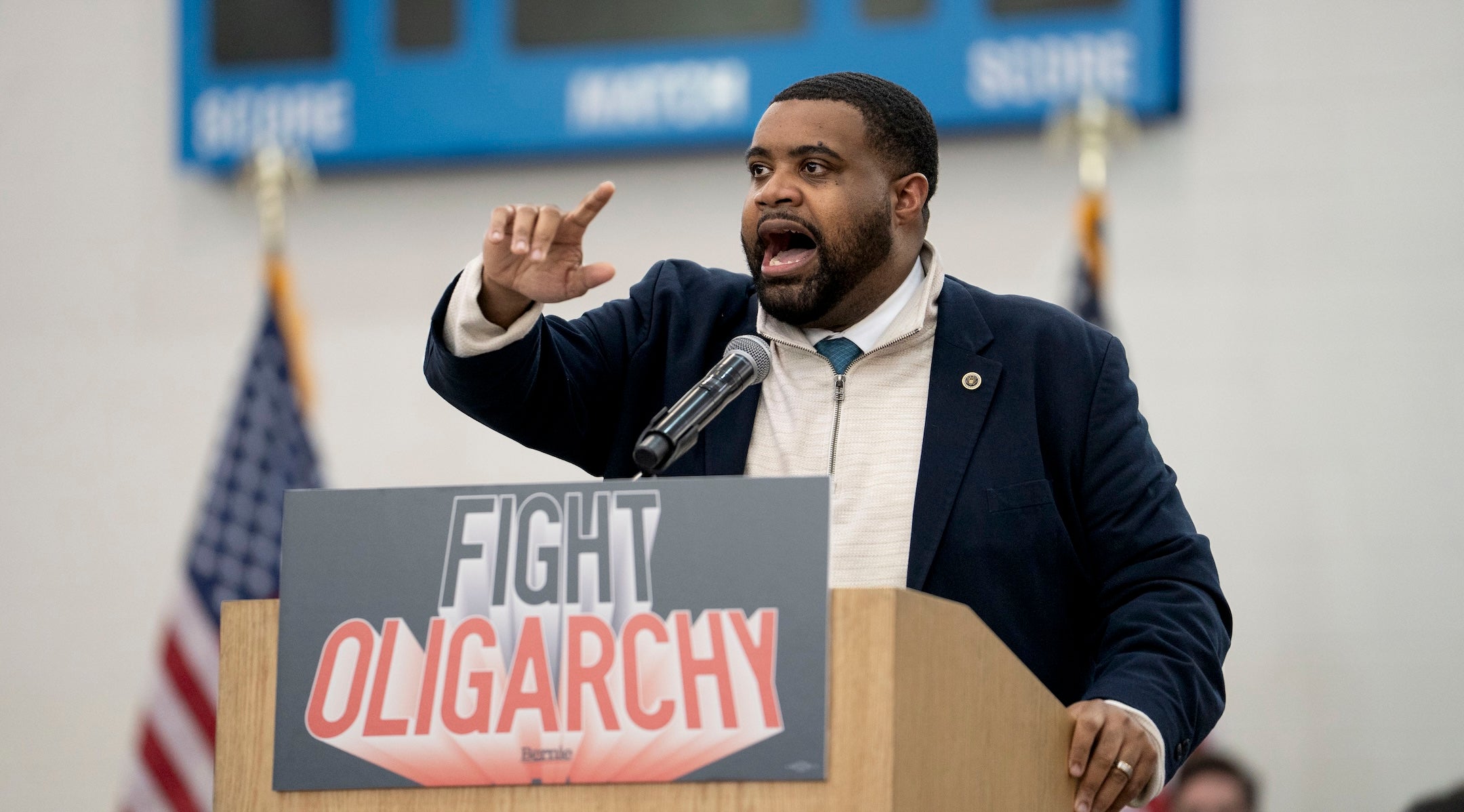
(JTA) — YPSILANTI, Michigan – A Black conservative group is distributing signs and paying for billboards in Michigan encouraging Black voters to support Jews and Israel, in the days before a contentious U.S. Senate race in which the Democratic candidate has struggled to shore up both voting groups.
The Center for Urban Renewal and Education (CURE), a Washington, D.C.-based nonprofit, has paid for a series of yard signs reading “Blacks and Jews Standing Together” throughout cities with high Black populations, including Detroit, Flint and Ypsilanti.
The nonprofit’s director, Star Parker, told the Jewish Telegraphic Agency in an email their goal is “to remind black Christian voters of unique and special reasons to stand with Israel.”
Parker said CURE is also paying for billboards in the area reading “Self Defense is Not Genocide” and “Many Black Evangelicals Agree that Israel Has a Right to Exist.”
The signs and billboards do not name any candidates. But Michigan’s Democratic Senate nominee, Abdul El-Sayed, has alienated many Jewish voters with his rhetoric on Israel and comments on Jewish safety.
He has also had difficulty shoring up Black support, another traditional Democratic constituency, with many Black Detroiters voting for his primary rival, U.S. Rep. Haley Stevens. That phenomenon has shifted somewhat in the race’s final days, with one poll commissioned by the Detroit News suggesting that 87% of likely Black voters would support El-Sayed.
Still, there can be distrust between Black and Arab communities as with Jewish and Arab populations. Sam Robinson, a Detroit-based reporter for a historic Black newspaper who has interviewed scores of Black voters in viral interviews, recently told the Columbia Journalism Review, “There’s a scarcity mindset that there are only so many resources and Arabs are somehow taking Black people’s share.”
Republican Mike Rogers, meanwhile, has courted Black voters as well as Jewish ones, with pro-Rogers ads highlighting tensions between local Black and Arab communities. A new super PAC linked to Rogers has spent heavily on ads stating that El-Sayed “has been disrespectful and dishonest with Black voters.”
CURE’s signs targeting Black voters appeared in the final week of the campaign. They followed an Oct. 22 interfaith roundtable in Detroit hosted by the organization, in which a local rabbi appeared alongside Black pastors to discuss the history of Black-Jewish organizing — a longtime alliance that has been shaken in recent years for a number of reasons.
Rabbi Aaron Bergman of Adat Shalom, a Conservative synagogue in the Detroit suburb of Farmington Hills, participated in the CURE roundtable. Over email, he told JTA that politics was not meant to be the focus of the event.
“It was mostly about teaching about antisemitism, which I guess at this point in history is political,” Bergman wrote.
El-Sayed has focused much of his campaign’s homestretch on shoring up the Black vote, visiting Black churches and holding events with former President Barack Obama and senior U.S. Rep. Jim Clyburn of South Carolina, a Black congressional leader. Driving up turnout in Black communities, usually one of the Democrats’ strongest constituencies, is viewed as key to his chances of taking the seat.
Stevens’ last-minute decision to endorse Rogers instead is a wildcard. Star told JTA she believed many “black Christian voters” would follow her lead.
“Their support for Israel needed a boost,” she said. “I believe this endorsement has taken Mike Rogers over the finish line with black voters.”

Yet there are signs that Palestinian rights may be a more animating issue among Michigan’s Black voters this year than in the past. Pro-Palestinian state Rep. Donavan McKinney, a democratic socialist, won his primary challenge against a pro-Israel incumbent in a majority-Black, Detroit-area congressional district in August. And during one Stevens primary campaign stop in Detroit, a Black community organizer directly confronted her over her support for Israel.
This article originally appeared on JTA.org.
The post In Michigan, a Black conservative group pushes Jewish and pro-Israel messaging appeared first on The Forward.
Uncategorized
New York Jewish leaders defend Democratic AG Letitia James from GOP challenger’s attacks
(JTA) — New York state Attorney General Letitia James and her Republican opponent Saritha Komatireddy are clashing over how to combat antisemitism ahead of Tuesday’s election.
The GOP challenger has frequently attacked James during the campaign over her handling of antisemitic crimes, but prominent Jewish leaders are rallying to defend the Democratic incumbent.
Komatireddy accuses James of turning a “blind eye” to antisemitic hate crimes as they grow more common in the state with the largest Jewish population.
A number of Jewish leaders have lined up to defend James’ record.
Mark Treyger, CEO of the Jewish Community Relations Council of New York, told the Jewish Telegraphic Agency in a statement that he has seen James’ commitment to New York communities “firsthand.”
“When an Ethiopian-Israeli small business owner in Harlem faced hate, she rearranged her statewide schedule to stand with her, offered immediate support, and followed through personally,” Treyger said, referring to anti-Israel backlash that faced Tsion Cafe.
“From confronting antisemitism and discrimination to protecting public safety and celebrating Jewish life, she has remained accessible and responsive to community concerns,” he continued, praising “her unwavering leadership and partnership.”
As a City Council member, James’ district included parts of the heavily Orthodox Jewish Crown Heights neighborhood, and she has called herself an “honorary Lubavitch.” Crown Heights United PAC endorsed James for reelection last month.
As attorney general of New York state since 2019, James is the state’s chief legal officer, leading an office with more than 700 lawyers that conducts statewide criminal and civil investigations.
But as reported hate crimes against Jews across the state have increased in the past decade, Komatireddy, who was a federal prosecutor in New York for more than a decade, says the attorney general isn’t doing enough.
“The data shows that antisemitic hate crimes are surging in New York, and someone has to step in and do something about it, because our DAs are being ineffective in stopping that trend,” Komatireddy said in an interview with JTA, referring to district attorneys who generally oversee the prosecution of hate crimes.
James has rejected Komatireddy’s claims. A campaign spokesperson told JTA that she has “stood arm in arm with the Jewish community all throughout her career.”
“She’s gone after bad actors who preyed upon Jewish New Yorkers time and time again, and will continue to fight against antisemitism and hate in all its forms,” the spokesperson said.
Jewish Democratic politicians in New York are supporting James’ bid. Outgoing U.S. Rep. Jerry Nadler, City Council Speaker Julie Menin and six other Jewish Democratic officials endorsed James at a press conference last week, where they commended her support for the Jewish community.
Manhattan Borough President Brad Hoylman-Sigal praised her for combating housing discrimination against Hasidic families in Orange County and for stopping a Rockland County car wash from overcharging Orthodox Jews.
Menin thanked James for annually marching in the Israel Day Parade — an example, she said, of James “standing with the Jewish community when things are difficult.”
“I’m verklempt right now,” James said after Menin’s remarks.
But some Jewish figures and groups are backing Komatireddy as she attempts to become the state’s first Republican elected as attorney general in more than 30 years. Komatireddy has the endorsement of President Donald Trump, who called James “corrupt” after she brought a civil suit against him over inflated property values and called for her to be removed as special prosecutor in a Cornell University rape lawsuit.
Komatireddy told reporters that she would declare a “state of emergency on antisemitism” on Day One as attorney general — a plan that James told JTA can only be enacted by the governor, not an attorney general.
Asked how she would declare a state of emergency, Komatireddy said she meant that she would utilize a law that allows the attorney general “to step in and prosecute hate crimes when a district attorney has been ineffective in doing so.” Komatireddy’s promises to the Jewish community also include establishing buffer zones outside Jewish schools and synagogues using existing civil rights law.
Komatireddy’s tough-on-crime, tough-on-antisemitism campaign has resonated with some Jewish New Yorkers, and could be the catalyst for “a lot of defections from James to Saritha,” predicted Moshe Davis, who was executive director of the mayor’s office to combat antisemitism under Mayor Eric Adams.
“I think a lot of the Jewish community is taking to her message,” said Davis.
A poll conducted by Siena last month has James ahead 54% to 39%; James led by 6 percentage points in the New York City suburbs.
Rabbi Elie Weinstock, who leads Long Island’s Jewish Center of Atlantic Beach, told JTA that there is “a sense of unease” among Jewish voters regarding antisemitic incidents.
“I think the Jewish community wants to hear people who will say, ‘I’ve got your back,’ and I think whoever gives off that impression will do well in the Jewish community,” said Weinstock, who counts Republican gubernatorial candidate Bruce Blakeman among his congregants.
He added that people’s opposition to New York City Mayor Zohran Mamdani, a Democrat like James, “may guide Jews’ votes” to Komatireddy.
Komatireddy attended a service at Park Avenue Synagogue and posted a video in October of the congregation’s rabbi Elliot Cosgrove wishing her “every blessing on your campaign” from the bimah. In a text to JTA, Cosgrove clarified that, while the post was recent, her visit was in “winter/spring.”
“I don’t / didn’t endorse. I always warmly welcome visitors,” he wrote.
Jewish Insider reported in October that Komatireddy posted photos from a meeting on the street with members of a Black Hebrew Israelite church that has called Jews “imposters” and the “Synagogue of Satan.”
Komatireddy told JTA that this was “an impromptu meeting” on the street in Rochester, and that “once we found out who they were, we rejected the hateful views that the group espouses” and deleted the post.
In March, Komatireddy wrote a scathing piece for the New York Post accusing James of turning a “blind eye” to antisemitic incidents.
But Binyamin Krauss, principal of SAR Academy, a Jewish day school in the Bronx, said “That’s not my experience” of James. Krauss last week hosted the attorney general at SAR, where she spoke with students. He pointed to her “supporting the community” on Manhattan’s Upper West Side after two men were stabbed there over the summer.
“Obviously you can disagree with certain decisions, when to prosecute, what to prosecute, how to handle a certain situation — but I do not agree with that characterization,” said Krauss, who added that he is not endorsing any candidates.
Meanwhile, Davis said that “turning a blind eye” is “not necessarily how I would frame it,” but opined that “people want to see more.” He also said that James is “someone who’s always shown up, always been a friend” to Jewish New Yorkers.
Phylisa Wisdom, who leads Mamdani’s office to combat antisemitism and was executive director of the liberal advocacy group New York Jewish Agenda, told JTA that James “has been a committed advocate for New York’s Jewish communities for decades,” going back to her time on the New York City Council.
“Attorney General James has used the tools of her office to root out antisemitism and help ensure that everyone in the state, including Jewish communities across the five boroughs, can live safely and thrive,” Wisdom said.
The left-wing group Jews for Racial and Economic Justice did not endorse James but recommended her in its voter guide, which commended her for taking action against far-right Zionist group Betar over “an alarming and illegal pattern of bias-motivated harassment and violence designed to terrorize communities and shut down lawful protest.”
This article originally appeared on JTA.org.
The post New York Jewish leaders defend Democratic AG Letitia James from GOP challenger’s attacks appeared first on The Forward.
Uncategorized
‘He made Black Jews not invisible anymore; he was the bridge’
Rabbi Capers C. Funnye, Jr. rabbi and spiritual leader of Beth Shalom B’nai Zaken Ethiopian Hebrew Congregation in Chicago, and the Chief Rabbi of the International Israelite Board of Rabbis, died Nov. 2 at the age of 74.
A cousin of Michelle Obama and an important leader for Black Jews in America, Funnye was raised in the African Methodist Episcopal Church and converted to Conservative Judaism. He held leadership positions in Chicago’s Jewish community and was a consultant to many cultural institutions throughout the United States.
“I’ve known him my whole life,” said Rabbi Tamar Manasseh said. “There is nothing that prepares you for this. I think it’s really important for people to know that he made Black Jews not invisible anymore. He was the bridge.”
“At that time it was not the priority for other Black Jews, but for him it was the priority,” Manasseh continued. “There were a million times that he was uncomfortable to one day bring comfort to us all.”
Funnye was born in 1952, in Georgetown, South Carolina, and attended Howard University. He received a B.A. in Hebrew literature and a rabbinic ordination from the Israelite Board of Rabbis, Inc., in Queens, New York, and a B.A. in Jewish studies and an M.A. in human services administration from the Spertus Institute of Jewish Studies, in Chicago.
In 1995, Funnye, Michelle Stein-Evers and Robin Washington (an editor-at-large at The Forward) founded the Alliance of Black Jews.
Funnye became the first African American member of the Chicago Board of Rabbis in 1997, and was named Chief Rabbi of the International Israelite Board of Rabbis, in New York in 2015.
He also served as a rabbi for congregations in Nigeria, Uganda, and other sub-Saharan African nations.
“Rabbi Capers Funnye was my ‘rebbe’ for connecting with the Black community and for understanding how important it is to bring the Black Jewish community to the very center of the Jewish community,” said Rabbi Asher Lopatin.
“I was inspired as he fought hard to gain acceptance as a full member of the Chicago Board of Rabbis and then succeeded in getting full membership in the New York Board of Rabbis and opening up the New York Board of Rabbis to graduates of the Israelite Rabbinical Academy,” Lopatin said. “I will never forget his passion, his brilliance, his insight and his love for Judaism, the Jewish community and Israel. May his memory be a blessing.”
“It was an honor to welcome Rabbi Funnye and members of the International Israelite Board of Rabbis to become part of our rabbinic family. His steadfast commitment to group relations helped us to better understand the dynamics of the Black Jewish community,” said Rabbi Joseph Potasnik, executive vice president of the New York Board of Rabbis. “May we continue to perpetuate his legacy.”
“Rabbi Funnye has touched countless lives with his spiritual leadership, wisdom, and unwavering commitment to our congregation and the broader Hebrew Israelite community. His legacy of faith, service, and dedication will continue to inspire generations,” Beth Shalom B’nai Zaken Ethiopian Hebrew Congregation wrote on its Facebook page.
The post ‘He made Black Jews not invisible anymore; he was the bridge’ appeared first on The Forward.
Uncategorized
Top Jewish lawyers quit Indiana ACLU amid controversy over new director
Four attorneys have resigned from the ACLU of Indiana amid concerns over the incoming executive director’s approach to free speech and allegations of antisemitism.
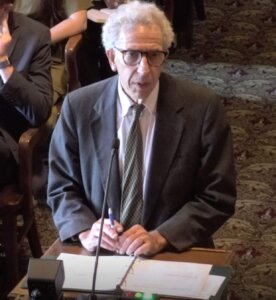
Legal director Kenneth Falk, a prominent Jewish civil rights lawyer who has twice argued before the U.S. Supreme Court, along with deputy legal director Gavin Rose, senior staff attorney Stevie Pactor and staff attorney Josh Bleisch, all resigned in recent weeks, the ACLU of Indiana’s board confirmed in a statement to the Forward. Their resignations were first reported by the Indy Star.
The concerns center on Nikkita Oliver, a lawyer and longtime Seattle activist who was announced in June as the next executive director of the ACLU of Indiana.
Oliver, who posted a Palestinian flag on Instagram about two weeks after Oct. 7, 2023, alongside quotes about oppressed peoples’ “right to resist,” made comments during a July meeting that a former staff member interpreted as questioning Jewish attorneys’ ability to represent pro-Palestinian activists fairly.
Oliver, who uses they/them pronouns, also said they objected to the ACLU’s landmark legal defense of neo-Nazis’ right to march in Skokie, Illinois in 1977, which raised questions for some former staff about whether Oliver was committed to defending free speech irrespective of ideology.
Oliver’s original start date of Sept. 1 has been pushed back as the ACLU of Indiana conducts a third-party investigation “to establish the facts.”
“It is distressing that a small group of staff who have, at most, interacted with me once seem to have generated these rumors and false allegations,” Oliver wrote in a statement to the Forward, adding that they “welcome a fair, third-party review.”
A disputed meeting
The wave of resignations followed a July “get to know you” coffee conversation between Oliver and Neil Hudelson, ACLU of Indiana’s director of philanthropy at the time.
Hudelson told the Forward that during that meeting, Oliver brought up a 2016 free speech case involving pro-Palestinian student activists at Indiana University, which the ACLU had declined to take. Two community members had reached out about the case after their hiring was announced, Oliver said.
Hudelson said he was unfamiliar with the case, or why the ACLU might have decided not to pursue it, and asked Oliver for details, which Oliver said they didn’t know. Hudelson then recalled explaining to Oliver that the ACLU of Indiana has repeatedly defended pro-Palestinian activists’ right to free speech.
Where the conversation took a turn, according to Hudelson, was when Oliver said three times that it was “very interesting” that the ACLU had declined to take the case.
The two parties’ interpretations of the interaction differ.
Hudelson’s interpretation was that Oliver viewed the organization’s Jewish attorneys, who had vigorously defended pro-Palestinian activists’ free speech rights, as biased against Palestinians.
“It’s not hard to know that 50% of our legal team at the time was Jewish,” Hudelson, who is not Jewish himself, told the Forward. “The fact they kept repeating, just finding it ‘very interesting,’ struck me as antisemitic.”
While Oliver also recalled bringing up the 2016 case, they disputed the idea that it had anything to do with the attorneys’ religious background.
“I am a direct person who says exactly what I mean without hedging,” Oliver said in a written statement documenting their recollection of the meeting. “I did not intend or insinuate anything beyond providing an example of a meritorious case the affiliate did not take.”
Hudelson filed a complaint at the time about the interaction and said he hoped the matter would be resolved with a private investigation.
Tensions flare
Pactor, one of the Jewish attorneys who resigned, told the Forward she had raised concerns about Oliver’s commitment to the ACLU’s nonpartisan mission. (The legal arm of the ACLU must refrain from intervening in political campaigns in order to maintain its 501(c)(3) tax-exempt status.)
Pactor said she filed a complaint expressing concern over a comment Oliver made during a meeting with her in July about wanting to turn Indiana “light red.”
In a statement to the Forward, Oliver said by turning the state “light red,” they meant ensuring equal access to voting, which “naturally shifts the political landscape away from an exclusive focus on a single party.” (Indiana has largely voted for Republicans for president.) Oliver also noted that Pactor was in the running to become executive director but was not selected.
For Pactor, those concerns were compounded by Oliver’s social media history.
Less than two weeks after the Oct. 7 attacks, Oliver posted a Palestinian flag to Instagram and quoted author Arundhati Roy, who said “People have the right to resist annihilation.” Oliver added in the post that Martin Luther King Jr. “began to see the limits of non-violent protest” toward the end of his life.
“I am heartbroken and angry,” Oliver wrote at the time. “If we want the violence to stop, we must stop the root cause. This means ending the occupation of Palestine by Zionist Israel, supporting Palestinian liberation and ending the apartheid state.”
The ACLU of Indiana board defended the post to the Forward as “an intellectual critique of power dynamics, not an incitement of violence.”
After two Israeli embassy staff, Yaron Lichinsky and Sarah Milgrim, were shot and killed outside the Capital Jewish Museum in May 2025, Oliver reposted this message on their Instagram story: “20k children dead: violence is okay. 2 israeli embassy staff members dead: violence is not okay anymore.”
In another post, after the May 2026 shooting at the Islamic Center of San Diego that killed three people, Oliver reshared an image on their Instagram story calling the attack “the direct result of white supremacist, Zionist and anti-Muslim rhetoric being pushed by the state and media.”
Blaming the mosque attack on “Zionist” rhetoric without evidence was concerning, Pactor said, especially since the two teenage gunmen had expressed neo-Nazi views in writings they left behind.
In a statement to the Forward addressing their social media posts, Oliver wrote, “These posts speak to the double standard that can exist in the media when some deaths are deemed tragic, and others are deemed necessary. All life is precious. I understand that, outside of free speech, pro-Palestine advocacy is not within the ACLU of Indiana’s portfolio, and I do not intend to change that.”
On Sept. 27, a group of 79 Jews across the country who identified themselves as “organizers for Palestinian rights” submitted a letter of support for Oliver, writing that they could “attest that Nikkita [Oliver] explicitly and consistently cares about the safety of Jewish people.”
Tensions continued to flare among the ACLU staff, culminating in a Sept. 29 board meeting attended by Hudelson, who said board members said Oliver was the victim of false allegations.
Hudelson said he was fired two days later. The board said it would not comment on the details of personnel matters but noted that one employee was fired “for cause.”
Pactor resigned a few weeks later, on Oct. 19.
The Skokie question
Oliver also brought a perspective to free speech advocacy that appeared to diverge from the ACLU’s longstanding tradition of defending the rights of even the most objectionable speakers.
In 1977, the ACLU famously represented neo-Nazis who wanted to march through Skokie, Illinois, a heavily Jewish suburb of Chicago that has been home to many Holocaust survivors. The neo-Nazis never ended up marching, though they won the legal right to do so in court — with Jewish ACLU attorney David Goldberger arguing on the neo-Nazis’ behalf.
The ACLU’s decision to defend the rights of neo-Nazis was controversial; at the time, many Jewish lawyers resigned in protest. But it also helped establish the organization’s credibility as a group committed to the principle of free speech for all.
The ACLU has repeatedly reaffirmed its decision in the Skokie case. Today, the ACLU website notes that many consider the Skokie case “one of the ACLU’s finest hours.”
Oliver told Hudelson during their July meeting that they disagreed with how the ACLU handled the case.
“If I had been the head of the ACLU during Skokie, I would have found a different approach through integrated advocacy — such as submitting an amicus brief on the First Amendment — that protected the free speech of all without subjecting a Jewish community to potential harm,” Oliver wrote in their account of the meeting with Hudelson.

That approach conflicts with the way the ACLU has historically operated. Falk, who had served as legal director at the Indiana ACLU since 1996 before resigning, is among those Jewish free speech lawyers who have represented clients many find unsavory. He has argued on behalf of the Ku Klux Klan on multiple occasions, including when the hate group wanted to host a rally at the Gary, Indiana City Hall.
“If we don’t stand up for the rights of everyone, even people we don’t necessarily personally agree with, all of our rights are diminished,” Falk told The Indiana Lawyer in May. (The Forward was unable to reach Falk for comment.)
Hudelson and Pactor both told the Forward they were concerned by Oliver’s approach.
“Ken was always saying, ‘You don’t know what it’s like until your rabbi has to ask you why you have the Grand Wizard of the KKK in your office,’” Hudelson said. “But that’s what we do. We’re the ACLU.”
In a statement, the board said the ACLU of Indiana was not changing its approach to free speech litigation.
“I understand that under the law hate speech is free speech, and I believe in the ACLU’s mandate to protect all people’s civil liberties and civil rights,” Oliver wrote in a statement to the Forward. “I am aware of the ACLU’s stance and understand the difference between the affiliate’s work and my own frameworks and political leanings.”
The third-party investigation is set to be completed in November.
The post Top Jewish lawyers quit Indiana ACLU amid controversy over new director appeared first on The Forward.
