


Uncategorized
In the work of 21 artists, 49 different ways to be Jewish
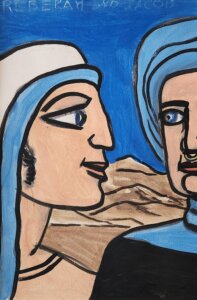
As I walked through the exhibit, Envisioning the Sacred: Modern Art from the Collection, at the Derfner Judaica Museum and Art Collection, I wondered aloud which was the more defining element in these 20th and 21st century paintings, drawings, prints and linoleum cuts. Was it the modernist sensibility, which encompassed figurative, abstract, symbolic and metaphorical approaches? Or was it the Jewish-themed content?
In the 49 pieces by 21 artists (including two etchings by Marc Chagall), there were illustrated Biblical characters and stories; depictions of traditions and rituals; and a fair number of the works employed the Hebrew alphabet to evoke emotion and inspire the composition.
“The exhibit shows how artists use a modern visual language to express their Jewish identities,” said Susan Chevlowe, chief curator and museum director who guided me through the light-filled gallery, which is part of the Hebrew Home at Riverdale and set on a shallow hill that slopes down to the Hudson River.
“It’s hard to separate the two elements or say which is more defining,” Chevlowe said. “The majority of these artists were artists early on in their lives, drawing and sketching as children. Some grew up steeped in a Jewish tradition and others came to their Jewish identity later in life, especially in the post-Holocaust years. Percival Goodman is an example. An agnostic, he was best known as a modernist architect. But in the post-Holocaust years he became interested in Biblical figures.”
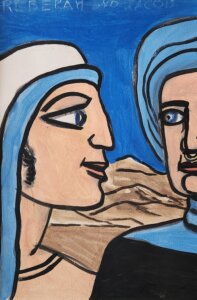
Chevlowe pointed to Goodman’s painting “Rebekah and Jacob,” presenting two large, sharply drawn flat heads. The bold colors outlined in stark black stripes summon forth figures that border on the cartoonish, yet are also strikingly beautiful. Here, the matriarch Rebekah beams at her younger son Jacob with whom she is scheming to steal her older son Esau’s birthright.
A number of the works reflect, in subtle and layered ways, Jewish traumas coupled with homage and pride and in some instances a touch of the elegiac.
Adam Muszka’s “Sabbath Meal,” painted in the 1960’s is a nostalgic look back at the lively Polish shtetl that he grew up in and that no longer exists. With its sentimental tone, the painting evinces distortion. Two figures in the foreground are over-sized, while the homes in the background are shrunken and lopsided — an indication, perhaps, that this is a falsely rosy memory.
In the seemingly more realistic 2003 painting, “Choral Synagogue, St. Petersburg, Russia,” one of the more recent works on display, Joyce Ellen Weinstein brings to life the massive temple entrance and the decorative gate in front of it, “which is slightly off kilter,” Chevlowe pointed out. “Notice the barbed wire on top of the gate. The painting suggests the dignity of the synagogue and its people and also the difficult position of Russian Jews throughout history.”
Chevlowe was hard pressed to pick a favorite, though she admitted a special fondness for Jane Logemann’s 1996 “Alphabet,” a series of pale blue and purple ink wash panels adorned with repeated pairs of Hebrew letters, in pen and ink, which create a vertical pattern from the top of the page to the bottom. The series is poetic, lyrical.
“Logemann is interested in patterns and structures of nature,” said Chevlowe. “Some letters are large, others small. There’s a randomness here. Her choices are intuitive. For many artists the abstract is spiritual. For some mysticism and spiritual quest are essential in their work.”
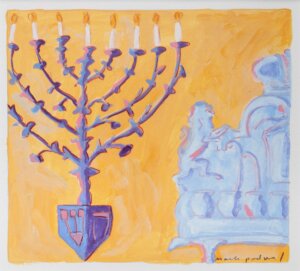
One of the better known artists in the group is Mark Podwal. In his 2002 “Dreidel Hanukkia,” an acrylic painting, we see a menorah balanced on a dreidel and on the opposite side of the page there’s a less readily definable bench lamp.
“It’s modern and old and very playful,” said Chevlowe. “And each Hanukkah light, the menorah and the bench lamp, is cut off by the frame, cut off by the rest of the world. It’s a fragment. We often see that in Degas too.”
Some of the painters are more deeply embedded in or influenced by particular schools of art than others. In Jacques Yankel’s joyful and expressionistic “Torah,” one can see the Marc Chagall and Chaim Soutine lineage. Yankel’s emigre artist father lived in Paris and was very much part of the Paris school of art, which included Chagall and Soutine.
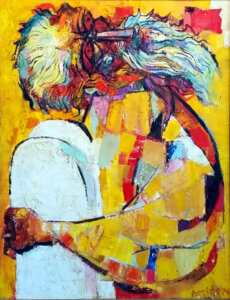
In New York, Ben-Zion, a Russian-born painter who arrived in the United States in 1920, was a recognized member of “The Ten,” abstract painters that consisted of, among others, Mark Rothko and Adolph Gottlieb, though curiously enough Ben-Zion was never really an abstract painter.
Moses was a frequent subject of his. In his 1962 “Moses Looking Down to the Promised Land,” our title character is viewed from the back, an imposing, heavily draped figure perched on a rocky terrain. He is staring out at Jericho, at once so close to and yet so far away from The Promised Land.
Abraham Rattner also employed Moses as the central figure and theme in his vibrant Picassoesque “Moses,” which features the Prophet clutching two blank tablets, devoid of the commandments or, indeed, any writings. His head twisted to the side and an integral element in a wild abstract design is as unsettling as it is thrilling. It is perhaps my favorite in the collection.
“I would like viewers to appreciate the richness in stylistic range and to be aware that these are highly trained, skilled and knowledgeable artists who come from a rich cultural tradition that includes all of art history,” Chevlowe told me. “At the same time they create something that’s original, authentic and beautiful.”
The post In the work of 21 artists, 49 different ways to be Jewish appeared first on The Forward.
Uncategorized
Israeli Artist Forced to Close Mexico City Exhibit for ‘Safety Reasons’ After Antisemitic Harassment, Vandalism

Pro-Palestinian protesters and vandals hold a flag during a demonstration against Amir Fattal, an openly Zionist Israeli graphic artist. They later spray-painted the facade of the private KÖNIG GALERIE gallery, where he was exhibiting some of his AI-generated works. Photo: Gerardo Vieyra / SOPA Images via Reuters Connect
An Israeli artist based in Berlin was forced to close his solo exhibition at a Mexico City gallery a week earlier than planned following continued antisemitic harassment, a protest at his exhibit, and vandalism of the gallery.
Artist and curator Amir Fattal shared the news on Instagram about the closing of his exhibit, “I’m Just Here For The Pool,” at the König contemporary art gallery. The show opened on Feb. 3 and was expected to close on April 1, according to the gallery.
On March 26, pro-Palestinian activists spray-painted antisemitic and anti-Israel messages and symbols across the outer walls of the König gallery. Swastikas, Star of Davids, the word “Nazi,” and more offensive messages were spray-painted along with the number “666.” The number is used by the Aryan Brotherhood, a white supremacist group, and it signifies the “number of the beast,” according to the Anti-Defamation League. On the door of the gallery, a vandal carved a swastika and the phrase “acqui hay terroristas,” which translates in English to “here there are terrorists.” The same phrase was written in chalk on the street in front of the gallery, according to photos shared by Reuters.
On March 21, during a guided tour of the gallery, roughly 15 demonstrators gathered outside, chanted against Fattal, and called him “a murderer” and “a Mossad agent,” according to Artnet.
Uncategorized
Israeli Forces to Expand Control in Southern Lebanon as Defense Chief Outlines Long-Term Security Plans

Smoke rises after an Israeli strike, amid escalating hostilities between Israel and Hezbollah, as the US-Israeli conflict with Iran continues, in southern Lebanon, March 28, 2026. Photo: REUTERS/Stringer
Israeli Defense Minister Israel Katz announced on Tuesday that the Israel Defense Forces (IDF) will maintain security control over territory in southern Lebanon up to the Litani River even after active ground operations against Hezbollah conclude, signaling plans for a sustained Israeli security presence along the northern front.
During a press briefing, Katz pointed to a shift beyond limited cross-border raids, outlining plans for a long-term security presence and the creation of a buffer zone as part of a broader effort to reshape the security landscape in Lebanon.
Under this new plan, the IDF will move to dismantle terrorist infrastructure in border villages using operational methods similar to those employed in the Gaza Strip against Hamas, aiming to permanently eliminate the threat of cross-border raids and anti-tank fire targeting Israeli frontline communities.
“The return of more than 600,000 southern Lebanese residents who fled north of the Litani River will remain completely prohibited until the security of Israel’s northern residents is guaranteed,” the Israeli defense chief said.
Katz also announced the IDF plans to establish a new defensive line inside Lebanese territory once the ground campaign concludes.
“The IDF will maintain security control over the entire area up to the Litani River, including all bridges, while fully neutralizing Radwan’s forces and destroying their weapons,” he said, referring to Hezbollah’s elite units.
“We are determined to separate Lebanon from Iran’s influence, to uproot the snake’s teeth, and eliminate Hezbollah’s threat capability,” Katz continued. “The situation in Lebanon will change once and for all — we will enforce security just as we do in Syria and Gaza.”
During a cabinet meeting on Tuesday, Israeli Prime Minister Benjamin Netanyahu outlined a tougher operational approach to the campaign in Lebanon, emphasizing shifts in battlefield tactics following the heavy toll the fighting has taken.
“I have ordered our soldiers to avoid entering buildings whenever possible, using mechanical engineering equipment and heavy weapons instead,” Netanyahu said, explaining that the goal is to “minimize casualties” and to safeguard soldiers on the ground.
With prospects of potential ceasefire negotiations with Iran to end the ongoing war still uncertain, Netanyahu said Israel is shaping a new security reality along its northern border and will act independently of any agreement possibly reached with Tehran.
“Even if an agreement is reached with Iran, a ceasefire in Lebanon cannot be imposed on us — that must be Israel’s own independent decision,” the Israeli leader said.
The Iranian regime backs and ultimately commands Hezbollah, having formed the Lebanese terrorist group in the 1980s and, since then, providing significant amounts of weapons, funding, and training.
Last week, Hezbollah Secretary General Naim Qassem warned that negotiating with Israel while under fire would amount to forced surrender, adding that his fighters are prepared to continue operations “without limits.”
With a ground maneuver underway to expand a defensive zone in southern Lebanon, the IDF says it has eliminated over 850 Hezbollah terrorists since fighting began earlier this month, while continuing to dismantle the group’s command and weapons infrastructure.
Israel has intensified strikes targeting Hezbollah, particularly south of the Litani River, where the group’s operatives have historically been most active against the Jewish state. Hezbollah opened fire on Israel earlier this month, just a few days after the US and Israel launched their joint military campaign against Iran.
Israel has long demanded that Hezbollah be barred from carrying out activities south of the Litani, located roughly 15 miles from the Israeli border.
Although the overall number of attacks has decreased, Hezbollah continues to launch significant strikes against civilian areas while maintaining sustained operations targeting IDF forces in southern Lebanon.
In just the first month of the conflict, Israeli officials report that Hezbollah has carried out more than 900 coordinated attacks, marking a sharp increase in cross-border activity and a broader expansion of its operations across the region.
On Sunday, Israeli forces intercepted a Hezbollah a terrorist cell disguised as paramedics who tried to transport weapons in an ambulance.
For years, Hezbollah has embedded command posts, weapons depots, snipers, and troops within Shiite villages, situating them in the heart of civilian centers near schools, hospitals, mosques, and main roads to turn entire communities into battlefields.
Uncategorized
Newest Members of the IDF’s Ultra-Orthodox Hasmonean Brigade Get Their Berets

Illustrative: Members of the Hasmonean Brigade during their beret ceremony at the Western Wall on Aug. 6, 2024. Photo: Screenshot
The third set of soldiers in the Hasmonean Brigade, the Israel Defense Force’s first ultra-Orthodox brigade, completed eight months of training earlier this month and received their dark blue berets at the end of a beret march of approximately 40 kilometers, according to the Israeli news outlet Walla.
The troops will join the regular forces of the Hasmonean Brigade, which was established in 2024 and has participated in military operations in Syria, the West Bank, the Gaza Strip, and southern Lebanon. Members of the brigade live an ultra-Orthodox lifestyle, and their blue berets reportedly symbolize the sky. The brigade is named after the Hasmonean Jewish dynasty that ruled Judea, and liberated Jerusalem and the Temple from oppressive Greek rule.
In February, members of the Hasmonean Brigade’s Yonatan Battalion completed its first-ever battalion-level exercise in the Golan Heights area, “marking the conclusion of the battalion’s operational certification process and its preparation for operational activity,” according to the military. During the exercise, the soldiers were trained in combat in open terrain, targeted operations, and urban warfare scenarios. It took place mere weeks after the start of the Israel-Iran war, also known as Operation Roaring Lion.
“You can be ultra-Orthodox and be a combat soldier – you are making history,” Commander of the Ground Forces, Major General Nadav Lotan, said at the time. “The Hasmonean Brigade continues to establish itself as a combat brigade within the ground forces. This exercise, along with the establishment of the battalions, marks another significant step forward. I am proud of you – the brigade’s troops and commanders. You operate at a high operational standard while preserving your unique identity.”