


Uncategorized
Indiana Jews race to reclaim a synagogue that shaped the Reform movement
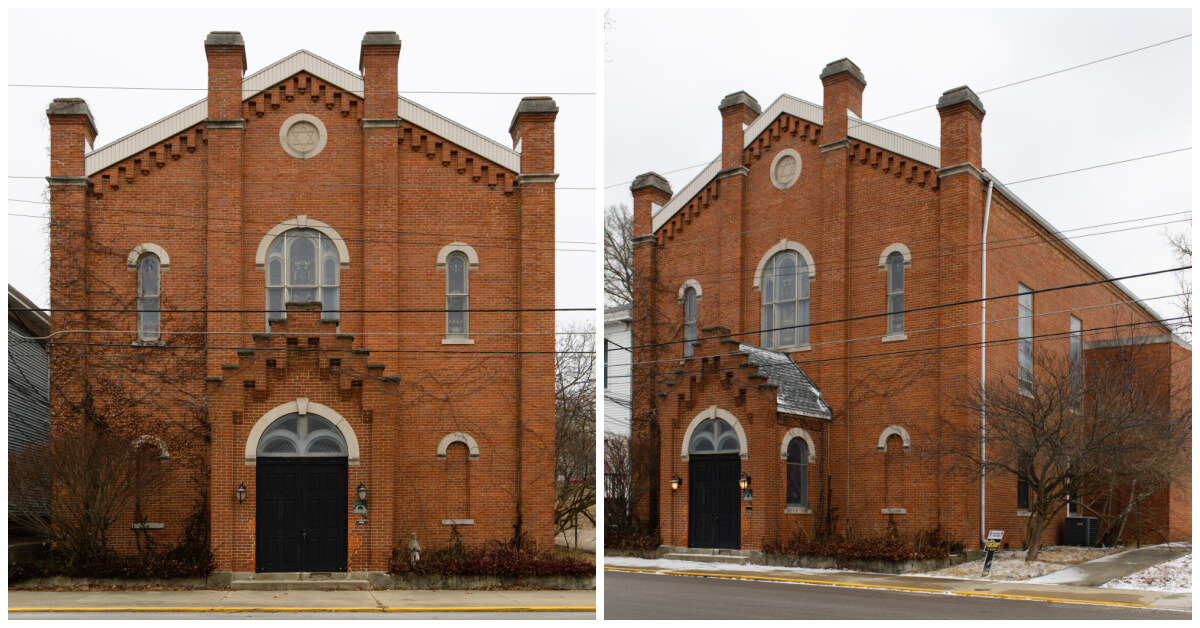
On South Seventh Street in downtown Lafayette, Indiana, a Star of David still crowns a synagogue built in 1867. In the mid-19th century, this congregation became an early laboratory of the Reform movement — and, historians say, the site of the first known egalitarian minyan in America.
Over the decades, it would serve as a proving ground for rabbis who went on to shape American Judaism. One of them, Julian Morgenstern, later rose to lead Hebrew Union College and helped secure visas for several Jewish scholars fleeing Nazi persecution — including Abraham Joshua Heschel.
The congregation moved to a new building in 1969. Since then, the old structure has housed churches, the Red Cross and other nonprofits. Now the building is for sale.
And a group of local Jews is trying to buy it back before it’s sold to someone else.
They have raised $9,751.
A sacred space
The campaign is being shepherded by Robyn Soloveitchik and Tanya Volansky. Both felt something when they stepped inside the old sanctuary last year during a tour.
“With the building being for sale, it is a giant question mark,” said Volansky, a medical massage therapist. “It would be wonderful not only to bring it back into the Jewish community. We want to guarantee it will be there for future generations.”
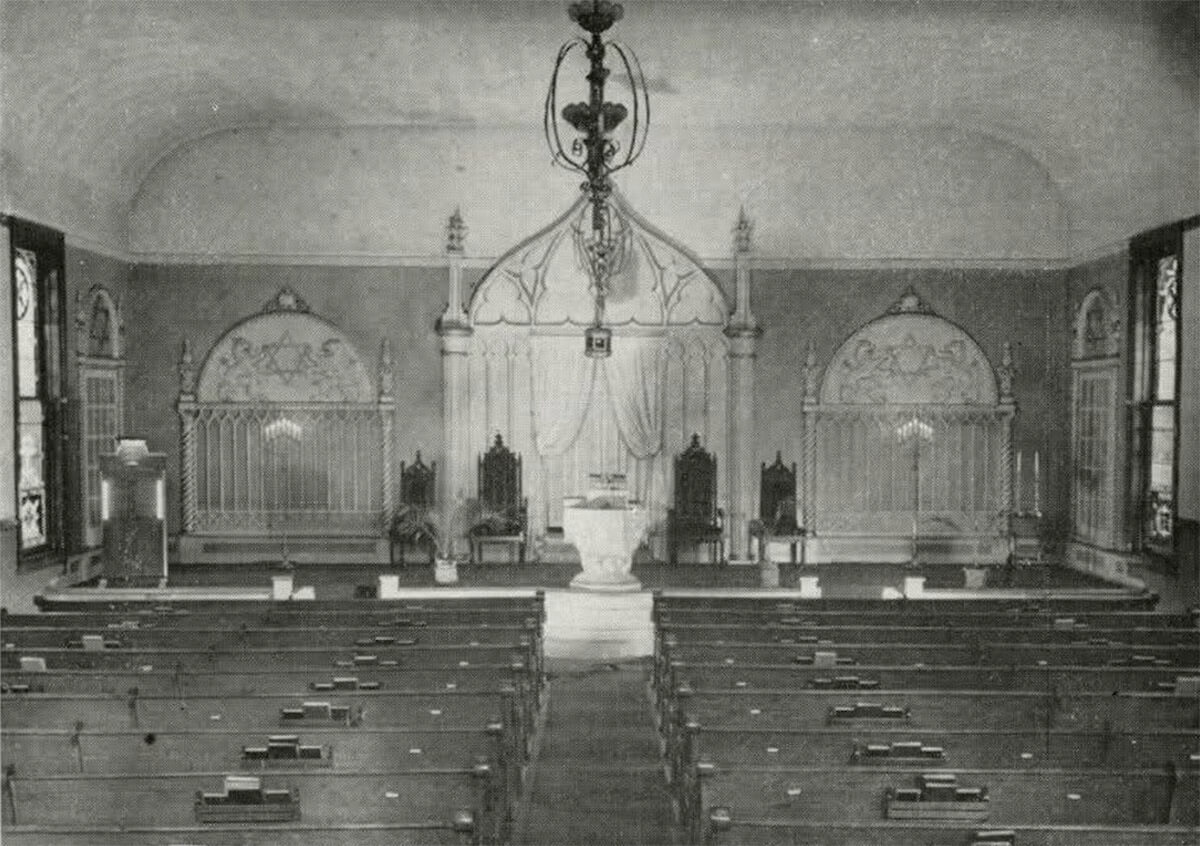
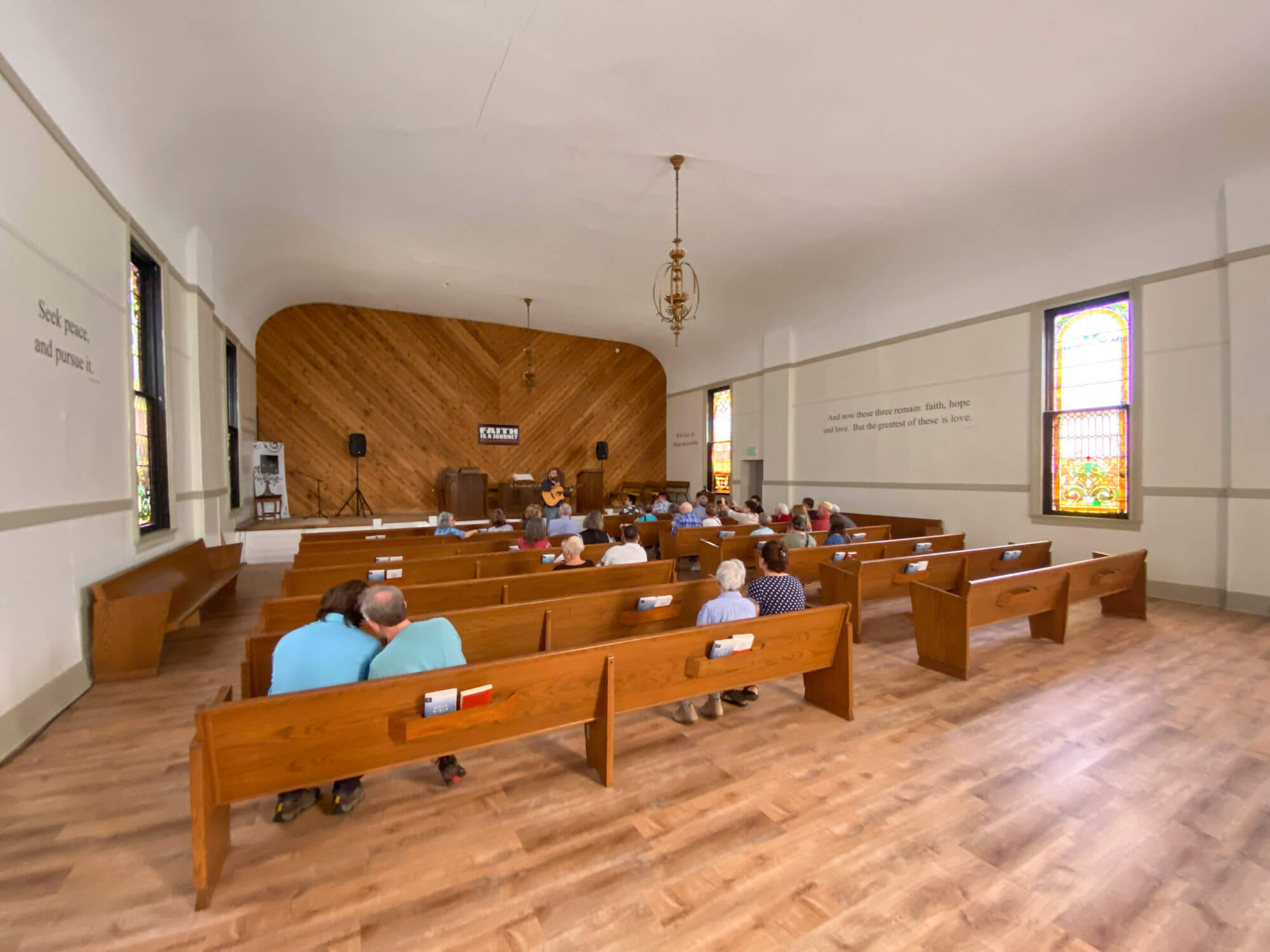
Soloveitchik, who works in auto manufacturing, looked up at the stained glass and wondered how it had survived. The sanctuary still dominates the upper floor. A wooden wall now covers the original ark.
The building is listed for $299,900.
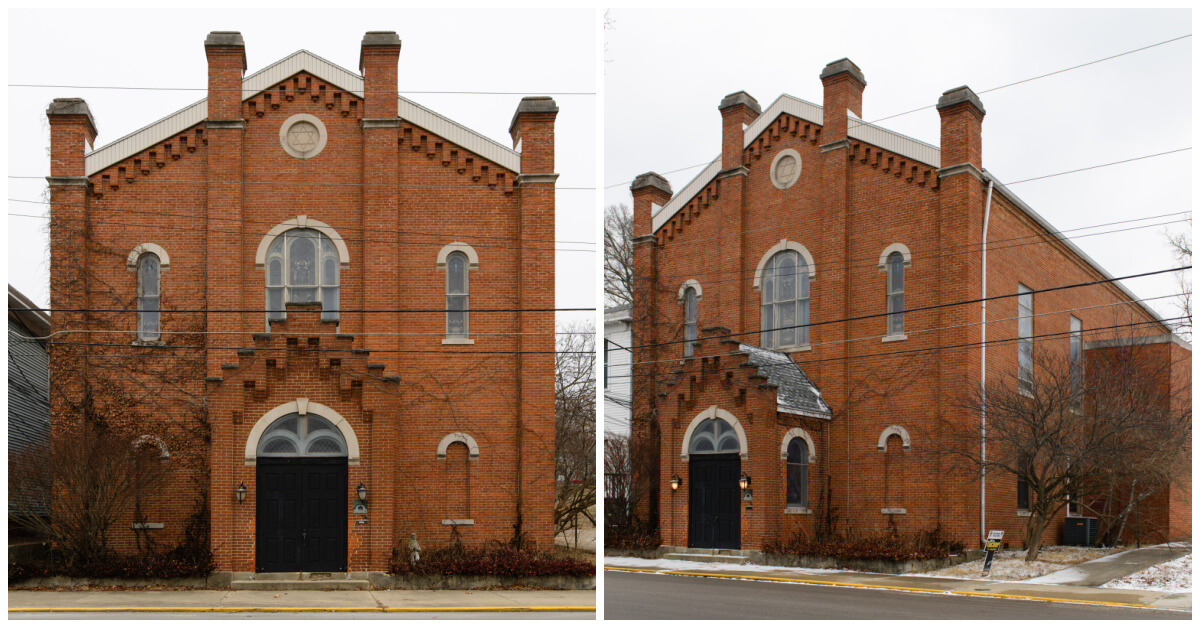
If someone else buys it — a developer, a church, an investor — there’s not much they can do to change the facade. Exterior changes, including alterations to the stained glass windows, must be approved by the Lafayette Historic Commission. But the building’s landmark status does not control who owns it or how the interior is used. Its future purpose would be up to whoever signs the deed.
So the two women and a few others formed a nonprofit, the Ahavas Achim Cultural Center, and began making calls. They built a website. They launched a crowdfunding campaign. They reached out to preservationists and descendants of Lafayette’s early Jewish families.
They are not trying to reopen the sanctuary as a full-time synagogue. Lafayette already has two: Temple Israel, which is Reform, and a small Conservative congregation, Sons of Abraham. It also has a Chabad and Hillel connected to Purdue University. Roughly 1,500 Jews, including students, live in the Greater Lafayette area.
Instead, they imagine something else: a place for adult education classes, film screenings and community events — a visible reminder that Jews have been part of Lafayette’s civic fabric since before the Civil War.
A rich history
Ahavas Achim was founded in 1849, when Lafayette was still a bustling river town along the Wabash. Many of its Jewish families had arrived by way of the Erie Canal, joining the westward stream of peddlers and merchants pushing into the American interior. Many were from Bavaria, accustomed to life as minorities in small European towns. In Indiana, they found familiar rhythms: small communities, German-speaking neighbors and space to build. Lafayette later became a major railroad hub on the way to St. Louis and Chicago.
In 1867, the congregation moved into its home on South Seventh Street. Local newspaper coverage of the dedication spilled across two columns on the front page — speeches transcribed, dignitaries listed, the building described in loving detail — as if the city itself understood that something lasting had been built.
More than 150 years later, the structure is now considered one of roughly a dozen or so 19th-century synagogue buildings still standing in the United States. That history, said Michael Brown of the Indiana Jewish Historical Society, is what moves people. “They see how rare it is,” he said. “It’s pretty important.”
In 1919, the congregation updated its constitution and adopted a new name: Temple Israel. And in 1969, as members increasingly lived across the river in West Lafayette, it relocated — this time to a new building closer to the university community.
Temple Israel never disappeared. It simply moved.
A minor league for Reform heavyweights
In the early 20th century, Lafayette’s temple functioned as something like a minor league franchise for Reform Judaism.
Rabbi Julian Morgenstern served here from 1904 to 1907 before becoming president of Hebrew Union College. From that perch, he watched European scholarship with mounting frustration. As Jewish academics fled rising antisemitism in the 1930s, many gravitated toward the more traditional Jewish Theological Seminary.
“That enraged him,” said Brown.
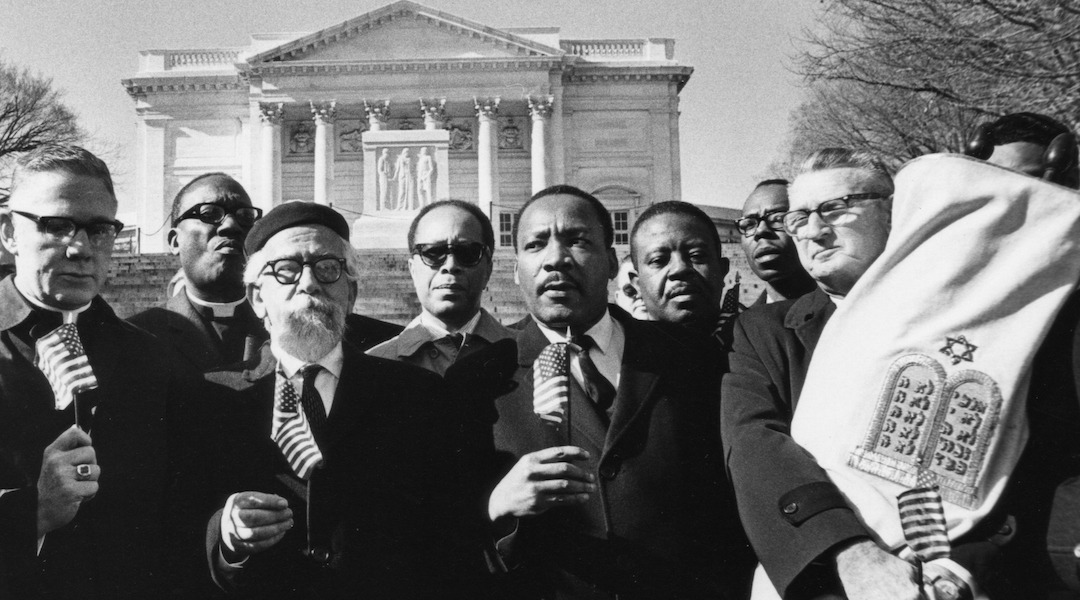
Morgenstern compiled a list of promising European scholars he believed Reform must recruit. He worked with the State Department to help secure visas for several rabbis and thinkers fleeing Nazi persecution. One of them was Abraham Joshua Heschel.
In the United States, Heschel would later encounter another Indiana rabbi, Abraham Cronbach, who was one of the people who introduced him to the idea that a rabbi could be a public activist as well as a scholar.
Morgenstern was not the only future luminary to pass through Lafayette’s pulpit.
Nathan Krass later served for decades at New York City’s Temple Emanu-El, one of the country’s most prominent Reform congregations. Morris Feurlicht, who stood up to the Ku Klux Klan during the 1920s in its Indiana stronghold, once stood here. Bernard J. Bamberger, a prolific Bible translator, would become president of the Central Conference of American Rabbis. Joshua L. Liebman — whose bestseller Peace of Mind reshaped how rabbis approached counseling — also served in Lafayette before rising to national prominence.
Lafayette’s Jewish footprint extended beyond the sanctuary. The city was also the birthplace of Academy Award-winning director Sydney Pollack and home to Jewish merchants and civic leaders who helped shape the town’s commercial and cultural life.
A fragile model
Wendy Soltz, a history professor at Ball State University who led the federally funded Indiana Synagogue Mapping Project, has documented 66 purpose-built synagogues across the state dating back as far as 1865. Of those, 24 have already been demolished — including nine of Indiana’s original 19th-century synagogues.
The Lafayette building, she said, “has statewide and national significance,”
But she also offered a caution.
Across Indiana, she has seen former synagogues converted into small museums — projects that begin with enthusiasm but struggle to sustain long-term interest.
“You get that initial wave of visitors,” she said. “But then it really dramatically trickles off.”
Where adaptive reuse has worked, she said, is when buildings function as active community centers rather than static exhibits. In Terre Haute, a former synagogue now operates as the Wabash Activity Center, hosting senior programs and public events. In Evansville, a community center incorporates the surviving tower of a burned synagogue into its campus — even using it in the organization’s logo.
“If it’s just a museum, it likely won’t work,” Soltz said of the Lafayette project. “But if there are aspects serving the community, that has proven staying power.”
With Indiana synagogues, not every rescue looks the same. Sometimes preservation takes surprising forms.
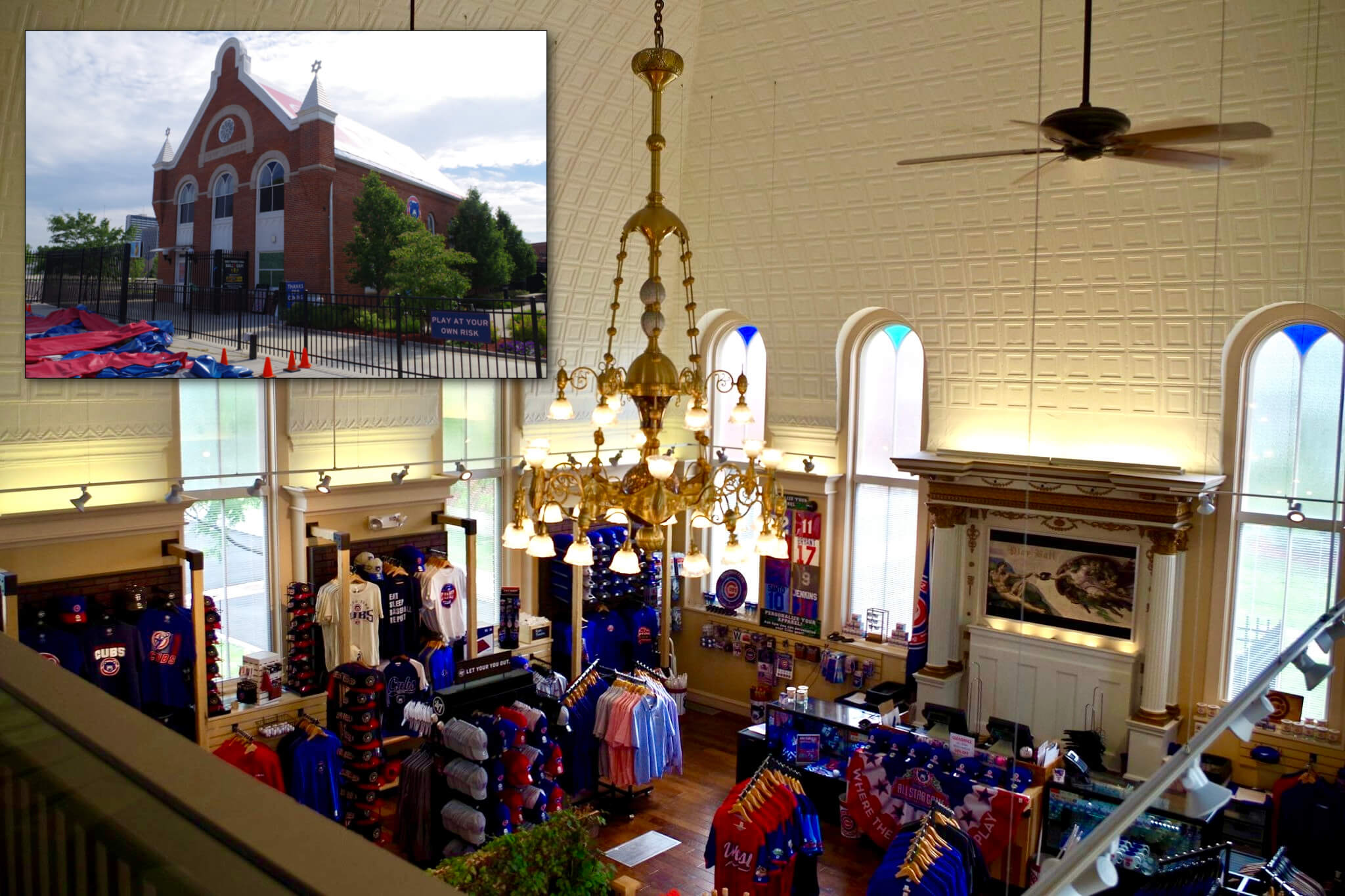
When a new baseball stadium was built in 2012 in South Bend, the team owner had to figure out what to do with a 1901 Romanesque Revival–style synagogue on the property that was listed on the National Register of Historic Places. The team spent $1 million restoring the building. It’s now where the gift shop is located. A mural on the wall of what’s now known as the Ballpark Synagogue riffs on the Sistine Chapel, depicting God passing a baseball to Adam along with words “Play Ball.”
Continuing a legacy
In 2024, during Temple Israel’s 175th anniversary, Rabbi Adam Bellows led congregants back into the old sanctuary for a commemorative tour.
“One of the highlights of my rabbinical career,” he said, was reciting the Shehecheyanu blessing there. Standing in the space, he felt connected “to all the past congregants and past rabbis and past prayer leaders.”
Bellows, the current rabbi of Temple Israel, is not formally involved in the buyback effort. But he supports it.
“I don’t think it’s counterproductive,” he said, even though his synagogue has room for events. He envisions the building as a monument to the long Jewish legacy in the region — a place for education and community gathering, even if regular worship remains across town.
“It’s a little bit of an underdog story,” he said. “But I believe in miracles.”
The post Indiana Jews race to reclaim a synagogue that shaped the Reform movement appeared first on The Forward.
Uncategorized
Jewish families and a rabbi ask to join lawsuit to block Oklahoma Jewish charter school
(JTA) — A rabbi, a Jewish mother who invokes her family’s Holocaust history, and a Jewish teenager are among seven Oklahoma residents who have asked a federal court to let them join the fight against a proposed Jewish public charter school in their state.
The group filed a motion Wednesday in federal court in Oklahoma City seeking to intervene in the lawsuit brought by the National Ben Gamla Jewish Charter School Foundation, which is trying to become the nation’s first publicly funded religious school.
Rabbi Daniel Kaiman, the principal rabbi of Congregation B’nai Emunah in Tulsa, says he opposes the mixing of religion and government because of the potential for abuse. His own children attend a public elementary school in Tulsa.
“I am passionate about Jewish education—indeed, I have dedicated my life to it. Kaiman wrote in a declaration filed with the court. “Children in my congregation, including my own children, receive excellent, privately funded Jewish education through our synagogue and at home in accordance with our community values. But the mixing of religion and government creates opportunities for religious coercion.”
The motion was filed on behalf of the seven by the ACLU, Americans United for Separation of Church and State, the Education Law Center, the Freedom From Religion Foundation and Oklahoma Appleseed.
Ben Gamla, founded by former Florida congressman Peter Deutsch, applied last year to open a virtual K-12 school in Oklahoma where Jewish religious teachings would be woven into all subjects and employees would be required to uphold Jewish tradition in their personal lives.
The Oklahoma Statewide Charter School Board rejected the application twice, in February and March, citing a 2024 Oklahoma Supreme Court ruling that barred religious charter schools. The 2024 ruling stood following a 4-4 vote in the U.S. Supreme Court after Justice Amy Coney Barrett recused herself from the case, reportedly over ties to the Catholic plaintiff in that case.
Ben Gamla filed a federal lawsuit against the board on March 24 arguing that the ban amounts to unconstitutional religious discrimination.
Now, the group opposing the school is asking to join the case as additional defendants alongside state Attorney General Gentner Drummond, who is also against religious charter schools. Their motion argues that neither Drummond nor the charter school board can be trusted to vigorously defend the state’s secular school laws. Drummond’s term ends in January, and it is unknown whether his successor will take the same position. The board, meanwhile, hired First Liberty Institute to represent it — a conservative Christian legal group that has consistently argued that religious charter schools should be legal.
Opposition to Ben Gamla is widespread among Oklahoma Jews. The Jewish Federation of Greater Oklahoma City sent a letter to Drummond opposing the proposed school, saying religious charter schools “risk eroding the constitutional safeguards that protect both religious freedom and government neutrality toward religion.”
Eric Baxter, the attorney representing Ben Gamla and Deutsch, has dismissed local Jewish opposition.
“The Jewish Federation doesn’t speak for all Jews. They have their own perspective,” he recently told Oklahoma’s News 9. “Peter has a much more robust view of how Jews can thrive in Oklahoma and throughout the United States.”
Baxter added that he expects the court to rule in Ben Gamla’s favor based on recent Supreme Court precedents involving religious schools.
“It’s a huge stretch to say that, just because you contract with the government or receive government funding, you’re suddenly a government actor,” he said. “We’re just saying the Oklahoma Supreme Court got it wrong.”
Joining Kaiman in the group seven is Erika DuBose, a social worker for the Cherokee Nation whose grandmother fled Germany during the Holocaust. Her daughter Sydney Gebhardt, a nonbinary high school senior who serves on the steering committee of Keshet, a Jewish organization supporting LGBTQ inclusion, also joined the motion.
“I believe that the separation of church and state helps all religions, particularly minority religions,” Gebhardt wrote. “So while I am passionate about Jewish education and support religious education in general, I believe that public funds should never be used to fund religious education, no matter the religion.”
Kara Joy McKee and her husband Gene Perry, a Jewish couple raising their child in Tulsa, say they want their child to learn about Judaism in their community and not through a government-run school.
“I also doubt that Ben Gamla is authentically committed to our Jewish values,” McKee wrote, “because it seeks to weaken the separation of church and state — which has been a crucial protection for religious minorities in this country.”
Bradley Archer, an atheist social studies teacher at an Oklahoma charter school, noted that Ben Gamla’s requirement that employees “uphold the standards of the Jewish tradition in their day-to-day work and personal lives” would bar him from working there. “I would be precluded from working as a teacher at Ben Gamla, as my atheistic beliefs prevent me from advocating for, embracing, or making life decisions based on any particular set of religious values,” he wrote.
Rachel Laser, president and CEO of Americans United, said opposition to the school has been broad and consistent.
“The courts, Oklahoma public school families and taxpayers, and Jewish leaders in the state all have rejected the creation of the nation’s first religious public school,” Laser, who is Jewish, said in a statement. “We’re proud to represent Oklahomans who won’t let a religious organization backed by Christian Nationalists strong-arm the people of Oklahoma into violating the Constitution’s promises of religious freedom and church-state separation.”
This article originally appeared on JTA.org.
The post Jewish families and a rabbi ask to join lawsuit to block Oklahoma Jewish charter school appeared first on The Forward.
Uncategorized
Murderer of Couple and 9-Year-Old-Son — ‘A Badge of Honor’ for Palestinians

Hamas gunmen stand guard on the day that hostages held in Gaza since the deadly Oct. 7, 2023, attack, are handed over to the International Committee of the Red Cross (ICRC), as part of a ceasefire and hostages-prisoners swap deal between Hamas and Israel, in Khan Younis, southern Gaza Strip, Oct. 13, 2025. Photo: REUTERS/Ramadan Abed
While the world is focused on the war to dismantle the danger to all humanity from the terror state of Iran, the Palestinian Authority (PA), clearly, wants to be the new terror state in the region.
The PA’s official TV station welcomed two terrorist murderers, recently released in the Hamas extortion deal in exchange for Israeli hostages, to its weekly TV program honoring terrorists.
While some naïve observers of the PA were surprised when Palestinian Media Watch (PMW) exposed that the PA supported the Oct 7 atrocities, which included mass murder of families, it should not have been a surprise as PA policy has always been to support and glorify mass murder.
And just two weeks ago, the PA did it again.
On its weekly show to honor terrorists, official PA TV interviewed two murderers. One was serving 7 life sentences, responsible for the deaths of Rabbi Ya’akov Yosef Dikstein, his wife Chana, and their 9-year-old son Shuvel Zion, and others. The terrorists were introduced as “dear brother … We will always view you as badges of honor on the Palestinian chest.”
Since the PA continues to define mass murderers as “badges of honor,” this again confirms what PMW has been insisting. The proper action for the international community is not to grant the PA statehood, but to designate it as a terror organization:

Official PA TV host: “Our two guests will be dear brother Khalil Abu Arram ‘Abu Jihad’ [i.e., terrorist, responsible for murder of 5], who was sentenced to 7 life sentences… Also with us is our dear brother Nidal Amar [i.e., terrorist, murdered 1]. Blessings to him as well. He is a free prisoner after more than 14 (sic, 12) years. His sentence was life imprisonment … We will always view you as badges of honor on the Palestinian chest.” [emphasis added]
[Official PA TV, Giants of Endurance, March 24, 2026]
That terrorist murderers are heroes and role models for the entire society is the ideology that the PA feeds Palestinians from early childhood and through all the years in the PA education system.
A high school in Jenin planted a “Martyrs’ Garden” honoring among others arch-terrorist Abu Jihad, responsible for murdering 125, and Walid Obeidi, responsible for murdering 11. At the inauguration of the Garden of the Martyrs event, at which PA Security Forces officers were also present, a Fatah official explained the rationale behind the Martyrs’ garden: Teaching youth to desire becoming terrorist “Martyrs.” He said: “Whoever honors the Martyr walks in his path,” and also stated that terrorist “Martyrs” are “more noble and precious than all of us”:

Insan National Action Association Chairman Fida Turkeman: “In honor of Palestinian Martyrs’ Day, we inaugurated the Garden of the Martyrs of Palestine here at the Jenin Vocational School…. We are proud of these important and great figures… They sacrificed their lives for Palestine, for the Palestinian cause, for liberation, for the right of return, and for the establishment of the Palestinian state on all national lands, on the occupied Palestinian lands, 1948 and 1967 [i.e., all of Israel]…”
Member of Fatah Jenin branch Osama Bazzour: “As we always say, whoever honors the Martyr walks in his path. We came to plant an olive tree… in the name of all the Martyrs of the Palestinian revolution and our Martyrs, who are more noble and precious than all of us… We will continue to walk in their path until victory, liberation, and return, Allah willing.”
Ahmad Rashid, school principal: “We hope that this [garden] will bring glory and eternity to the Martyrs of Palestine.” [emphasis added]
Some of the same arch-terrorists were honored by Fatah and the PLO at a Palestinian Martyrs’ Day event at Al-Burj Al-Shamali refugee camp in Lebanon. At the terrorists’ memorial, a PLO official explained that “Martyrdom is the path to victory [and] freedom of Palestine”:

Text on screen: “On behalf of [PA] President [Mahmoud Abbas]: Palestinian Ambassador [in Lebanon] Dr. Muhammad Al-As’ad lays wreaths on the monument of the Martyrs of the Palestinian revolution”
Secretary of Fatah and the PLO factions in Lebanon Nasser Al-Lahham: “Many are the Martyrs of Palestine who sacrificed their lives for their freedom and our freedom, and no brave person can equal them and compete with their Martyrdom, because Martyrdom is the path to the approaching victory, which leads to the freedom of Palestine and its people.” …
In the background of the stage was a large poster featuring PA Chairman Mahmoud Abbas and former head of the Black September terror organization Salah Khalaf “Abu Iyad.”
Reporter:“At every turning point in our national cause, the last wills of the Martyrs and their sacrifice continue to serve as a roadmap towards Palestine.”
Participants in the event carried a large poster featuring terrorist Khalil Al-Wazir “Abu Jihad” who was responsible for the murder of 125 people, Salah Khalaf “Abu Iyad,” Mahmoud Abbas, and former PLO and PA Chairman Yasser Arafat.
Text on poster:“Here we remain” [emphasis added]
[Official PA TV News, Jan. 7, 2026]
Earlier this year, a Fatah official also used the term “badges of honor” to describe terrorist prisoners serving long-term sentences:

Follow-up Commission for Prisoners’ Affairs Director and Fatah member Amin Shuman: “[The prisoners] merit to be a symbol for all our Palestinian people who appreciate the prisoner (i.e., terrorist) who is serving more than 20 years and even 25 years, and even the administrative detainees, the female prisoners, the children, and all the models of the prisoners’ movement inside the Israeli prisons … They are a badge of honor on the forehead of every Palestinian and Arab and every free person in this world.” [emphasis added]
[Official PA TV, Topic of the Day, Dec. 30, 2025]
So, as Israel and the US fight to destroy one terror state, the PA is actively building another beside Israel.
The author is the founder and director of Palestinian Media Watch, where a version of this article first appeared.
Uncategorized
Jews in Curacao: A Remarkable History (PART ONE)

A look inside the exhibit “Longing for Freedom. The World of Anne Frank” opening at the Jewish Museum Curacao. Photo: Anne Frank House
Curacao is a small island in the Atlantic Ocean near Venezuela known for its rich Jewish history. Covering 170 square miles, it is an autonomous country within the Kingdom of the Netherlands.
Curacao may ring a bell as the place Jews escaping Lithuania named as their final destination in escaping Europe, but its Jewish roots go back much further, to when it was called the “Mother Congregation of the Americas.”
This is the story of Curacao.
Curacao was conquered by a Spanish expedition in 1499 and remained under Spanish control until 1634. At that time, the Dutch decided to capture Curaçao from Spain in response to Spain’s seizure of Saint Martin from the Dutch West India Company (WIC).
In April 1634, the WIC sent Admiral Johannes Van Walbeeck to take Curacao and Bonaire from the Spanish. These islands were important for their location near the American continent and for their role in trade and shipping,
In May 1634, Van Walbeeck departed from Holland with a fleet of four ships, 180 sailors, and 250 soldiers. To their good fortune, the Spanish had mostly abandoned Curacao, which facilitated the Dutch conquest. During this time, Curacao’s first known Jew, Samuel Cohen, arrived to serve as an interpreter for the Dutch. On August 21, the Spanish forces surrendered, and Van Walbeeck was appointed the first governor of the Netherlands Antilles.
Arrival of the First Jewish Settlers
At first, the Dutch used Curaçao as a naval base against Spain. After the Peace of Westphalia in 1648, the island lost its strategic value, so the WIC encouraged Dutch settlers to farm there. In 1651, Joao d’Yllan, a Portuguese Jew, and 12 Jewish families from Amsterdam’s Portuguese community moved to Curacao. They were promised religious freedom, land, tax breaks, exemption from guard duty on Shabbat even during war, and government protection. This was the earliest charter of its kind for Jews in the New World.
The families established a plantation called Plantation De Hoop (Plantation of Hope).
A larger group of Jewish settlers came in 1659, bringing a 14th-century Torah Scroll from the Amsterdam community. This Torah is still used today at the Mikveh Israel-Emmanuel Synagogue. Most of these settlers were refugees from the Spanish and Portuguese Inquisitions. After first moving to the Netherlands or Northern Brazil, they now settled in Curacao, starting a new chapter for the Jewish community there.
Farmers? Not Quite. Financiers — Absolutely!
The settlers first tried to farm, but the dry soil made it difficult. By 1660, the Jewish community moved to Willemstad and began trading between Northern Europe and South America. They found great success in this new focus.
Once trade routes connected Curacao with Northern Europe and South America, business on the island grew quickly. The Jewish community became the largest and wealthiest in the Americas. From 1670 to 1900, Jews in Curacao owned over 1,200 sailing ships, with at least 200 Jewish captains. A 1728 report said, “the lion’s share of shipping is in Curacao Jewish hands.”
Due to the risks involved in shipping, marine insurance was invented to help distribute the risk of loss of ships or cargo among the parties involved. Most of the insurance brokers were Jewish, and they eventually also became the bankers of Curacao. By the early 20th century, three commercial banks owned by Sephardic Jews were established in Curacao: Maduro’s Bank, Curiel’s Bank, and Edwards Henriquez & Co.’s Bank. (The first two merged in 1932 to form Maduro & Curiel’s Bank, which is the oldest and most extensive bank in the Netherlands Antilles and Aruba.)

An archived photo in Maduro’s bank. Photo: provided.
In another successful business, Jewish businessmen Haim Mendes Chumaceiro and Edgar Senior started Senior & Co. in 1896 to make Curaçao liqueur. It was first made for medicine but soon became a popular drink. The founders’ families still run the company, and they are the only ones who use Curacao-grown larahas in their liqueur. The product is also Star-K Kosher certified.
Interestingly, the Jews of Curacao also provided refuge and funds to Simon Bolivar, known as the “George Washington of South America” when he was fighting for freedom from Spain. As the Jews of Curacao shared his hatred for Spain, due to their experience of the Inquisition, they were eager to help him. They provided a place for Bolivar and his family and Curacao’s Jews even served in his army.
In short, over the years, the Jewish community in Curacao gained great wealth and influence, and, as we will see, they used it to strengthen their own community and support other communities throughout the Americas.
Building The Community
While still in its early years, in 1659, the Jewish community of Curacao created Haskamos, defining how the community would be governed. A key component of rulership was a Machamad (the equivalent of a board) that would govern the community for years to come.
The Machamad was a mixed blessing. They had control over all that went on within the community, and in good times, this was positive, but in times when the members of the Machamad were more concerned with their own power than the good of the community, this led to divisions and strife that would ultimately lead to the demise of the proud Curacao community.
The Haskamos of the Curacao community were patterned after those of the Portuguese Talmud Torah Kehillah in Amsterdam, from where most of them had come, and to which they would remain deeply connected. Over the coming centuries, Rabbis for Curacao would be sent from Amsterdam, and Amsterdam would continue to lead and direct the Jewish community from across the ocean.
In 1651, the community established itself as Congregation Mikveh Yisrael. By 1674, the community had grown enough in size and finances to buy its first shul building in Willemstad. In 1703, they rebuilt it with a larger structure, and in 1730, they tore it down and constructed a magnificent edifice that remains in use to this day. It was built by a master carpenter brought in from Amsterdam and was completed by Pesach of 1732. The beautiful shul is called the Snao (which means synagogue in Papiamentu, the language of Curacao). It has 50-foot-high ceilings and 18th-century copper chandeliers, and it was built to resemble the shul in the Amsterdam community from which most Jews in Curacao had come. The shul is large enough to seat 600 people. Today, it is a major tourist attraction in Curacao.
The shul is unique for its sand-covered floors. Some believe the sand is to remember the forty years the Jewish people spent in the desert. Others say it recalls God’s promise to Abraham that his descendants would be as many as the stars and the sand. Another idea is that it comes from Jews who prayed in secret during the Inquisition and used sand to quiet their footsteps and prayers.

Inside a shul with a sand-covered floor. Photo: provided,
By the late 1740’s, the Jewish community had expanded beyond Willemstad into its neighboring Otrabanda, where a new shul, Neve Shalom, was founded in 1746. Over the next few years, disagreements arose over whether Mikveh Yisroel shul should make decisions for the new community or whether Neve Shalom was now an independent community. The conflict grew to such an extent that it affected the island’s economy (indicating the Jewish community’s importance to Curaçao’s economy), and the government got involved.
In 1750, the Prince of Holland ordered the two communities to make peace. His royal order required Neve Shalom to follow the leadership of the Machamad and the board of Mikveh Yisroel, and to obey the directives of the Portuguese community in Amsterdam.
The Curacao community had many organizations that helped the poor and the sick. In fact, the community was so renowned for taking care of the needy that the Kehillah of Amsterdam would pay the travel expenses for poor members to go to Curaçao and settle there, knowing they would be well cared for. This occurred so frequently that by 1736, Governor Juan Pedro van Collen asked the West India Company to stop giving passports to poor Jews because he worried that they would become a burden to Curacao.
The Rabbis of Curacao
The Jewish community in Curaçao was deeply committed to their faith. In the 1600s, Jews there had more rights and freedoms than anywhere else in the Western world. While more rights often led to assimilation in other places, this was rare in Curacao. For the next two centuries, the community remained strong. Unlike other Jewish communities in the Americas, they made Jewish education a top priority and worked hard to give their children a strong religious foundation.
In 1674, Chacham Josiau Pardo arrived from Amsterdam to become Curacao’s first rabbi. He came from a family of rabbis, and in fact, his father had served as a judge in the Amsterdam Jewish court of law alongside the famous Rabbi Menashe ben Israel. Rabbi Pardo’s focus was on the Torah study of the community. He set up a medras (beit medrash study hall) for the children of the community.
With Chacham Pardo as leader, the community required boys to attend the medras from age five to sixteen, showing their strong commitment to Torah study. In Europe then, only wealthy or very dedicated boys continued learning after bar mitzvah, yet in Curacao attendance was mandatory. Families that did not send their sons to the medras could be fined or even forced by the government to comply.
Chacham Pardo also started the Yeshiva Eitz Chaim v’Ohel Yaakov to train teachers, Chazzanim, and those who wanted to study Torah for additional years. This was the first yeshiva-like school in the Western Hemisphere, and many of its graduates would go on to lead Jewish communities in the Americas.
In 1683, after Rabbi Pardo moved to Jamaica, there was no rabbi for the community until 1696 when Rabbi Eliau Lopez arrived in Curacao. He had previously served as the Chacham of Barbados and as the leader of the Curacao community until his passing in 1713.
Rabbi Raphael Jesurun, a student of the Eitz Chaim Yeshiva in Amsterdam, served as rabbi from 1717 to 1748. Rabbi Raphael Mendes de Sola, who had been a rabbi in Amsterdam, came to Curacao in 1744 to serve as an assistant Rabbi to Rabbi Jesurun. After his passing, he served as the Chacham until his passing in 1761.
The next rabbi was Rabbi Isaac Henriquez Farro from Amsterdam. Tragically, he passed away just a few days after arriving in Curacao in July 1762. At this point, the community persuaded Rabbi Raphael Chaim Yitzchok Karigal, who was a Torah scholar and a fundraiser for the community of Chevron, to serve as rabbi until the native Curacaon Rabbi Jacob Lopez da Fonseca would return with semicha from the Eitz Chaim Yeshiva of Amsterdam, as he was expected to become the next rabbi of Curacao. Rabbi Karigal agreed and stayed for two years. He later became a rabbi in Newport, Rhode Island, and New York City.
Rabbi Jacob Lopez da Fonseca returned to Curacao in 1764 and served as the Chacham until his passing in 1815. He was the first Chacham born in Curacao to serve the community.
Rabbi Menachem Levine is the CEO of JDBY-YTT, the largest Jewish school in the Midwest. He served as Rabbi of Congregation Am Echad in San Jose, CA, from 2007 to 2020. He is a popular speaker and writes for numerous publications on Torah, Jewish History, and Contemporary Jewish Topics. Rabbi Levine’s personal website is https://thinktorah.org A version of this article was originally published at Aish.