



Uncategorized
Israel Acts Because It Has No Choice

A blaze after Israel’s Fire and Rescue Service said that an industrial building and a fuel tanker at Israel’s Oil Refineries were hit by debris from an intercepted Iranian missile, amid the US-Israel conflict with Iran, in Haifa, Israel, March 30, 2026. Photo: REUTERS/Rami Shlush
Ask ordinary people why conflict persists in the Middle East, and the answer is almost automatic. Israel is blamed. Israel is labeled the aggressor. Israel is said to have started it. If you suggest instead that Israel is a nation worn down by decades of unrelenting terrorism, the reaction is disbelief. Many assume you are repeating a talking point rather than stating reality. That reaction is not grounded in facts. It is the product of repetition and narrative. And it falls apart the moment evidence is taken seriously.
Let us begin with what is too often ignored.
Since 1980, there have been thousands of non-suicide terrorist attacks targeting Jews. This excludes approximately 150 to 200 suicide bombings carried out since the late 1980s. It also excludes more than 40,000 rockets launched from Gaza toward Israeli population centers since 2001. These are not sporadic outbreaks of violence. They represent a continuous and deliberate campaign aimed at civilians. The purpose has never been ambiguous. The targets are Jews living in their own state.
Yet the label of aggressor continues to be assigned to Israel.
In 2005, Israel made a significant and painful decision. It withdrew from Gaza unilaterally. Jewish towns were dismantled. Territory was handed over with the hope that it might create space for peace or at least stability. What followed was neither. Armed groups seized control and transformed Gaza into a base for attacks. Rockets replaced diplomacy. Tunnels replaced infrastructure. Civilians in Israel became routine targets. To describe this reality as resistance or self defense is not an honest interpretation. It is a distortion that erases responsibility for deliberate violence against innocents.
Now that Israel responds, the tone of international discourse shifts dramatically — but no sovereign state would accept what Israel has endured. Not over years. Not over decades.
Consider also the narrative that dominated global conversation prior to October 2023. Gaza was widely described as an open air prison. The phrase was repeated so frequently that it became accepted as fact. Yet the data tells a far more complicated story.
In 2022 alone, more than 74,000 truckloads of goods entered Gaza from Israel. These shipments included food, medical supplies, and materials necessary for daily life. Large quantities of industrial diesel were supplied to support electricity production. Tens of thousands of tons of cooking gas were delivered. At the same time, Gaza exported goods outward, with thousands of truckloads leaving the territory, most through Israeli crossings.
Even during periods when rockets were being launched at Israeli cities, these supply routes remained active. Humanitarian aid continued to flow.
This does not resemble the simplistic image of isolation that has been promoted globally. It reflects a far more complex and uncomfortable reality, one that does not fit neatly into slogans.
Media outlets often repeated claims without adequate scrutiny. Advocacy groups amplified selective narratives. International institutions adopted language that obscured rather than clarified. The result was an environment in which violence against Israel was contextualized, while Israel’s responses were condemned.
Over time, this created a predictable pattern. Armed groups learned that initiating attacks would not necessarily lead to universal condemnation. Instead, attention would shift quickly to Israel’s reaction. Civilian areas would be used as shields, knowing that the consequences would generate international pressure on Israel rather than on those who initiated the violence.
The events of October 7 exposed the consequences of this dynamic in the starkest possible terms. Civilians were murdered. Families were taken hostage. Atrocities were carried out with brutality that should have unified global opinion. Yet even in that moment, many voices chose to explain rather than condemn, to rationalize rather than confront.
That instinct reveals a deeper issue within international discourse.
Israel today is engaged in actions that any state would consider necessary under similar circumstances. It is defending its population. It is targeting organizations committed to its destruction. It is confronting networks that extend beyond its immediate borders. Groups such as Hamas, Islamic Jihad, and Hezbollah operate with support from actors who seek broader regional destabilization.
This is not a matter of choice. It is a matter of obligation.
History provides a useful comparison. After the attacks of September 11, 2001, the international community broadly supported decisive action against those responsible. There was recognition that no government could allow such attacks to go unanswered.
The question then arises as to why this principle is applied inconsistently.
One explanation lies in a persistent double standard. When some nations act in self defense, it is understood as necessary. When Israel does the same, it becomes a subject of dispute. This inconsistency has shaped perceptions for years and has influenced policy, media coverage, and public opinion.
Israel is not seeking approval to exist or to defend its citizens. It is exercising a fundamental responsibility shared by all states. The expectation that it should behave differently, or accept conditions no other nation would tolerate, is neither reasonable nor sustainable.
The essential question remains straightforward. If faced with sustained attacks on its civilians, what would any government do? Would it refrain from action? Would it rely solely on appeals for restraint?
The answer is evident.
Israel’s actions are not exceptional. They are consistent with the basic principle that a country must protect its people.
And that is precisely what Israel is doing.
Sabine Sterk is the CEO of Time To Stand Up For Israel.
Uncategorized
Report: US, Israel Preparing for Resumptions of Strikes Against Iran
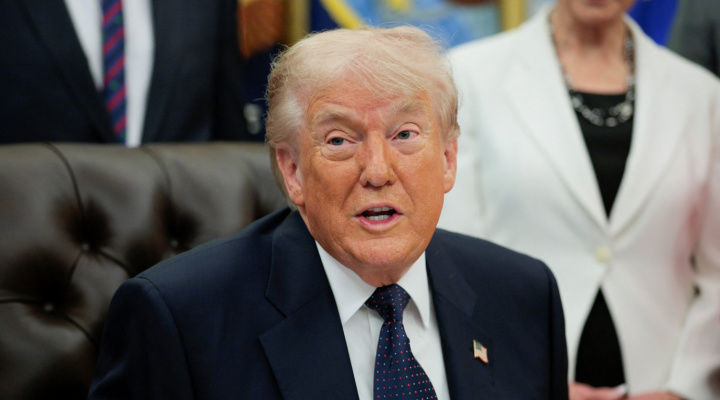
US President Donald Trump speaks during an event to sign a memorandum in the Oval Office at the White House in Washington, DC, US, May 5, 2026. Photo: REUTERS/Evan Vucci
i24 News – The United States and Israel are engaged in intense preparations — the largest since the cease-fire took effect — for the possible resumption of attacks against Iran as early as next week, the New York Times reported Saturday citing two Middle East officials, who spoke on condition of anonymity.
Meanwhile, the Israeli Mako News reported Israeli official sources as saying that US President Donald Trump is expected to convene his closest team of advisors in the next 24 hours to make a final decision on the Iran matter. Israel estimates that a decision on military action may be made very soon, the report added.
According to NYT, should Trump decide to resume military strikes, options include more aggressive raids targeting Iranian military and infrastructure targets, US officials said.
Uncategorized
Trump Says Xi Agrees Iran Must Open Strait, But No Sign China Will Weigh In

US President Donald Trump participates in events at the Great Hall of the People and does a greeting with the President of the People’s Republic of China Xi Jinping May 14, 2026, in Beijing China during a trip focused on trade, regional security, and strengthening bilateral ties between the world’s two largest economies. Photo: Kenny Holston/Pool via REUTERS/File Photo
US President Donald Trump said Chinese President Xi Jinping had agreed Tehran must reopen the Strait of Hormuz, though China gave no indication it would weigh in.
Flying back from Beijing on Friday after two days of talks with Xi, Trump said he was considering whether to lift US sanctions on Chinese oil companies buying Iranian oil. China is the biggest buyer of Iranian oil.
“I’m not asking for any favors because when you ask for favors, you have to do favors in return,” Trump said when asked by a reporter on Air Force One whether Xi had made a firm commitment to put pressure on the Iranians to reopen the strait.
Xi did not comment on his discussions with Trump about Iran, although China’s foreign ministry criticized the war, calling it a conflict “which should never have happened, has no reason to continue.”
‘WE WANT THE STRAITS OPEN’
Iran has effectively shut the strait, which carried one-fifth of global oil and liquefied natural gas supply before the US and Israel launched attacks on February 28. The disruption to shipping has caused the biggest oil supply crisis in history, pushing up oil prices.
Ebrahim Azizi, who heads the Iranian parliament’s national security committee, said on Saturday that Tehran had prepared a mechanism to manage traffic through the strait along a designated route that would be unveiled soon.
Azizi said only commercial vessels and parties cooperating with Iran would benefit, and that fees would be collected for specialized services provided under the mechanism.
Thousands of Iranians were killed in the US and Israeli airstrikes. Thousands more have been killed in Lebanon in fighting between Israel and the Iran-backed group Hezbollah, though Israel and Lebanon agreed on Friday to a 45-day extension of a ceasefire that has tamped down the conflict there.
The US paused its attacks last month but began a port blockade. As of Saturday, 78 commercial ships had been redirected and four disabled to ensure compliance with the blockade, the US military said.
Tehran, which carried out strikes against Israel, US bases and Gulf states after the war began, has said it will not unblock the strait until the US ends its blockade. Trump has threatened to resume attacks if Iran does not agree to a deal.
“We don’t want them to have a nuclear weapon, we want the straits open,” Trump said in Beijing, alongside Xi.
Iran, which has long denied it intends to build a nuclear weapon, has refused to end nuclear research or relinquish its hidden stockpile of enriched uranium.
Iranian Foreign Minister Abbas Araqchi said Tehran had received messages from the US indicating Washington was willing to continue talks.
Pakistan has been mediating between Washington and Tehran. Iranian news agency Nournews said Interior Minister Eskandar Momeni had held “detailed” discussions with his visiting Pakistani counterpart on Iran-Pakistan relations and the prospects for resuming peace talks, but gave no details.
TRUMP LOSING PATIENCE
Trump, who told Fox News’ “Hannity” program in an interview aired on Thursday that he was losing patience with Iran, said Tehran “should make a deal.”
Oil prices rose around 3 percent to around $109 a barrel on Friday [O/R] on concerns about a lack of progress in resolving the conflict.
Talks on ending the war, which has become a liability for Trump ahead of US congressional elections in November, have been on hold since last week when Iran and the US each rejected the other’s most recent proposals.
Araqchi said on Friday that Iran would welcome Chinese input, adding that Tehran was trying to give diplomacy a chance but did not trust the US, which has curtailed previous rounds of talks by launching air strikes.
When the US and Israel launched their attacks on Iran at the end of February, they said one of their aims was to weaken the authorities so Iranians could topple the government.
There has been little sign of organized dissent in Iran during the war, and rights groups say the government has cracked down heavily on its opponents.
Iran’s judiciary said on Saturday that 39 people had been executed for collaborating with Israeli or US spy agencies, or taking part in “terror” or armed unrest, since the war started, the judiciary’s news agency Mizan reported.
It said 36 “medium-level” dissidents had received long prison sentences.
Uncategorized
Tens of Thousands March in London in Separate Immigration, Pro‑Palestinian Protests

Protesters take part in a “Unite the Kingdom” rally organised by British anti-immigration activist Stephen Yaxley-Lennon, also known as Tommy Robinson, in London, Britain, May 16, 2026. REUTERS/Hannah McKay
Tens of thousands of people marched through central London on Saturday in two separate protests – one against high levels of immigration and another in support of Palestinians.
Police deployed 4,000 officers, including reinforcements from outside the capital, and pledged “the most assertive possible use of our powers” in what they called their biggest public order operation in years.
By 1200 GMT, shortly after both marches started, police said they had made 11 arrests for a range of offenses. They had earlier forecast turnout of at least 80,000.
Prime Minister Keir Starmer on Friday accused organizers of the Unite the Kingdom march of “peddling hate and division, plain and simple.”
The march was organized by anti-Islam activist Stephen Yaxley-Lennon, known as Tommy Robinson. The government barred 11 people it described as “foreign far-right agitators” from entering Britain to address the protest.
A previous protest led by Robinson in September drew around 150,000 people, police said, and featured a video address by US tech billionaire Elon Musk. More than 20 people were arrested, and police are still seeking more than 50 suspects.
MARCHERS WAVE BRITISH AND ENGLISH FLAGS
On Saturday, Robinson supporters gathered in central London, waving mainly British and English flags.
“I think that too much migration – not migration, but too much migration – is causing a lot of problems, upsetting a delicate balance here,” said Allison Parr, who also criticized net-zero environmental policies.
Annual net migration approached 900,000 in 2022 and 2023, but fell back to around 200,000 last year after tighter work visa rules.
Concern over immigration – including the arrival of asylum seekers on small boats – has weighed on Starmer’s popularity and boosted the right-wing Reform UK party, whose leader Nigel Farage has distanced himself from Robinson.
Some protesters chanted abuse about Starmer.
Robinson, who has convictions for assault, stalking and other offenses, urged supporters this week to act peacefully in what he billed as “the greatest patriotic display the world has ever seen.”
Earlier this year, he traveled to the US, where he met a State Department official and addressed supporters about what he called “the dangers of Islam” and “the Islamification of Great Britain.”
Census data showed 6.5 percent of people in England and Wales identified as Muslim in 2021, up from 4.9 percent in 2011.
PRO-PALESTINIAN PROTESTERS MARK NAKBA DAY
Nearby, pro-Palestinian demonstrators held a march to mark Nakba Day, commemorating Palestinians’ loss of land in the 1948 war that followed the creation of Israel. “Nakba” means catastrophe in Arabic.
The march also drew those opposing the Unite the Kingdom rally, alongside predominantly Palestinian flags.
London has recently seen a spate of arson attacks on Jewish sites, and two Jewish men were stabbed last month in an incident being treated as terrorism.
Police said repeated large pro-Palestinian marches – 33 since the Hamas-led attack on Israel in October 2023 – had left many Jewish people feeling too intimidated to enter central London.
While protesters held a range of views, police said they routinely made arrests for racially and religiously aggravated public order offenses, inciting racial hatred or supporting proscribed organizations.
The government said police would arrest protesters who chanted “globalize the intifada,” a reference to Palestinian uprisings against Israel that many British Jews view as inciting antisemitism.
Some protesters on Saturday chanted “Death to the IDF”, referring to the Israeli army – language that police said had previously been a reason for arrests when aimed at Jewish people.