



Uncategorized
Iran’s Deepening Water Crisis Threatens 35 Million as Economy Buckles Under US Pressure, Mounting Domestic Strain
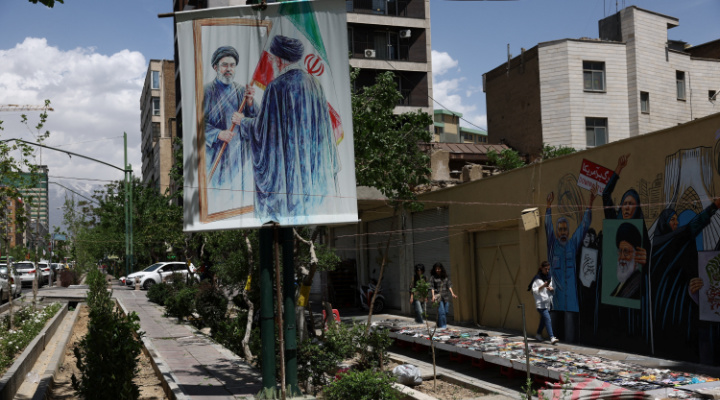
People walk on a street near a mural featuring an image of the late Supreme Leader of Iran, Ayatollah Ali Khamenei, in Tehran, Iran, May 6, 2026. Photo: Majid Asgaripour/WANA (West Asia News Agency) via REUTERS
As talks with the United States over a possible deal to end the war remain uncertain, Iran’s economy is under mounting strain, with prolonged water shortages, pressure on energy infrastructure, and slowing industrial output deepening what authorities describe as an “economic war.”
With Iran entering the summer months amid a deepening water and electricity crisis, government officials estimate that around 35 million people will face water shortages, intensifying concerns over deteriorating living conditions, mounting economic strain, and daily hardship across the country.
On Monday, Issa Bozorgzadeh, a spokesman for the country’s water industry, reported that rainfall has fallen “below normal” levels across 11 provinces, warning that Tehran is among the worst affected as it enters its sixth consecutive year of drought.
Now, Iranian authorities are urging citizens to cut consumption and adopt stricter usage habits, pointing to deep structural failures in the water and power sectors as public frustration rises over supply disruptions, mismanagement, and declining living standards.
Officials have also announced planned summer power outages, warning that the deepening energy crisis could lead to factory shutdowns, reduced industrial output, rising unemployment, and higher prices.
On Sunday, Arash Najafi, head of the Energy Commission of Iran’s Chamber of Commerce, noted that household, commercial, and office blackouts are likely to continue daily throughout the summer, while the industrial sector will continue to be targeted for power cuts” or “will continue to bear the brunt of power cuts.
Given the damage to several petrochemical facilities in Israeli and US strikes and their reliance on electricity from the national grid, Najafi said most available power would now be directed toward keeping these complexes operational around the clock.
“The Islamic Republic will be forced to impose electricity consumption restrictions for about 120 days, and given the lack of effective means for people to significantly reduce usage, this will result in widespread blackouts,” the Iranian official said in a statement.
Amid growing public frustration over the ongoing crisis, Majid Doustali, a member of Iran’s parliamentary planning and budget committee, called on citizens to cut back on electricity, water, and fuel consumption as part of the country’s resistance efforts in what he described as an “economic war.”
“Every effort by the public to save resources represents a direct challenge to the enemy’s economic conspiracy,” Doustali said.
Even as the crisis continues to weigh heavily on the Iranian people, a nationwide internet blackout remains in place, having exceeded 1,728 hours as of Monday, after authorities imposed the shutdown more than two months ago, effectively isolating millions of Iranians from independent reporting on the war and access to global news.
Across much of the country, unstable internet forces many people to rely on illegal black-market virtual private networks (VPNs) — tools that bypass government censorship — to stay connected beyond Iran’s borders, with access costing millions, and users risking imprisonment and national security charges.
According to a CNN estimate, Iranians have spent roughly $1.8 billion on internet access over the past two months.
Soaring costs and crumbling infrastructure have also forced businesses to cut jobs on a massive scale, leaving many workers unemployed and intensifying social and economic pressures across the country, The New York Times reported.
Dozens of major companies have reportedly laid off hundreds of employees across multiple industries, with the industrial sector alone potentially putting up to 3.5 million workers at risk, as the country’s economy reels from the impact of a US naval blockade on Iranian ports that began in mid-April.
The US blockade has prevented the regime from exporting energy through the Strait of Hormuz — a critical global energy chokepoint through which about one-fifth of the world’s oil supply passes.
With companies sharply reducing or freezing production amid shutdowns and mass layoffs, the private sector downturn is further threatening the regime by reducing tax revenues, which the government has come to rely on heavily amid mounting sanctions and trade restrictions.
Iran’s new supreme leader, Ayatollah Mojtaba Khamenei, has attempted to contain the fallout by urging companies to avoid layoffs “to the extent possible.”
But the regime’s internet shutdown alone has cost businesses and companies an estimated $80 million in daily losses, The New York Times reported.
As the Iranian currency continues to plunge and inflation peaks near 60 percent, senior official Gholamhossein Mohammadi said the war has already cost around one million jobs, alongside “the direct and indirect unemployment of two million people.”
Meanwhile, Iran’s energy sector is also under severe strain, with exports falling sharply, storage capacity nearing its limits, and infrastructure under growing pressure.
According to data from commodity analytics firm Kpler, Iran could exhaust its oil storage capacity within 25 to 30 days if the crisis continues, prompting cuts in output at several oil fields to ease pressure.
Amid an export collapse exceeding 70 percent, the government now faces a critical decision between shutting wells to manage storage constraints or risking long-term damage to key oil fields.
Even though Kpler’s report estimates Tehran may not feel the full revenue hit for another three to four months due to payment delays and pre-existing sales flows, the regime is expected to face a heavy blow, with losses potentially reaching $200–250 million per day.
With domestic tensions rising and the internal economic crisis worsening, Iranian officials are increasingly wary that renewed protests could erupt in the coming days, further destabilizing an already volatile situation.
Uncategorized
Sen. Cory Booker Reaffirms Commitment To Maintaining Israel’s ‘Qualitative Military Edge,’ Criticizes ‘Reckless War’ In Iran

April 12, 2026, New York, New York, United States: (NEW) 2026 NAN Convention. April 11, 2026, New York, New York, USA: U.S. Senator Cory Booker speaks during Day 4 of the National Action Network (NAN) 35th Anniversary Convention at Sheraton New York Times Square Hotel on April 11, 2026 in New York City. (Credit: M10s / TheNews2)(Foto: M10S/Thenews2/Zumapress) (Credit Image: © M10s/TheNEWS2 via ZUMA Press Wire)
Sen. Cory Booker (D-NJ) defended his continued support for Israel in a recent interview while distancing himself from what he described as a “reckless war,” underscoring the increasingly delicate balancing act facing pro-Israel Democrats amid mounting political pressure from the party’s progressive wing.
In an interview with the media outlet RealClearPolitics, Booker emphasized that his opposition was not directed at Israel itself, but rather at policies he believes risk further destabilizing the Middle East and weakening long-term regional security.
“Let’s be clear, I’m opposed to a reckless war that has made the United States and Israel less safe, as well as our other Arab allies. I will not support arms from the United States or any of our allies, including Israel, in a context of a war that is endangering our national security and Israel’s. I continue to support our US military being the strongest in the world,” Booker said.
The comments come as divisions within the Democratic Party over Israel have intensified following over two years of conflict in Gaza and escalating tensions involving Iran-backed militant groups across the region. While a growing faction of Democrats has pushed for stricter conditions on military aid to Israel, Booker sought to position himself as firmly supportive of the US-Israel alliance even as he voiced concern about the conduct and trajectory of the conflict.
Booker, however, emphasized that he still supports helping Israel maintain its military advantage over its neighbors in the Middle East, a position which analysts argue helps bolster American geopolitical interests in the region.
“I continue to support Israel having a qualitative military edge, the ability to defend themselves, and offer deterrents. But in the context of this war, I will not support more military armaments to conduct what I think is a disaster that’s endangering American lives, Israeli lives, and as we see in the UAE and Saudi Arabia, our regional allies as well.”
Booker, long viewed as one of the Senate’s more traditionally pro-Israel Democrats, has historically backed military assistance to the Jewish state and has frequently spoken about the importance of Israel as America’s closest democratic ally in the Middle East. His latest remarks appeared aimed at reassuring pro-Israel voters and donors wary of the party’s leftward shift on the issue.
However, Booker raised eyebrows recently when he joined a record number of Democratic senators to vote in favor of Sen. Bernie Sanders’ (D-VT) resolution against sending more arms to Israel, raising questions among some pro-Israel observers about his position on Israel.
Of the 47 Senate Democrats, 40 voted in favor of blocking sales of bulldozers and 36 voted in favor of blocking transfers of so-called “dumb” bombs.
The failed votes represent the largest show of opposition to military aid for Israel within the party in recent memory. While previous efforts spearheaded by Sanders drew support from a smaller bloc, this vote saw roughly 80 percent of Senate Democrats vote against transferring aid to the Jewish state, signaling a seismic shift in the dynamic between the Democratic Party and Israel.
Booker’s framing may reflect a broader strategy among mainstream Democrats: separating criticism of specific military operations from opposition to Israel’s existence or security needs.
Supporters of Israel argue that distinction is increasingly important as anti-Israel rhetoric grows more common in some activist circles following Hamas’ October 7 attacks and the subsequent war in Gaza. A growing number of Democratic officials and ambitious progressive candidates have accused the Jewish state of committing “genocide” in Gaza. Israeli officials have repeatedly argued that military operations are necessary to dismantle Hamas and prevent future attacks against Israeli civilians.
Booker’s comments may signal an effort to preserve bipartisan support for Israel at a time when polling shows younger Democratic voters becoming more critical of the Israeli government. At the same time, pro-Israel advocates have warned that weakening US backing could embolden Iran and its regional proxies, including Hamas and Hezbollah.
The senator did not indicate support for ending military cooperation with Israel altogether, instead emphasizing that American leadership should focus on both protecting Israeli security and preventing a wider regional war.
Uncategorized
Israel bars YouTuber Tyler Oliveira from entering country, citing ‘harassment of Jews’ on social media
(JTA) — Israel’s Diaspora affairs minister, Amichai Chikli, confirmed on Monday that right-wing YouTube provocateur Tyler Oliveira had been barred from entering Israel, accusing him of coming to the country with the “aim of spreading hatred.”
Amid reports that Oliveira had been rebuffed at Ben Gurion Airport, Chikli resurrected a weeks-old post from the YouTuber asking, “You guys think Israel will let me into the country?” and replied with a blunt, one-word answer: “No.”
Oliveira has drawn allegations of antisemitism in recent months over videos in which he claimed to expose widespread fraud in Kiryas Joel, a Hasidic enclave in upstate New York, and Lakewood, a heavily Orthodox town in New Jersey.
The videos, which each garnered over 9 million views, drew outcry from Jewish leaders who accused Oliveira of trafficking in antisemitic stereotypes and mischaracterizing Jewish communities as hotbeds of corruption.
On Friday, Oliveira sat for an interview with the conservative influencer Tucker Carlson, who himself claimed in February that he had been “detained” after arriving at an Israeli airport to conduct an interview with U.S. Ambassador to Israel Mike Huckabee. Both Huckabee and Israel denied Carlson’s allegation.
In a statement to Israel National News, the Ministry of Diaspora Affairs and Combating Antisemitism said the decision to bar Oliveira stemmed from his activity that “goes beyond legitimate freedom of expression” and includes “inciting statements against Jews and the dissemination of content with antisemitic characteristics.”
The far-right Jewish activist Laura Loomer posted a series of tweets on Monday that she said included comments from Chikli. The Israeli minister retweeted one of them, signaling his endorsement.
“I’m proud to have denied entry to Israel today to an unfortunate YouTuber who is using the harassment of Jews as a way to get clout on social media,” Loomer said Chikli told her. He added, “If you come to Israel with the intent on inciting violence and hatred against Jewish people, you will not be allowed entry into our country.”
Israel has previously banned other foreign activists and public figures from entering the country over their support for the boycott Israel movement, including European Union lawmakers Lynn Boylan and Rima Hassan last year as well as U.S. Reps. Rashida Tlaib and Ilhan Omar in 2019.
The post Israel bars YouTuber Tyler Oliveira from entering country, citing ‘harassment of Jews’ on social media appeared first on The Forward.
Uncategorized
Hochul makes play for Orthodox voters with tuition relief and synagogue buffer zones

New York Gov. Kathy Hochul is making an early play for Jewish voters ahead in her reelection bid, coupling a major initiative to help families pay for yeshivas with tough-on-antisemitism legislation.
The moves aid Orthodox Jewish voting blocs — before her Republican challenger, Bruce Blakeman, gains traction.
A recent Siena University poll of 804 voters found Hochul leading Blakeman statewide by 16 points, 49% to 33%. But among the smaller sample of 65 Jewish voters, the race was far tighter, with Hochul leading just 46% to 41%.
Central to Hochul’s outreach was her announcement last week, during a private meeting with Orthodox leaders, that New York will opt into President Donald Trump’s new federal school-choice tax credit program. Known as the Education Freedom Tax Credit, it allows taxpayers to receive up to a $1,700 federal tax credit for donations to scholarship-granting organizations, which can then fund tuition assistance and other educational expenses.
A spokesperson for the governor confirmed that Hochul is supportive of the program as part of a broader commitment to helping families afford nonpublic education. Emma Wallner, the spokesperson, added that the administration is reviewing the federal program to ensure there are no “poison pills that could harm New York’s education system.”
For Orthodox voters, tuition relief has long ranked alongside Israel and antisemitism as a political priority. In 2014, former Gov. Andrew Cuomo made a last-minute effort to court the community by pledging to expand a state tuition assistance program to cover yeshivas as “a matter of justice.” Cuomo ultimately won 70% of the vote in Borough Park, one of the largest Orthodox strongholds. That proposal later failed in the state legislature.
Hochul and her allies remain mindful of the results of the 2022 governor’s race, when former Rep. Lee Zeldin came within five percentage points of defeating her. Zeldin, who is Jewish, was powered by strong Orthodox support.
That memory looms large as Hochul prepares for a likely matchup against Bruce Blakeman, the first Jewish executive of Nassau County, who has positioned himself as a tough-on-crime conservative focused on antisemitism and support for Israel.
Blakeman has so far struggled to gain broader traction statewide and has yet to build deep relationships within the Orthodox political infrastructure in Brooklyn and Rockland County. Orthodox voting blocs, a traditionally Republican-leaning constituency, have repeatedly backed incumbents and even Democrats when communal priorities align.
A spokesperson for the Blakeman campaign did not immediately respond to questions from the Forward about whether the Republican candidate supports the tuition-relief initiative or plans to offer a proposal of his own.
Addressing rising antisemitism

Blakeman, who met with Trump at the White House last week to discuss his candidacy, could further face a challenge presenting himself as a stronger protector of the estimated 1.8 million Jews across the state amid rising antisemitism.
Hochul, who endorsed New York City Mayor Zohran Mamdani last year after remaining neutral during the Democratic primary, has been seen by some in the Jewish community as a counterweight within the Democratic Party to the mayor, whose handling of antisemitism and criticism of Israel has left many Jewish voters uneasy.
The Democratic incumbent has publicly opposed several key Mamdani priorities, like universal free buses and a millionaire tax, and has also distanced herself from Mamdani on Israel and pro-Palestinian protests on campus.
Hochul is moving fast on that front, too.
Last week, she announced a tentative budget deal that includes a measure to create a 25-foot buffer zone to protect houses of worship statewide from protest. “We’ve seen demonstrations targeting faith communities outside synagogues, mosques and churches,” Hochul told reporters. This is not free expression, this is harassment, and it has no place in the state of New York.” The measure would go further than a more limited enactment passed by the New York City Council requiring safety plans for protests near houses of worship, which Mamdani allowed to become law without his signature.
Hochul has also proposed an additional $35 million in security funding for vulnerable institutions, bringing total state spending on such protection to $131 million since she took office.
The legislation remains unresolved in Albany. Assembly Speaker Carl Heastie told reporters Thursday there was “no deal” yet on the broader state budget package. Some Jewish lawmakers have also criticized the proposed 25-foot buffer zone as too narrow, arguing it should be expanded to at least 100 feet, similar to protections already in place around polling sites.
Blakeman told the Forward last week that he would push to expand the buffer zone if elected governor. “I think 25 feet is too close,” he said.
David Greenfield, a former New York City Council member who introduced Hochul to Orthodox leaders when she became the lieutenant governor candidate in 2014 and boosted her in 2022, said that Hochul is “cementing her status as the best friend the Jewish community has had in Albany in decades” by pushing this agenda. “At a moment when Jewish New Yorkers are looking for leaders who will actually show up for them, Hochul keeps showing up,” said Greenfield, now head of the Met Council charity organization.
Blakeman’s play
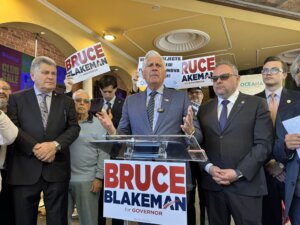
Blakeman has also made fighting antisemitism a central theme of his campaign. On Sunday, Blakeman addressed a rally held by Zionist groups in Queens, after swastikas were found spray-painted on synagogues and homes in Forest Hills and Rego Park. “We have to make sure that every antisemite knows that we will not back down, that we will stand up to it,” he said in his remarks. Speaking to the New York Post, Blakeman also called Mamdani “un-American” and “antisemitic.”
Last week, Blakeman held a press conference in Brighton Beach, a Brooklyn neighborhood with a significant Russian-speaking Jewish population, calling for the cancellation of a planned concert by Yulduz Usmonova, an Uzbek singer accused of making antisemitic statements. “Never again will we tolerate antisemitism or attacks on the Jewish people anywhere in the world, and especially here in Brooklyn, with this huge Jewish community of which my wife Segal was a member of,” Blakeman said.
The battle for the Jewish vote traditionally unfolds later in the season, closer to the High Holidays season, when voters pay more attention to the election. But Hochu’s recent moves signal she is not waiting until the fall to lock up support from a swing and reliable voting bloc.
The post Hochul makes play for Orthodox voters with tuition relief and synagogue buffer zones appeared first on The Forward.