


Uncategorized
Israel Cannot Outsource Its Survival
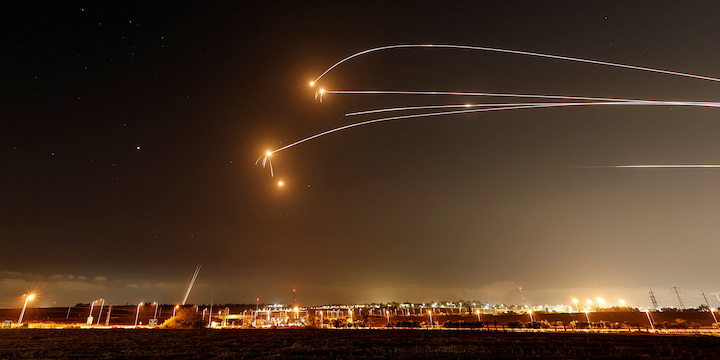
Israel’s Iron Dome anti-missile system intercepts rockets launched from the Gaza Strip, as seen from Sderot, Israel May 13, 2023 Photo: REUTERS/Ammar Awad
Israel’s security doctrine has been shaped by a harsh but undeniable reality: hesitation invites criticism, but delay can invite catastrophe.
This is not a posture of arrogance or defiance; it is an expression of responsibility toward all of Israel’s citizens. For Israel, the cost of miscalculation is not theoretical, it is measured in lives. From its founding, Israel has faced existential threats that no other modern democracy has had to confront so consistently or so closely.
Surrounded by hostile actors, terrorist organizations, and regimes that openly question its right to exist, Israel has learned that survival depends on clarity, preparedness, and the willingness to act when necessary, even when such actions are unpopular internationally. Waiting for consensus or permission has historically proven to be something that could endanger Israel’s very existence.
This does not mean Israel rejects peace. On the contrary, Israel has repeatedly demonstrated a willingness to pursue peace where peace is genuinely possible, and cooperation where cooperation enhances security. Peace treaties with former adversaries, regional partnerships, and humanitarian initiatives all testify to Israel’s desire for stability and coexistence. But peace cannot be built on unenforceable promises or blind faith in actors who have repeatedly violated agreements and norms.
Israel will not gamble its existence on assurances that cannot be guaranteed or enforced. Sovereignty, in this context, is not a symbolic concept or a political slogan. It is the concrete ability to defend oneself when no one else will, or when others cannot act in time. Sovereignty means maintaining independent judgment, operational freedom, and the resolve to protect one’s population under all circumstances.
History has taught the Jewish people an enduring and painful lesson: ultimate responsibility for Jewish survival rests with the Jewish State itself. Centuries of persecution, abandonment, and broken promises culminated in a clear understanding that security outsourced is security endangered. Israel’s independence is not only political; it is moral and existential.
Alliances matter. International partnerships, shared values, and moral clarity play an important role in strengthening Israel’s position and legitimacy. Israel values its allies and understands the importance of cooperation in a complex global environment. But when survival is at stake, alliances cannot replace independent decision-making.
No ally can assume responsibility for Israel’s existence, and none should be expected to.
When Israel acts to protect itself, it often ends up protecting others as well. By confronting extremist ideologies, disrupting terrorist networks, and standing as a frontline defender against radicalization, Israel contributes to global security, even when this reality is uncomfortable or inconvenient for the international community to acknowledge.
In the end, Israel’s guiding principle remains clear: peace where possible, strength where necessary, and sovereignty as the final shield.
History has shown that when Israel defends itself decisively, it not only safeguards its own people but helps prevent greater instability beyond its borders. Whether the world is ready to admit it or not, Israel’s self-defense has often served as a defense of shared values and global security itself.
Sabine Sterk is the CEO of Time To Stand Up For Israel.
Uncategorized
‘We Need to Wake Up’: Sylvan Adams Warns of Organized, Coordinated Antisemitism After Oct. 7

Canadian-Israeli philanthropist Sylvan Adams on The Algemeiner’s “J100” podcast. Photo: Screenshot
The protests began before the war did.
That, for Sylvan Adams, is the detail that should change how people understand everything that followed Hamas’s Oct. 7, 2023, massacre across southern Israel.
Speaking on The Algemeiner‘s “J100” podcast, the Canadian-Israeli philanthropist pointed to the anti-Israel demonstrations that erupted across Western cities on Oct. 8 — less than 24 hours after Hamas’s atrocities — as evidence that the global reaction was not simply emotional or spontaneous.
“Israel hadn’t even entered Gaza yet,” Adams said. “We were still counting our dead.”
The speed and coordination of those protests, he argued, suggest something deeper: a preexisting infrastructure of activism, funding, and ideology that was activated the moment the attacks occurred.
“It’s like they flicked a switch,” he said.
In Adams’ view, the surge of antisemitism that followed the Oct. 7 attack is not an isolated phenomenon, but the visible expression of a long-building system — one tied to Islamist movements, state-backed funding, and ideological allies across the West.
“We need to wake up,” he said.
At the same time, Adams was clear that the loudest voices are not the majority. Most people, he argued, are neither antisemitic nor deeply anti-Israel — but they are not organized, not activated, and not nearly as visible.
“The majority is there,” he said. “But they’re not activists.”
That imbalance has allowed more extreme narratives to dominate public discourse, particularly among younger audiences shaped by social media and campus environments.
Adams’ response to this challenge has not been confined to analysis.
A businessman who built his career in Canada before making aliyah a decade ago, he has become one of Israel’s most prominent philanthropists, directing major investments toward institutions in the country’s south.
In the aftermath of Oct. 7, he announced $100 million gifts to both Ben-Gurion University of the Negev and Soroka Medical Center — moves he framed not as charity, but as long-term investments in Israel’s resilience.
The goal, he said, is not just to rebuild, but to reinforce.
Alongside those efforts, Adams has pursued a less conventional form of advocacy: using sports and culture to reshape how Israel is perceived abroad.
An accomplished cyclist and world champion in his age category, he has helped bring major international events to Israel, including global cycling races and high-profile appearances by figures such as Lionel Messi.
The strategy is to reach audiences that are not tuning in for politics — and introduce them to a different version of Israel.
“People are always surprised,” Adams said. “It’s not what they thought.”
That approach reflects a broader philosophy: that Israel must be strengthened not only on the ground, but in the way it is seen.
Adams’ worldview is rooted in his own family history. Born to Holocaust-surviving parents from Romania, whose journeys passed through pre-state Israel before settling in Canada, he grew up in a deeply Zionist home before eventually building a life in Montreal.
His decision to move to Israel later in life was, in his telling, less a break than a return.
“I always thought we would end up there,” he recalled his wife saying.
Now based in Israel, Adams has positioned himself as both a builder and a messenger —investing in the country’s future while trying to influence how it is understood beyond its borders.
His message to Jews outside Israel was direct.
“We’re one people,” he said. “Israel belongs to all of us.”
In the current moment, that idea carries added weight — not just as a statement of identity, but as a call to responsibility.
Uncategorized
Hamas Tightens Grip on Gaza, New Analysis Shows, as Iran War Delays Second Phase of Ceasefire

Hamas fighters on Feb. 22, 2025. Photo: Majdi Fathi via Reuters Connect
As the international community struggles to advance the second phase of an already fragile ceasefire between Israel and Hamas, the Palestinian terrorist group is exploiting the war in Iran to tighten its civilian and security grip on the Gaza Strip and rebuild its military capabilities, according to a new report.
The Meir Amit Intelligence and Terrorism Information Center (ITIC) — an Israel-based research institute — released a new report this week warning that the US-Israel conflict with Iran and disputes over management of Gaza are delaying the implementation of the second phase of the US-backed ceasefire agreement, under which Hamas was expected to disarm as Israeli forces were set to withdraw from parts of the enclave.
The report also warned that such delays are giving Hamas a window of opportunity to rearm and further tighten its control over Gaza, complicating fragile efforts to move forward with the next stage of the truce.
ITIC’s new assessment shows Hamas has moved to reassert control over parts of the war-torn enclave and consolidate its weakened position by targeting Palestinians it labeled as “lawbreakers and collaborators with Israel.”
With its security control tightening, Hamas’s brutal crackdown has escalated, sparking widespread clashes and violence as the group seeks to seize weapons and eliminate any opposition.
The report further notes that Hamas’s confidence is on the rise across Gaza, visible in the increasingly public presence of armed operatives from both its military wing and security forces, underscoring the group’s tightening hold on the roughly 47 percent of the enclave it controls without an Israeli military presence.
Social media videos widely circulated online show Hamas members brutally beating Palestinians and carrying out public executions of alleged collaborators and rival militia members.
According to ITIC’s newly released report, Hamas is also rebuilding its military capabilities by smuggling arms from Egypt and producing weapons independently, while simultaneously consolidating civilian control through expanded police presence, regulation of markets, and the distribution of financial aid to residents in areas it governs.
Earlier this year, the US-backed plan to end the war in Gaza hit major roadblocks after proposals surfaced that would allow Hamas to retain some small arms — an idea strongly denounced by Israeli officials who insist the Islamist group must fully disarm.
Officials involved in the US-led Board of Peace drafted a plan that would allow Hamas to retain small arms while surrendering longer-range weapons as part of a “phased disarmament” process over several months, with heavy weapons to be “decommissioned immediately.”
However, key details about where the surrendered arms would go and how the process would be enforced remain unclear.
The initial framework also required “personal arms” to be “registered and decommissioned” as a new Palestinian administration takes charge of security in the enclave.
Israel has previously warned that Hamas must fully disarm for the second phase of the ceasefire to move forward, pointing to tens of thousands of rifles and an active network of underground tunnels still under the terrorist group’s control.
If the Palestinian Islamist group does not give up its weapons, Israel has vowed not to withdraw troops from Gaza further or approve any rebuilding efforts, effectively stalling the ceasefire agreement.
The Israel Defense Forces (IDF) currently occupies about 53 percent of the Strip, with most of the Palestinian population living in the remaining portion of the enclave under Hamas control.
Israeli Prime Minister Benjamin Netanyahu has insisted the country will not accept anything less than the full demilitarization of Gaza, warning that any reconstruction or political transition in the enclave depends on Hamas relinquishing its weapons.
Under US President Donald Trump’s 20-point Gaza peace plan, phase two would involve deploying an international stabilization force (ISF), beginning large-scale reconstruction, and establishing a Palestinian technocratic committee to oversee the territory’s administration.
According to media reports, the ISF could total around 20,000 troops, though it remains uncertain whether the multinational peacekeeping force will actually help disarm Hamas.
Over the past few weeks, Israel has resumed military operations in the Gaza Strip aimed at forcibly disarming Hamas. The IDF’s previous operations during the last two years of war had been partly limited by efforts to protect Israeli hostages kidnapped by Hamas, the last of whom were released last year as part of the ceasefire.
On Tuesday, Israeli forces announced that several Hamas Nukhba terrorists were eliminated during a strike in central Gaza after troops intercepted the operatives while they were conducting a military training exercise in the area.
IDF forces in the Southern Command remain deployed at key locations in the Gaza Strip, with the army warning it will employ all necessary force to neutralize threats and maintain control across the territory.
This week, the United Nations Security Council met to review progress on the Gaza peace plan and the implementation of phase two, originally adopted in November under the fragile truce between Israel and Hamas.
According to Nickolay Mladenov, the high representative for Gaza on Trump’s Board of Peace, a transitional Palestinian governing body has already been established in the enclave, and a framework agreed upon by the guarantor countries — the US, Egypt, Turkey, and Qatar — has been presented to armed groups, which he said establishes “the principle of one authority, one law, and one weapon.”
“The National Committee exercises authority solely on an interim basis,” Mladenov said during a speech, referring to the transitional Palestinian government that has been established.
“The end state is a reformed Palestinian Authority capable of governing Gaza and the West Bank, and ultimately a pathway to Palestinian self-determination and statehood,” he continued.
The proposed plan would require all armed groups in Gaza to transfer their arms to a transitional Palestinian governing authority, starting with their larger-scale weapons and monitoring compliance before reconstruction begins, while allowing fighters to gradually return to civilian life.
Mladenov also confirmed that Indonesia, Morocco, Kazakhstan, Kosovo, and Albania have committed troops to the ISF.
“The people of Gaza want reconstruction, and reconstruction requires the decommissioning of weapons,” he said, describing this link as the framework’s “driving force.”
So far, there is no timeline or clarity on discussions with relevant groups, nor on any potential Israeli military withdrawal.
As of February, Israel was planning to resume military operations in the Gaza Strip to forcibly disarm Hamas, with the IDF is drawing up plans for a renewed major offensive.
Israeli Defense Minister Israel Katz warned that Hamas will be disarmed by force if it continues to violate the ceasefire and pose a threat to Israel’s security.
“If Hamas does not disarm in accordance with the agreed framework, we will dismantle it and all of its capabilities,” the Israeli defense chief said this month.
However, with Israel focused on fighting Iran as well as its chief proxy Hezbollah in Lebanon, it appears a new offensive is unlikely to take place in Gaza in the immediate future.
Uncategorized
Sam Altman Shuts Down OpenAI’s Sora, Video Sharing App Notorious for Antisemitic Content

Three videos featured on Sora on March 24, 2026, promoted antisemitic stereotypes and violence against Jews. Photo: Screenshots
In a surprise move that has stunned industry watchers and killed a $1 billion licensing deal with Disney, OpenAI announced it would shutter Sora, the controversial video-generating app which drew condemnation last year for its unwillingness to stop the production and sharing of antisemitic content.
“We’re saying goodbye to the Sora app,” Sora’s X account posted on Tuesday. “To everyone who created with Sora, shared it, and built community around it: thank you. What you made with Sora mattered, and we know this news is disappointing. We’ll share more soon, including timelines for the app and API and details on preserving your work.”
Reflecting the seeming abrupt nature of the decision, OpenAI had published on Monday a “Creating with Sora safely” guide. The company claimed that its product “uses layered defenses to keep the feed safe while leaving room for creativity. At creation, guardrails seek to block unsafe content before it’s made — including sexual material, terrorist propaganda, and self-harm promotion — by checking both prompts and outputs across multiple video frames and audio transcripts.”
The guide stated, “We’ve red teamed to explore novel risks, and we’ve tightened policies relative to image generation given Sora’s greater realism and the addition of motion and audio.”
With the release of the standalone Sora 2 app in September 2025, The Algemeiner and other news organizations documented the antisemitic tropes emerging on the platform with one recurring visual depicting Jews chasing after coins.
Following the announcement of Sora’s shutdown on Tuesday, The Algemeiner reviewed the app’s feed and discovered multiple antisemitic videos within minutes.
The first from user @frankel944 depicts an elaborate 30-second narrative of an older Hassidic Jew with a long beard and traditional religious garb who demands a poor man’s $10,000 savings in exchange for moldy bread and soup. He complies, inspiring the Jewish man to then take the money, fly to Mexico, dance in a sombrero with a mariachi band, and then return to the US to say his prayers at the synagogue.
A second from @davidkline16 features a young man — apparently one of the user’s friends — walking in a synagogue proclaiming that he has been appointed the rabbi and inviting people to come and celebrate. A surreal, fleshy orb with a face floats in the background and starts to interrupt the warm greeting, menacingly yelling “Rapist! Rapist!” One of the recurring jokes that young people had used Sora to do was to transform their friends into Jewish converts.
The third is one of the most chilling as it depicts violence against Jews. User @orituviaabaselo felt compelled to create and share a video featuring a group of eight Hassidic Jewish men sitting at a table, speaking Hebrew, and eating challah in the middle of a dark road at night. Moments later a blue car comes barreling into the group sending them every which way. The clip ends with one of the Jews not concerned for his friends’ injuries, but asking where he can find his hat.
In October, the Anti-Defamation League (ADL) published research from its Center on Technology and Society which revealed that among the multiple AI-video generating apps tested, the programs would respond to antisemitic, racist, or other bigoted prompts at least 40 percent of the time. The ADL’s analysts found that, compared to its competitors, Sora “performed the best in terms of content moderation, refusing to generate 60% of the prompts.”
In January, the ADL analyzed multiple large language models and found that OpenAI’s ChatGPT lagged behind Anthropic’s Claude in its ability to detect antisemitism.
Some analysts suspect that this intra-industry rivalry may have played a role in OpenAI’s decision to shut down Sora as part of an effort to focus the company’s resources on core business capabilities. Anthropic was founded in 2021 by former OpenAI staffers dissatisfied with OpenAI CEO Sam Altman’s attitudes toward the dangers of AI. In recent years its Claude large language model has developed hegemony among computer programmers and other technical workers.
The Wall Street Journal reported on Tuesday that OpenAI sought to pivot to focus more on “so-called productivity tools,” a category currently dominated by Anthropic, rather than continuing with the cost-intensive videos.
Farida Khalaf, a business analyst and data engineer who focuses on cybersecurity, wrote Monday on Substack Notes predicting what would happen the next day. “Meta shutdown Metaverse, NEXT will be SORA from open AI,” she wrote.
On March 17, Meta announced its CEO Mark Zuckerberg had chosen to shut down Horizon World, the virtual reality platform which he had previously backed so heavily he chose to change the company’s name in October 2021 from Facebook to Meta.
Khalaf drew the comparison, asking, “Remember the hype surrounding the SORA app release? It seems to be following a similar trajectory, and with costs running higher than its revenue, the sustainability of this model is questionable.”
Forbes estimated in November that Sora was costing OpenAI $15 million a day. “We have been quite amazed by how much our power users want to use sora, and the economics are currently completely unsustainable. we thought 30 free gens/day would be more than enough, but clearly we were wrong!” Sora’s head Bill Peebles wrote on X on Oct. 30, 2025.
In December, Disney had signed a $1 billion agreement with OpenAI to license 200 characters for inclusion in Sora. “As the nascent AI field advances rapidly, we respect OpenAI’s decision to exit the video generation business and to shift its priorities elsewhere,” said a spokesperson for the film company.
On Tuesday, Altman announced his refocused priorities on X.
“AI will help discover new science, such as cures for diseases, which is perhaps the most important way to increase quality of life long-term,” Altman wrote. “AI will also present new threats to society that we have to address. No company can sufficiently mitigate these on their own; we will need a society-wide response to things like novel bio threats, a massive and fast change to the economy, extremely capable models causing complex emergent effects across society, and more.”