



Uncategorized
Israel Did Not Drag the US Into War

US President Donald Trump speaks with White House Chief of Staff Susie Wiles and Secretary of State Marco Rubio during military operations in Iran, at Trump’s Mar-a-Lago resort in Palm Beach, Florida, US. February 28, 2026. The White House/Social Media/Handout via REUTERS
“If anything, I might have forced Israel’s hand,” President Donald Trump exclaimed to a journalist on March 3. He was answering a question posed by ABC News Senior Political Correspondent Rachel Scott, who had just asked the Commander in Chief whether Israel had “pulled the United States into war.”
“Based on the way the negotiation [with Iran] was going, I think they were going to attack first,” Trump replied. “And I didn’t want that to happen.”
The President is completely right.
After a sound bite from Secretary of State Marco Rubio went viral, many on the isolationist right and the pro-Palestinian, “anti-war” left claimed that Israel, a country the size of New Jersey, had dragged the world’s most powerful military into a regional conflict.
“We knew there was going to be an Israeli action, we knew that that would precipitate an attack against American forces, and we knew that if we didn’t preemptively go after them before they launched those attacks, we would suffer higher casualties,” Rubio stated on March 2.
“So he’s flat out telling us that we’re in a war with Iran because Israel forced our hand,” responded popular conservative pundit Matt Walsh in a post on X.
But, as often occurs in cyberspace, Rubio’s comments were taken wildly out of context.
During the same press conference, Rubio was asked a similar question again: “Was the US forced to strike because of an impending Israeli action?” Rubio set the record straight unequivocally.
“No … No matter what, ultimately, this operation needed to happen … This had to happen no matter what.”
The Secretary of State is correct. His answer about Israel triggering the operation implied that it was only a matter of when, not if, the mission would be undertaken by the US.
American military power had been amassing in the Middle East for months, and some reports said that planning for the combined strikes began as far back as December. Other reports suggested that the operation was intended to begin a week earlier, but the conditions weren’t right.
Intelligence provided to Israel by the Central Intelligence Agency, combined with actionable intelligence gathered for years by Israel’s Mossad, suggested that February 28, at around 10 am Tehran time, was the optimal starting line for the mission. Why? Because former Supreme Leader Ayatollah Ali Khamenei was due to meet with nearly 50 of his closest advisors and other senior leaders, above ground. According to The Wall Street Journal, those were the circumstances that nailed down a start date for the ongoing conflict.
That’s why commentators across the aisle got Rubio’s statement so very wrong. In fact, Israel has shown in the past that it would comply willingly should its friends in Washington wish for IDF military action not to go forward.
On June 24, 2025, the Israeli Air Force cancelled planned strikes on Iran after Trump announced that he had told Netanyahu to bring the pilots home and that a ceasefire was in place. The strikes were planned in retaliation for a vicious attack on a Beer Sheva residential building that killed several civilians. Even then, Israel respected the wishes of the United States.
The ongoing conflict in Iran is a combined effort between what US Central Command (CENTCOM) Commander Brad Cooper called, “the two most powerful air forces in the world, the US and Israel,” comments later echoed by Secretary of War Pete Hegseth. It began with full coordination and will end the same way.
As Hegseth said, “only the United States of America military could lead this — only us. But when you add in the Israeli Defense Forces — a devastatingly capable force — the combination is sheer destruction for our radical Islamist Iranian adversaries.”
Aaron Goren is a research analyst and editor at the Foundation for Defense of Democracies (FDD).
Uncategorized
London Police Set Up Specialist Jewish Protection Team

A police officer stands at the scene, after a man was arrested following a stabbing incident in the Golders Green area, which is home to a large Jewish population, in London, Britain, April 29, 2026. Photo: REUTERS/Hannah McKay
British police are setting up a new team of 100 officers including counter terrorism specialists to help protect Jewish communities across London after a series of antisemitic attacks including the stabbing of two men.
The plan announced on Wednesday for a dedicated protection team comes as officers announced more arrests for antisemitism, including detaining a 35-year-old man on Saturday after rocks were thrown at an ambulance belonging to the Jewish community.
London‘s top police boss Mark Rowley said Jewish communities were facing “sustained threats” from hostile state actors as well as extreme right-wing groups, elements of the extreme left, and Islamist terrorists.
Detectives are examining whether the arson incidents have possible Iranian links, after British security officials warned that Iran was using criminal proxies to carry out hostile activity.
Since late March, there have been a number of high-profile arson attacks with four Jewish ambulances burned and synagogues targeted. Last week, two Jewish men were also stabbed. Both victims survived the attack.
Over the past four weeks, police said they had arrested around 50 people for antisemitic hate crimes and charged eight individuals. On top of that, 28 arrests have been made as part of investigations alongside counter terrorism policing for arson and other serious incidents.
“This new team will be primarily focused on protecting the Jewish community, which faces some of the highest levels of hate crime alongside significant terrorist and hostile state threats,” said a statement from London‘s Metropolitan Police force.
British Prime Minister Keir Starmer convened a meeting on Monday with business, health and cultural leaders aimed at trying to tackle antisemitism.
Uncategorized
Iran Reviewing US Proposal to End War, Though Key Demands Remain Unaddressed
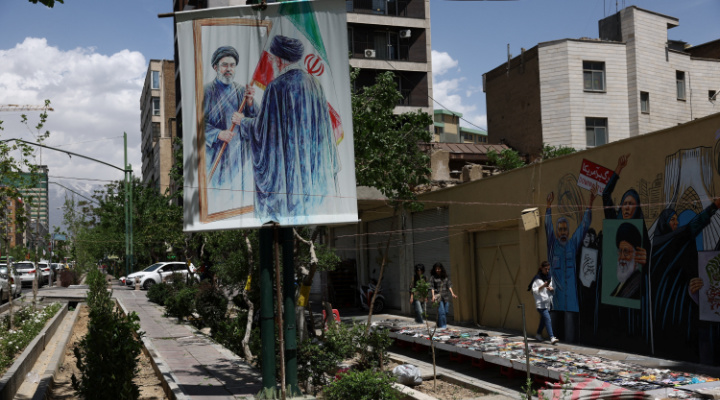
People walk on a street near a mural featuring an image of the late Supreme Leader of Iran, Ayatollah Ali Khamenei, in Tehran, Iran, May 6, 2026. Photo: Majid Asgaripour/WANA (West Asia News Agency) via REUTERS
Iran said on Wednesday it was reviewing a US peace proposal that sources said would formally end the war while leaving unresolved the key US demands that Iran suspend its nuclear program and reopen the Strait of Hormuz.
An Iranian foreign ministry spokesperson cited by Iran‘s ISNA news agency said Tehran would convey its response. US President Donald Trump said he believed Iran wanted an agreement.
“They want to make a deal. We’ve had very good talks over the last 24 hours, and it’s very possible that we’ll make a deal,” Trump told reporters in the Oval Office on Wednesday.
Earlier in the day, Trump had sounded more pessimistic about the chances of a deal. In a Truth Social post, he threatened to restart the US bombing campaign in Iran, calling the possibility of Tehran agreeing to the latest US proposal a “big assumption.”
Trump has repeatedly played up the prospect of an agreement that would end the war that started Feb. 28, so far without success. The two sides remain at odds over a variety of difficult issues, such as Iran‘s nuclear ambitions and its control of the Strait of Hormuz, which before the war handled one-fifth of the world’s oil and gas supply.
A Pakistani source and another source briefed on the mediation said an agreement was close on a one-page memorandum that would formally end the conflict. That would kick off discussions to unblock shipping through the strait, lift US sanctions on Iran, and set curbs on Iran‘s nuclear program, the sources said.
It was unclear how the memorandum differs from a 14-point plan proposed by Iran last week, and Iran has yet to respond to the latest US proposal.
Iran‘s semi-official Tasnim news agency, citing an unnamed source, said the US proposal contained some unacceptable provisions, without specifying which ones.
Iranian lawmaker Ebrahim Rezaei, a spokesperson for parliament’s powerful foreign policy and national security committee, described the text as “more of an American wish-list than a reality.”
“The Americans will not gain anything in a war they are losing that they have not gained in face-to-face negotiations,” he wrote on social media.
OIL PRICES TUMBLE
Reports of a possible agreement caused global oil prices to tumble to two-week lows, with benchmark Brent crude futures falling around 11% to around $98 a barrel at one point before rising back above the $100 mark.
Global share prices also leapt and bond yields fell on optimism about an end to a war that has disrupted energy supplies.
Trump on Tuesday paused a two-day-old naval mission to reopen the blockaded strait, citing progress in peace talks.
The US military has kept up its own blockade on Iranian ships in the region. US Central Command said forces fired at an unladen Iranian-flagged tanker on Wednesday, disabling the vessel as it attempted to sail toward an Iranian port in violation of the blockade.
NO MENTION OF KEY US DEMANDS
The source briefed on the mediation said the US negotiations were being led by Trump’s envoy Steve Witkoff and son-in-law Jared Kushner. If both sides agreed on the preliminary deal, that would start the clock on 30 days of detailed negotiations to reach a full agreement.
The full agreement would end the competing US and Iranian blockades on the strait, lift US sanctions, and release frozen Iranian funds. It would also include some curbs on Iran‘s nuclear program, with the aim of a pause or moratorium on Iranian enrichment of uranium.
While the sources said the memorandum would not initially require concessions from either side, they did not mention several key demands Washington has made in the past, which Iran has rejected, such as curbs on Iran‘s missile program and an end to its support for proxy militias in the Middle East.
The sources also made no mention of Iran‘s existing stockpile of more than 400 kg (900 pounds) of near-weapons-grade uranium.
Israeli Prime Minister Benjamin Netanyahu, Trump’s ally against Iran, said on Wednesday the two leaders agreed that all enriched uranium must be removed from Iran to prevent it from developing a nuclear bomb.
Tehran denies wanting to acquire a nuclear weapon.
Uncategorized
Musée d’Orsay Opens Permanent Exhibition Space Dedicated to Nazi-Looted Artwork
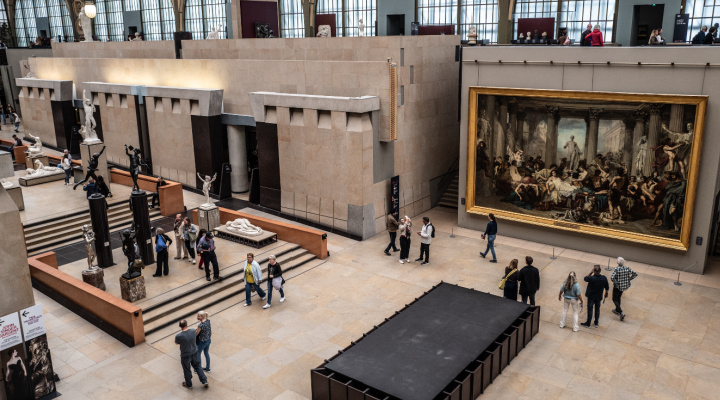
Inside the Musée d’Orsay. Photo: ZUMA Press Wire via Reuters Connect
The Musée d’Orsay in France opened a new permanent exhibition room on Tuesday dedicated to works of art that were owned by Jews and looted by the Nazis across Europe during World War II before being returned to France after the war.
The new gallery room is titled “To whom do these works belong?” and will feature rotating installations of works of art recovered after World War II also known as Musées Nationaux Récupération (National Museums Recovery) pieces. Provenance investigators and researchers are still working to identify the original owners of these MNR artworks.
“Over time, the room is intended to evolve to present to the public the discoveries resulting from this research, some of which could allow new restitutions,” said the museum. “It thus constitutes a space of memory, transparency and active research, at the heart of contemporary issues related to the history of the collections.”
Now on display in the exhibition is 13 works, including the 1879 painting “Dinner at the Ball” by Edgar Degas, according to The Times. The painting was previously owned by Fernand Ochsé, a Jewish merchant and art collector living in France who was murdered in the Auschwitz concentration camp during the Holocaust along with his wife. The painting was among thousands of artworks stolen by the Nazis or forcibly sold to Nazi occupiers in France. Also on display in the exhibit is Pierre-Auguste Renoir’s portrait “Madame Alphonse Daudet” from 1876.
The new gallery room and research done by provenance investigators is being funded with support from the nonprofit organization American Friends of Musées d’Orsay et de l’Orangerie (AFMO). According to the organization, 60,000 artworks looted by the Nazis during World War II around Europe were returned to France by 1950 and 224 of those recovered artworks are housed at the museum and in need of further provenance research to find their original owners. Fifteen MNRs kept at the Musée d’Orsay have already been returned to its rightful owners.
Over the next few years, AFMO will fund a team of art historians and researchers, led by provenance expert Dr. Ines Rotermund-Reynard, and they will focus on finding the owners of the 224 recovered artworks in the Musée d’Orsay’s collections, but also approximately 200 additional pieces acquired by the museum after 1933.