



Uncategorized
Israel Prepares for Possible Return to War in Gaza as Ceasefire Talks Stall, Hamas Rejects Disarmament

Israeli soldier on guard in Gaza, February 2026. Photo: Jonathan Sacerdoti / The Algemeiner
As the Palestinian terrorist group Hamas continues to reject disarmament and further stalls progress on the US-backed Gaza ceasefire deal, Israeli officials are weighing contingency plans for a renewed military campaign should negotiations collapse entirely.
According to multiple media reports, the Israel Defense Forces believes the current negotiations are unlikely to result in either Hamas’s disarmament or the full demilitarization of the Gaza Strip, warning that the terrorist group is exploiting the diplomatic pause to rebuild its capabilities, consolidate control, and further entrench its governance in Gaza.
“Hamas is deliberately dragging its feet. It is exploiting attention on Iran and Lebanon and, in the meantime, is entrenching itself in the Gaza Strip — reasserting control over the territory, establishing governance structures, and rebuilding its military capabilities,” a military source told the Israeli news outlet Walla.
“As things stand, there are two possibilities: a US declaration that the negotiations have reached a deadlock and a return to fighting, or Washington pushing a partial, ‘perforated’ agreement on Israel that would significantly undermine our security interests and erode the operational gains achieved so far,” he continued.
As regional tensions continue to mount, Maj. Gen. Yaniv, commander of the IDF Southern Command, on Wednesday presented Israel’s political leadership with a new operational plan pushing the military to brace for a potential return to combat and initiate a wide-ranging reassessment of its ground maneuver strategy and operational approach.
For months now, the US-led Board of Peace has been conducting parallel negotiations with Israel and Hamas, attempting to tie the large-scale reconstruction of the war-torn enclave to the complete dismantling of the terror group’s weapons arsenal.
However, after continued failed attempts to reach an agreement, the Board of Peace will not hold Israel to the terms of last year’s ceasefire any longer if Hamas again rejects the proposed disarmament framework, according to a document obtained by The Times of Israel.
The board’s High Representative for Gaza Nickolay Mladenov has previously warned that Hamas’s refusal to disarm could trigger a resumption of the war. But now, the official is reportedly signaling that Israel would not be expected to halt military operations or guarantee humanitarian access to Gaza if the ceasefire framework collapses.
Hamas has consistently refused to relinquish its weapons, insisting that Israel must first fully comply with phase one of the ceasefire — including expanded humanitarian aid deliveries, full reopening of the Rafah crossing, and withdrawal of Israeli forces to the agreed Yellow Line — before any disarmament process can proceed.
For its part, Israel has warned that the Islamist group must fully disarm for the second phase of the ceasefire to move forward, pointing to tens of thousands of rifles and an active network of underground tunnels still under the terrorist group’s control.
If Hamas does not give up its weapons, Israeli officials have vowed not to withdraw troops from Gaza any further or approve any rebuilding efforts, effectively stalling the ceasefire agreement.
Under the ceasefire, the Israeli military currently controls over 50 percent of Gaza, while Hamas remains entrenched in the nearly half of Gazan territory it still controls, where the vast majority of the population lives.
In its latest counterproposal, the terrorist group said that any transfer of its weapons would only be possible as part of a wider process leading to the establishment of a Palestinian state.
As the second phase of the Gaza ceasefire agreement remains stalled, Israeli officials have warned that Hamas is quietly exploiting the pause in fighting to tighten its control over civilian life while simultaneously rebuilding its military capabilities behind the scenes.
Last month, local elections saw the Palestinian Authority (PA) record notable gains, with results appearing strong on the surface. However, experts warn the outcome actually reinforced Hamas’s political theater, projecting an image of shifting authority while the group effectively maintains its control on the ground.
According to a report by Israel’s Channel 14, although newly elected municipal figures are formally affiliated with Fatah, the party of PA President Mahmoud Abbas, the presence of Hamas-linked representatives still signals the group’s continued political penetration at the local level.
Beyond official political appointments, Hamas-linked personnel are widely believed to remain embedded within municipal administrative structures, enabling the group to maintain effective control over day-to-day governance away from public view.
At the same time, through checkpoints, strict regulation of goods, and control over key public institutions, including hospitals, the Palestinian terrorist group has been quietly reestablishing its civilian governance structures across the war-torn enclave, with its authority still visibly enforced on the ground.
Hamas has also been reactivating internal security mechanisms to enforce day-to-day order, while conducting extensive intelligence operations aimed at identifying alleged collaborators with Israel and suppressing any opposition.
In an effort to reassert control and shore up its weakened position, the group has launched a violent internal campaign against armed militias and local gangs, targeting those it labels “lawbreakers and collaborators,” with the crackdown escalating into widespread clashes and violence as Hamas members move to seize weapons and eliminate remaining pockets of resistance.
Even after more than two years of war, the group is also rebuilding its military capabilities, including recruiting new operatives, conducting field and command-level training, restoring intelligence and surveillance networks, and reconstructing underground tunnel systems and weapons stockpiles.
Uncategorized
Musée d’Orsay Opens Permanent Exhibition Space Dedicated to Nazi-Looted Artwork
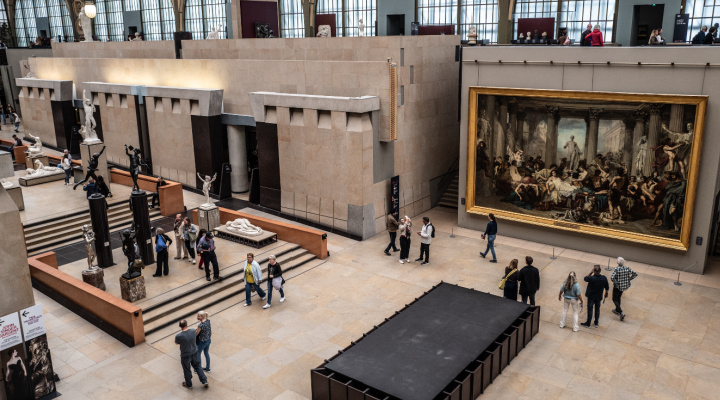
Inside the Musée d’Orsay. Photo: ZUMA Press Wire via Reuters Connect
The Musée d’Orsay in France opened a new permanent exhibition room on Tuesday dedicated to works of art that were owned by Jews and looted by the Nazis across Europe during World War II before being returned to France after the war.
The new gallery room is titled “To whom do these works belong?” and will feature rotating installations of works of art recovered after World War II also known as Musées Nationaux Récupération (National Museums Recovery) pieces. Provenance investigators and researchers are still working to identify the original owners of these MNR artworks.
“Over time, the room is intended to evolve to present to the public the discoveries resulting from this research, some of which could allow new restitutions,” said the museum. “It thus constitutes a space of memory, transparency and active research, at the heart of contemporary issues related to the history of the collections.”
Now on display in the exhibition is 13 works, including the 1879 painting “Dinner at the Ball” by Edgar Degas, according to The Times. The painting was previously owned by Fernand Ochsé, a Jewish merchant and art collector living in France who was murdered in the Auschwitz concentration camp during the Holocaust along with his wife. The painting was among thousands of artworks stolen by the Nazis or forcibly sold to Nazi occupiers in France. Also on display in the exhibit is Pierre-Auguste Renoir’s portrait “Madame Alphonse Daudet” from 1876.
The new gallery room and research done by provenance investigators is being funded with support from the nonprofit organization American Friends of Musées d’Orsay et de l’Orangerie (AFMO). According to the organization, 60,000 artworks looted by the Nazis during World War II around Europe were returned to France by 1950 and 224 of those recovered artworks are housed at the museum and in need of further provenance research to find their original owners. Fifteen MNRs kept at the Musée d’Orsay have already been returned to its rightful owners.
Over the next few years, AFMO will fund a team of art historians and researchers, led by provenance expert Dr. Ines Rotermund-Reynard, and they will focus on finding the owners of the 224 recovered artworks in the Musée d’Orsay’s collections, but also approximately 200 additional pieces acquired by the museum after 1933.
Uncategorized
California Man Pleads Guilty to Killing Jewish Pro-Israel Protester; Judge Weighs Light Sentence
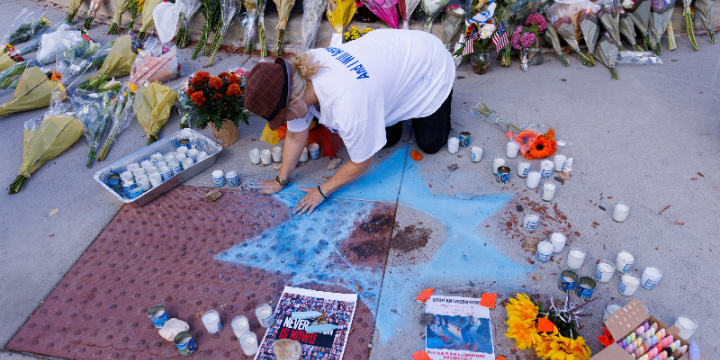
Chalk drawer Elena Colombo of the Hamakom Synagogue draws a blue star around blood at the exact location on the sidewalk where Paul Kessler was attacked in Thousand Oaks, California, US, Nov. 7, 2023. Photo: Mike Blake via Reuters Connect
Prosecutors in Ventura County, California have obtained a felony conviction against a community college professor who caused the death of an elderly Jewish man he struck in the face with a megaphone during a heated argument which started at the interstice of dueling demonstrations over the Israel-Hamas war.
Loay Alnaji, 54, on Tuesday pleaded guilty to involuntary manslaughter and battery causing serious injury, along with a special allegation and aggravating factor that he personally used a weapon to strike pro-Israel protester, 69, according to the Ventura County District Attorney’s Office.
The killing occurred in November 2023, when pro- and anti-Israel protesters confronted each other in the city of Thousand Oaks, in the early days of the Gaza war. Prosecutors said Alnaji hit Kessler in the head with a megaphone. Kessler fell to the ground, hit his head on the pavement, and died the next day.
However, even though the charges carry a maximum of four years in prison, Alnaji faces a much lighter sentence when he appears in court on June 25 for his sentencing. Ventura County Superior Court Judge Derek Malan, who is presiding over the case, has promised to honor an agreement to limit his sentence to three years of “formal probation” and “up to” one year in jail for a guilty plea.
Following the proceedings, the Ventura County District Attorney’s office said that so light a punishment, reportedly negotiated directly between Alnaji and Malan ahead of Tuesday’s hearing, is contrary to the preferences of the prosecutorial team which fought to hold him fully accountable for the weight of the crime.
“Alnaji should be sentenced to prison for his violent behavior, and our office strongly objects to any lesser sentence,” district attorney Erik Nasarenko said. “While no amount of punishment will ever fully account for the Kessler family loss, a prison commitment underscores the severity of this crime and will deter others from committing similar acts of violence.”
As previously reported by The Algemeiner, Kessler sustained two impacts — the blow to his head and a second from the concrete to which he fell after being knocked down. Given the charged political climate in which the killing occurred, law enforcement officials hesitated for days to pronounce that the matter would lead to criminal charges, citing conflicting witness accounts of the altercation. At one point, Alnaji’s only interaction with the Ventura County Police Department was a traffic stop initiated while officers conducted a search of his home.
Ultimately, 10 days passed before police officers arrested him on the charges to which he pled guilty on Tuesday — and he almost evaded those when Judge Ryan Wright, the first judge presiding over the case, ruled that there was insufficient evidence to hold a trial.
Since being assigned to the Kessler case in March following the death of its former presiding judge, Malan has avoided relating Alnaji’s actions to rising antisemitic hatred in the US, downgrading the deadly encounter to a disagreement between “two old guys.”
Doing so miscarries justice, the leader of a Jewish civil rights organization told The Algemeiner on Wednesday, stressing the importance of the justice system’s responding to antisemitic violence and hate crimes with a meaningful deterrent.
“The outrageously lenient plea deal offered to Loay Alnaji is a devastating failure of justice that minimizes the death of 69-year-old Jewish man Paul Kessler and sends a chilling message about how seriously antisemitic violence,” said Liora Rez, executive director and founder of StopAntisemitism. “By intervening against the district attorney’s recommendation and dismissing this killing as merely ‘two old guys’ having a dispute, Judge Derek Malan ignored both the deadly consequences of Alnaji’s actions and the disturbing reality that someone promoting pro-Hamas propaganda helped fuel the environment that led to Kessler’s death.”
Follow Dion J. Pierre @DionJPierre.
Uncategorized
Mamdani Hedges in Response to Mob Targeting New York City Synagogue

New York City Mayor Zohran Mamdani holds a press conference at the New York City Office of Emergency Management, as a major winter storm spreads across a large swath of the United States, in Brooklyn, New York City, US, Jan. 25, 2026. Photo: REUTERS/Bing Guan
Protests targeting an Israeli real estate event at a New York City synagogue have put Mayor Zohran Mamdani’s leadership under renewed scrutiny after demonstrators returned to the Upper East Side location on Tuesday night.
The demonstration prompted a significant police response and raised concerns about rising antisemitic rhetoric in the city home to the world’s largest Jewish population outside of Israel.
Protesters gathered outside Park East Synagogue in Manhattan during a showcase called “The Great Israeli Real Estate Event 2026,” which included the marketing of properties in Israel proper as well as West Bank settlements. At the demonstration, activists held signs and chanted slogans that went beyond criticism of Israel, seemingly calling for the death and expulsion of Jews and, in some cases, support for US-designated terrorist groups.
“Death, death to the IDF [Israel Defense Forces],” “Rapists,” and “Settlers, settlers go back home, Palestine is ours alone” were among the insults screamed by the protesters, some of whom also waved flags belonging to the Lebanese terrorist group Hezbollah.
The scene marked a return to the same synagogue that was the site of a contentious protest in November, which drew widespread condemnation and sparked debate over the boundaries between political expression and hate speech. At that gathering, demonstrators chanted “We don’t want no Zionists here” and “Resistance, you make us proud, take another settler out,” among others. One speaker claimed, “It is our duty to make them think twice before holding these events! We need to make them scared.”
Both protests were organized by the anti-Zionist activist organization Pal-Awda.
This time, however, the New York City Police Department (NYPD) appeared better prepared. Officers established barricades and maintained distance between demonstrators and synagogue attendees, preventing the kind of close confrontations seen in the earlier protest. While tensions remained high, authorities largely kept the situation contained, avoiding major physical clashes.
Still, video circulating on social media appeared to show hordes of protesters storming and attempting to penetrate the barricades erected by the NYPD to separate the synagogue from the demonstrations. According to multiple reports, police had to deploy pepper-spray and at least one officer was hospitalized during the chaos.
Ronen Levy, a Queens-based pro-Israel counterprotester, repudiated the demonstrations as a threat to the local Jewish community.
“You want to protest? You want to assemble on the street, you want to assemble in a park, you want to assemble in a center or Columbus Circle? You’re more than welcome,” Levy told AMNY. “But to protest in a shul or a mosque or a church, that’s unethical, that’s un-American.”
“It came to where they do it in the shul, because it’s a lot easier to get Jewish people to come down, because it’s a Jewish congregation,” Levy continued. “Most people in synagogues, they want to go live in Israel.”
The incident came amid an ongoing surge in antisemitic hate crimes in New York City. According to police data, Jews this year have been targeted in the majority of all hate crimes committed in the city, continuing a troubling trend of rising antisemitism following Hamas’s Oct. 7, 2023, massacre across southern Israel. Mamdani took office on Jan. 1.
Jewish community leaders have increasingly voiced concern about demonstrations occurring near religious institutions, warning that such actions blur the line between protest and intimidation.
Mamdani, who faced criticism over his response to the November protest outside the same Manhattan synagogue, on Wednesday expressed support for the police’s response but also condemned the Israeli real estate event.
“I think that I’ve made it clear time and time again that we in this city believe in the sacrosanct nature of the right to protest, and also are committed to ensuring that any New Yorker can safely enter or exit from a house of worship, and that access never be in question, while we also protect the First Amendment,” Mamdani said during a press conference. “And I do believe that the police ensured that yesterday evening.”
However, the mayor went on to defend the protesters’ cause.
“There is no tolerance for hatred of Jewish New Yorkers,” he said. “I’ve also been clear to New Yorkers, my honest opinions about the fact that when we have a real estate expo that is promoting the sale of land, which includes the sale of land in occupied West Bank in settlements that are a violation of international law, that that is something that I firmly disagree with.”
“I also believe that many New Yorkers firmly disagree with it, because it has been at the heart of an ongoing effort to displace Palestinians from their homes,” Mamdani added.
Mamdani’s office issued a similar statement on Tuesday in the hours leading up to the protest.
“He further inflamed tensions on an already volatile situation,” the Anti-Defamation League’s New York/New Jersey branch said of Mamdani’s comments. “The mayor had a responsibility to de-escalate. He did the opposite.”
Mamadani faced intense criticism from Jewish leaders and pro-Israel advocates after issuing a similar statement in November that appeared to legitimize the gathering of demonstrators who called for violence against Jews outside Park East Synagogue.
Julie Menin, the speaker of City Council, defended the protesters’ first Amendment Rights while admonishing efforts to intimidate synagogue attendees.
“The right to peaceful protest must be protected, and so must the ability of individuals to safely access a house of worship without fear or intimidation,” Menin said.
Mamdani has come under immense scrutiny over his record of anti-Israel statements, repeatedly accusing Israel of committing “genocide” in Gaza and claiming that Israel does not grant “equal rights” to all of its inhabitants. Given his track record of anti-Israel sentiment, which according to critics has fueled hostility toward Jews, Mamdani’s handling of antisemitism has come under the spotlight.