



Uncategorized
Israel Launches Mobile Climate Lab in Kenya to Improve Africa’s Data Collection for Environmental Policy
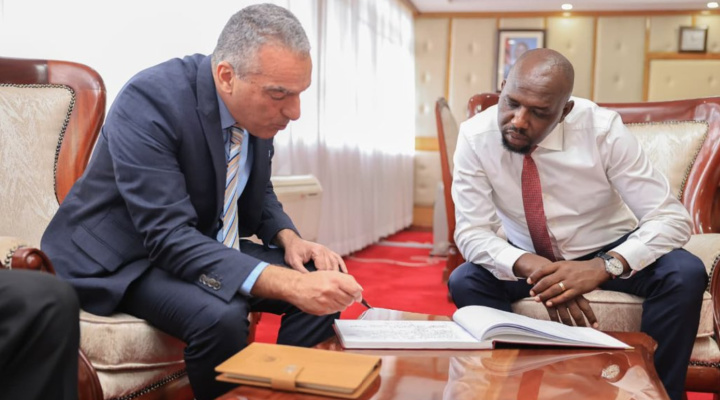
Israel’s Ambassador to Kenya, Gideon Behar, meets with Cabinet Secretary for Interior and National Security, Kipchumba Murkomen, on March 3, 2026. Photo: Screenshot
Israel’s Ambassador to Kenya has announced an initiative to deploy a mobile climate laboratory to grow data collection in the African nation, an effort to provide real-time information so policymakers can pursue solutions as temperatures continue to rise across the continent.
“There is a huge gap in climate data and climate knowledge in Africa, and the work of this laboratory helps us close this gap,” Gideon Behar said on Saturday while visiting the International Livestock Research Institute (ILRI) site in Kapiti, the current home of the mobile lab. He said that the plan would allow political leaders “to make better policy decisions based on real and accurate science.”
Israel’s Weizmann Institute of Science has spearheaded and operated the project. In December, the institute described the project’s importance, explaining that “Africa’s landscapes are transforming faster than almost anywhere else on earth, yet the continent remains one of the world’s largest blind spots in climate observations.”
The institute said that following a months-long journey around the African continent by sea, the “fully equipped Biosphere–Atmosphere Research Mobile Lab is about to roll onto African soil, launching an ambitious campaign to measure how land-use change is reshaping the region’s carbon, water, and energy cycles.”
ILRI’s Director General Appolinaire Djikeng described the importance of the project for not only Kenya but also the entire African continent.
“We are in a society where we need data to make decisions,” Djikeng said. “The pressure from the climate crisis requires precision. This facility allows us to generate the evidence needed to guide sustainable food production and environmental management.”
Academics leading the research team include Dan Yakir, professor in the Department of Earth and Planetary Sciences, staff scientist Eyal Rotenberg, and post-doctoral researcher Dan Elhanati. Rotenberg said that climate models in Africa today “are not well calibrated because there has been very little measurement. This initiative will provide the data needed to validate and improve those models.”
The mobile unit features more than 30 scientific instruments set to measure carbon exchanges, levels of solar radiation, water usage, and these factors’ impact on changes in vegetation. The lab’s ability to move enables much broader and more diverse data collection in a variety of ecosystems, according to the researchers.
“I’ve been working in this field for 25 years, studying vegetation – atmosphere interactions,” Rotenberg told Kenya’s Capital FM. “Not only how vegetation affects the atmosphere, but how the atmosphere affects vegetation.”
“That is my core motivation — to come to Africa,” he added. “Unlike in Europe, the United States, Japan or China, there is very little measurement here. But climate is global. We must understand it everywhere, especially in Africa.”
Behar — who also serves as Ambassador-Designated to Uganda, Tanzania, Malawi, and Seychelles and Permanent Representative of UNEP and UN HABITAT (UNON) — said “the measurements and scientific work being conducted here will serve the global fight against climate change.”
Rotenberg emphasized, “If vegetation uses most of the water, there is less available for human use … We need to understand that balance.”
The project plans to operate for three years before relocating to Mount Kenya and other regions. Weizmann then plans to expand to Tanzania, South Africa, and other countries.
According to the World Meteorological Organization (WMO) State of the Climate in Africa 2024 report, “extreme weather and climate change are intensifying hunger, insecurity, and displacement across Africa, impacting every facet of socio-economic development.” Depending on the data set, 2024 was either the warmest or second warmest year in Africa on record, and the previous decade was the warmest ever recorded.
WMO Secretary-General Celeste Saulo said the organization’s report “reveals a stark pattern of extreme weather events, with some countries grappling with exceptional flooding caused by excessive rainfall and others enduring persistent droughts and water scarcity.”
The effort in Kenya comes as Israel has expanded efforts in Africa to counter the impacts of climate change and the widespread droughts that have followed.
In February, officials and workers from Somaliland’s National Water Authority arrived in Israel for a course developed to train them on Israeli technology and techniques for water preservation and treatment. The trip came two months following Israel’s recognition of Somaliland, located in the Horn, as an independent, sovereign state.
Uncategorized
Germany’s Main Mosque Network Under Fire Over Speakers Accused of Antisemitic Incitement

Pro-Palestinian demonstrators during a protest against Israel to mark the 77th anniversary of the “Nakba” or catastrophe, in Berlin, Germany, May 15, 2025. Photo: REUTERS/Axel Schmidt
Germany’s main mosque association is facing growing controversy over speakers scheduled for its Cultural Days, a public program of community events, as experts warn of antisemitic incitement on a public stage and call for the event to be canceled.
Organized by the Turkish-Islamic Union for Religious Affairs (DITIB) in Hamburg, a city in northern Germany, the event is being advertised as a family-friendly gathering.
However, political figures, Jewish community representatives, and experts have sharply condemned the event, warning it risks providing a platform for antisemitic rhetoric and raising serious concerns over its tone and messaging.
Under mounting political pressure, DITIB was forced to remove four of the six speakers from the program, citing their hateful rhetoric and the promotion of antisemitic narratives.
“Those who act within our communities must not be associated with positions that express antisemitism, glorify violence, show hostility toward individuals, or incite hatred,” the association wrote in a statement.
Yet the controversy continues, as the event still advertises two remaining speakers who have drawn sustained criticism.
According to German author Eren Güvercin, a vocal critic of political Islam in the country, the two remaining speakers — Furkan Tiraşçı and Mahmut Sağır — have also been accused on social media of posting antisemitic content and glorifying terrorist organizations, raising questions over why they should be allowed to participate.
In several posts, Tiraşçı has repeatedly downplayed or justified the Hamas-led invasion of and massacre across southern Israel on Oct. 7, 2023, and referred to deceased Hamas leader Ismail Haniyeh as a “martyr.”
“He was a good Muslim, a good mujahid, a good family man. My condolences to the Muslim community. Every martyrdom is a new beginning on the path to victory,” Tiraşçı wrote in a post on X at the time of Haniyeh’s death.
He has also repeatedly shared antisemitic caricatures, including depictions of Israeli Prime Minister Benjamin Netanyahu with vampire fangs and blood, labeled “killer,” as well as photomontages comparing Netanyahu to Adolf Hitler or placing him in Nazi-era imagery.
As for the second guest, Sağır has been accused of glorifying Hamas leaders and describing the Israeli population as a “cursed community” that has “drowned the world in blood for centuries” — remarks that echo decades-old antisemitic tropes. The quote appears to refer directly to Jews, as the modern state of Israel was only established in 1948.
According to Güvercin, Sağır “shares content that goes far beyond legitimate criticism and delves deeply into hateful ideologies.”
#DITIB–#Bergedorf feiert vom 14. – 17. Mai auf dem Frascatiplatz ihr 40-jähriges Bestehen.
Nachdem ich öffentlich darauf hingewiesen habe, dass vier namhafte Referenten, die aus der Türkei für dieses Fest eingeflogen werden sollten, immer wieder mit antisemitischen Aussagen und… pic.twitter.com/9Kc517ztxY— Eren Güvercin (@erenguevercin) May 4, 2026
In an Instagram post following Haniyeh’s death, Sağır wrote: “May the Lord receive him into His mercy, may his place be in paradise and his rank be elevated. The fate of those who thrive on cruelty is bleak and will be so. If not today, then tomorrow God will bring about the means to exact this reckoning. We believe it, and we bear witness.”
In the past, DITIB has faced multiple controversies, with some members making antisemitic remarks and spreading hateful messages.
Last year, the German government urged DITIB to publicly break with Turkish President Recep Tayyip Erdogan’s antisemitic and anti-Israel rhetoric, citing the association’s close ties to him.
According to local reports, German authorities told religious leaders to formally break with Erdogan’s hateful statements or risk losing government support and cooperation.
For years, the German government has supported DITIB in training imams, as well as helping to foster community programs and religious initiatives.
Most of these religious leaders are trained abroad — especially in Turkey — and brought to local mosques by large Muslim organizations on multi‑year contracts, shaping the religious education and messaging that reaches the community.
Now, German lawmakers and the country’s Jewish community are calling for a mandatory certification process for all imams amid a surging wave of antisemitism, including multiple cases of religious leaders promoting anti-Jewish violence.
In 2023, the German government signed an agreement with the Turkish government’s Directorate of Religious Affairs (Diyanet) and DITIB for a new imam training program.
By sending imams from Turkey and paying their salaries, the Diyanet oversees DITIB and its hundreds of communities across Germany, shaping the ideological direction of more than 900 mosques and influencing the training of their imams.
However, a new program has brought an end to this practice of sending imams directly from Turkey. Instead, Turkish students are trained in Germany in cooperation with the German Islam Conference (IKD).
With this new agreement, imams live permanently in German communities and have no formal ties to the Turkish government. Still, experts doubt that this alone will curb the Diyanet’s political influence.
Uncategorized
National Education Association Accused of Antisemitism in Bombshell Civil Rights Complaint

National Education Association (NEA) President Becky Pringle speaks during a “May Day” rally in Washington, DC on May 1, 2026. Several protests took place in the city centering on progressive causes including workers’ rights, immigrant rights, and climate change. Photo by Bryan Dozier via Reuters Connect
The largest teachers union in the US has been accused of proliferating antisemitism across its interstate network of chapters, offices, and K-12 schools in a new disturbing civil rights complaint filed with the US Equal Employment Opportunity Commission (EEOC) on Monday.
The National Education Association (NEA) blocks Jews from promotions, mentorship opportunities, and participation in social justice initiatives, the Louis D. Brandeis Center for Human Rights Under Law alleges in the action. The advocacy group further argues that antisemitic discrimination at the NEA is more than an invisible, bureaucratic force which disappears Jews from prominent roles. According to the Brandeis Center, anti-Zionist NEA officials want to be seen and recognized as a legitimate force in the union, and to that end have led in-person mobs against Jewish delegates attending union conferences; “physically intimidated” them; and even once took the step of excising Jews from its guidance on teaching students about the Holocaust.
During an annual conference held in 2025, the NEA ordered security to remove metal detectors from the entrance amid threats against the lives of Jewish delegates, according to the complaint. In many cases, the union allegedly ignores complaints of antisemitism which reach high-level officials through reporting channels the NEA itself composed. Virtually no one accused of having abused Jewish NEA members has been punished, let alone subject to a formal investigation, the Brandeis Center says.
The complaint adds that the NEA in 2025 also took the widely derided step of proclaiming that Holocaust commemoration must decentralize Hitler’s program to exterminate European Jews and “recognize the more than 12 million victims of the Holocaust from different faiths, ethnicities, races, political beliefs, genders, and gender identification, abilities/disabilities, and other targeted characteristics.”
Historically, such a move has been taken to minimize Jewish suffering and the role that antisemitism played in Nazi ideology and World War II.
“The NEA’s conduct is both completely illegal and morally unjustifiable. All educators, regardless of their ethnicity, deserve a safe workplace and support from the people whose job it is to protect them. In this case, the hostile, antisemitic environment propagated by the NEA is not confined to the union; it touches every school and every classroom in which an NEA member works,” Brandeis Center chairman and founder Kenneth Marcus said in a statement. “This is exactly the type of discrimination against which Title VII was designed to protect.”
Title VI of the Civil Rights Act prohibits discrimination based on race, color, or national origin in any program or activity receiving federal funding.
“Fighting to protect our NEA members from bigotry, we’re also fighting to protect our children from an environment that allows discrimination and antisemitic tropes,” Marcus added. “Unions are supposed to protect their members’ rights. The NEA is actually violating them.”
What the union promotes within its ranks inexorably appears in K-12 classrooms, the Brandeis Center says, pointing to a surge in antisemitic incidents in K-12 schools, a slew of which have been brought before civil courts and federal agencies. Just this month, another Jewish advocacy group, The Deborah Project, sued the San Leandro Unified School District (SLUSD) in California for standing down while a Jewish high school student was abused at its “Social Justice Academy” program. In another case, a teacher filmed her students saying that “the Jews” are “the people who took over, basically just stole the Palestinians’ land.”
Worker’s’ advocacy groups maintain that unions have played a role in promoting the “new antisemitism” which masks its antisemitic viewpoints with appeals to anti-Zionism, human rights, and other liberal values to squeeze anti-Jewish hatred through the Overton window.
In New York City, the federal government is investigating reports that members of the United Federation of Teachers (UFT) are procuring students for membership in anti-Zionist study groups teaching that Israelis are “genocidal white supremacists” and that Hamas terrorists are “martyrs.” The initiative there is funded by a nonprofit titled “Rethinking Schools,” which itself has been a recipient of exorbitant financial gifts from the NEA.
“The historical record shows that, whatever their shortcomings, previous generations of teacher-union leaders stood up to antisemitism in K-12 schools on behalf of their Jewish members and promoted strong US support for Israel in the face of existential attacks on that country,” union antisemitism expert Paul Zimmerman wrote in a damning report on the subject published in September. “Now, antisemitic activists grossly dishonor that legacy by weaponizing teacher unions to spread antisemitism, intimidate Jewish teachers, and recast the classroom as a battlefield against the West.”
Meanwhile, students at Columbia University recently escalated their fight against a graduate workers union dominated by anti-Israel advocates by filing a federal complaint with the National Labor Relations Board (NLRB).
The students allege that the bosses who run Student Workers of Columbia (SWC), an affiliate of United Auto Workers (UAW), devote more energy and resources to pursuing “radical policy proposals” than improving occupational conditions. In collective bargaining negotiations, it allegedly pressures the university to adopt the boycott, divestment, and sanctions (BDS) movement against Israel and to enact other measures, such as ending its partnership with the New York City Police Department (NYPD) and closing a dual-degree program with Tel Aviv University.
“All of this adds up to a union that is out of control, and I note that they don’t have an agenda against the mullahs in Iran, against the dictator who runs Turkey, against the Chinese communists who oppress their citizens or the North Koreans. But they have an agenda against Israel, the one democracy in the Middle East,” Glenn Taubman, staff attorney for the National Right to Work Foundation (NRTW), told The Algemeiner during an interview.
Follow Dion J. Pierre @DionJPierre.
Uncategorized
Reform Judaism helped craft the Voting Rights Act. Its evisceration gives Jews a new mission
Last week, the Supreme Court further gutted what is left of the Voting Rights Act of 1965. The Court’s ruling was terrible for the country, and particularly for communities of color whose votes will be diminished by this decision. But the ruling touched another, very personal nerve because the Voting Rights Act was partially drafted in my office, the Religious Action Center of Reform Judaism.
The RAC is a longtime hub of civil rights activity. From the earliest days after our 1962 dedication, Reform movement staff with the RAC worked alongside the staff of other civil rights and public interest organizations, including the Leadership Conference on Civil Rights. The era’s social justice luminaries, our movement’s leaders among them, would gather around our conference table to discuss, debate and craft policies to address racial injustices — including legislation that became the Civil Rights Act of 1964 and Voting Rights Act of 1965.
Many American Jews have no idea of our community’s connection to the law’s origins, rooted in a Jewish commitment to working across lines of difference and in an understanding that our safety is in solidarity with other marginalized communities who experience bigotry. But as Jews, we all know that we can only flourish in a true democracy in which every voice is heard, because every vote counts equally.
For decades, section two of the Voting Rights Act helped ensure that voters of color had a fair opportunity to participate in the political process. By narrowing how states can use race data to draw electoral maps, the Court’s ruling will dilute the voices of communities of color, and further weaken a law often called the “crown jewel” of the Civil Rights Movement — one that was the product of a moral struggle in which people of many faiths, including Jews, risked their lives.
Rabbi Dick Hirsch, the founder of the RAC marched with Dr. Martin Luther King Jr. in Selma because he understood that American Jewish safety is tied to the health of American democracy. During Freedom Summer, Andrew Goodman and Michael Schwerner — two white, Jewish men — were murdered alongside James Chaney, a non-Jewish Black man, while registering voters in Mississippi. Goodman and Schwerner did not see voting rights as someone else’s issue, but understood fighting for them to be a Jewish obligation.
That understanding is rooted in Jewish tradition. The Talmud teaches that “a ruler is not to be appointed unless the community is first consulted.” The VRA, which was reauthorized repeatedly over the decades by bipartisan majorities in Congress, was a crucial step to ensuring that communities of color were fairly consulted on the issues that affect their lives.
For decades after Reconstruction, Black representation in Congress was negligible and at times effectively nonexistent. That began to change only after the VRA became law. Today, there are more than 60 Black members of Congress, the highest number in American history. That progress was not inevitable. It was the direct result of legal protections that ensured fair access to the ballot.
By making it easier for states to defend discriminatory maps under claims of partisanship, the Court has weakened one of the most important tools to ensure fair representation. The result will be fewer fair Congressional maps — an effort well underway, in the wake of the decision, in states like Tennessee — less representative institutions, and a political system that reflects fewer voices.
Some will argue that this is simply the normal push and pull of constitutional interpretation, but history suggests otherwise. When democratic norms weaken, minority communities are among the first to feel the consequences.
For American Jews, this progression is not theoretical. Our security and prosperity, in this country as others, have depended not only on physical protection, but also on good laws, functional institutions and a system of checks and balances that uphold equal rights and reject discrimination.
George Washington recognized this in his 1790 letter to the Jewish community of Newport, Rhode Island, in which he promised that the United States would give “to bigotry no sanction, to persecution no assistance.”
In recent years, we have seen how fragile those protections can be.
Antisemitism has risen sharply, often alongside forces that divide Americans along racial, ethnic, and political lines. Efforts to weaken voting rights, undermine trust in elections and concentrate power do not occur in isolation. They are part of a broader pattern that threatens the pluralistic democracy on which Jewish life in the U.S. depends.
When the Court took a major piece out of the VRA in 2013’s Shelby v. Holder decision, Justice Ruth Bader Ginsburg famously warned in her stinging dissent that the Court’s decision was “like throwing away your umbrella in a rainstorm because you are not getting wet.” Today, the rain has not stopped. If anything, it is falling harder.
We must persevere through this storm. The path forward will not be easy, but it is clear.
In legislatures, we must push for stronger protections, among them state-level voting rights acts and renewed federal legislation. In the courts, advocates must continue to challenge discriminatory practices wherever possible. And at the ballot box, citizens must exercise their right to vote with renewed urgency.
For the Jewish community, this is a moment to organize. Through initiatives such as the Reform Movement’s 2026 Every Voice, Every Vote campaign, Reform Jews and our allies are working to expand access to the ballot and defend the democratic system that has allowed our community to thrive. This is how we put our values into practice.
Democracy requires participation, vigilance and a willingness to defend the rights of others. It demands that we act against all wrongdoings, not only when our own rights are directly threatened.
For Jews, that responsibility is part of our tradition and our history. As Rabbi Hirsch famously observed at the RAC’s dedication, “our forefathers did not rest with the issuance of general pronouncements from the detached heights of Mt. Sinai. They descended into the valley of reality.”
The Supreme Court decision is not just another technical shift in election law. It is a setback for American democracy, and for those of us who understand that democracy is not just a system of government but a moral commitment.
The question is whether we will meet this moment.
Democracy will not defend itself.
The post Reform Judaism helped craft the Voting Rights Act. Its evisceration gives Jews a new mission appeared first on The Forward.