



Uncategorized
Jack Ukeles, who used data and idealism to shape Jewish communal life, dies at 89
(JTA) — Throughout a storied career of more than five decades that included key roles in teaching courses at elite universities, policy planning for city and state governments and community surveys for Jewish organizations around the world, Jack Ukeles had one consistent goal: to blend research, data and strategic problem-solving with idealism in making the world a better place.
Ukeles, who died July in Jerusalem at the age of 89, was widely and deeply admired as well for his integrity, wisdom and compassion on both a personal and professional level.
He was also one of the most prominent members of a cohort of Jewish social scientists who, from the 1980s through the 2000s, played a central role in setting the agenda for organized Jewish life. Philanthropists and nonprofit leaders sought their data and recommendations on hot-button issues like rising intermarriage, attachment to Israel, population trends and declining engagement with Jewish institutions.
In 1981, Ukeles joined the Jewish non-profit world as senior planning officer of the New York Federation of Jewish Philanthropies (now UJA-Federation of New York). He led the charity’s first scientific study of the New York area’s Jewish population, and major studies on senior services and Jewish poverty.
Five years later, he went out on his own, launching Ukeles Associates, Inc., and for 28 years led consulting projects combining his experience in policy research, planning and management for a range of secular and Jewish non-profits.
Speaking at the funeral in Jerusalem, where Ukeles and his wife, Mierle, lived since making aliyah in 2012, longtime friend and colleague Asher Ostrin predicted that Ukeles’s teaching, in both classrooms and nonprofit board rooms, will have a lasting effect, especially for American Jewry.
“Generations of Jewish communal professionals are his students, and are taught to reflect the method and values he held dear,” said Ostrin, an executive at the American Jewish Joint Distribution Committee.
Those values were shaped growing up in a religious Zionist home, aware of the trauma his parents endured in Eastern Europe before settling in New York. Ukeles’s mother wanted a first-rate Jewish education for her only son, and after visiting a number of yeshivas, moved the family from The Bronx to Brooklyn so he could attend the Yeshiva of Flatbush, where he thrived academically and as student council president and member of the basketball team.
After seeing a newspaper ad announcing the opening of a university in Israel committed to integrating modern scholarship and traditional Jewish learning, he applied and was accepted in 1955 to Bar-Ilan University’s first class.
“My father was proud to be a member of that first class, and as a student leader there, he wanted to help build the school and be a part of its growth” in synthesizing secular and religious studies, his daughter Raquel Ukeles recalled. “But the administration wasn’t interested.” He was 18 at the time.
After a year in Israel, Ukeles attended a yeshiva and Brooklyn College, where he took courses in community planning, research and data. He received his B.A. in political science in 1959, and an M.A. in city planning two years later at the University of Pennsylvania. In 1962, Ukeles spent a year in New Delhi, India, as a Fulbright Fellow and returned to complete his Ph.D. at Penn in 1971.
During his graduate school years, Ukeles turned a summer job in the New York City planning department into a three-year position. He helped produce the first data-driven analysis of New York City’s housing needs, and was part of a team that reshaped the city’s approach to urban renewal.
He then turned to academia, starting a long-term pattern of moving back and forth between university posts — including the New School, where he later became chairman of the first urban policy graduate program in the U.S. — and designing and leading civil service and financial reforms in New York through the mayor’s office under Abe Beame and Ed Koch.
On behalf of Jewish organizations, he conducted a 2006 survey of Atlanta’s Jewish population that confirmed the explosive growth of Jewish communities in the Sun Belt, and co-authored a 2002 community study showing how Russian immigrants and Orthodox Jews were changing the face of New York City Jewry.
Ukeles was he co-authopr of a 2012 study showing that New York City area’s Jewish population was on the rise again, thanks largely to the growth of Orthodox households.(Spencer Platt/Getty Images)
In 2009, he wrote a report on how nonprofits can turn the severe economic downturn into opportunity. Drawing on his experience in city management, he advised nonprofits neither to panic nor deny the reality of squeezed budgets.
“You can forget about strategy if you do not have courage, if you do not have big ideas, or if you do not have vision, and most importantly, if you do not have compassion,” he said in a lecture that year drawing on the report. “In fact, without the ‘right stuff,’ you are in the wrong line of work.”
Family members noted that the common thread in Ukeles’s career in academia, city government and non-profits was to deal with difficult problems by making decisions based on real data, not theoretical ideas, and to bring the stakeholders around the table to make the best — or sometimes least worst — decisions based on need and priority.
Elie Kaunfer, CEO and president of the Hadar Institute, a center of Jewish life and learning, said that when Ukeles conducted the first formal evaluation of the organization in 2011, “he taught me so much about what kind of questions to ask — not just about experience of the program but ultimate impact on people’s lives.”
John Ruskay, former CEO of UJA-Federation, described him as “a loyal friend and dear colleague who I and so many others turned to repeatedly for counsel, for wisdom, for ‘chizuk’” (inner strength).
Sometimes his counsel came with critique. Steve Bayme, a former American Jewish Committee executive and longtime Ukeles friend, noted: “Jack knew how to offer constructive criticism and even occasional rebuke in ways that colleagues, including those in senior communal positions, could hear and absorb.”
Alan Gill, who served as CEO of the JDC, praised Ukeles for “his expertise in challenging and guiding us.” He said Ukeles “yelled at us” once, which was unheard of from consultants who tended to be dispassionate and analytical, he noted. But the outburst had “a positive effect,” Gill added, reminding JDC staff how much “the mission and work mattered” to Ukeles.
That sense of heartfelt criticism also applied to Ukeles’s devotion to, and frustration with, the state of Israel in recent years. He agonized over the growth of extremism in the haredi Orthodox community and Jewish settler violence, and he spoke out in pieces he published in The Times of Israel.
“Jack loved the Jewish people,” said Sally Gottesman, who was hired by Ukeles as a young consultant in 1997. Now an activist-philanthropist focused on gender and justice in the Jewish community, Gottesman said Ukeles was “a mentor and master teacher” and praised his efforts to promote equality for women.
A prime example was his support for and great pride in the accomplishments of his wife, Mierle, who in seeking to blend art with waste management became the official artist-in-residence of the NYC Department of Sanitation, a volunteer position she has held since 1977. Her unique career was the focus of an award-winning 2025 documentary, “Maintenance Artist.”
“Jack was my heart and soul,” she said. “His support, championing my being a free artist and a full person, all through the years, extending as well to his supporting the work of many other women artists of our time, was without a peer, without an end.”
In addition to his wife, Ukuleles is survived by his daughters, Raquel, who is head of collections at the National Library of Israel, and Yael, a product market manager and founder of two non-profit Israeli environmental education programs, and a son, Meir, who works with an Israel-based VC fund investing in startups.
The post Jack Ukeles, who used data and idealism to shape Jewish communal life, dies at 89 appeared first on The Forward.
Uncategorized
Georgia voters decide the future of Jon Ossoff, a Jewish Democrat who increasingly criticizes Israel
(JTA) — Jewish voters in Georgia went to the polls on Tuesday to choose between Democratic Sen. Jon Ossoff, who has increasingly criticized Israel, and Republican Rep. Mike Collins, his pro-Israel challenger with ties to white nationalists.
Ossoff, who is Jewish, called Collins a “notorious bigot, antisemite, and extremist” during the bitterly fought election. Collins said that Ossoff “caved to the radicals” by voting to halt certain arms shipments to Israel.
Ossoff’s voting record on Israel has captured a shift in the Democratic party. While he has supported measures to boost Israeli defense systems, he also became one of the first Senate Democrats to vote for blocking offensive weapons sales to Israel in 2024, as the country’s military conduct in Gaza drove mounting opposition.
In contrast, Collins has pledged continued military support for Israel and described the country as “a frontline partner against Iran and their partners in terror” in the Atlanta Jewish Times. A self-described “born again Christian,” Collins added that he supports Israel because “my faith tells me to and because it is the right policy for America.”
Collins’ campaign was mired in controversies surrounding his associates. One of his former staffers posted images of a swastika and a Ku Klux Klan robe online, while another partook in a group chat with prominent white nationalists that aimed to help an accused Holocaust denier. Collins’ son-in-law is a social media influencer who has promoted conspiracy theories that “Jews control our government” and called to deport all Muslims.
Ossoff took aim at those associations during the candidates’ two debates, saying that Collins “hired half the Third Reich to staff your congressional office” and was “unable to stop someone under your own roof from disseminating neo-Nazi propaganda while you run for the Senate.” Collins has said that he condemns antisemitism and does not support his son-in-law’s views.
Meanwhile, Ossoff’s vote against offensive weapons for Israel in November 2024 divided Georgia’s Jews. In an open letter, a coalition including Georgia synagogues, the Jewish Federation of Greater Atlanta, the local Anti-Defamation League chapter and the American Israel Public Affairs Committee told Ossoff they were “deeply disappointed” and the vote demonstrated that his “commitment to Israel’s security is not ironclad.”
An opposing letter from over 100 Atlanta Jewish leaders, including rabbis and heads of liberal organizations, thanked Ossoff for his vote. They said his position represented “a growing portion of the American Jewish community that believes that the US-Israel relationship should be grounded in our laws, national security interests and shared values.”
AIPAC, the pro-Israel lobby, attacked Ossoff and other senators who supported the bill in an advertising blitz. But Ossoff was backed by J Street, a liberal Jewish Middle East advocacy group, which spent $3 million on ads attacking Collins and other AIPAC-supported Republicans.
Ossoff subsequently voted for further measures in 2025 and 2026 to block sales of rifles, bulldozers and 1,000-pound bombs to Israel. Collins repeatedly attacked Ossoff for those votes, accusing the senator of giving in to “radicals” in the Democratic party who were “pushing the anti-Israel agenda.”
Ossoff has walked a tightrope between criticizing Israel and distancing himself from his party’s staunchest left flank. In his Oct. 8 debate with Collins, he was asked whether Israel committed genocide in Gaza, a charge made by a growing chorus of progressives. Ossoff cited Israeli war crimes while deferring to international courts.
“The question of genocide is a question of whether a government has the specific intent to destroy a national or ethnic group, and that is a question for the International Criminal Court,” Ossoff said. “There is no doubt in my mind that Israeli forces prosecuting the war in Gaza violated the law of armed conflict and international humanitarian law.”
Ossoff has also excoriated Trump’s decision to join Israel in a war with Iran. Like other Democratic candidates across the country, Ossoff accuses Trump of “lying a nation into war” and sending “prices soaring with his warmongering in the Middle East.”
Ossoff’s rising popularity has spurred speculation about his potential future as a 2028 presidential contender, though he said he has “zero interest in running for president.”
This article originally appeared on JTA.org.
The post Georgia voters decide the future of Jon Ossoff, a Jewish Democrat who increasingly criticizes Israel appeared first on The Forward.
Uncategorized
Why Nick Fuentes endorsed Democrats in the midterms
Nick Fuentes is a devoted conservative, open antisemite and far-right agitator. On his Rumble show, one of the most viewed on the streaming platform, he regularly calls for mass deportations, labels women the biggest threat to America, praises Hitler, slanders Black people as illiterate and blames Jews for a host of societal ills.
So why, on the morning of the 2026 midterm elections, did he post, “Get out and vote Democrat today?”
It sounds like a joke, which wouldn’t be out of the ordinary for the shockjock humor the far-right influencer employs. Fuentes paraded with MAGA flags on Boston University’s liberal campus when he was briefly enrolled there. He went to the Unite the Right rally in Charlottesville. He had dinner with the then-former president Trump alongside Kanye West. He celebrated the president’s win in 2024.
But Fuentes was not kidding. In his streams on Rumble, where he runs his podcast, America First with Nicholas J. Fuentes, he has been telling his followers, often called Groypers, to vote blue no matter who. He has done the same on X, where his once-banned account was reinstated when Musk bought the platform.
What changed his mind? Well, in large part, Israel.
Fuentes has been complaining for nearly a year now about Trump, for myriad reasons. On X, Fuentes harshly criticized Trump’s refusal to release the Epstein files and his failure to deport millions. He slammed the war with Iran. And, as ever, the streamer known for his antisemitism has speculated about Jewish influence on rightwing politicians and causes.
On a stream urging his followers once again to vote for Democratic politicians in congressional races, he said that Trump had failed to end the “genocide in Gaza” and had instead broken his promises not to start any new wars — and done so at Netanyahu’s bidding no less. Angrily, he pointed out that Trump had come into office with control of both the House and the Senate, and with the support of some of the most-desired demographics of American voters: young men.
“For the first time in like a quarter of a century, it was hip to be Republican. It was cool,” Fuentes said, recalling Trump’s win in 2024. But then, he argued, the Republican leadership blew it: “You lost the comedians, you lost the podcast bros, you lost the normies! Normies don’t like war with Iran. Normies don’t like 3.7% inflation!”
But don’t take Fuentes’ endorsement of Democrats as proof that the worst antisemitism now lies with the left; the influencer has been clear that he reviles the Democratic party and is still a right-winger. Not only is he an avowed white nationalist and antisemite, he is a devout traditionalist Catholic who does not believe women should be allowed to vote. However much he dislikes anything to do with Jews, he is not truly interested in uniting with anti-Zionist progressive candidates just because they criticize Israel. (He is, however, happy to endorse Amy Action, a blonde white Democrat, over the Indian Vivek Ramaswamy, who Fuentes called an “anchor baby.”)
Instead, he has said his Democratic endorsement is a tactical one, a way to steer and influence the Republican party to come closer to his Christian nationalist, antisemitic, closed borders ideology.
“James Talarico is a Satanic wicked disgusting figure. Abdul Rahman El-Sayed in Michigan is a lying scumbag. He’s trying to maintain this facade that he’s Woke 2.0, patriotic, just wants healthcare — he’s a Muslim socialist. Pure contempt for America and whites,” Fuentes said on a stream about the midterms. “These are some of the worst Democrats ever! But maybe that is the wake up call we are going to need as the anti-left opposition to put up some legitimately good candidates.”
If there is a blue wave on Tuesday night, as Fuentes predicts, he believes the Republican party will blame him for it — and he’s ready to accept responsibility. He did, after all, urge his followers to vote Democratic. But don’t be fooled; he won’t be pushing the Democrats to become groypers. Most likely, he’ll present himself and his followers as the natural successors to lead the Republican party in 2028.
The post Why Nick Fuentes endorsed Democrats in the midterms appeared first on The Forward.
Uncategorized
Capers Funnye wasn’t a ‘Black Jew’ — he was a good Jew
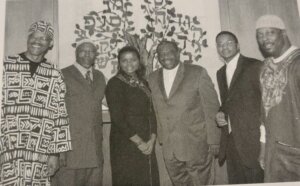
This morning, when I woke up, it was the first time in my entire life that my spiritual leader, my rabbi and my friend, was gone. People are born and die every day, and we live totally oblivious to that fact, but I feel the absence of this one human being almost on a cellular level. And the very person I would call to help me make sense of a time like this is the one who is gone.
Rabbi Capers Funnye wasn’t your typical rabbi. How could he be, though? After all, his congregation was full of Black folks and people of color. There were also some white congregants, but for the most part, his temple was a place created for people like me to have somewhere to go and practice Judaism freely without suspicion or judgment. Beth Shalom was established over one hundred years ago by Black Jews who knew at that time that they could actually be arrested here in America, in Chicago, for daring to say out loud that they were Jewish. I know that sounds unthinkable, but it’s a historical fact: It used to be illegal in Chicago for Blacks to claim that they were Jewish.
Rabbi Funnye dedicated his life to ensuring that Black Jews wouldn’t have their Jewishness questioned.

White Jews love to reminisce about the Civil Rights Movement and their close relationship to the Black community, and this coalition brought about monumental changes to American society. But those same white Jews who marched in Selma and rode buses to Mississippi had little to no interaction with Black Jews. We were nonexistent. A myth, if you will. Some people had heard that there were Black people who called themselves Jews, but no one had actually ever seen one or met one.
We were there, but just as other Jews had hidden before, we were hiding too. We worshipped in basements, living rooms, and the backs of storefronts. We were in the shadows until Rabbi Funnye came along. He was born to leave the world a better place than he found it, and that’s exactly what he did.
Rabbi Funnye was supposed to be an AME pastor, but the church didn’t need him. The synagogue, the Jewish people, did.
I used to joke with him that I’d known him so long I could remember when he had a full head of black hair. And I did. I can remember going to services and seeing him on the bimah on Shabbat. Even as a little kid, I recognized he was different. He had a voice that could command the attention even of a pew full of antsy five-year-olds. But he also had a smile so warm that we never felt scolded. When he spoke, people couldn’t help but listen, and eventually he started saying what people wanted and needed to hear.
I watched him rise from assistant rabbi to leader.He could teach Torah in a way that held the congregation’s interest, imparting important lessons while adding levity with razor-sharp wit and perfectly timed humor.
If I’d been born male, I probably would’ve wanted to be a rabbi my whole life. I wanted to be like him. But I was a girl, and that was unthinkable.
But he made me believe I could do things.
I can remember when he started to integrate the Chicago Jewish community. When we’d go to events like Shabbat dinners or Black and Jewish seders, he was unfazed by the whispers and stares when he’d ask where the tables were for those who were both Black and Jewish. While this made the rest of us uncomfortable and, for some, unwilling to ever go back into any room where we were treated as oddities, he was undeterred.
He went back, over and over again. He would not allow the existence of Black Jews to go unacknowledged any longer. And many of us went with him. I was one. I saw how he was treated at times by white rabbis and even just by people who were white and Jewish and still felt that somehow they were better than him. It would infuriate me, but not him. He’d smile, tell a joke or one of his signature stories that would completely disarm them.
And while the behavior of some of my white co-religionists would thoroughly anger me, Rabbi Funnye understood how to deal with bigotry and hate in other ways. He grew up in it. He knew how to rise above it. Another lesson learned. He never met hate with hate or derision with derision. He met it with love.
He knew that was the only way he could move us from the shadows and out of the margins, into the mainstream. And it was also the only way that he could show white Jews we were nothing to fear or exclude.
At times, his message wasn’t popular with Black Jews who wanted nothing to do with white Jews or with white Jews who weren’t ready to accept the fact that G-d made Black Jews too.
None of that changed the fact that it was the right one.
Chief Rabbi Funnye wasn’t a Black Jew. He was a good Jew. And that is the lesson that I, and hopefully all who knew him, will learn from his life.
The post Capers Funnye wasn’t a ‘Black Jew’ — he was a good Jew appeared first on The Forward.
