



Uncategorized
Javier Bardem Slams Trump, Netanyahu for Iran War Before Declaring ‘Free Palestine’ at Academy Awards

Javier Bardem and Priyanka Chopra Jonas on stage during the Oscars show at the 98th Academy Awards in Hollywood, Los Angeles, California, US, March 15, 2026. Photo: REUTERS/Mike Blake
Spanish actor Javier Bardem protested the US-Israeli war with Iran while speaking to reporters on the red carpet at the 98th Academy Awards on Sunday night, before taking to the stage at the awards show in Los Angeles and declaring “Free Palestine.”
The Oscar winner, 57, attended the ceremony at the Dolby Theater wearing on his tuxedo lapel a pin that said, “No a la Guerra,” which in Spanish means, “No to War.” He wore the same pin in 2003 to protest the US invasion of Iraq.
The “F1” star has been a vocal critic of Israel’s military actions in the Gaza Strip during the Israel-Hamas war and has publicly voiced support for a “Free Palestine” several times in the past. While speaking to reporters at the Academy Awards, he blasted the US and Israel for their joint strikes against Iran, specifically calling out US President Donald Trump and Israeli Prime Minister Benjamin Netanyahu.
“I’m wearing a pin that I used in 2003 with the Iraq war, which was an illegal war,” Bardem told The Hollywood Reporter on Sunday night on the Oscars red carpet. “And we are here, 23 years after, with another illegal war, created by Trump and Netanyahu with another lie, which is to defeat the regime. But they are radicalizing the regime by their horrific actions. So that’s not the reason, as it was not the reason weapons of mass destruction in 2003.”
Bardem also wore to the Oscars this year a pin in support of Palestinian resistance on his tuxedo lapel. On the pin was a drawing of Handala, a character created by Palestinian newspaper cartoonist Naji al-Ali in 1969. Handala is a 10-year-old Palestinian refugee who is turning his back to the world and has become a long-standing symbol for Palestinians. Bardem said it is a “Palestine symbol of resistance.”
Later on in the evening, while co-presenting the award for best international feature film with actress Priyanka Chopra Jonas, Bardem made more political comments, but this time about “Palestine.” When he walked on stage, the first thing he said was, “No to war. Free Palestine,” before presenting the nominees for the category.
After getting off stage, he told Variety he felt compelled to take about the “injustice” he feels is taking place in the Middle East. “Which in this case is the genocide in Palestine that is still going on … what is going on in the West Bank, the abuse of civil rights and human rights and ethnic cleansing,” he added. “It’s horrible … and then the illegal war [in Iran].”
“They are not defeating any regime, they are radicalizing the regime, bombing innocent people,” Bardem claimed about the US-Israeli joint strikes against Iran.
Before entering the Vanity Fair afterparty, he told USA Today: “We are going back to the same beginning of lying and manipulating us … it’s not about freedom. It’s not about changing any regime. It’s about creating a chaos that only benefits the richest and the people that have the power to control the area.”
Uncategorized
Rashida Tlaib Introduces Resolution ‘Recognizing Ongoing Nakba’

US Rep. Rashida Tlaib (D-MI) addresses attendees as she takes part in a protest calling for a ceasefire in Gaza outside the US Capitol, in Washington, DC, US, Oct. 18, 2023. Photo: REUTERS/Leah Millis
US Rep. Rashida Tlaib (D-MI) on Thursday reintroduced a congressional resolution recognizing the 78th anniversary of what she described as the “ongoing nakba,” using the Arabic term for “catastrophe” deployed by Palestinians and anti-Israel activists to refer to the establishment of the modern state of Israel in 1948.
The resolution, introduced on the anniversary of Israel’s independence, accuses the Jewish state of carrying out “ethnic cleansing,” “apartheid,” and “genocide” against Palestinians, language that many pro-Israel lawmakers in Congress and advocacy groups strongly reject as inflammatory and inaccurate. The measure also calls for renewed US support for the United Nations Relief and Works Agency for Palestine Refugees in the Near East (UNRWA), an agency that has faced mounting scrutiny from Israel and several Western governments over allegations that employees participated in or supported Hamas’s Oct. 7, 2023, massacre across southern Israel.
In a statement announcing the resolution, Tlaib argued that the so-called nakba “did not end” with the Arab-Israeli war in 1948 and continues today through Israeli military operations and settlement expansion.
“War criminal Netanyahu and his cabinet have repeatedly threatened to ethnically cleanse the entire Palestinian population in Gaza, annex the land, and permanently occupy it. Today, they are extending these same threats towards southern Lebanon,” she said, referring to Israel Prime Minister Benjamin Netanyahu and military operations against US-designated terrorist groups Hamas and Hezbollah. “As we mark the 78th anniversary of the Nakba, we honor all of those killed since the ethnic cleansing of Palestine began and all those who have been forced from their homes and violently displaced from their land.”
Activists often invoke the term “nakba” when discussing the displacement of some 750,000 Palestinian Arabs following Israel’s War of Independence, many of whom left the nascent state for varied reasons, including that they were encouraged by Arab leaders to flee their homes to make way for the invading Arab armies. At the same time, about 850,000 Jews were forced to flee or expelled from Middle Eastern and North African countries in the 20th century, primarily in the aftermath of Israel’s declaring independence.
Tlaib’s resolution is co-sponsored by several prominent progressive Democrats, including Reps. Alexandria Ocasio-Cortez (NY), Ilhan Omar (MN), Ayanna Pressley (MA), and Summer Lee (PA).
The move is likely to draw fierce criticism from pro-Israel lawmakers and Jewish organizations, many of whom argue the resolution ignores the historical context surrounding Israel’s founding and the 1948 war. Israel accepted the United Nations partition plan in 1947 to create two states, one Jewish and one Arab, while neighboring Arab states rejected it and launched a military invasion after Israel declared independence.
The resolution also calls for a so-called Palestinian “right of return,” a demand insisting that potentially millions of descendants of Palestinian refugees should be able to return to the land of Israel, a step that, according to proponents, would result in the abolition of the world’s only Jewish state.
“This immense trauma, including the loss of their loved ones and connections to the communities they grew up in, needs to be repaired. True peace must be built on justice and the inalienable right of return for Palestinian refugees,” Tlaib said in her statement.
While refugees are generally defined as those who flee a country out of credible fear of persecution, UNRWA uniquely defines Palestinian refugees to include all descendants of those who left the land, regardless of where they were born.
Tlaib, the only Palestinian American member of the US Congress, has emerged as one of Israel’s loudest critics on Capitol Hill, repeatedly accusing the Jewish state of genocide and drawing rebuke from fellow lawmakers.
Uncategorized
Toronto Sees 50% Drop in 2025 Hate Crimes, Yet 82% of Religiously Motivated Attacks Target Jews

A member of law enforcement personnel works at the scene outside the US Consulate after shots were fired, in Toronto, Ontario, Canada, March 10, 2026. Picture taken with a mobile phone. Photo: REUTERS/Kyaw Soe Oo
Even as Toronto recorded an overall decline in reported hate crimes last year, newly released data shows the city’s Jewish community continued to face disproportionately high levels of targeted antisemitism and violence amid an increasingly concerning social climate.
On Thursday, Toronto Police released its annual hate crime statistical report, showing that Jews accounted for 82 percent of all religiously motivated hate crimes in 2025, compared to 14 percent targeting Muslims.
Even though the Jewish community makes up less than 3 percent of Toronto’s population, officials now warn that Jewish residents are 14 times more likely than other residents to be targeted in a hate incident.
With 81 anti-Jewish hate crimes recorded, Jews and Israelis were the targets of 35 percent of all reported hate incidents in the city.
Despite a 50 percent overall decline in reported hate crimes, from 443 in 2024 to 231 in 2025, Toronto has seen a 40 percent increase in such incidents so far this year compared with the same period last year.
Toronto Police Chief Myron Demkiw noted that, even with the overall decline, the Jewish community continued to be the primary target of hate-motivated offenses.
“We are steadfast in our commitment to confronting hate in all its forms and making it easier for people to come forward and report incidents of hate,” Demkiw said in a press release.
Because police-reported hate crime data only includes incidents that come to the attention of authorities and are later confirmed or suspected to be hate-driven, official figures likely underestimate the true scale of such incidents.
Over the past two years, Toronto authorities have expanded law enforcement capacity and resources to investigate hate crimes by establishing a Counter-Terrorism Security Unit and increasing specialized training for officers, while also strengthening Holocaust education initiatives and introducing digital literacy programs for youth aimed at countering online radicalization.
Centre for Israel and Jewish Affairs Vice President Michelle Stock called the latest statistics “deeply alarming,” warning of a broader reality of hostility that Jewish families across the city are confronting on a daily basis.
“Toronto prides itself on being a city where people of all backgrounds can live openly, safely and without fear. Those values are undermined when any community no longer feels secure expressing its identity in public,” Stock said in a statement.
“From synagogues to schools to public displays of Jewish identity, blatant attacks against the Jewish community are becoming more frequent and more brazen,” she continued. “Jewish Canadians are being targeted simply for who they are. No one should have to think twice about wearing a kippah, attending synagogue, sending their children to Jewish schools or participating openly in Jewish life.”
The city’s figures reflect a broader nationwide rise in antisemitism and anti-Israel hostility, with the Jewish advocacy group B’nai Brith Canada reporting a record high in anti-Jewish hate crimes in 2025 for the second consecutive year, documenting 6,800 such cases across the country.
According to the latest report, antisemitic incidents nationwide increased by 9.3 percent last year, surpassing the previous record total of 6,219 set in 2024.
With an average of 18.6 incidents per day, this figure represents a 145.6 percent increase from 2022, before the Hamas-led invasion of and massacre across southern Israel on Oct. 7, 2023.
Early 2026 data already indicate the country is now on track to see its most violent year against the Jewish community in recent memory, with more violent antisemitic attacks recorded so far this year than during all of 2025, B’nai Brith Canada reported.
In total, 11 violent antisemitic incidents have already been recorded across the country since January, surpassing the 10 violent cases documented during all of last year
“These brazen attacks on Jewish Canadians are a sign of a crisis of antisemitism that has spiraled out of control,” Simon Wolle, chief executive officer of B’nai Brith Canada, said in a statement.
“Violence such as this, which has escalated from targeting synagogues to targeting Jewish people directly, does not occur in a vacuum. It is what happens when governments fail to act despite mounting evidence that antisemitism is becoming more normalized and dangerous,” Wolle continued.
Last week, a group of Jewish worshippers standing outside the Congregation Chasidei Bobov synagogue in Montreal was targeted in a drive-by shooting, leaving one person with minor injuries.
A week earlier, three visibly Jewish residents were targeted in a separate antisemitic attack when suspects opened fire with a gel-pellet gun, causing minor injuries.
Uncategorized
Israel, Lebanon Extend Ceasefire by 45 Days as Washington Talks Conclude
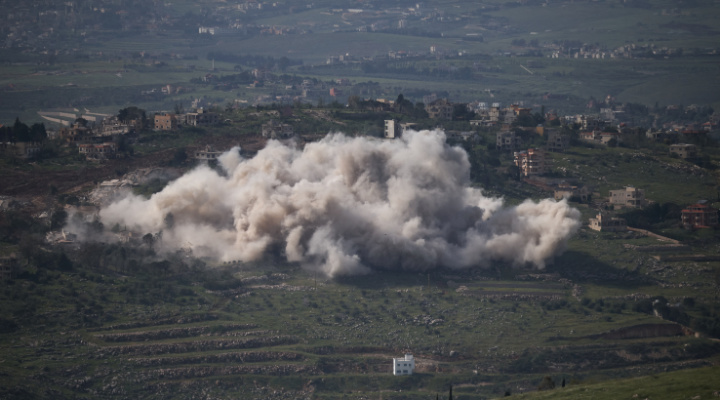
Smoke rises following explosions in southern Lebanon, near the Israel-Lebanon border, as seen from northern Israel, April 27, 2026. Photo: REUTERS/Shir Torem
Israel and Lebanon agreed to a 45-day extension of a ceasefire that has tamped down the conflict between Israel and Iran-backed terrorist group Hezbollah in southern Lebanon, as two days of talks facilitated by Washington concluded on Friday with an agreement to hold further meetings in the coming weeks.
“The April 16 cessation of hostilities will be extended by 45 days to enable further progress,” State Department spokesperson Tommy Pigott said on X, adding that the talks aimed at settling decades of conflict between the two countries were “highly productive.” The ceasefire was set to expire on Sunday.
The Lebanese and Israeli delegations issued positive statements about the talks, their third meeting since Israel intensified air attacks on Lebanon after Hezbollah fired missiles at Israel on March 2, three days into the US-Israeli war with Iran. Israel‘s bombing campaign and ground invasion into Lebanon’s south displaced some 1.2 million people, before US President Donald Trump announced a ceasefire last month following initial talks between the two countries’ ambassadors in Washington.
Hezbollah and Israel have continued to trade blows, with hostilities focused in southern Lebanon, where Israeli forces are occupying a self-declared security zone.
LEBANON WANTS HOSTILITIES TO CEASE
The US-led mediation between Lebanon and Israel has emerged in parallel to diplomacy aimed at ending the US-Iran conflict. Iran has said ending Israel‘s war in Lebanon is one of its demands for a deal over the wider conflict.
Lebanon’s delegation, which is attending despite objections from Shi’ite Muslim Hezbollah, has prioritized a cessation in hostilities in the talks. Israel says Hezbollah, which openly seeks the Jewish state’s destruction, must be disarmed as part of any broader peace agreement with Lebanon.
The Washington meetings, the highest-level contact between Lebanon and Israel in decades, have evolved to include security and military officials. Pigott said on X that a new “security track” of the negotiations would be launched at the Pentagon on May 29, while the State Department will convene the two sides again June 2-3 for a political track of negotiations.
“We hope these discussions will advance lasting peace between the two countries, full recognition of each other’s sovereignty and territorial integrity, and establishing genuine security along their shared border,” Pigott said.
Lebanon’s delegation said in a statement that it wanted to turn the momentum from the ceasefire into a lasting peace agreement. “The extension of the ceasefire and the establishment of a US-facilitated security track provide critical breathing space for our citizens, reinforce state institutions, and advance a political pathway toward lasting stability,” the delegation said.
Israeli ambassador to the US Yechiel Leiter said the talks were “frank and constructive.”
“There will be ups and downs, but the potential for success is great. What will be paramount throughout negotiations is the security of our citizens and our soldiers,” Leiter said on X.